When Fire Hits a Thomaston Home, Depth of Restoration Matters More Than Speed
When fire hits a home on the Great Neck Peninsula, the damage runs deeper than what you can see — and we handle all of it, from the first call to the final permit issued by the Village of Thomaston’s building department.
I needed a professional consultation explanation of procedure for safe removal of Asbestos in my apartment complex. Without having an account yet, I was very impressed with the caring, knowledgeable and generous advice offered by Jessica, and will look forward to doing business in the future. Thank you so much! I feel much more informed about a sometimes scary endeavor. Peace. Nancy Silva Mineola, NY.
Mia Munoz
Used this company to clean up some water flood in my house. They were fast and easy to work with.very professional, Would recommend to anyone!
Nini Valle
Great company, had a flood and they responded quickly and efficiently. Billed my insurance company directly. I highly recommend this company!
joe colapietro, jr
I had pipe freeze in my basement right before a snow storm and they made to within an hour to help start the clean up process. They we by our side throughout the entire process and even helped with the insurance company. They did such a great job with the cleanup, repair, remidiation, I contracted them to perform the repairs and finishes in the basement. They came with enough manpower and material to get the job done. Leo and Jessica were nothing but a pleasure to deal with!!
Cristian Arredondo c
I had some water damage in my home and Green Island was able to take care of my issue quickly and effectively. I am very pleased with the work they did. They responded quickly and were very professional.
Michael M
Outstanding service! From the office to the field crew everyone was friendly, helpful and responsive. I highly recommend Green Island Group.
Your Thomaston Home Is Back — Fully, Not Partially
A fire doesn’t just burn what it touches. Smoke travels through wall cavities, HVAC ductwork, and every unsealed gap in your home — often reaching rooms that never saw a flame. In Thomaston’s older housing stock, where homes range from pre-war construction to mid-century colonials, that contamination can embed deep into materials that look fine on the surface but aren’t.
The coastal proximity to Little Neck Bay and Manhasset Bay keeps ambient humidity elevated year-round on the Great Neck Peninsula. That matters because the water used to suppress a fire doesn’t just dry on its own — in this climate, mold can begin developing within 24 to 48 hours. When fire damage restoration and water extraction happen simultaneously under one crew, you stop a second crisis before it starts.
For a home valued above a million dollars in Thomaston, the stakes of an incomplete restoration are real. Hidden soot, unaddressed smoke odor in the ductwork, or missed structural damage doesn’t stay hidden forever — it surfaces later, costs more, and affects what your property is worth. Getting it right the first time isn’t a premium. It’s the only outcome that makes sense.
Licensed for Every Layer of Damage Your Thomaston Home Presents
We are a locally owned, IICRC-certified restoration company based on Long Island, serving Thomaston and the broader Nassau County area with a full-service team that handles everything — emergency response, smoke and soot remediation, water extraction, hazardous materials abatement, and complete reconstruction. One company. One point of contact. No handoffs.
What separates us in a market like Thomaston is the depth of our licensing. We hold the Nassau County General Contractor License required to pull permits through the Village of Thomaston’s building department, the NYS DOL Asbestos and Mold Licenses, and the USEPA Lead/RRP Certification. In a village where many homes predate 1978, those credentials aren’t optional — they’re legally required to complete the job.
We’ve completed over 5,000 restoration projects across New York State, work directly with insurance companies, and have a documented track record of guiding Long Island homeowners through the claims process from start to finish.
No Surprises — Here Is Exactly What Happens When We Restore Your Home
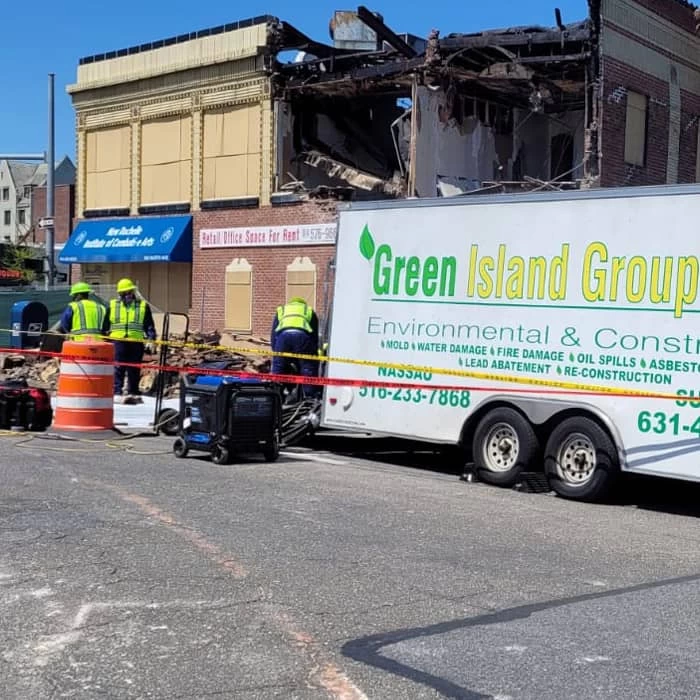
The process starts the moment you call. We operate 24 hours a day, every day of the year, and stage equipment to reach Thomaston and Nassau County locations within one hour. When our crew arrives, the first priority is stopping active damage — that means water extraction from firefighting suppression, emergency board-up if needed, and a full structural assessment before any cleaning begins.
From there, the scope of work gets documented thoroughly. In Thomaston, where homes often contain asbestos-containing materials or lead-based paint in older construction, that assessment includes testing for hazardous materials before any demolition or soot removal begins. This isn’t a delay — it’s what keeps the job legal, safe, and covered by your insurance. Skipping it creates liability and health risks that show up later.
Once the scope is confirmed and insurance documentation is submitted, remediation begins: soot and smoke removal, HVAC cleaning, structural drying, odor treatment using thermal fogging and air scrubbers, and any required asbestos or lead abatement. Reconstruction follows under the same contractor, with permits pulled through the Village of Thomaston’s building department. You don’t manage multiple vendors. We manage the entire process and keep you informed at every stage.
Full Scope, Not Just What's Visible on the Surface
Fire damage restoration in Thomaston covers more ground than most homeowners expect going in. Beyond the obvious burn area, we address smoke and soot contamination throughout the structure, oily residue removal from oil burner puff-backs — a common event in Long Island’s older oil-heated homes — HVAC system cleaning, content cleaning and pack-out, structural drying, and mold prevention. If your home has older construction, hazardous materials testing and licensed abatement are built into the process, not treated as a separate engagement.
Because Thomaston operates under its own village-level building code — Chapter 91 of the Thomaston Village Code covers fire prevention and building construction — any significant restoration or reconstruction work requires permits issued by the Village’s building department. Our Nassau County General Contractor License qualifies us to pull those permits directly, which means no gap between remediation and rebuild, and no situation where you’re left holding a half-restored home while waiting on a separate contractor to get licensed and permitted.
We handle insurance billing directly. We document every phase of the work to insurance standards, submit on your behalf, and advocate for complete coverage — including secondary damage categories like HVAC contamination and hazardous materials disturbance that are easy to miss without an experienced restoration team walking the claim.
Does fire damage restoration in Thomaston require a village building permit?
Yes — and this is one of the most important things to clarify before any contractor starts work on your home. Thomaston is an incorporated village with its own building department and its own fire prevention and construction ordinance under Chapter 91 of the Thomaston Village Code. Any significant restoration or reconstruction work following a fire requires permits issued at the village level, not just through Nassau County. The contractor you hire needs to hold a valid Nassau County General Contractor License to legally pull those permits and perform the reconstruction work.
This matters more than it might seem. If a contractor starts work without the proper permits — or lacks the licensing to obtain them — you can face stop-work orders, fines, and complications with your insurance claim. We hold the Nassau County GC License and handle the permitting process directly with the Village of Thomaston, so there’s no gap between remediation and rebuild and no administrative burden falling on you during an already stressful situation.
How do I know if smoke damage has spread beyond the room where the fire started?
Smoke doesn’t stay where the fire was. It travels through HVAC ductwork, wall cavities, attic spaces, and any unsealed gap in the structure — often reaching rooms on the opposite side of the house from the burn zone. In many cases, the rooms that look untouched are still contaminated with microscopic soot particles and odor-causing compounds that have embedded into drywall, insulation, and soft materials.
The only way to know the true extent of smoke contamination is a thorough professional assessment — not a visual walkthrough. We use air quality testing and systematic inspection of HVAC systems and structural cavities to map the actual spread of smoke damage before any cleaning begins. In older Thomaston homes with original ductwork and plaster walls, this step is especially important because contamination can be hiding in places that surface cleaning will never reach. Skipping the assessment means leaving damage behind, and that shows up later as persistent odor, air quality issues, or a failed insurance claim.
My Thomaston home was built in the 1940s — does that affect the restoration process?
It does, significantly. Homes built before 1978 may contain lead-based paint, and homes built before roughly 1980 may contain asbestos in floor tiles, ceiling tiles, pipe insulation, joint compound, and roofing materials. In a fire or smoke event, these materials can be disturbed — and once disturbed, they create a legal and health hazard that requires licensed abatement before any further work can be done.
New York State law requires a specific NYS DOL Asbestos License to legally perform asbestos abatement, and USEPA Lead/RRP Certification for lead work. Most general contractors and many restoration companies don’t hold both. If your contractor starts demolition or soot removal without testing for these materials first, they’re creating a liability for themselves and a health risk for your family. We hold the NYS DOL Asbestos License, NYS DOL Mold License, and USEPA Lead/RRP Certification — which means we can legally and safely handle the full scope of what an older Thomaston home is likely to present, without stopping the job to bring in a separate specialist.
Will my homeowners insurance cover the full cost of fire damage restoration?
Most standard homeowners insurance policies cover fire damage restoration, including smoke damage, water damage from firefighting suppression, and structural repairs — but the coverage you actually receive depends heavily on how thoroughly the damage is documented and how the claim is submitted. Insurance companies don’t automatically cover everything; they cover what’s documented and claimed correctly.
For a high-value property in Thomaston — where the average home value exceeds one million dollars — this documentation gap can represent a significant financial difference. Secondary damage categories like HVAC contamination, asbestos disturbance, and mold prevention are often underclaimed simply because the homeowner or contractor didn’t flag them during the initial assessment. We bill insurance companies directly, document every phase of the restoration to insurance standards, and submit on your behalf. We’ve guided hundreds of Long Island homeowners through the claims process, and our experience with Nassau County properties means we know which damage categories to look for and how to make sure your insurer accounts for all of them.
What is a puff-back, and does it count as fire damage for insurance purposes?
A puff-back happens when an oil burner misfires or backfires, sending a wave of oily black soot through your home’s interior in a matter of seconds. There’s no flame, no fire alarm, and often no dramatic event — just a sudden coating of dark, greasy soot on walls, ceilings, floors, and every surface the air reaches, including inside your HVAC system. It’s one of the most common soot contamination events in Long Island homes, particularly in older properties on the North Shore that rely on oil heat.
Puff-back damage is typically covered under homeowners insurance as a sudden and accidental event, but the cleanup is more technically demanding than standard fire soot removal because oil-based soot bonds differently to surfaces and requires specific cleaning agents and methods. Our technicians are trained specifically for puff-back cleanup, including the removal of oily residue from HVAC ductwork and contents — not just visible wall and ceiling surfaces. If you’ve experienced a puff-back in your Thomaston home, the scope of contamination is almost always larger than it appears at first glance.
How long does fire damage restoration typically take for a home in Thomaston?
The honest answer is that it depends on the scope of damage — but most residential fire damage restoration projects in Nassau County fall somewhere between one week and several months, depending on whether the work involves remediation only or full reconstruction. A contained kitchen fire with limited smoke spread might be resolved in one to two weeks. A fire that has damaged multiple rooms, disturbed asbestos-containing materials, or requires structural reconstruction will take longer, particularly when village-level building permits through Thomaston’s building department are part of the process.
What affects the timeline most is how quickly the full scope of damage is assessed and documented. Delays typically happen when hazardous materials testing wasn’t done upfront, when permits weren’t pulled correctly, or when remediation and reconstruction are handled by separate contractors who aren’t coordinating. Because we manage the entire process — from emergency response through permitted reconstruction — under one roof, there are no handoff delays and no waiting on a second contractor to get started. We’ll give you a realistic timeline after the initial assessment, and we’ll keep you updated throughout so you’re never left wondering where your home stands.