When the Ocean and the Bay Both Win, Your Basement Loses
Atlantic Beach sits between Reynolds Channel and the Atlantic Ocean — and when either one surges, your basement is the first thing that pays for it. We respond 24/7 with licensed flooded basement cleanup built for exactly this kind of exposure. Our team understands that a barrier island home isn’t like an inland property. The water comes from two directions, the humidity never fully leaves, and the homes here were built in an era when asbestos and lead were standard materials. That context changes how we approach every job.
I needed a professional consultation explanation of procedure for safe removal of Asbestos in my apartment complex. Without having an account yet, I was very impressed with the caring, knowledgeable and generous advice offered by Jessica, and will look forward to doing business in the future. Thank you so much! I feel much more informed about a sometimes scary endeavor. Peace. Nancy Silva Mineola, NY.
Mia Munoz
Used this company to clean up some water flood in my house. They were fast and easy to work with.very professional, Would recommend to anyone!
Nini Valle
Great company, had a flood and they responded quickly and efficiently. Billed my insurance company directly. I highly recommend this company!
joe colapietro, jr
I had pipe freeze in my basement right before a snow storm and they made to within an hour to help start the clean up process. They we by our side throughout the entire process and even helped with the insurance company. They did such a great job with the cleanup, repair, remidiation, I contracted them to perform the repairs and finishes in the basement. They came with enough manpower and material to get the job done. Leo and Jessica were nothing but a pleasure to deal with!!
Cristian Arredondo c
I had some water damage in my home and Green Island was able to take care of my issue quickly and effectively. I am very pleased with the work they did. They responded quickly and were very professional.
Michael M
Outstanding service! From the office to the field crew everyone was friendly, helpful and responsive. I highly recommend Green Island Group.
A Dry Basement Isn't Enough — It Has to Stay That Way
Getting the water out is the easy part. What most homeowners don’t realize until it’s too late is that the real damage happens in the days after — inside the walls, under the subfloor, behind the concrete block that’s been sitting wet since the storm. In Atlantic Beach, where salt air and chronic coastal humidity are part of daily life, moisture doesn’t just linger — it compounds. Hidden water in a barrier island home doesn’t dry out on its own. It feeds mold.
Mold can begin growing within 24 to 48 hours of water exposure. If your Atlantic Beach home was built in the 1950s or early 1960s — which describes the majority of the village’s housing stock — there’s another layer to think about. Flooded floor tiles and disturbed pipe insulation from that era can contain asbestos. Wet walls may have lead-based paint. A cleanup that ignores those realities isn’t a cleanup — it’s a liability.
What you actually want after a basement flood is a home that’s been fully dried, tested, treated, and cleared by people who are licensed to handle everything the water touched. That’s the difference between moving on and dealing with this again in six months.
Licensed Basement Flooding Remediation Nassau County
Every License the Job Actually Requires — Under One Roof
We serve Nassau County, Suffolk County, and the New York City metro — and we understand that Atlantic Beach isn’t just another South Shore town. It’s a barrier island with one road in and one road out, a housing stock that predates most of its inland neighbors, and a flood history that FEMA documents at the village level. That context shapes how every job here gets approached.
The license stack we carry is genuinely rare in this industry: NYS DOL Mold License, NYS DOL Asbestos License, USEPA Lead and RRP certifications, IICRC Water and Fire Damage certification, and General Contractor licenses for Nassau County, Suffolk County, and New York City. New York State is one of the few states in the country that requires a dedicated mold contractor license — meaning most companies operating here legally cannot perform that work. We can.
From the first call through the final walkthrough, you’re dealing with one company that holds every credential the job demands — not a crew that handles extraction and hands the rest off to someone else.
From Standing Water to Structurally Sound — Here's the Sequence
The first step is getting there fast and assessing what you’re actually dealing with. Not all basement flooding is the same. A burst pipe is Category 1 — clean water, straightforward extraction. Storm surge from the Atlantic Ocean pushing through your foundation is Category 3 — black water, biohazard protocols, full decontamination. In Atlantic Beach, where major storms can produce both ocean surge from the south and bay surge from Reynolds Channel simultaneously, that assessment matters before a single piece of equipment gets unloaded.
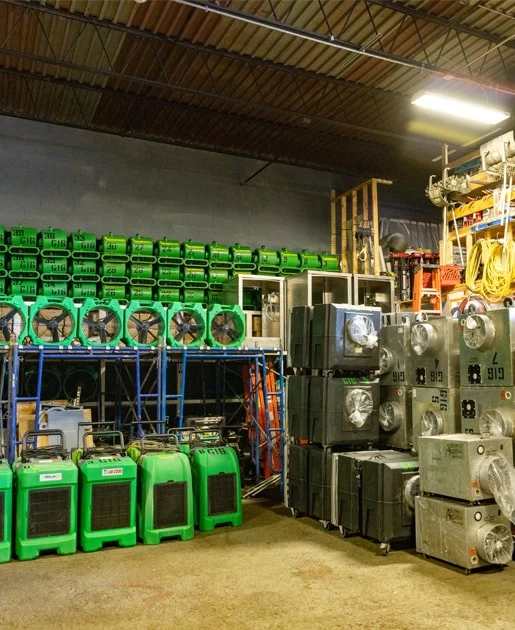
Once the water category is confirmed, our team extracts standing water using industrial-grade equipment, then moves into structural drying — not just running a dehumidifier and hoping for the best, but placing commercial air movers and monitoring moisture levels inside wall cavities, under flooring, and in the concrete itself. Given the naturally elevated water table on a barrier island at sea level, the drying phase here requires more attention than it does in an inland home. Ambient humidity alone will fight the process if it’s not managed correctly.
If the assessment turns up asbestos-containing materials — common in Atlantic Beach homes built in 1958 or earlier — that work is handled by our licensed asbestos team before any demolition or debris removal begins. After drying is confirmed with moisture readings, mold prevention treatment is applied to affected surfaces. If structural elements need to come out and be rebuilt, our Nassau County General Contractor license covers that too. You don’t need to find a second contractor to finish what we started.
Flooded Basement Cleaning Services Atlantic Beach NY
What's Actually Included When Your Basement Floods Here
Flooded basement cleanup in Atlantic Beach covers a wider scope than most homeowners expect going in — and for good reason. The combination of coastal storm exposure, older housing stock, and the chronic humidity of a sea-level barrier island means the job rarely stops at extraction and drying. Here’s what a full-scope response from us actually includes.
Emergency water extraction comes first, using industrial pumps and wet vacuums rated for the volume that a storm surge or severe Nor’easter can leave behind. Structural drying follows with commercial air movers and dehumidifiers, monitored by moisture meters and thermal imaging that find the water you can’t see. Mold prevention treatment is applied to all affected surfaces as part of the standard scope — not an add-on — because in Atlantic Beach’s salt-air environment, skipping that step is how you end up with a mold problem three months later.
For homes with pre-1978 construction — which covers most of Atlantic Beach — the scope also includes hazardous material assessment. If asbestos-containing floor tiles or pipe insulation are present, our NYS DOL-licensed asbestos team handles abatement before any demolition proceeds. Lead paint handling follows USEPA and RRP protocols. Insurance documentation is prepared throughout the process to support claims under both standard homeowners policies and NFIP flood insurance, which many Atlantic Beach homeowners carry as a separate required policy. When structural rebuilding is needed after remediation, our Nassau County General Contractor license means that work stays in-house from start to finish.
Does flood insurance actually cover basement flooding in Atlantic Beach, NY?
This is one of the most common points of confusion for Atlantic Beach homeowners, and it matters a lot given how many residents here are required by their mortgage lenders to carry NFIP flood insurance alongside a standard homeowners policy. The short answer: it depends on which policy and what caused the flooding.
Standard homeowners insurance typically covers sudden, accidental water events — a burst pipe, a failed water heater, an appliance leak. It does not cover flooding caused by storm surge, rising groundwater, or water entering from outside the home. That’s where NFIP flood insurance comes in. If Reynolds Channel or the Atlantic Ocean pushed water into your basement during a named storm or severe Nor’easter, that’s a flood insurance claim, not a homeowners claim. The two policies have different adjusters, different documentation requirements, and different coverage limits — and navigating both at the same time while managing property damage is genuinely stressful. We assist with documentation for both policy types throughout the cleanup process, so you’re not piecing that together on your own after the fact.
How quickly does mold start growing after a basement floods?
Mold can begin colonizing wet structural materials within 24 to 48 hours of water exposure. The 72-hour mark is generally considered the critical threshold — after that point, mold remediation becomes significantly more complex and expensive than it would have been if drying had started immediately.
In Atlantic Beach, that window is tighter in practice than it sounds on paper. The ambient humidity from the ocean and Reynolds Channel means your basement isn’t drying passively while you wait for a crew to show up. Salt air holds moisture differently than inland air, and the naturally high water table of a barrier island keeps the surrounding environment saturated. Professional drying equipment — commercial air movers, industrial dehumidifiers, moisture-monitored structural drying — is what actually moves the needle here. A box fan and a consumer dehumidifier from a hardware store won’t close the gap fast enough in a coastal environment like this one.
My Atlantic Beach home was built in the 1950s — should I worry about asbestos in my flooded basement?
Yes, and it’s worth taking seriously. The median construction year for homes in Atlantic Beach is 1958, which places most of the village’s housing stock squarely in the era when asbestos was used routinely in floor tiles, pipe insulation, joint compound, and ceiling materials. When a basement floods, that water can disturb materials that were previously stable and undamaged — and disturbed asbestos is a very different situation than intact asbestos.
The problem is that you can’t identify asbestos-containing materials by looking at them. Vinyl floor tiles from the 1950s and 1960s are a common source, and they look identical to non-asbestos tiles. The only way to know is testing. If your home was built before 1980 and you have a flooded basement, the responsible approach is to have a licensed asbestos professional assess the space before any demolition, debris removal, or floor tile disturbance happens. We hold the NYS DOL Asbestos License and handle assessment and abatement in-house — so that piece of the job doesn’t require a separate contractor or a separate scheduling process.
Can a restoration crew actually reach Atlantic Beach quickly after a major storm?
It’s a fair question, and one that’s specific to this community in a way that doesn’t apply to most Nassau County towns. Atlantic Beach has one road connection to the mainland — the Atlantic Beach Bridge — and after a significant storm event, that bridge can be congested, restricted, or temporarily closed depending on conditions. That’s not a hypothetical. It’s part of how this community experiences major weather.
We operate throughout Nassau County and understand the access dynamics of the Long Beach Barrier Island. Emergency response planning for barrier island communities accounts for bridge conditions and dispatch logistics in a way that a company unfamiliar with the area simply won’t. The 72-hour mold window doesn’t pause for bridge traffic, which is exactly why having a restoration company that already knows this geography — and has a plan for it — matters more here than it does in a town with four different highway routes in and out.
How much does flooded basement cleanup typically cost in Atlantic Beach?
The range is wide, and the honest answer is that the final cost depends on how much water came in, what category of water it was, how long it sat, and what materials were affected. As a general benchmark, flooded basement cleanup runs roughly $4 to $12 per square foot depending on water contamination level. A clean-water event in a smaller basement might come in around $1,600 to $3,000. A Category 3 contaminated-water event — the kind associated with storm surge flooding, which is a realistic scenario in Atlantic Beach — in a larger basement can reach $12,000 or more. If structural rebuilding is needed after remediation, that adds to the total.
One factor that’s specific to Atlantic Beach: homes with pre-1978 construction that require asbestos abatement will see higher costs than a comparable job in a newer home, because licensed abatement has its own scope and process. The same applies if lead paint handling is required. The upside is that we handle all of it under one contract — there’s no markup from subcontracting hazmat work to a separate vendor. Your insurance documentation, whether through a homeowners policy or an NFIP flood policy, is prepared throughout the job to support your claim accurately.
What's the difference between a water damage company and a licensed mold remediator — and do I need both?
In New York State, mold remediation is a licensed trade — one of fewer than five states in the country that requires a dedicated contractor license specifically for mold work. That means a general restoration company that isn’t NYS DOL-licensed for mold cannot legally perform mold remediation, even if they’re fully licensed for water extraction and structural drying. They’re two different scopes under state law.
In practice, this matters because water damage and mold risk are inseparable after a basement flood — especially in Atlantic Beach, where the combination of coastal humidity, salt air, and the high water table of a barrier island creates conditions where mold develops faster and more aggressively than in inland homes. If you hire a water damage company that isn’t mold-licensed, you may end up needing a second contractor to finish the job — or worse, the mold issue gets missed entirely and surfaces months later. We hold both the IICRC Water and Fire Damage certification and the NYS DOL Mold License, so the full scope of work — extraction, drying, mold prevention, and remediation if needed — is handled by one licensed team from start to finish.