I needed a professional consultation explanation of procedure for safe removal of Asbestos in my apartment complex. Without having an account yet, I was very impressed with the caring, knowledgeable and generous advice offered by Jessica, and will look forward to doing business in the future. Thank you so much! I feel much more informed about a sometimes scary endeavor. Peace. Nancy Silva Mineola, NY.
Mia Munoz
Used this company to clean up some water flood in my house. They were fast and easy to work with.very professional, Would recommend to anyone!
Nini Valle
Great company, had a flood and they responded quickly and efficiently. Billed my insurance company directly. I highly recommend this company!
joe colapietro, jr
I had pipe freeze in my basement right before a snow storm and they made to within an hour to help start the clean up process. They we by our side throughout the entire process and even helped with the insurance company. They did such a great job with the cleanup, repair, remidiation, I contracted them to perform the repairs and finishes in the basement. They came with enough manpower and material to get the job done. Leo and Jessica were nothing but a pleasure to deal with!!
Cristian Arredondo c
I had some water damage in my home and Green Island was able to take care of my issue quickly and effectively. I am very pleased with the work they did. They responded quickly and were very professional.
Michael M
Outstanding service! From the office to the field crew everyone was friendly, helpful and responsive. I highly recommend Green Island Group.
A flooded basement doesn’t just mean wet floors. It means a clock running against you because mold can start growing within 24 to 48 hours of a water event, and every hour you wait turns a cleanup job into a remediation project. The difference between calling today and calling tomorrow can easily be thousands of dollars in additional work.
Calverton’s flooding risk is different from the coastal towns to the south. You’re not dealing with storm surge you’re dealing with a water table that responds fast to heavy rain, sandy Pine Barrens soils that saturate quickly, and a Peconic River corridor that’s been naturally wet since this area was cranberry farming country. When a nor’easter knocks out your power for twelve hours and your sump pump goes with it, the water doesn’t wait for the storm to pass.
What you get when this is handled right is a basement that’s genuinely dry not surface-dry, but verified dry with moisture meters and thermal imaging that find what your eyes can’t. You get documentation your insurance company will accept. And you get a clear answer on whether there’s anything behind your walls that needs attention before it becomes a bigger problem. That’s the outcome that actually matters.
New York State Vetted Us You Can Trust Our Credentials
We’re an approved emergency response contractor for the NYS Office of General Services. That’s not a self-declared credential it’s an independent vetting by New York State government that confirms our licensing, insurance, and operational capability. We hold a Suffolk County General Contractor license covering both the Town of Riverhead and Town of Brookhaven portions of Calverton, plus NYS DOL Mold, NYS DOL Asbestos, USEPA Lead, and USEPA RRP certifications. One company, every license the job may require.
We’re also NYS certified MBE and WBE independently issued by the State, not self-declared. CEO Jessica Dussan and VP Leo Torres are personally reachable and appear by name in real customer reviews. Over 5,000 completed restoration projects across New York State, 12-plus years in operation, and 24/7/365 availability including eastern Suffolk County homes along the Route 25 corridor and throughout the Calverton Hills area. When you call, you reach the people who own the outcome.
Basement Flooding Remediation Process Calverton NY
From Standing Water to Verified Dry Here's the Honest Walkthrough
The first thing that happens when you call is an actual response not a callback queue, not a next-morning appointment. We’re available around the clock because water damage doesn’t schedule itself. When we arrive, we assess the full scope before touching anything. That means identifying the water source, categorizing the water type, and checking for hidden saturation in walls, insulation, and subfloor using moisture meters and thermal imaging. In Calverton’s older housing stock many homes built in the 1960s through 1980s that assessment also includes checking whether flooding has disturbed asbestos-containing materials or lead paint, because those require licensed handling that a standard water extraction crew isn’t equipped to provide.
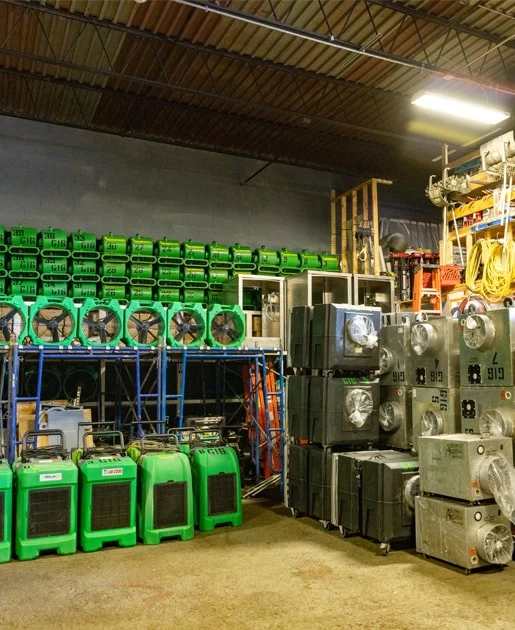
Once the scope is clear, we extract standing water, set industrial drying equipment, and begin the controlled drying process. This isn’t a one-visit job we monitor moisture levels over the following days to confirm the structure is actually drying, not just feeling dry. If mold remediation is needed, we’re already licensed for it under NYS DOL. If reconstruction is needed after that, our Suffolk County General Contractor license covers it.
For residents in the Town of Riverhead portion of Calverton, any structural restoration work requiring permits goes through Riverhead Town Hall. For homes south of the Peconic River in the Town of Brookhaven section, that’s Brookhaven Town Hall. We know the difference, and we handle the documentation accordingly. You don’t have to figure out which jurisdiction you’re in.
Flooded basement cleanup in Calverton isn’t always a straightforward water extraction job. If the flooding came from outside groundwater pushing through your slab or foundation walls after a sustained rain event you may be dealing with contaminated water that carries soil, bacteria, or worse. If your cesspool or septic system was overwhelmed by saturated ground conditions, that’s a Category 3 sewage event requiring full hazmat protocols, not a mop and a dehumidifier. Many contractors in this market aren’t licensed to handle that scenario. We are.
Every job includes water extraction, industrial drying, moisture verification, and a clear written assessment. When the situation calls for it and in Calverton’s older homes, it often does we add licensed mold remediation, asbestos assessment, or lead-safe handling to the scope. We bill your insurance company directly and handle adjuster communication, so you’re not managing paperwork on top of everything else. Multiple customers have specifically cited this in their reviews as the reason they called us back.
We don’t subcontract the parts of the job that require licensing. Everything from initial water removal through environmental remediation through reconstruction stays with one team, one point of contact, and one company that’s accountable for the finished result. For a Calverton homeowner who’s already dealing with a stressful situation, not having to coordinate four different contractors is a real and meaningful difference.
Why does my Calverton basement keep flooding even when it hasn't rained that hard?
This is one of the most common questions we hear from homeowners along the Route 25 corridor and in the Calverton Hills area. The answer usually comes down to the water table. Calverton sits at the edge of the Central Pine Barrens, where the sandy, porous soils allow rainwater to move quickly into the ground which means the water table responds fast to any sustained wet period. It doesn’t take a major storm to push groundwater up against your foundation. A week of moderate rain can be enough.
The Peconic River bottomland in the southern portion of Calverton has historically been swampy terrain this area was cranberry farming country for a reason. Homes built on or near that corridor are sitting on naturally high-moisture ground, and basements in those areas are especially vulnerable to water infiltration through slab cracks and foundation walls rather than through windows or doors. If your sump pump is also aging or undersized, that risk compounds quickly. A professional assessment can tell you whether you’re dealing with a drainage issue, a pump capacity issue, or a foundation sealing issue and which one to address first.
Does homeowners insurance cover basement flooding from a sump pump failure in New York?
It depends on your specific policy, and the answer matters a lot given the financial stakes. Standard homeowners insurance in New York typically does not cover flooding from groundwater or surface water intrusion that’s what flood insurance is for. However, sump pump failure is often a separate category. Many policies include a water backup or sump pump failure rider that does cover this scenario, but it’s usually an add-on, not a default inclusion.
The most important thing you can do right now before you touch anything is call your insurance company and document everything. Take photos and video of the water level, the affected materials, and any visible damage before extraction begins. We bill insurance companies directly and handle adjuster communication as part of every job. We’ve done this enough times to know what documentation adjusters require and how to present the scope of work in a way that supports your claim. You shouldn’t have to figure out insurance while you’re also dealing with a flooded basement.
How quickly does mold start growing after a basement floods in Calverton?
Mold can begin growing within 24 to 48 hours of a flooding event under the right conditions and eastern Long Island’s humidity levels during spring and fall nor’easter season create exactly those conditions. Once mold establishes itself in wall cavities, insulation, or subfloor material, it’s no longer a drying job it’s a remediation job, which is more involved, more regulated, and more expensive.
The 72-hour window is the industry benchmark that matters most. If water is extracted and drying begins within that window, the probability of significant mold growth drops substantially. If a basement sits wet for several days which can happen when a nor’easter knocks out power and a sump pump fails the mold risk becomes much more serious. Under New York State law, mold remediation projects involving more than 10 square feet of affected area require a licensed contractor. We hold the NYS DOL Mold license required to legally perform that work, and we carry moisture meters and thermal imaging equipment to find hidden saturation that visual inspection misses.
Is it safe to go into my flooded basement before a professional arrives?
It depends on what type of water you’re dealing with and whether there’s any electrical risk. If there’s any chance your electrical panel, outlets, or appliances are submerged or in contact with standing water, do not go in until the power to that area has been shut off at the breaker and if you’re not certain it’s safe to access the breaker yourself, call your utility company first.
Beyond electrical safety, the water category matters. Clean water from a burst pipe is a different situation than water that’s backed up through a cesspool or come in from outside carrying soil and groundwater contaminants. Calverton’s rural character means many homes rely on cesspools rather than municipal sewer and when saturated ground conditions overwhelm a cesspool, the backup that enters your basement is classified as Category 3 water, which carries bacteria and pathogens that require protective equipment to handle safely. Walking through that water without knowing what it contains is a real health risk. Until a professional can assess the source and category, limit your exposure and document what you can from a safe position.
My Calverton home was built in the 1970s does a flooded basement create an asbestos risk?
Potentially, yes and this is a question worth taking seriously rather than assuming the answer is no. Homes built in Calverton during the 1950s through the late 1970s commonly used asbestos-containing materials in pipe insulation, floor tiles, ceiling tiles, and wall joint compound. These materials are generally stable when undisturbed, but flooding changes that. Wet insulation, damaged floor tiles, and saturated drywall in a basement can disturb asbestos-containing materials in ways that release fibers into the air.
New York State requires a licensed asbestos contractor to assess and handle any regulated asbestos-containing material. We hold the NYS DOL Asbestos license required to legally perform that work, along with USEPA Lead certification for homes where lead paint is also a concern. If you’re not sure whether your home contains these materials, the safest approach is to have a licensed contractor assess before extraction and drying begins not after. We include this evaluation as part of our initial scope assessment on older homes, so you’re not discovering a problem halfway through the job.
How much does flooded basement cleanup typically cost in Suffolk County?
The honest range for professional flooded basement cleanup in Suffolk County runs from roughly $2,000 on the low end for a limited clean-water event with minimal affected area, up to $8,000 or more when the scope includes significant water volume, contaminated water, mold remediation, or structural repairs. Most homeowners end up somewhere in the middle around $4,000 to $6,000 for a typical basement flooding event that’s addressed promptly.
What drives cost up most reliably is delay. Every additional day of standing water or incomplete drying expands the affected area, increases the probability of mold growth, and adds remediation scope that wouldn’t have existed if the job started sooner. In Calverton specifically, where older homes with cesspools and aging sump pumps are common, the initial scope can expand if the assessment turns up contaminated water or disturbed hazardous materials both of which require licensed handling that adds to the project cost. The clearest way to control your final cost is to start the process quickly and work with a contractor who can assess the full scope upfront rather than discovering complications mid-job. We provide a clear written assessment before work begins so you know what you’re looking at before anything starts.