Carle Place Homes Built in the 1950s and 60s Need Different Cleanup Than Newer Construction
When your basement floods in a Carle Place home built in the 1950s or 60s, you’re not just dealing with water. We handle flooded basement cleanup in Carle Place with the full license stack to manage whatever’s underneath — asbestos, lead paint, mold, and structural damage that older homes are prone to.
I needed a professional consultation explanation of procedure for safe removal of Asbestos in my apartment complex. Without having an account yet, I was very impressed with the caring, knowledgeable and generous advice offered by Jessica, and will look forward to doing business in the future. Thank you so much! I feel much more informed about a sometimes scary endeavor. Peace. Nancy Silva Mineola, NY.
Mia Munoz
Used this company to clean up some water flood in my house. They were fast and easy to work with.very professional, Would recommend to anyone!
Nini Valle
Great company, had a flood and they responded quickly and efficiently. Billed my insurance company directly. I highly recommend this company!
joe colapietro, jr
I had pipe freeze in my basement right before a snow storm and they made to within an hour to help start the clean up process. They we by our side throughout the entire process and even helped with the insurance company. They did such a great job with the cleanup, repair, remidiation, I contracted them to perform the repairs and finishes in the basement. They came with enough manpower and material to get the job done. Leo and Jessica were nothing but a pleasure to deal with!!
Cristian Arredondo c
I had some water damage in my home and Green Island was able to take care of my issue quickly and effectively. I am very pleased with the work they did. They responded quickly and were very professional.
Michael M
Outstanding service! From the office to the field crew everyone was friendly, helpful and responsive. I highly recommend Green Island Group.
Standing water is the part you can see. What causes the real damage is everything that happens after — moisture that absorbs into concrete block walls, soaks into wood framing, and hides inside insulation long after the floor looks dry. In a Carle Place home built in the 1950s or 60s, that moisture doesn’t just sit there. It starts working on materials that were never meant to stay wet, and within 48 to 72 hours, mold becomes a near-certainty if the space isn’t properly dried and documented.
The homes in Carle Place carry something that most restoration companies don’t account for. A significant portion of the hamlet’s housing stock was built during the era when asbestos-containing floor tiles, pipe insulation, and ceiling materials were standard — and when lead-based paint was universal. When water disturbs those materials, the cleanup scope changes entirely. It’s no longer just water extraction and a few dehumidifiers. It becomes a multi-hazard remediation that requires specific state and federal licenses to handle legally and safely.
Getting this right the first time also protects the investment you’ve made in your home. With median home values approaching $900,000 in Carle Place, the cost of a cleanup that misses hidden moisture or leaves disturbed materials unaddressed isn’t just a health risk — it’s a financial one. A mold problem that develops behind finished walls after a “completed” cleanup can run well into five figures to fix properly.
We hold NYS DOL Mold, NYS DOL Asbestos, USEPA Lead, USEPA RRP, IICRC Water Damage, and General Contractor licenses covering Nassau County, Suffolk County, and New York City — simultaneously. That’s not a list of marketing credentials. That’s the difference between a company that can legally complete every phase of a flooded basement remediation in Carle Place and one that has to stop short, subcontract, or skip steps we’re not licensed to handle.
Most restoration companies operating in Nassau County hold an IICRC certification and a basic contractor license. A handful hold a mold license. Very few hold asbestos and lead credentials on top of that. For a community where the majority of homes in Carle Place were built before 1978 — many before 1960, in the same era as the original Levitt development that put Carle Place on the map — that gap in licensing is a real problem when a basement floods.
We also assist with insurance documentation and carrier communication, so you’re not navigating that process alone while also managing a flooded home.
From the First Call to a Dry, Documented, Restored Basement
It starts with a call — any hour, any day. We maintain 24/7 emergency response with a one-hour arrival target for Carle Place and the surrounding Nassau County area. When a storm overwhelms the drainage corridor along the Meadowbrook State Parkway and sump pumps across Carle Place start failing overnight, that response time matters. The 72-hour mold window doesn’t pause because it’s 2 a.m.
On arrival, we conduct a full assessment — not a visual scan, but instrument-based moisture detection using thermal imaging and professional moisture meters. This maps every wet surface in the structure, including behind finished walls and under flooring. If the home was built before 1978, that assessment also includes an evaluation for asbestos-containing materials and lead-based paint that may have been disturbed by the water. This step is where most companies fall short, and where our license stack becomes the deciding factor.
From there, the process moves through water extraction, structural drying, mold prevention treatment, and — where applicable — asbestos or lead abatement under the appropriate NYS DOL and USEPA certifications. Because we also hold a Nassau County General Contractor license, the structural restoration that follows — drywall, flooring, framing — happens under the same contract, with the same crew, on the same invoice. Every phase is documented for your insurance carrier. You don’t manage five vendors. You make one call.
Built for Carle Place's Aging Homes — Not Just the Water on the Floor
Flooded basement cleanup in Carle Place isn’t a single-step job, and we don’t treat it like one. The full scope of what we deliver covers water extraction, structural drying, thermal imaging moisture verification, mold prevention treatment, and post-remediation documentation — all performed under IICRC Water Damage certification and NYS DOL Mold licensure. For homes built before 1978, the assessment also includes evaluation for asbestos-containing materials and lead-based paint, with abatement performed under NYS DOL Asbestos and USEPA Lead/RRP certifications if needed.
Flooding in Carle Place comes from several directions — Long Island’s high water table pushing through aging foundation walls, stormwater overwhelm during heavy rain events, sump pump failures in systems that have been running since the Eisenhower administration, and sewage backups when Nassau County’s infrastructure gets overwhelmed. Each of those scenarios carries a different contamination level. A pipe burst is Category 1. A sump overflow with groundwater is Category 2. A sewage backup is Category 3 — black water — and requires full biohazard decontamination protocols, not just extraction and drying. We’re equipped and licensed for all three.
Because we hold a Nassau County General Contractor license, the work doesn’t stop at remediation. Structural repairs — replacing water-damaged drywall, subfloor, framing, and finishes — are completed by the same team under the same contract. No handoff, no gap in accountability, no second contractor to schedule while your basement sits open.
Does homeowners insurance cover a flooded basement in Carle Place, NY?
It depends on what caused the flooding, and the distinction matters a lot. Standard homeowners insurance in New York typically covers sudden, accidental water damage — a burst pipe, a failed appliance, or an HVAC condensate line that backed up. What it generally does not cover is flooding from natural events like groundwater intrusion, storm surge, or a rising water table. That type of coverage requires a separate flood insurance policy, typically through FEMA’s National Flood Insurance Program.
For Carle Place homeowners, this is a genuinely important distinction because a lot of the basement flooding that happens here isn’t from a burst pipe — it’s from the water table rising during sustained rainfall, stormwater overwhelm near the Meadowbrook Parkway corridor, or an aging sump pump that finally gave out during a storm. Those events may or may not be covered depending on the exact cause and how your policy is written. We assist with insurance documentation and damage assessment reporting, which helps ensure that covered events are properly documented and gives you the best possible footing when you file your claim.
How quickly does mold start growing after a basement floods?
Mold can begin developing within 24 to 48 hours of water exposure, and by the 72-hour mark, growth becomes highly probable if the space hasn’t been properly dried. That’s EPA guidance, and it’s the reason response time matters as much as it does. The longer moisture sits in concrete block walls, wood framing, and insulation, the deeper it penetrates and the more difficult and expensive the remediation becomes.
What makes this particularly relevant for Carle Place is the age of the housing stock. Older homes built in the 1950s and 60s often have less ventilation in basement areas, more porous foundation materials, and original insulation that absorbs water readily. A basement that looks dry to the eye after extraction can still carry enough residual moisture to sustain mold growth for weeks. We use thermal imaging and professional moisture meters to verify that the structure is actually dry — not just visually clear — before the job is considered complete.
What does Category 3 water damage mean, and do I need special cleanup?
Water damage is classified into three categories based on contamination level. Category 1 is clean water — a burst supply line or appliance overflow. Category 2 is gray water, which carries some contamination — a sump pump overflow with groundwater, for example. Category 3 is black water, which is the most serious: sewage backups, floodwater that has contacted waste systems, or water that has been sitting long enough to become heavily contaminated.
In Carle Place and across Nassau County, Category 3 events are more common than most people expect. When heavy rain overwhelms the municipal sewer infrastructure, sewage can back up through basement floor drains — and that’s a biohazard situation, not just a mess. It requires full decontamination of every affected surface, proper disposal of contaminated materials, and air quality verification afterward. A plumber who “does cleanup” or a general handyman is not equipped or licensed for this. We handle all three categories and will identify which one you’re dealing with during the initial assessment so the correct protocols are applied from the start.
My Carle Place home was built in the 1950s — should I be worried about asbestos in my flooded basement?
If your home was built before 1980, it’s a legitimate question worth taking seriously. Asbestos-containing materials were standard in residential construction through the late 1970s — floor tiles, pipe insulation, ceiling tiles, and joint compound were all common sources. In a dry, undisturbed state, these materials typically don’t pose an immediate risk. But when a basement floods, water can saturate and physically disturb them, which changes the situation.
The original Levitt homes built in Carle Place starting in 1946 were constructed on concrete slabs with no basements, but the Cape Cods, Colonials, and split-levels built in subsequent decades — which make up a large portion of Carle Place’s current housing stock — do have basements, and many of those were built squarely in the era when asbestos was in widespread use. We hold a NYS Department of Labor Asbestos Contractor License, which means we can legally assess, contain, and abate asbestos-containing materials if they’re found during a flooded basement cleanup. If you’re calling a restoration company that doesn’t hold this license, they are not equipped to handle that part of the job — and they may not tell you that upfront.
How long does it take to fully dry out a flooded basement?
The honest answer is that it varies, and anyone who gives you a flat number without seeing the space first is guessing. A small, unfinished basement with a clean water source and no structural saturation might be fully dried in three to five days with professional equipment. A finished basement with water-damaged drywall, soaked insulation, and saturated framing can take significantly longer — sometimes one to two weeks — and may require material removal before the drying process can be completed effectively.
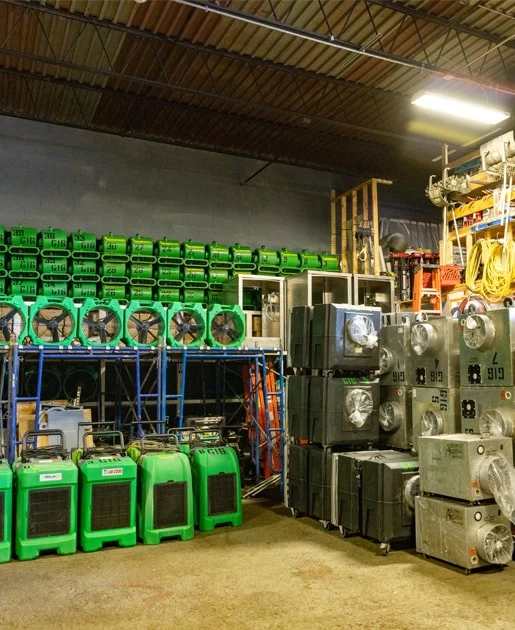
In Carle Place specifically, the age and construction type of the home plays a role. Older concrete block foundations are more porous than poured concrete and can hold moisture longer. Basements with original 1950s or 60s construction details — wood framing, older insulation types, limited ventilation — tend to dry more slowly than newer builds. We use industrial-grade air movers, dehumidifiers, and desiccant equipment calibrated to the specific conditions of each job, and we verify completion with moisture meters and thermal imaging rather than visual inspection alone. The goal isn’t to call it done when it looks dry. It’s to call it done when the instruments confirm it.
What causes basement flooding in Carle Place, and can it happen again?
Carle Place sits in a flat section of central Nassau County where several factors converge to make basement flooding a recurring risk rather than a one-time event. Long Island’s geology means the water table sits relatively close to the surface in many areas, and after sustained rainfall it rises — pushing hydrostatic pressure against basement walls and floors even when there’s no visible surface flooding. The Meadowbrook State Parkway corridor that cuts through the hamlet concentrates stormwater runoff during heavy rain events, and the stormwater infrastructure beneath streets built out in the 1950s and 60s wasn’t designed for the intensity of rain events that have become more common in recent years.
Add to that the age of the sump pumps and drainage systems in many Carle Place homes — equipment that may have been installed decades ago and has never been replaced — and you have a situation where the next flooding event isn’t really a question of if, but when. Our assessment process looks at more than just the immediate damage. We identify the underlying vulnerabilities — a cracked foundation wall, a failing sump pump, a clogged perimeter drain — that will cause the problem to repeat if they’re not addressed. Cleanup alone is a temporary fix. Understanding why it happened and what needs to change is how you actually protect your home going forward.