When Your Centereach Basement Floods, Every Hour Counts
Basements in Centereach flood fast and the damage compounds faster. We respond in under an hour, handle everything from water extraction to mold remediation, and deal with your insurance directly so you don’t have to.
I needed a professional consultation explanation of procedure for safe removal of Asbestos in my apartment complex. Without having an account yet, I was very impressed with the caring, knowledgeable and generous advice offered by Jessica, and will look forward to doing business in the future. Thank you so much! I feel much more informed about a sometimes scary endeavor. Peace. Nancy Silva Mineola, NY.
Mia Munoz
Used this company to clean up some water flood in my house. They were fast and easy to work with.very professional, Would recommend to anyone!
Nini Valle
Great company, had a flood and they responded quickly and efficiently. Billed my insurance company directly. I highly recommend this company!
joe colapietro, jr
I had pipe freeze in my basement right before a snow storm and they made to within an hour to help start the clean up process. They we by our side throughout the entire process and even helped with the insurance company. They did such a great job with the cleanup, repair, remidiation, I contracted them to perform the repairs and finishes in the basement. They came with enough manpower and material to get the job done. Leo and Jessica were nothing but a pleasure to deal with!!
Cristian Arredondo c
I had some water damage in my home and Green Island was able to take care of my issue quickly and effectively. I am very pleased with the work they did. They responded quickly and were very professional.
Michael M
Outstanding service! From the office to the field crew everyone was friendly, helpful and responsive. I highly recommend Green Island Group.
There’s a difference between a basement that looks dry and one that actually is. Surface water disappears fast. What stays behind moisture trapped inside walls, saturated insulation, mold beginning to form in the dark that’s what causes the real damage. Most homeowners don’t find out until weeks later, when the smell hits or the drywall starts to bubble.
Centereach’s housing stock makes this especially relevant. The majority of homes here were built between the 1950s and 1970s the Dawn Estates and Eastwood Village era which means older foundation walls with decades of freeze-thaw cracks, original plumbing that’s more likely to fail, and basement materials that may include asbestos pipe insulation or lead-based paint. When those materials get wet, the situation changes from a cleanup job to an environmental one. Getting the water out is step one. Understanding what you’re dealing with behind the walls is what actually protects your home and your family.
The groundwater pressure in the Brookhaven area also means your Centereach basement may be taking on water through the slab or foundation cracks not just from a burst pipe or storm drain overflow. That kind of intrusion is slower, quieter, and easier to miss until the damage is already done. A real remediation process accounts for all of it, not just what’s visible on the floor.
We’ve been handling water damage, mold remediation, and environmental restoration across Long Island and New York City for over 12 years and more than 5,000 completed projects. We’re not a franchise. There’s no national call center routing your call to whoever’s available. When you reach us, you’re reaching a team led by real people CEO Jessica Dussan and VP Leo Torres who are personally accountable for how every job goes.
For homeowners in Centereach and the surrounding communities in ZIP code 11720 Selden, Farmingville, Terryville what matters most is that the company you call is licensed for everything we’re going to find. We hold NYS DOL Mold and Asbestos licenses, USEPA Lead and RRP certifications, and a Suffolk County General Contractor license covering all work in the Town of Brookhaven. That’s not a common combination. Most water damage companies in this market hold one or two of those. We hold all of them.
We’re also a NYS-certified Minority and Woman-Owned Business independently verified by New York State and an approved emergency response contractor for the NYS Office of General Services. That last one matters: the State of New York has vetted us to respond to public emergencies, and we hold ourselves to that same standard on every residential call in Centereach.
Basement Flooding Remediation Process Centereach, NY
From the First Call to a Fully Restored Basement Here's What to Expect
When you call, we’re moving. Our response target for central Suffolk County is under one hour and that’s been confirmed by actual customers in verified reviews, not just something we put on a website. The first thing we do when we arrive is assess the full scope: where the water came from, what category of water it is (clean pipe water, gray water, or sewage backup), what materials have been affected, and whether anything we’re looking at requires environmental handling before extraction begins. In a Centereach home built before 1980, that last step isn’t optional it’s how you avoid turning a flood cleanup into a hazmat incident.
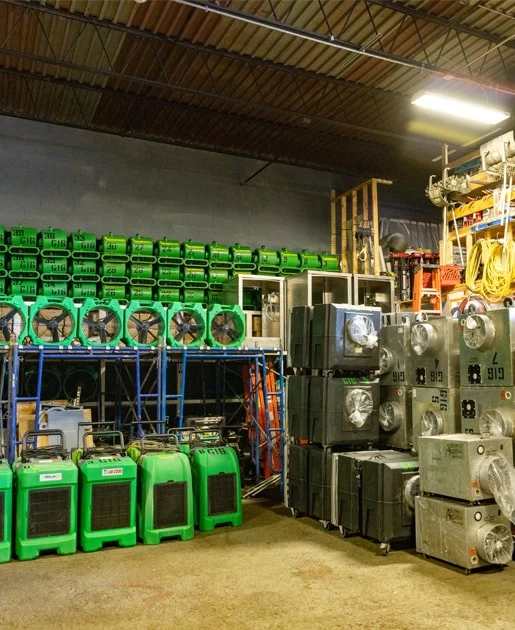
Once we’ve assessed, we extract. Industrial water removal equipment pulls standing water fast, and then the drying process begins with commercial-grade dehumidifiers and air movers placed strategically based on your basement’s layout and the extent of saturation. We monitor moisture levels throughout not just at the surface because the goal is structural dryness, not just visual dryness. If mold is already present or conditions are favorable for growth, we handle remediation as part of the same process, not as a separate contractor you have to coordinate later.
If reconstruction is needed drywall, flooring, framing, insulation we handle that too under our Suffolk County General Contractor license. Any work requiring a permit through the Town of Brookhaven Building Department gets handled properly, with documentation that supports your insurance claim at every step. We bill your insurance carrier directly and keep you informed throughout, so you’re not left managing paperwork while your basement is still drying out.
One Company Handles It All Water, Mold, Hazmat, Reconstruction
Most water damage companies in the Centereach market do one thing: extract water and dry surfaces. That’s fine if your flooding was a clean, straightforward pipe burst in a newer home. But for the majority of homes in this area built in the 1950s through 1970s, with original construction materials and aging infrastructure flooding almost always uncovers something else. Wet pipe insulation that tests positive for asbestos. Damaged wall surfaces with lead paint underneath. Mold already forming inside a wall cavity that looked fine from the outside. Each of those requires a licensed specialist. With most companies, that means multiple contractors, multiple schedules, and multiple invoices.
We handle the entire scope under one roof. Water extraction and structural drying. Mold assessment and remediation under our NYS DOL Mold license. Asbestos and lead handling under our NYS DOL Asbestos and USEPA certifications. And full reconstruction drywall, flooring, framing under our Suffolk County General Contractor license. For sewage backup situations, which are a genuine biohazard under IICRC S500 Category 3 standards, we bring the full containment and disposal protocols required by law. That’s not standard across this market.
We also manage the insurance side directly. We document everything from the moment we arrive photos, moisture readings, material assessments, scope reports and we communicate with your adjuster so the claim moves forward without you having to chase it. For Centereach homeowners navigating the difference between what a standard policy covers and what the Town of Brookhaven’s storm damage grant program might cover for qualifying repairs, having that documentation done right from the start makes a real difference.
Does homeowners insurance actually cover basement flooding in Centereach, NY?
It depends on the cause and that distinction matters a lot in this area. Standard homeowners insurance typically covers sudden, accidental water damage, like a burst pipe or a washing machine line that fails. What it usually doesn’t cover is water that enters from outside your home groundwater pushing through foundation cracks, surface runoff, or a backed-up municipal drain. In Centereach, where the Brookhaven area’s water table is notably high and many homes rely on sump pumps as a first line of defense, the line between a covered event and an excluded one can be frustratingly thin.
The most important thing you can do is call a remediation company before you start cleaning anything up yourself. Proper documentation photos, moisture readings, a written scope of what was damaged and how is what your adjuster needs to process the claim. We document everything from the moment we arrive and bill your insurance carrier directly. We’ve worked through enough Long Island claims to know how to present the damage in a way that supports your coverage, not undermines it. If your situation involves a gap in coverage, we can also walk you through what the Town of Brookhaven’s storm damage assistance program covers for qualifying homeowners.
How fast does mold actually start growing after a basement floods?
Faster than most people expect mold can begin colonizing within 24 to 48 hours of water intrusion, especially in a basement environment where humidity is already elevated and airflow is limited. By 72 hours, active mold growth is common in porous materials like drywall, wood framing, and insulation. At that point, you’re no longer just dealing with a water damage job you’re dealing with a remediation job, which costs more, takes longer, and requires licensed contractors in New York State.
In a Centereach home with a finished basement, that window is even tighter because the water is often trapped behind walls and under flooring where you can’t see it. The surface might feel dry while the framing behind the drywall is still saturated. That’s exactly why the drying phase of a proper remediation isn’t just about running a dehumidifier for a day it involves monitoring moisture levels inside wall cavities and subfloor materials until everything reaches acceptable thresholds. Waiting to call, or attempting to dry things out yourself with a shop vac and a box fan, almost always results in a mold problem that would have been preventable with a faster professional response.
What should I do the moment I discover my Centereach basement is flooded?
First, don’t go in if there’s any chance the water has reached electrical outlets, your panel, or any plugged-in appliances. Standing water and electricity is the most immediate safety risk in a flooded basement, and it’s not worth rushing past that step. If you can safely cut power to the basement from your breaker panel without entering the space, do that first. Then call us not after you’ve tried to clean it up yourself, but before.
The reason that order matters is documentation. Your insurance claim depends on the condition of the space as it was found, not after you’ve moved things around or started extracting water with equipment that isn’t capturing moisture data. When we arrive, we assess and document immediately water source, water category, affected materials, moisture readings and that record is what supports your claim. In older Centereach homes, there’s also the question of what’s in the water and what materials it’s touched. If your basement has pipe insulation or floor tiles from the 1960s, those materials need to be assessed before anyone starts pulling them apart. Calling first costs you nothing. Starting the cleanup yourself before you know what you’re dealing with can cost significantly more.
Why does my basement keep flooding even when it hasn't rained that hard?
This is one of the most common questions we hear from homeowners in central Suffolk County, and the answer usually comes down to groundwater not surface water. The Brookhaven area sits above an aquifer system that experiences seasonal water table fluctuations, and during certain times of year, that table rises high enough to push water through foundation cracks and slab seams without any storm event triggering it. If your Centereach basement floods during a moderate rain or even during dry periods after a wet stretch, hydrostatic pressure from groundwater is likely the cause.
Homes built in the 1950s and 1960s which describes a large portion of Centereach’s housing stock have foundation walls that have been through 60-plus years of freeze-thaw cycles. Those walls develop hairline cracks over time, and as the water table rises, water finds those cracks. A sump pump helps, but if the pump is undersized, aging, or loses power during a storm, it can’t keep up. If this is a recurring pattern in your home, the flooding cleanup is only part of the solution the underlying entry point needs to be addressed as well. We can assess both the immediate damage and the likely source so you’re not dealing with the same problem six months from now.
Is sewage backup in my basement covered by insurance, and how dangerous is it?
Sewage backup is classified as Category 3 water damage under IICRC S500 standards the most serious category, meaning the water is considered grossly contaminated and carries bacteria, pathogens, and potential viral exposure. It is not a cleanup job you should approach without proper protective equipment, and it is not something a general handyman or standard water damage company is equipped to handle legally or safely. In New York State, proper sewage remediation requires licensed contractors and compliant disposal of all contaminated materials.
On the insurance side, sewage backup is often excluded from standard homeowners policies unless you’ve added a specific sewage backup rider. It’s worth checking your policy before an event happens, because adding that coverage is usually inexpensive and the cleanup costs without it can be significant. In Centereach and the broader Brookhaven area, aging municipal sewer infrastructure combined with heavy rain events can overwhelm drain lines and push sewage backward into basement floor drains it’s not a rare scenario. We handle Category 3 events with full containment protocols, proper disposal, and antimicrobial treatment of all affected surfaces. We document everything for your insurer and can help you understand what your specific policy covers before the claim is filed.
Do I need a permit for basement repairs after water damage in Brookhaven Town?
It depends on the scope of the work. Extraction, drying, and mold remediation typically don’t require a permit on their own. But if the water damage leads to structural repairs replacing framing, opening walls, modifying plumbing, or doing any electrical work those repairs fall under the Town of Brookhaven Building Department’s permit requirements. Skipping that step isn’t just a code issue; it can create problems when you sell the home or file an insurance claim, because unpermitted work is a liability that shows up in title searches and inspections.
We hold a Suffolk County General Contractor license, which covers all permitted reconstruction work in the Town of Brookhaven. We handle the permit process as part of the job you don’t need to navigate the Building Department on your own while you’re also dealing with a damaged basement. For Centereach homeowners whose damage may qualify for the Town of Brookhaven’s storm damage assistance program, which offers grants of up to $50,000 for health and safety repairs not covered by insurance for qualifying residents, having a licensed contractor managing the documentation from the start is often a requirement for that process as well. We’re familiar with how it works and can help you understand whether it applies to your situation.