Central Islip's Aging Sewers Don't Wait Neither Do We
When Central Islip’s combined sewer system backs up into your basement during a storm, every hour you wait makes the damage worse. We respond 24/7 with licensed flooded basement cleanup and we bill your insurance directly.
I needed a professional consultation explanation of procedure for safe removal of Asbestos in my apartment complex. Without having an account yet, I was very impressed with the caring, knowledgeable and generous advice offered by Jessica, and will look forward to doing business in the future. Thank you so much! I feel much more informed about a sometimes scary endeavor. Peace. Nancy Silva Mineola, NY.
Mia Munoz
Used this company to clean up some water flood in my house. They were fast and easy to work with.very professional, Would recommend to anyone!
Nini Valle
Great company, had a flood and they responded quickly and efficiently. Billed my insurance company directly. I highly recommend this company!
joe colapietro, jr
I had pipe freeze in my basement right before a snow storm and they made to within an hour to help start the clean up process. They we by our side throughout the entire process and even helped with the insurance company. They did such a great job with the cleanup, repair, remidiation, I contracted them to perform the repairs and finishes in the basement. They came with enough manpower and material to get the job done. Leo and Jessica were nothing but a pleasure to deal with!!
Cristian Arredondo c
I had some water damage in my home and Green Island was able to take care of my issue quickly and effectively. I am very pleased with the work they did. They responded quickly and were very professional.
Michael M
Outstanding service! From the office to the field crew everyone was friendly, helpful and responsive. I highly recommend Green Island Group.
Most homeowners in Central Islip don’t realize the real damage isn’t what they can see. It’s the moisture sitting inside the wall cavity of a 1950s Cape Cod on Carleton Avenue. It’s the saturated sill plate under a 1960s Colonial that got three inches of standing water during a summer thunderstorm. By the time visible mold appears, the hidden damage has already been spreading for weeks.
Nearly half the homes in Central Islip were built between the 1940s and 1960s. That era of construction plaster walls, wood framing, minimal basement insulation absorbs water differently than newer builds. Water doesn’t just sit on the floor. It travels through the framing, under the flooring, and into materials that never fully dry on their own. Professional moisture meters and thermal imaging find what your eyes miss, and what a shop vac and a box fan will never reach.
When the job is done right, you get your basement back not a basement that looks dry but isn’t. No mold showing up six weeks later. No warped subfloor discovered during a renovation. No insurance claim that falls apart because the first cleanup was incomplete. That’s the difference between a real remediation and a surface-level response.
Basement Flooding Remediation Contractor Central Islip
Licensed for Everything Your Central Islip Basement Might Be Hiding
We’ve completed more than 5,000 restoration projects across New York State over the past 12-plus years. We hold a Suffolk County General Contractor license which means we can legally pull permits through the Town of Islip Division of Building and perform structural repairs, not just extract water and leave. We also carry a NYS Department of Labor Mold license, a NYS DOL Asbestos license, and USEPA Lead and RRP certifications. In Central Islip, where nearly half the housing stock predates 1970, that licensing combination matters more than most homeowners realize.
We’re led by CEO Jessica Dussan and VP Leo Torres, who are named by real customers in independent reviews. We’re also an approved emergency response contractor for the NYS Office of General Services the same vetting standard applied to contractors who work on New York State public facilities. And we’re certified by New York State as both a Minority Business Enterprise and Women Business Enterprise, independently not self-declared.
Flooded Basement Cleaning Process Central Islip, NY
From Standing Water to Structurally Dry Here's Our Sequence
The first call gets a real person, any hour of the day or night. We dispatch a crew immediately not scheduled for the next morning. When we arrive, the first step is assessing the water category. That matters more than most people know. Clean water from a burst pipe in a cold January common in Central Islip’s older homes with uninsulated basement walls is handled differently than Category 3 sewage backup from an overwhelmed combined sewer system during a summer storm. The protocol, the protective equipment, and the legal handling requirements are different for each.
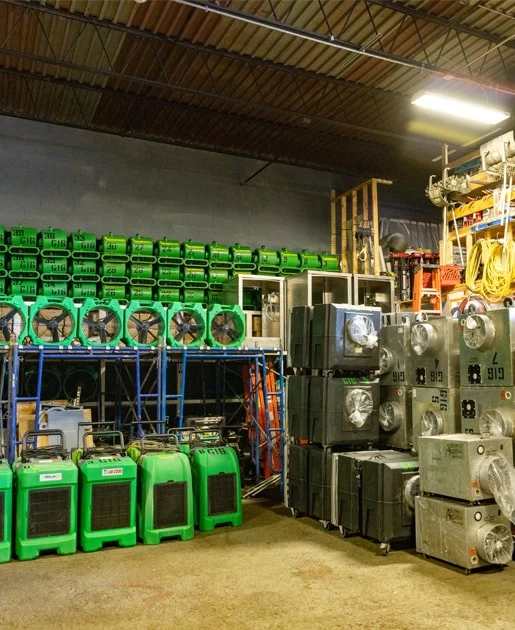
Once we identify and control the water source, extraction begins. Industrial-grade equipment pulls standing water fast. Then the drying phase starts commercial air movers and dehumidifiers running continuously, with moisture readings taken at regular intervals to track progress inside the walls and under the flooring, not just at the surface. If your home was built before 1980 and materials need to be removed, we check for asbestos or lead before demolition begins. That’s not optional it’s a legal requirement in New York State, and we’re licensed to handle it without stopping the job or handing it off to someone else.
If structural repairs are needed drywall, framing, flooring we pull permits through the Town of Islip, and complete the work under our Suffolk County General Contractor license. One company, one contract, one insurance claim.
Basement Flooding Remediation Services Central Islip, NY
Every Hazard Central Islip's Flooding Profile Throws at a Basement
Central Islip’s flooding profile is specific. This isn’t coastal storm surge it’s inland flooding driven by saturated clay-heavy soil pressing against foundation walls, combined sewer systems backing up during heavy rain events, and the Connetquot River watershed drainage pattern that sends water into the central Suffolk County corridor when storms overwhelm the system. The August 2014 event 13.57 inches of rain in 24 hours, a New York State record set at the Islip weather station showed exactly what this area’s infrastructure is up against when a serious storm hits.
Our flooded basement cleanup service covers the full scope of what that kind of flooding actually produces: emergency water extraction, structural drying with continuous moisture monitoring, mold remediation under a NYS DOL Mold license, sewage backup decontamination for Category 3 blackwater events, asbestos and lead assessment and abatement in pre-1980 homes, and complete structural reconstruction when materials need to come out. There’s no point in the process where you’re handed off to a separate contractor or left managing multiple companies.
We also handle insurance documentation and bill carriers directly. For most Central Islip homeowners, that means no out-of-pocket payment upfront, no chasing reimbursements, and no gap between what the adjuster approves and what the job actually requires because we advocate through that process with you.
Why does my Central Islip basement keep flooding even after it's been repaired?
This is one of the most common frustrations homeowners in Central Islip deal with, and the answer almost always comes down to one of two things: the original cleanup didn’t find all the moisture, or the underlying cause was never actually fixed. Central Islip’s clay-heavy soil retains water far longer than sandy soil does. After a heavy rain, that saturated ground continues pressing against your foundation walls for days sometimes weeks. If the drainage around your foundation isn’t directing water away properly, or if there are cracks in the foundation that weren’t sealed, the water will find its way back in regardless of how well the interior was cleaned up.
The other factor is hidden moisture. Older homes in Central Islip especially the Cape Cods and Colonials built in the 1950s and 1960s have wood framing and plaster walls that hold moisture long after the floor looks dry. If a previous cleanup relied on visual inspection rather than moisture meters and thermal imaging, they likely left saturated material behind. That material stays wet, mold grows, and the problem continues. A proper remediation addresses the moisture inside the structure, not just on the surface.
Does homeowners insurance cover sewage backup flooding in my basement?
Standard homeowners insurance policies in New York typically do not cover sewage backup as part of the base policy it’s usually an add-on endorsement. That said, many Central Islip homeowners have this coverage without realizing it, so the first thing to do is pull out your policy documents or call your agent before assuming you’re not covered. If the flooding came from a sudden and accidental event a burst pipe, for example that’s more likely to fall under standard coverage than a sewer backup.
What matters just as much as coverage is documentation. Insurance adjusters want to see moisture readings, photos taken before cleanup begins, and a detailed scope of work. We document everything from the moment we arrive and communicate directly with your insurance carrier throughout the process. We bill the insurance company directly, which means you’re not fronting the cost and waiting for reimbursement. Given how common sewer backup flooding is in Central Islip the aging combined sewer system is a known infrastructure issue it’s worth verifying your coverage before the next storm season, not after.
How quickly does mold start growing after a basement flood in New York?
Mold can begin developing within 24 to 48 hours of water intrusion under the right conditions and Central Islip’s humid summers create exactly those conditions. Warm temperatures, poor ventilation in older basement spaces, and the porous materials common in mid-century construction (wood framing, plaster, older drywall) give mold everything it needs to establish quickly. By the time you see it on a wall surface, the colony behind that wall has often been growing for weeks.
The 48-hour window is real, and it’s why response time matters so much. A cleanup that starts within a few hours of the flooding event costs significantly less than one that starts three days later not because the labor rate changes, but because the scope of mold remediation grows substantially with every day of delay. Getting a licensed crew on-site fast isn’t just about peace of mind. It’s the single most effective way to keep the total cost of a flooded basement event manageable.
My Central Islip home was built in the 1950s is asbestos a concern during flood cleanup?
Yes, and it’s something most water damage companies won’t bring up because they’re not licensed to handle it. Homes built before 1980 in Central Islip frequently contain asbestos in pipe insulation, floor tiles, ceiling tiles, and joint compound. When a flood requires tearing out wet drywall, flooring, or insulation, those materials can be disturbed and release asbestos fibers if they’re not properly identified and handled first. Under New York State law, any disturbance of asbestos-containing materials requires a contractor holding a NYS Department of Labor Asbestos license.
Nearly half of Central Islip’s housing stock was built between the 1940s and 1960s, which puts a significant portion of the community in exactly this situation. If you hire a water damage company that isn’t licensed for asbestos abatement, one of two things happens: they either stop the job when they encounter suspect materials and leave you to find a separate abatement contractor, or worse they proceed without the proper protocols and create a health and liability issue. We hold the NYS DOL Asbestos license and can assess, abate, and continue the restoration without stopping the job or bringing in a third party.
What is the difference between water mitigation and full water damage restoration?
Mitigation is the emergency phase stopping the damage from getting worse. That includes extracting standing water, setting up drying equipment, and removing materials that can’t be saved. It’s the immediate response. Restoration is everything that comes after: replacing the drywall, rebuilding the flooring, repairing structural components, and returning the space to its pre-loss condition. Many companies only do one or the other, which means you end up managing a handoff between contractors in the middle of an already stressful situation.
In Central Islip, where flooding often involves sewage contamination, potential asbestos in older materials, and structural damage that requires permitted work through the Town of Islip, having a single company handle both phases matters. We carry a Suffolk County General Contractor license, which means we can pull the permits required for structural restoration work and complete the job from water extraction through finished reconstruction under one contract. You don’t have to coordinate between a mitigation company, a mold remediator, and a GC it’s handled by one team with one point of accountability.
How do I know if a water damage contractor is actually licensed to work in Suffolk County?
This is worth asking directly, because the answer separates legitimate contractors from companies that show up with equipment but aren’t authorized to do everything the job requires. In Suffolk County, any contractor performing structural repairs replacing drywall, framing, flooring needs a General Contractor license issued by Suffolk County. Mold remediation on areas larger than 10 square feet requires a NYS Department of Labor Mold license. Asbestos work requires a separate NYS DOL Asbestos license. These are legal requirements, not optional credentials.
You can verify contractor licenses through the Suffolk County Department of Labor and NYS DOL licensing portals both are publicly searchable. Ask any company you’re considering for their license numbers before work begins. Central Islip falls under the Town of Islip’s jurisdiction for building permits, so any structural restoration work also needs to be permitted through the Town of Islip Division of Building at 655 Main Street in Islip. A licensed contractor will know this and handle it as a standard part of the job. If a company quotes you a price and never mentions permits, that’s a red flag worth paying attention to.