Flooded Basement Cleanup in Cooperative Village, NY
When Your Co-op Building Floods, You Need More Than a Pump
The mid-century buildings throughout Cooperative Village weren’t built for basement flooding but the East River corridor makes it a real possibility. When water enters your basement, we handle everything from extraction through hazardous material clearance, with direct insurance billing so you’re not fighting that battle alone.
I needed a professional consultation explanation of procedure for safe removal of Asbestos in my apartment complex. Without having an account yet, I was very impressed with the caring, knowledgeable and generous advice offered by Jessica, and will look forward to doing business in the future. Thank you so much! I feel much more informed about a sometimes scary endeavor. Peace. Nancy Silva Mineola, NY.
Mia Munoz
Used this company to clean up some water flood in my house. They were fast and easy to work with.very professional, Would recommend to anyone!
Nini Valle
Great company, had a flood and they responded quickly and efficiently. Billed my insurance company directly. I highly recommend this company!
joe colapietro, jr
I had pipe freeze in my basement right before a snow storm and they made to within an hour to help start the clean up process. They we by our side throughout the entire process and even helped with the insurance company. They did such a great job with the cleanup, repair, remidiation, I contracted them to perform the repairs and finishes in the basement. They came with enough manpower and material to get the job done. Leo and Jessica were nothing but a pleasure to deal with!!
Cristian Arredondo c
I had some water damage in my home and Green Island was able to take care of my issue quickly and effectively. I am very pleased with the work they did. They responded quickly and were very professional.
Michael M
Outstanding service! From the office to the field crew everyone was friendly, helpful and responsive. I highly recommend Green Island Group.
Dry Floors Aren't Enough When Your Building Was Built in 1950
When water gets into a basement in Cooperative Village whether it’s a pipe failure in a Hillman Housing mechanical room or storm surge pushing in from the FDR Drive corridor the damage almost never stops at the waterline. In buildings constructed between 1930 and 1962, water travels into wall assemblies, under flooring, and through utility chases in ways that are completely invisible until mold shows up weeks later. By then, what started as a manageable cleanup has turned into something much more expensive and disruptive.
The buildings here are also a different animal than a postwar ranch house on the Island. Pipe insulation, floor tiles, and ceiling materials from this era routinely contained asbestos. The walls are painted with lead-based paint. When water disturbs those materials, you’re not just dealing with moisture you’re dealing with regulated hazardous substances that require licensed contractors to touch legally. Most restoration companies will either stop work when they encounter this or, worse, keep going without the licenses to do it properly.
What you actually need after a basement floods in one of these Cooperative Village buildings is complete resolution: every moisture pathway identified, every affected material documented, hazardous materials handled legally, and post-remediation clearance in writing. That’s what brings the damage to a real close not just fans running for three days and a handshake on the way out.
Licensed Basement Flooding Remediation, Lower East Side
Every License the Job Requires, Under One Roof
We are a licensed environmental contracting and restoration company serving New York City and the Long Island metro. We hold active New York State Department of Labor licenses for asbestos abatement, mold remediation, lead abatement, and water damage restoration simultaneously, not as referrals to subcontractors. That matters in a place like Cooperative Village, where every building predates 1963 and the materials inside them reflect it.
We work directly in New York City’s regulatory environment NYC Department of Buildings permits, NYC DEP asbestos notification protocols, and the dual-policy insurance structures that come with cooperative ownership. If you’re a shareholder at East River Housing, Hillman, Amalgamated Dwellings, or Seward Park, we understand that a flooding event may involve your building corporation’s master policy and your own HO-6 policy at the same time. We handle both sides of that documentation so you’re not stuck in the middle.
One call covers the full scope. That’s not a tagline it’s just how we’re set up.
What Actually Happens From the First Call to Final Clearance
When you call, we ask a few quick questions where the water is, how long it’s been there, and whether you know the source. That information helps us arrive with the right equipment and the right crew. We respond 24 hours a day, and in a community like Cooperative Village where a building-wide mechanical failure can affect multiple units simultaneously, getting there fast matters. Mold begins growing on wet materials within 24 to 48 hours that window is real, and we take it seriously.
On arrival, we assess before we extract. Using moisture meters and thermal imaging, we map where water has traveled inside wall assemblies, under flooring, and into insulation spaces you can’t see and a visual inspection won’t catch. In the pre-1960s construction common throughout Cooperative Village’s towers, water pathways through mechanical chases and shared wall assemblies can be extensive. We document everything, which also gives you the scope report your cooperative board and insurance adjuster will need.
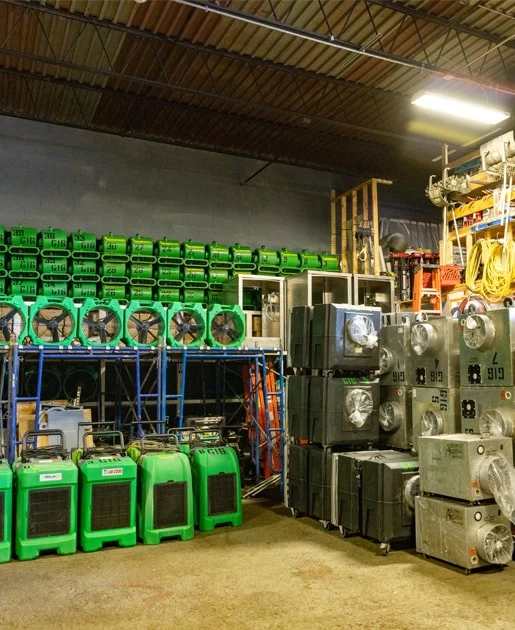
From there, we extract standing water, set up structural drying equipment calibrated to the specific conditions, and handle any asbestos or lead abatement required under NYS DOL protocols before disturbing affected materials. When drying is complete, we verify with post-remediation testing moisture readings at industry-standard goals, air quality confirmation, and written clearance documentation. The job isn’t done until the numbers say it’s done.
Basement Water Damage Restoration, Cooperative Village
Built for the Specific Reality of Co-op Building Flooding in Cooperative Village
Flooded basement cleanup in a housing cooperative isn’t the same job as in a single-family home, and our service reflects that. In Cooperative Village, that means we’re equipped to work in basement mechanical rooms, utility corridors, common area hallways, and individual apartments all under one contract, with damage in each area documented separately so both the building’s master policy claim and your HO-6 claim can be processed accurately.
Because every building in Cooperative Village was constructed before 1962, our scope always includes a hazardous materials assessment before any demolition or material removal begins. If asbestos-containing materials or lead paint are present in the affected area and in buildings of this vintage, they very likely are we handle abatement in-house under our active NYS DOL licenses. You don’t get handed off to a separate contractor and left to coordinate the timeline yourself.
We also manage direct insurance billing, which means you’re not fronting costs and waiting for reimbursement while the work is happening. For shareholders in Cooperative Village particularly long-term residents who may be on fixed incomes that matters. The East Side Coastal Resiliency Project is still under construction through approximately 2026, and until that protection is fully in place, the flood risk along the FDR Drive corridor remains real. We’re set up to handle it completely, every time.
Who is responsible for basement flooding in a Cooperative Village co-op building?
This is genuinely one of the most common questions we get from shareholders in Cooperative Village, and the honest answer is: it depends on where the water came from. In a housing cooperative, the building corporation is generally responsible for damage originating in common areas or building systems a failed main line, a mechanical room failure, or water intrusion through the building envelope. Damage that originates inside your unit a broken appliance, a failed in-unit fixture typically falls under the shareholder’s responsibility per the proprietary lease.
The practical problem is that the source isn’t always obvious, especially in a building where mechanical systems run through shared chases and utility corridors. That’s why thorough documentation from the start matters so much. We assess and document the source and pathway of water intrusion in a format that works for both the building corporation’s insurer and your own HO-6 carrier so the question of responsibility gets answered by evidence, not by whoever argues loudest.
Does my HO-6 insurance policy cover flooded basement cleanup costs in a co-op?
HO-6 cooperative unit owner policies typically cover water damage that originates within your unit a burst pipe, a failed appliance, or water that enters through a building failure and damages your personal property and interior finishes. What they generally do not cover is flooding from external sources, like storm surge or groundwater intrusion, unless you have a separate flood insurance policy through the National Flood Insurance Program or a private carrier.
Given Cooperative Village’s position directly adjacent to the East River and the Lower East Side’s documented status as one of the highest flood-risk residential areas in New York City flood insurance is worth reviewing if you don’t currently have it. The East Side Coastal Resiliency Project will eventually reduce that risk, but it’s still under construction. In the meantime, we work with both your HO-6 carrier and the building’s master policy carrier directly, handling billing and adjuster communication so you’re not navigating two separate claims processes at once.
Does flooding in a pre-1960s building mean there's asbestos or lead paint involved?
In buildings constructed before the mid-1970s, asbestos-containing materials were standard pipe insulation, 9×9 vinyl floor tiles, ceiling tiles, and joint compounds all commonly contained asbestos during the construction era that covers every building in Cooperative Village. Lead-based paint was standard on interior and exterior surfaces in all residential construction before 1978. So when water floods a basement or mechanical room in a building from this era, the honest answer is: there’s a meaningful probability that disturbed materials contain regulated hazardous substances.
This matters because New York State law prohibits unlicensed contractors from disturbing asbestos-containing materials. A restoration company without an active NYS DOL asbestos abatement license has to stop work when they encounter those materials and bring in a separate contractor adding time, cost, and coordination complexity to an already stressful situation. We hold active NYS DOL licenses for both asbestos and lead abatement, which means we assess for these materials before any demolition begins and handle abatement in-house if it’s needed. No handoffs, no delays, no gray areas.
How quickly does mold start growing after a basement floods in Manhattan?
The EPA’s established timeline is 24 to 48 hours on wet building materials under typical indoor conditions. In a New York City summer when humidity inside a building’s basement or mechanical room can be high even before a flooding event that window can be even shorter. The point is that mold growth is not a slow-developing problem you have days to think about. It starts fast, and in a cooperative high-rise building like the towers at East River Housing or Seward Park in Cooperative Village, moisture that isn’t contained quickly can migrate through shared wall assemblies and ventilation systems in ways that affect adjacent units and common areas.
That’s why our response operates around the clock. When you call at 2 a.m. because a pipe has failed in your building’s mechanical room, we’re available. The faster water is extracted and structural drying begins, the smaller the footprint of the damage and the smaller the claim, the simpler the conversation with your building’s board and your insurance carrier.
Will the cooperative board need to be involved in approving the cleanup work?
In most cases, yes at least for work that affects common areas, building systems, or structural elements. Cooperative boards in buildings like those in Cooperative Village typically require notification for any significant repair or remediation work, and some boards require formal approval before contractors begin work in common areas. For work limited to the interior of your individual unit, the process is usually simpler, but it’s worth confirming with your building’s managing agent before work begins.
We’re familiar with how cooperative building governance works and can provide the scope documentation, license credentials, and insurance information that a board or managing agent typically requests before authorizing work. If the damage involves both common areas and your unit which is common when a building system fails we document the two areas separately, which makes it easier for the board and both insurance carriers to process their respective portions of the claim cleanly.
Is the Lower East Side at real flood risk, or was Sandy a one-time event?
Sandy was not a one-time anomaly it was a demonstration of what the Lower East Side’s geography makes possible. The Federal Reserve Bank of New York’s research specifically identifies the Lower East Side as one of the highest flood-risk areas for residential housing in all of New York City. The reason is straightforward: the East River waterfront runs directly along the eastern edge of Cooperative Village, with several East River Housing buildings addressed on FDR Drive itself. When the East River rises, this community is in the path.
That’s exactly why the City of New York and the federal government committed $1.45 billion to the East Side Coastal Resiliency Project a continuous 2.4-mile barrier of berms, floodwalls, and raised parkland designed to protect more than 110,000 Lower East Side residents. Construction is ongoing and expected to run through approximately 2026. Until that protection is fully in place, the flood risk along the FDR Drive corridor is real and documented. Aging water main infrastructure beneath the FDR Drive corridor has also caused street flooding and building water intrusion independent of any weather event. The risk here is layered, and it’s worth being prepared for it.