When bay water, a burst pipe, or a backed-up sewer line fills your basement, every hour counts. We respond 24/7 with the licenses, equipment, and local knowledge to handle flooded basement cleanup in Copiague, NY and we bill your insurance directly.
I needed a professional consultation explanation of procedure for safe removal of Asbestos in my apartment complex. Without having an account yet, I was very impressed with the caring, knowledgeable and generous advice offered by Jessica, and will look forward to doing business in the future. Thank you so much! I feel much more informed about a sometimes scary endeavor. Peace. Nancy Silva Mineola, NY.
Mia Munoz
Used this company to clean up some water flood in my house. They were fast and easy to work with.very professional, Would recommend to anyone!
Nini Valle
Great company, had a flood and they responded quickly and efficiently. Billed my insurance company directly. I highly recommend this company!
joe colapietro, jr
I had pipe freeze in my basement right before a snow storm and they made to within an hour to help start the clean up process. They we by our side throughout the entire process and even helped with the insurance company. They did such a great job with the cleanup, repair, remidiation, I contracted them to perform the repairs and finishes in the basement. They came with enough manpower and material to get the job done. Leo and Jessica were nothing but a pleasure to deal with!!
Cristian Arredondo c
I had some water damage in my home and Green Island was able to take care of my issue quickly and effectively. I am very pleased with the work they did. They responded quickly and were very professional.
Michael M
Outstanding service! From the office to the field crew everyone was friendly, helpful and responsive. I highly recommend Green Island Group.
The real cost of a flooded basement isn’t always what you see the day it happens. It’s what gets left behind when the cleanup isn’t done right moisture trapped inside walls, saturated insulation that never fully dried, and mold that quietly takes hold within 24 to 48 hours. On the South Shore, where coastal humidity is already elevated after a storm, that window closes faster than most people expect.
Copiague’s housing stock is predominantly post-war construction ranches and colonials built in the 1950s, 60s, and 70s. That means older waterproofing, aging pipe materials, and in many cases, building materials that contain asbestos or lead paint behind the drywall. When a flood forces that drywall down, the cleanup isn’t just a water job anymore. You need a contractor licensed to handle what’s actually in there not one who’ll skip past it and hand you a liability.
When the work is done correctly, you get a dry, documented, fully restored basement and a closed insurance claim not a mold problem six months from now. That’s what complete flooded basement remediation actually looks like.
Licensed for Everything Your Older Copiague Home Might Reveal
We’ve been doing environmental restoration work across Long Island and New York City for over 12 years, with more than 5,000 completed projects. We hold Suffolk County General Contractor licensing, a NYS DOL Mold license, a NYS DOL Asbestos license, and USEPA Lead and RRP certifications. That’s not a credential list for show it’s what allows us to handle every hazard a flooded basement in a 1965 Copiague ranch might uncover, under one contract, without subcontracting a single piece of it.
We already serve Copiague Harbor the private waterfront community off South Great Neck Road so this isn’t a market we’re learning. We know the peninsula access routes, the coastal flood exposure south of Montauk Highway, and the kind of damage that follows a South Shore storm event. We’re also NYS-certified as a Minority Business Enterprise and Woman-Owned Business Enterprise, independently verified by New York State a reflection of the community we actually work in.
What Actually Happens From Your First Call to a Dry Copiague Basement
It starts the moment you call. We’re available 24 hours a day, every day, and response time matters especially in Copiague’s peninsula communities like Amity Harbor and Copiague Harbor, where storm surge events can push water in fast and the clock on mold growth starts immediately. When we arrive, the first priority is stopping active water intrusion and assessing the source whether that’s groundwater pushing through a foundation, a sewer line backup, or storm-driven bay water.
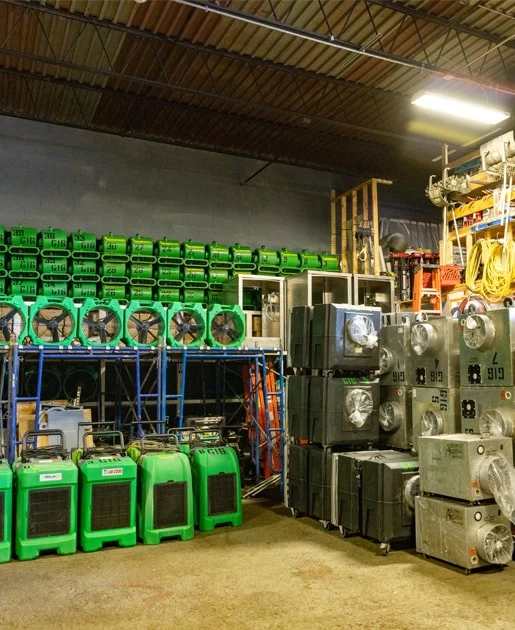
From there, we extract standing water using industrial-grade equipment and begin structural drying with commercial dehumidifiers and air movers. We use moisture meters and thermal imaging to confirm what’s wet behind walls and under flooring because visible dryness and actual dryness are two different things, and the difference matters when mold is the concern. If the assessment reveals disturbed building materials that may contain asbestos or lead common in Copiague’s older housing stock we handle that in-house under our NYS and EPA certifications. No second contractor, no gap in the process.
Once everything is dry and documented, we move into restoration and reconstruction as needed. Throughout the entire job, we manage the insurance documentation and communicate directly with your adjuster. By the time we’re done, you have a closed-out claim and a basement that’s actually clean not just dry on the surface.
One Contractor, Every License, No Gaps in the Work
Flooded basement cleanup in Copiague covers a lot of ground depending on what caused the flooding and what the water touched. Category 1 water from a burst pipe is a very different job than Category 3 sewage backup from an aging clay sewer lateral which is one of the most common calls we get in this hamlet, given how much of the post-war infrastructure is still in the ground. Sewage water is a documented biohazard, and it requires containment, licensed disposal, and OSHA-compliant handling. That’s not optional, and it’s not something a general handyman or unlicensed crew can legally perform in Suffolk County.
Every flooded basement job we handle includes water extraction, structural drying, moisture verification, mold assessment, and full documentation for your insurance claim. If the flood disturbed materials that require asbestos or lead remediation which is a real possibility in any Copiague home built before 1980 that work is performed in-house under our NYS DOL Asbestos license and USEPA Lead certification. You don’t get handed off to a subcontractor and left to manage the coordination yourself.
We hold the Town of Babylon-applicable Suffolk County General Contractor license, which means all structural restoration work is permitted and compliant. For Copiague homeowners carrying property tax bills around $10,000 a year and a home worth over $500,000, the last thing you need is unpermitted work complicating your insurance claim or your resale.
Does homeowners insurance cover flooded basement cleanup in Copiague, NY?
It depends on what caused the flooding, and the answer matters a lot before any work begins. Standard homeowners insurance typically covers sudden and accidental water damage like a burst pipe or an appliance failure but it generally does not cover flooding from outside sources like storm surge or rising groundwater unless you have a separate flood insurance policy. For Copiague homeowners in the peninsula communities of Amity Harbor and Copiague Harbor, where coastal exposure is real and FEMA elevation compliance is actively marketed in real estate listings, having that separate flood policy in place is worth reviewing before the next storm season.
What we do on every job is handle the documentation and adjuster communication directly. We bill your insurance carrier, provide detailed damage reports, and walk through the claim with you so you’re not navigating it alone. Many homeowners don’t realize how much of the claim process a contractor can support and for a community that lived through the Sandy claims process, having someone in your corner who knows how to document correctly makes a real difference in what actually gets covered.
How fast does mold actually grow after a basement flood on Long Island?
The standard answer is 24 to 48 hours, and that’s accurate but the real-world timeline in a coastal South Shore environment like Copiague can be even tighter. After a storm event, the ambient humidity in and around the home is already elevated. Warm, wet, humid conditions accelerate mold colonization, particularly in porous materials like drywall, insulation, and wood framing. If a basement stays wet for more than a day or two without active drying equipment running, mold isn’t a risk it’s likely already starting.
This is why response time isn’t just a marketing point. The difference between calling immediately and waiting to “see if it dries out” can be the difference between a straightforward water extraction job and a full mold remediation project that costs several times more. We use thermal imaging and moisture meters to find moisture that isn’t visible to the eye inside wall cavities, under subfloors because that’s where mold establishes itself before you ever see it on the surface.
My Copiague basement flooded from what looks like sewage is that more serious?
Yes, significantly more serious. Sewage backup is classified as Category 3 water the highest contamination level because it contains bacteria, viruses, and pathogens that pose a direct health risk. This isn’t something you clean up with bleach and a mop. It requires full containment, proper PPE, licensed disposal of contaminated materials, and documentation that the area has been properly decontaminated. In Suffolk County, Category 3 cleanup is subject to environmental regulations governing how waste is handled and disposed of.
Sewage backups in Copiague are more common than most homeowners expect, largely because a significant portion of the hamlet’s post-war housing stock is still connected to aging clay and cast iron sewer laterals that are prone to cracking, root intrusion, and backflow. If your basement flooded and the water has any discoloration, odor, or came up through a floor drain, treat it as Category 3 until a professional confirms otherwise. We’re licensed and equipped to handle it safely from start to finish.
Should I be worried about asbestos or lead in my Copiague home after a basement flood?
If your home was built before 1980, it’s a legitimate concern worth taking seriously. Asbestos was commonly used in floor tiles, pipe insulation, ceiling tiles, and wall insulation in homes built throughout the 1950s, 60s, and 70s the same era that produced most of Copiague’s residential housing stock. Lead-based paint was standard in homes built before 1978. When a flood forces you to remove wet drywall, flooring, or insulation, those materials can be disturbed, and disturbing them without the proper licensing creates a hazardous situation and a legal liability.
Most water damage contractors including national franchise operations are not licensed to handle asbestos or lead in-house. They’ll either skip past it or bring in a subcontractor, which adds time, cost, and a gap in accountability. We hold the NYS DOL Asbestos license and USEPA Lead and RRP certifications, so if those materials are present, we handle them as part of the same job. No handoff, no separate contractor to coordinate, no unresolved hazmat issue sitting behind your newly rebuilt wall.
How much does flooded basement cleanup typically cost in Copiague, NY?
The range is wide because the scope varies significantly depending on what caused the flooding, how long the water sat, how much square footage was affected, and whether hazardous materials are involved. A straightforward water extraction and drying job for a smaller basement with clean water and no structural damage might fall in the $1,500 to $3,500 range. A more involved job Category 3 sewage backup, mold remediation, asbestos abatement, and partial reconstruction can reach $10,000 or more.
The most important thing to understand is that insurance coverage is often available for a significant portion of this cost, and how the damage is documented from the start affects what gets approved. We provide line-item estimates before work begins so you know exactly what you’re looking at out of pocket, and we bill your insurance carrier directly. For Copiague homeowners carrying property tax bills around $10,000 a year, the last thing you need is a vague estimate that balloons mid-job. We don’t work that way.
Is a flooded basement in Amity Harbor or Copiague Harbor handled differently than inland Copiague?
In terms of the cleanup process itself, the core steps are the same extract, dry, assess, remediate, restore. But the cause of the flooding and the risk profile are genuinely different for the peninsula communities. Amity Harbor and Copiague Harbor extend directly into the Great South Bay, and both sit south of Sunrise Highway the boundary that defined the mandatory evacuation zone during Superstorm Sandy. Homes in those neighborhoods face storm surge and tidal flooding risks that inland Copiague simply doesn’t, and many properties there were built to FEMA elevation specifications specifically because of that exposure.
For waterfront peninsula homes, the assessment has to account for the possibility that outside floodwater which is Category 3 contamination reached the basement, even if it looks like clean water on the surface. Bay water carries contaminants, sediment, and biological material that require the same licensed handling as sewage. We already serve Copiague Harbor specifically, so we know the access routes, the construction patterns in those neighborhoods, and what a post-storm assessment in that area actually requires. That local familiarity isn’t something you get from a franchise dispatcher working off a zip code.