Dix Hills basements flood differently than most and getting it wrong costs more than the cleanup. We respond fast, handle everything, and bill your insurance directly.
I needed a professional consultation explanation of procedure for safe removal of Asbestos in my apartment complex. Without having an account yet, I was very impressed with the caring, knowledgeable and generous advice offered by Jessica, and will look forward to doing business in the future. Thank you so much! I feel much more informed about a sometimes scary endeavor. Peace. Nancy Silva Mineola, NY.
Mia Munoz
Used this company to clean up some water flood in my house. They were fast and easy to work with.very professional, Would recommend to anyone!
Nini Valle
Great company, had a flood and they responded quickly and efficiently. Billed my insurance company directly. I highly recommend this company!
joe colapietro, jr
I had pipe freeze in my basement right before a snow storm and they made to within an hour to help start the clean up process. They we by our side throughout the entire process and even helped with the insurance company. They did such a great job with the cleanup, repair, remidiation, I contracted them to perform the repairs and finishes in the basement. They came with enough manpower and material to get the job done. Leo and Jessica were nothing but a pleasure to deal with!!
Cristian Arredondo c
I had some water damage in my home and Green Island was able to take care of my issue quickly and effectively. I am very pleased with the work they did. They responded quickly and were very professional.
Michael M
Outstanding service! From the office to the field crew everyone was friendly, helpful and responsive. I highly recommend Green Island Group.
Your Basement Restored Before Mold Makes the Decision
The moment water gets into your basement, the clock starts. Mold can begin growing within 24 to 48 hours and in a finished Dix Hills basement, that means your home office, your kids’ playroom, or your media room is at risk. Every hour matters.
What makes Dix Hills different from most of Long Island is the ground itself. Unlike the sandy, fast-draining soils on the South Shore, Dix Hills sits on clay-heavy moraine terrain the kind that holds water against your foundation walls and basement slab long after the rain stops. That sustained hydrostatic pressure is what pushes water through cold joints, block wall gaps, and foundation cracks that look minor until they’re not. By the time you see it, moisture has often already spread behind your finished walls.
When the job is done right, you get more than a dry floor. You get documentation our insurance adjusters can actually use, a clear picture of what was affected and what isn’t, and the confidence that nothing was left wet inside your walls to become a problem six months from now. That’s the difference between a real restoration and someone running a dehumidifier and calling it done.
We’ve been completing restoration work across Suffolk County for over 12 years and more than 5,000 projects. That’s not a marketing number it means your flooding scenario, whatever caused it, is one we’ve handled before. We hold a Suffolk County General Contractor license, a NYS DOL Mold license, a NYS DOL Asbestos license, USEPA Lead and RRP certifications, and we’re an approved emergency response contractor for the NYS Office of General Services. The state vetted us independently. That matters.
For homeowners in Dix Hills where a significant portion of the housing stock was built in the 1950s, 1960s, and 1970s that licensing stack isn’t just a credential wall. It’s directly relevant to your home. Flooding in a pre-1978 Dix Hills home can disturb asbestos pipe insulation, asbestos floor tiles, and lead-based paint. Most water damage companies aren’t licensed to touch those materials. We are, which means we can complete the full scope of your job without stopping, subcontracting, or leaving anything unresolved.
We are also independently certified by New York State as both a Minority Business Enterprise and a Woman-Owned Business Enterprise led by CEO Jessica Dussan and VP Leo Torres, who are personally accountable for every job we take.
From the First Call to the Final Inspection, Here's What Happens
When you call, we dispatch immediately day or night, weekday or weekend. Our response times are confirmed in real customer reviews, including jobs completed during snowstorms. We know the roads in and around Dix Hills, and we’re not routing through a national call center. You reach us directly, and we move.
On arrival, the first thing we do is assess the full scope not just the visible water. We use professional moisture meters and thermal imaging cameras to map saturation inside your walls, under your flooring, and along your foundation. In older Dix Hills homes, this step is critical. Water that enters through a clay-pressured foundation wall doesn’t stay where you can see it. It travels, and finding it early is the difference between a contained cleanup and a gut renovation. If your home was built before 1978, we assess for asbestos and lead hazards before any material is disturbed because the Town of Huntington requires permitted reconstruction work, and we handle that permitting process as your licensed General Contractor.
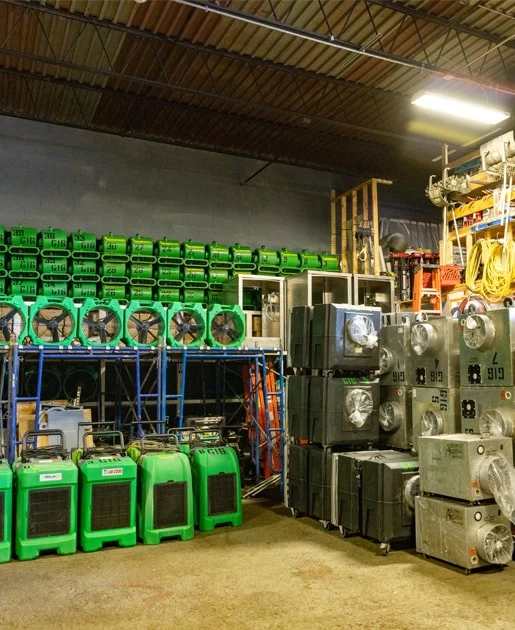
From there, we extract standing water, set industrial drying equipment, and begin controlled demolition of any materials that can’t be saved. Once the structure is dry and verified with post-drying moisture readings, we handle mold remediation if needed, rebuild what was removed, and document everything for your insurance claim. You don’t manage multiple contractors. You don’t chase paperwork. We handle it from start to finish.
Flooded Basement Cleaning and Mold Remediation Dix Hills
Full-Scope Restoration Built for Dix Hills Homes Specifically
Most water damage companies can extract water and run fans. What they can’t do is handle what a flooded basement in a 1960s Dix Hills Colonial actually requires which often goes well beyond drying. We provide complete restoration: emergency water extraction, structural drying with industrial dehumidifiers and air movers, moisture mapping with thermal imaging, mold remediation under our NYS DOL Mold license, asbestos and lead abatement under our USEPA and NYS DOL certifications, controlled demolition of unsalvageable materials, full basement reconstruction under our Suffolk County General Contractor license, and direct insurance billing from start to finish.
The insurance piece is worth understanding clearly. We document your damage in the format adjusters need, communicate directly with your carrier, and bill them directly. Multiple customers have noted this in their own reviews not because we coached them to, but because it genuinely changed their experience. For a household managing a $1 million-plus property in Dix Hills, not having to become an expert in insurance claims on top of everything else is real value.
Whether your basement flooded from a sump pump failure during a nor’easter, a burst pipe in a cold snap, a sewage backup, or slow groundwater intrusion through a clay-pressured foundation wall the process is the same. We find everything, dry everything, document everything, and restore everything. One company, one contract, one call.
What actually causes basement flooding in Dix Hills, and is my home at risk?
The most common cause of basement flooding in Dix Hills isn’t a burst pipe or a backed-up sewer it’s sump pump failure during a storm. Dix Hills sits on clay-heavy moraine terrain, which means the soil around your foundation holds water rather than draining it quickly the way sandy South Shore soil does. When a storm saturates that clay and your sump pump can’t keep up or loses power, which happens regularly during nor’easters hydrostatic pressure builds against your foundation walls and slab from every direction. Water finds the path of least resistance: cold joints, block wall gaps, hairline cracks that were never a problem before.
If your home was built in the 1950s, 1960s, or 1970s which describes a large portion of Dix Hills housing stock you also have aging plumbing that adds risk. Galvanized steel supply lines corrode from the inside out, and original cast iron drain lines can crack under root pressure or simply fail with age. The rolling terrain of the hamlet also concentrates stormwater runoff toward low-lying lots between the hills, so your specific position on the property matters. If you’re in a topographic low point and your sump pump is more than a few years old, your risk is real.
How quickly does mold grow after a basement flood, and why does timing matter so much?
Mold begins growing within 24 to 48 hours of a flooding event and that timeline doesn’t care whether it’s a weeknight, a holiday, or the middle of a nor’easter. In a finished Dix Hills basement with drywall, carpet, wood framing, and stored contents, that window closes fast. By 72 hours, active mold growth is likely behind your walls even if the floor looks like it’s drying out. What you can see on the surface is rarely the full picture.
The reason timing matters so much in Dix Hills specifically is what’s at stake. A finished basement in a Dix Hills home represents real equity renovation investment, functional living space, and a meaningful portion of your home’s value. Delaying professional cleanup by even 24 hours can turn a manageable water extraction job into a full mold remediation project that adds thousands of dollars to the total cost and weeks to the timeline. The difference between calling at midnight and calling the next morning can be the difference between saving your drywall and replacing it entirely. That’s just how the biology works, and it’s why we respond 24 hours a day.
Does homeowners insurance cover flooded basement cleanup in Dix Hills, NY?
It depends on the cause, and this is where a lot of homeowners get caught off guard. Standard homeowners insurance policies in New York typically cover sudden and accidental water damage a burst pipe, an appliance malfunction, or an overflow from a plumbing fixture. What they often don’t cover by default is groundwater intrusion, sump pump failure, or flooding from outside the home. Sump pump failure coverage is usually available as an endorsement or rider, and many Dix Hills homeowners don’t realize they have it or don’t have it until they’re filing a claim.
The most important thing you can do right now, before anything happens, is pull out your policy and look for water backup and sump pump coverage. If you’re already dealing with a flooding event, call us first and we’ll help you understand what’s likely covered based on the cause. We document damage in the format insurance adjusters require, communicate with your carrier directly, and handle billing on your behalf. We’ve done this enough times across Suffolk County to know what adjusters look for and how to make sure your claim reflects the actual scope of the damage not just what was visible on the surface.
My Dix Hills home was built in the 1960s does that change what a flooded basement cleanup involves?
Yes, significantly. Homes built before 1978 which covers a large portion of Dix Hills’s housing stock, given the median construction year of 1970 frequently contain asbestos pipe insulation on hot water lines, asbestos-containing vinyl floor tiles in basements, and lead-based paint on walls and trim. When a basement floods and you need to remove water-damaged drywall, flooring, or insulation, those materials can become active health hazards if they’re disturbed by an unlicensed contractor.
A water damage company without USEPA Lead, USEPA RRP, and NYS DOL Asbestos certifications cannot legally or safely handle those materials. Hiring someone without those licenses doesn’t just create a health risk it creates liability for you as the homeowner if the work isn’t done in compliance with state and federal regulations. We hold all three of those certifications, which means we can assess, contain, and properly dispose of hazardous materials as part of the same job without stopping work, without bringing in a separate abatement contractor, and without leaving you to manage the coordination. For older Dix Hills homes specifically, this isn’t an edge case. It’s a real and common part of the job.
How much does flooded basement cleanup typically cost in Dix Hills, NY?
The honest answer is that it depends on the scope, and scope varies more than most people expect. A straightforward water extraction and drying job in a small, unfinished basement might run $2,000 to $4,000. A finished basement with saturated drywall, flooring, and stored contents the kind of space that’s common in Dix Hills homes can run $4,000 to $8,000 or more before any reconstruction begins. If mold remediation is needed, that adds cost. If the home was built before 1978 and asbestos or lead materials are involved, that adds cost as well.
What drives the final number most is how quickly the job starts. Every hour of delay after a flooding event expands the affected area as moisture wicks further into walls and framing. A job that costs $3,500 if you call within the first few hours can cost $7,000 or more if you wait two days. The other major variable is documentation quality a properly documented claim that captures the full scope of damage, including hidden moisture behind walls, recovers more from your insurance carrier than a surface-level assessment. We provide that documentation as a standard part of every job, which is one of the reasons our customers consistently note the insurance process as a positive part of their experience with us.
What should I do the moment I discover my basement is flooded in Dix Hills?
The first thing is safety. Don’t walk into a flooded basement if you’re not certain the power is off water and live electrical panels don’t mix, and many Dix Hills homes have electrical panels in or adjacent to the basement. If you can safely access your breaker box from outside the affected area and cut power to the basement, do that first. If you can’t do it safely, don’t go in.
Once you know it’s safe, call us before you start moving things or running fans. The instinct to start cleaning up yourself is understandable, but moving water around without proper extraction equipment spreads contamination and makes it harder to document the original damage for your insurance claim. If the flooding involves sewage backup or outside floodwater what the industry classifies as Category 3 water that’s a hazmat situation that requires licensed environmental contractors, not a shop vac. We handle all three categories of water damage, respond 24 hours a day, and can be on-site in under an hour from your call. The sooner we get there, the more we can save and the more your insurance claim will reflect what actually happened.