When Moriches Bay Pushes Back, Your Basement Pays First
Coastal flooding in Eastport isn’t a rare event it’s a recurring reality. We respond fast, handle the contamination correctly, and work directly with your insurance so you’re not managing a crisis alone.
I needed a professional consultation explanation of procedure for safe removal of Asbestos in my apartment complex. Without having an account yet, I was very impressed with the caring, knowledgeable and generous advice offered by Jessica, and will look forward to doing business in the future. Thank you so much! I feel much more informed about a sometimes scary endeavor. Peace. Nancy Silva Mineola, NY.
Mia Munoz
Used this company to clean up some water flood in my house. They were fast and easy to work with.very professional, Would recommend to anyone!
Nini Valle
Great company, had a flood and they responded quickly and efficiently. Billed my insurance company directly. I highly recommend this company!
joe colapietro, jr
I had pipe freeze in my basement right before a snow storm and they made to within an hour to help start the clean up process. They we by our side throughout the entire process and even helped with the insurance company. They did such a great job with the cleanup, repair, remidiation, I contracted them to perform the repairs and finishes in the basement. They came with enough manpower and material to get the job done. Leo and Jessica were nothing but a pleasure to deal with!!
Cristian Arredondo c
I had some water damage in my home and Green Island was able to take care of my issue quickly and effectively. I am very pleased with the work they did. They responded quickly and were very professional.
Michael M
Outstanding service! From the office to the field crew everyone was friendly, helpful and responsive. I highly recommend Green Island Group.
A Dry Basement Isn't Enough Here's What Actually Matters
When water gets into your basement in Eastport on the South Shore, the visible mess is only part of the problem. The bigger issue is what you can’t see moisture trapped inside drywall, under subfloors, and behind finished walls. In a 1990s-built Eastport home, those materials soak fast and mold colonizes within 24 to 48 hours. Coastal humidity along Moriches Bay doesn’t give you much buffer.
What you actually need after a flooded basement is confirmed structural dryness not just a dry-looking floor. That means industrial drying equipment, moisture readings taken inside wall cavities, and a contractor who knows the difference between surface dry and structurally dry. Skipping that step is how a $3,000 cleanup turns into a $15,000 mold remediation six months later.
There’s also the water source to consider. Eastport’s flooding isn’t always a burst pipe. Storm surge, a rising water table from prolonged rain, or a sump pump that gave out during a nor’easter brings a different category of water into your basement water that carries bacteria and contaminants and legally requires a licensed environmental contractor to handle. That’s not a technicality. It’s the difference between a cleanup that actually protects your home and one that just looks like it did.
Licensed for What South Shore Flooding Actually Brings In
We’re an independently owned environmental restoration company not a franchise, not a call center. With more than 12 years of experience and over 5,000 completed restoration projects across New York State, we’ve handled the full range of what Long Island flooding looks like, from simple pipe bursts to Category 3 contamination events involving bay water and sewage.
What sets us apart in Eastport isn’t just experience it’s the licensing stack. We hold a Suffolk County General Contractor license covering both the Town of Brookhaven and Town of Southampton jurisdictions that Eastport straddles, plus NYS Department of Labor licenses for Mold and Asbestos, USEPA Lead and RRP certifications, and approval as an emergency response contractor for the NYS Office of General Services. That last one matters: the State of New York has independently vetted us. That’s not a marketing line it’s a public record.
When you call, you’re reaching a company where CEO Jessica Dussan and VP Leo Torres are personally involved. In a hamlet of roughly 2,200 people where word travels fast, that kind of accountability isn’t optional it’s how we operate.
From Standing Water to Structurally Dry No Gaps, No Handoffs
The first call triggers an emergency response 24 hours a day, including weekends and holidays. A crew arrives fast, assesses the water source and category, and begins extraction immediately. If the water came from outside storm surge off Moriches Bay, groundwater intrusion, or a backed-up sewer line it gets classified correctly from the start, because the contamination protocols for Category 2 and Category 3 water are entirely different from a clean pipe burst.
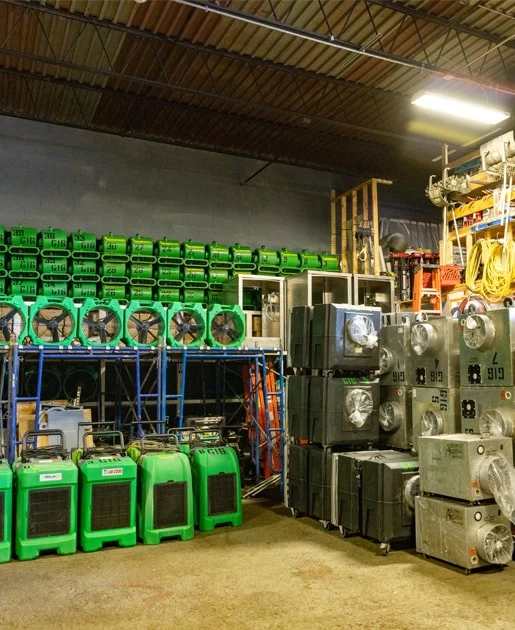
Once the water is out, the drying phase begins. This isn’t fans pointed at a wet floor. Industrial dehumidifiers and air movers are positioned based on moisture readings taken inside wall cavities, under flooring, and behind any finished surfaces. In Eastport’s coastal environment, ambient humidity slows drying times compared to inland areas the equipment setup accounts for that. Readings are tracked daily until the structure hits target moisture levels, not just until things look dry.
From there, if mold remediation, asbestos handling, or structural reconstruction is needed, it’s all handled under the same roof. Because Eastport sits across two town jurisdictions Brookhaven to the west and Southampton to the east permits for reconstruction work may need to be pulled from different building departments depending on where your property sits. We’re licensed and familiar with both, so that complexity doesn’t slow your project down or land on your plate.
Flooded basement cleanup in Eastport can mean a lot of different things depending on what caused it and what’s in the water. We handle the complete range water extraction, structural drying, contamination testing, mold remediation, asbestos and lead abatement, sewage decontamination, and full reconstruction. You don’t get handed off to a second company halfway through the job.
For homes along North Bay Avenue and other waterfront parcels built on former duck farm land, the flooding risk isn’t just weather-driven it’s embedded in the land itself. Those properties sit on historically low-lying, wetland-adjacent parcels where the water table is already close to grade. When a storm pushes bay water inland or extended rain saturates the ground, hydrostatic pressure against basement walls and floor slabs builds fast. The response has to account for that, not just treat it like a standard water removal call.
Every job includes direct insurance billing. We document the damage with the detail that adjusters require, communicate with your carrier directly, and handle the claims process from our end. For Eastport homeowners carrying both homeowners insurance and NFIP flood insurance which many do, given the coastal exposure that matters. Navigating two separate policies with different coverage triggers while managing a flooded home is a real burden, and it’s one less thing you should have to carry.
Is the water in my flooded Eastport basement safe to clean up myself?
It depends entirely on where the water came from. If a supply line burst inside your home and you caught it quickly, that’s clean water Category 1 and basic extraction with proper drying is the concern. But in Eastport, a lot of basement flooding doesn’t come from inside the house. Storm surge off Moriches Bay, groundwater intrusion through foundation walls, or a sump pump failure during a prolonged nor’easter brings in water that’s been in contact with soil, sediment, and biological material. That’s Category 2 at minimum, and if there’s any sewage involvement, it’s Category 3.
Category 2 and Category 3 water carry bacteria and contaminants that aren’t visible and don’t disappear when the water dries. Under New York State regulations and OSHA protocols, Category 3 cleanup legally requires a licensed environmental contractor not because it’s a bureaucratic formality, but because the decontamination process is genuinely different and the health risk to anyone in the space is real. Attempting to clean it yourself without proper PPE, containment, and disposal protocols puts your family at risk and can also complicate an insurance claim if the carrier determines the damage was worsened by improper handling.
How fast does mold actually grow after a basement flood in Eastport?
The standard answer is 24 to 48 hours, and that’s accurate but it’s worth understanding what that timeline actually means in practice. Mold doesn’t need standing water to grow. Once building materials absorb moisture drywall, wood framing, carpet padding, engineered lumber the colonization process begins. In Eastport’s coastal environment, where ambient humidity along Moriches Bay is higher than inland areas of Suffolk County, moisture-saturated materials don’t air-dry naturally the way they might further west on Long Island.
That means the 48-hour window isn’t generous. If water enters your basement on a Friday night and you’re calling contractors Saturday morning, you’re already working against the clock. The homes built in Eastport during the 1990s which make up the majority of the housing stock were constructed with drywall and synthetic materials that are highly susceptible to mold. Once mold colonizes inside a wall cavity, the remediation scope expands significantly. What might have been a $3,000 to $5,000 drying job becomes a $10,000-plus mold remediation with demolition involved. Speed matters because the math doesn’t work in your favor the longer you wait.
Does homeowners insurance cover basement flooding from a storm or bay surge in Eastport?
This is one of the most common points of confusion for Eastport homeowners, and it’s worth being direct about it. Standard homeowners insurance does not cover flooding caused by an external water source including storm surge from Moriches Bay, rising groundwater, or overland flooding. That type of damage falls under flood insurance, which is a separate policy typically issued through FEMA’s National Flood Insurance Program (NFIP). Many Eastport homeowners near the bay carry both, but not everyone does, and the coverage triggers are different.
What homeowners insurance typically does cover is sudden and accidental water damage from an internal source a burst pipe, a failed water heater, an appliance overflow. If your sump pump backs up, that may fall under a sewage and water backup rider, which is a separate add-on that not all policies include by default. The practical takeaway: before you assume your insurance covers a flooded basement, check whether you have flood insurance through NFIP, whether your homeowners policy includes a backup rider, and what your deductibles are for each. We handle direct billing for both homeowners and flood insurance claims and can help document the damage in the format adjusters require for each policy type.
What does basement flooding remediation actually cost in Suffolk County?
The range is wide because the scope varies significantly depending on what caused the flooding, how long the water sat, and what the water was in contact with. For a contained Category 1 event clean water from a burst pipe, caught quickly you’re typically looking at $2,000 to $7,500 for extraction, drying, and any minor material removal. That number climbs when the water source is contaminated, when materials need to be demolished and disposed of as regulated waste, or when mold remediation is required on top of the drying work.
In Eastport specifically, a few factors can push costs higher than the Suffolk County average. Homes on former duck farm parcels along the waterfront often have more complex drainage and foundation conditions than standard residential builds. Finished basements common in the 1990s construction era require more labor to dry properly because moisture hides behind walls and under floors. And if the flooding involved bay water or sewage, the contamination protocols add cost but are not optional. The most expensive outcome is always the one where the initial cleanup was done incompletely and mold is discovered months later that remediation, combined with reconstruction, routinely runs $15,000 or more.
My basement in Eastport keeps flooding is that a drainage problem or something else?
Recurring basement flooding in Eastport is often a combination of factors, and the answer isn’t always as simple as “your sump pump needs upgrading.” The community sits on the South Shore with direct Moriches Bay exposure, and a significant portion of Eastport’s residential land was developed on former duck farm parcels historically low-lying, wetland-adjacent ground where the water table naturally sits close to the surface. When rainfall is prolonged or storm surge pushes bay water inland, that water table rises and hydrostatic pressure builds against basement walls and floor slabs from below and laterally.
That’s a different problem than a surface drainage issue, and it requires a different solution. Interior drainage systems, sump pump upgrades, and waterproofing membranes can help manage the symptoms, but understanding the underlying cause whether it’s water table elevation, foundation wall failure, inadequate grading, or storm surge exposure determines what actually works long term. After a flooding event, a thorough assessment of how and where the water entered is the starting point. Patching the visible damage without addressing the entry point typically means you’ll be dealing with the same situation again within a season or two.
Does Green Island Group handle the permits for reconstruction after a flooded basement in Eastport?
Yes and in Eastport, this is worth paying attention to. The hamlet sits on the boundary between two separate town jurisdictions: the Town of Brookhaven on the west side and the Town of Southampton on the east. Depending on where your property sits relative to West Pond, reconstruction permits after a flood loss may need to be pulled from different building departments with different requirements and processing timelines. Most contractors working in Eastport aren’t set up for both jurisdictions and may not even be aware of the split.
We hold a Suffolk County General Contractor license that covers both town jurisdictions, and we’re familiar with the permitting process on both sides of that line. For work involving mold, asbestos, or lead which can come into play in older waterfront properties or homes that have been renovated over the years we also hold the NYS Department of Labor licenses required for that work specifically. The practical benefit to you is that you’re not coordinating between a restoration company and a separate GC while also managing an insurance claim. One company handles the extraction, the remediation, the abatement if needed, and the rebuild with the permits pulled correctly for wherever your property sits in Eastport.