Elmont's Older Homes Don't Get a Second Chance After a Flood
When water gets into a post-war basement on Dutch Broadway or anywhere near the Cross Island Parkway, the clock starts immediately — and Green Island Group is built to beat it.
I needed a professional consultation explanation of procedure for safe removal of Asbestos in my apartment complex. Without having an account yet, I was very impressed with the caring, knowledgeable and generous advice offered by Jessica, and will look forward to doing business in the future. Thank you so much! I feel much more informed about a sometimes scary endeavor. Peace. Nancy Silva Mineola, NY.
Mia Munoz
Used this company to clean up some water flood in my house. They were fast and easy to work with.very professional, Would recommend to anyone!
Nini Valle
Great company, had a flood and they responded quickly and efficiently. Billed my insurance company directly. I highly recommend this company!
joe colapietro, jr
I had pipe freeze in my basement right before a snow storm and they made to within an hour to help start the clean up process. They we by our side throughout the entire process and even helped with the insurance company. They did such a great job with the cleanup, repair, remidiation, I contracted them to perform the repairs and finishes in the basement. They came with enough manpower and material to get the job done. Leo and Jessica were nothing but a pleasure to deal with!!
Cristian Arredondo c
I had some water damage in my home and Green Island was able to take care of my issue quickly and effectively. I am very pleased with the work they did. They responded quickly and were very professional.
Michael M
Outstanding service! From the office to the field crew everyone was friendly, helpful and responsive. I highly recommend Green Island Group.
The August 2024 storm dropped over 10 inches of rain on Elmont in a single day. Fallon Avenue flooded. Elmont Road flooded. The Cross Island Parkway interchange backed up. And in hundreds of basements across the hamlet, homeowners discovered something they weren’t prepared for — water that got in fast and didn’t leave on its own. What comes after that moment matters more than most people realize.
Mold doesn’t wait for a convenient time. Within 72 hours of water entering your basement, it can begin growing inside wall cavities, behind drywall, and through insulation — places you can’t see and a box fan can’t reach. By the time you smell it, it’s already spread. Getting the water out is step one. Getting the structure genuinely dry — verified with moisture meters, not just a visual check — is what actually protects your home.
For Elmont specifically, there’s another layer most cleanup companies don’t mention. The majority of homes here were built between the 1940s and 1960s, which means asbestos floor tiles, lead paint on basement walls, and aging pipe insulation are common. A flooded basement in a home like that isn’t just a drying job — it’s a multi-hazard situation that requires licensed handling from start to finish. It’s the reality of what Elmont’s housing stock looks like, and it’s exactly why the company you call matters.
We serve Elmont, Nassau County, Suffolk County, and the New York City metro area with a credential stack that most restoration companies in this market simply don’t hold. NYS DOL Mold License. NYS DOL Asbestos License. USEPA Lead/RRP Certification. IICRC Water Damage Certification. Nassau County General Contractor License. New York is one of only a handful of states in the country that legally requires a dedicated mold contractor license — and we have it.
That matters in Elmont more than almost anywhere else in Nassau County. When you’re dealing with a flooded basement in a 1955 Cape Cod — the kind of home that makes up a huge portion of this hamlet — the job can involve mold, asbestos, lead, and structural repairs all at once. Most companies can handle one of those. We handle all of them, under one contract, with the licenses to back it up.
From the first call to the final walkthrough, you’re working with a team that knows the Town of Hempstead permitting process, understands Elmont’s drainage vulnerabilities, and has seen firsthand what a major Nassau County flood event does to homes like yours.
What Actually Happens From the First Call to a Dry Basement
It starts with a call — and someone actually picks up, any time of day or night. When you reach out, you’ll talk to a real person who can assess your situation, ask the right questions, and get a crew moving. In a flooding event, that response window is everything. The 72-hour mold threshold isn’t flexible, and our dispatch is built around that reality.
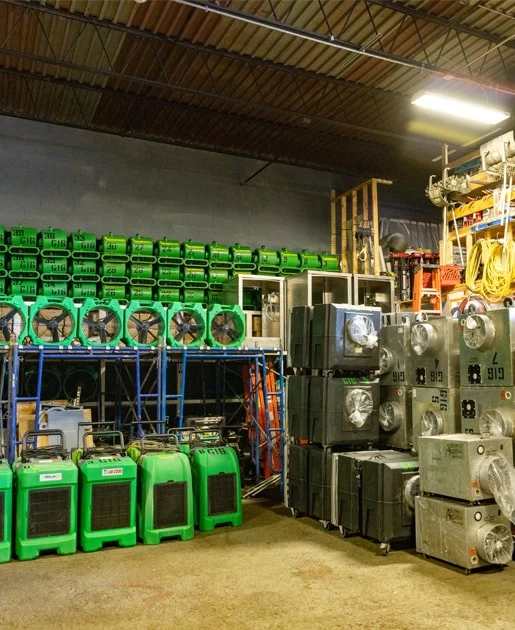
When the team arrives, the first priority is water extraction — industrial-grade equipment that pulls standing water out fast, not consumer gear that takes hours to make a dent. After extraction comes the part most homeowners don’t see: moisture detection. Using professional meters and thermal imaging, we map every wet surface, including inside walls and under flooring, because water travels further than it looks. In Elmont’s older homes, where concrete block foundations, original hardwood subfloors, and decades-old insulation hold moisture differently than modern construction, this step is especially important.
From there, the drying and dehumidification phase begins, typically running 3 to 5 days depending on the extent of the damage. If testing reveals mold, asbestos-containing materials, or lead paint disturbance — all real possibilities in pre-1978 Elmont homes — we handle licensed remediation before any reconstruction begins. Structural repairs, drywall replacement, and flooring restoration are completed under our Nassau County General Contractor license, so you’re not left coordinating a second contractor to finish the job. The Town of Hempstead permit process is managed as part of that scope when required.
Built for What Elmont Basements Actually Deal With
Flooded basement cleanup in Elmont isn’t a one-size-fits-all job. The flat terrain of western Nassau County, aging combined infrastructure near the Queens border, and a housing stock where pre-1978 construction is the norm — not the exception — means the scope of a proper cleanup here goes beyond what you’d see in a newer suburb. Our service is built around that reality.
Water extraction and structural drying are the foundation of every job. But in Elmont, that’s often followed by mold assessment and remediation under our NYS DOL Mold License, asbestos testing and abatement under our NYS DOL Asbestos License, and lead-safe work practices under USEPA Lead/RRP certification for any home built before 1978 — which covers the majority of addresses in this hamlet. These aren’t optional add-ons. In many cases, they’re legally required steps that unlicensed operators skip entirely, leaving homeowners with hidden liability.
Insurance navigation is also part of what we bring to the table. A lot of Elmont homeowners find out mid-crisis that their standard homeowners policy doesn’t cover storm flooding — only sudden events like burst pipes. We help document damage thoroughly, communicate with carriers, and build the paper trail needed to support any valid claim. One call, one team, one complete job — from the first pump to the last permit.
Does homeowners insurance cover a flooded basement in Elmont, NY?
This is one of the most common — and most painful — discoveries Elmont homeowners make after a flooding event. Standard homeowners insurance typically covers sudden, accidental water damage, like a burst pipe or an appliance failure. It does not cover flooding from storms, groundwater, or overland water — the kind of flooding that hit Fallon Avenue and Elmont Road during the August 2024 event. For that, you’d need a separate flood insurance policy through the National Flood Insurance Program (NFIP) or a private carrier.
If you do have flood coverage, the average NFIP claim payout runs close to $46,000 — which gives you a sense of how costly these events can be. We assist with damage documentation and carrier communication to help you get the most out of whatever coverage you have. If you’re not sure what your policy covers, that’s actually a good conversation to have now, before the next storm season hits.
How long does flooded basement cleanup actually take from start to finish?
The honest answer depends on what the water left behind. Water extraction itself can often be completed within a few hours. Structural drying — the phase where industrial dehumidifiers and air movers run continuously to pull moisture out of framing, concrete, and insulation — typically takes 3 to 5 days. After that, if testing reveals mold or hazardous materials, remediation adds time before reconstruction can begin.
In Elmont’s older housing stock, it’s not unusual for a job to involve multiple phases: drying, mold remediation, asbestos abatement, and then structural repair. Each phase has to be completed and verified before the next begins — that’s not a bureaucratic formality, it’s how you make sure the problem is actually solved. A thorough job in a home like yours typically runs 1 to 2 weeks from first call to final walkthrough, though more complex situations can take longer.
Is mold a real risk after basement flooding, or is it overstated?
Mold can begin colonizing within 24 to 48 hours of water exposure, and the 72-hour mark is widely considered the critical threshold. After that point, the likelihood of mold growth in wet materials increases significantly. The problem is that mold doesn’t grow where you can see it first. It starts in wall cavities, behind drywall paper, inside insulation, and under flooring — places that look fine on the surface but aren’t.
In Elmont’s post-war homes, this risk is compounded by the materials themselves. Older fiberglass insulation, original wood framing, and drywall from the 1950s and 60s are particularly hospitable to mold once wet. And because New York State legally requires a licensed mold contractor to perform remediation — not just anyone with a spray bottle — the company you hire actually matters from a compliance standpoint. We hold the NYS DOL Mold License. Most competitors operating in the Elmont market don’t cite this credential at all.
Can I just dry out my Elmont basement myself with fans and a dehumidifier?
You can try — and for a very minor, isolated leak, consumer-grade equipment might be enough. But for anything involving standing water, soaked walls, or flooring that’s been submerged, the honest answer is that fans and a hardware store dehumidifier won’t get the job done. They move surface air. They don’t pull moisture out of concrete block foundations, wood framing, or the insulation packed between your basement walls.
The other issue is verification. Without professional moisture meters and thermal imaging, you have no way to confirm that the structure is actually dry — you’re just guessing based on how it looks and smells. In Elmont’s older homes, where the basement walls may be concrete block with decades of absorbed moisture, that guess is often wrong. Homeowners who dry out their own basements and think the problem is solved frequently call us weeks later when the mold smell returns — at which point the job is significantly more involved and more expensive than it would have been on day one.
My Elmont home was built in the 1950s — does that change what's involved in cleanup?
It does, and it’s one of the most important questions you can ask. Homes built before 1978 — which covers the vast majority of Elmont’s housing stock, particularly the Cape Cods and ranches concentrated around Dutch Broadway and the streets off Hempstead Turnpike — commonly contain asbestos floor tiles, asbestos pipe insulation, and lead paint on walls and trim. When a basement floods, water disturbs these materials. Removing wet flooring, cutting into drywall, or handling damaged insulation in a pre-1978 home without proper precautions creates a hazardous exposure risk.
Under federal EPA regulations, any renovation or repair work that disturbs lead-based paint in a pre-1978 home requires a certified RRP (Renovation, Repair, and Painting) contractor. Asbestos abatement requires a NYS DOL Asbestos License. We hold both. This isn’t about upselling — it’s about doing the job legally and safely in a home like yours. An unlicensed operator who skips testing and pulls up your old floor tiles without proper containment is creating a problem that’s far more expensive to fix than the original flood.
Why does Elmont flood so often, and what can I do to protect my basement going forward?
Elmont’s flooding problem comes down to geography and infrastructure. The hamlet sits in the flat, low-lying terrain of western Nassau County, at the junction of the Cross Island Parkway and the Southern State Parkway — an area with minimal natural elevation change and limited capacity to drain large volumes of water quickly. When a slow-moving storm system stalls over Long Island, like the one that produced over 10 inches of rain in August 2024, the drainage system gets overwhelmed and water has nowhere to go but into low-lying areas — including basements.
The older infrastructure near the Queens border compounds this. Many Elmont homes also depend entirely on sump pumps to keep basements dry during heavy rain, and those pumps fail — either from power outages during storms or from sheer volume exceeding their capacity. After a cleanup, the most practical protective steps are a battery backup sump pump system, foundation crack sealing, and a professional assessment of your drain tile condition. We can identify the specific vulnerabilities in your basement during the restoration process and give you a clear picture of what’s working and what isn’t — so the next major storm doesn’t send you back to square one.