When the Sound Storms and Your Fort Salonga Basement Pays for It
Fort Salonga basements flood from all directions coastal surge from the Long Island Sound, hillside runoff down the rolling terrain, high water tables, and aging pipes common in homes built in the 1950s and 1960s. We respond fast, handle everything, and bill your insurance directly.
I needed a professional consultation explanation of procedure for safe removal of Asbestos in my apartment complex. Without having an account yet, I was very impressed with the caring, knowledgeable and generous advice offered by Jessica, and will look forward to doing business in the future. Thank you so much! I feel much more informed about a sometimes scary endeavor. Peace. Nancy Silva Mineola, NY.
Mia Munoz
Used this company to clean up some water flood in my house. They were fast and easy to work with.very professional, Would recommend to anyone!
Nini Valle
Great company, had a flood and they responded quickly and efficiently. Billed my insurance company directly. I highly recommend this company!
joe colapietro, jr
I had pipe freeze in my basement right before a snow storm and they made to within an hour to help start the clean up process. They we by our side throughout the entire process and even helped with the insurance company. They did such a great job with the cleanup, repair, remidiation, I contracted them to perform the repairs and finishes in the basement. They came with enough manpower and material to get the job done. Leo and Jessica were nothing but a pleasure to deal with!!
Cristian Arredondo c
I had some water damage in my home and Green Island was able to take care of my issue quickly and effectively. I am very pleased with the work they did. They responded quickly and were very professional.
Michael M
Outstanding service! From the office to the field crew everyone was friendly, helpful and responsive. I highly recommend Green Island Group.
Standing water in your basement is not just an inconvenience. Every hour it sits, it’s working against you saturating the subfloor, climbing the drywall, and setting the stage for mold that can take hold in as little as 24 to 48 hours. In Fort Salonga’s coastal humidity, that clock moves fast.
What you actually want is simple: water gone, everything dried properly, no mold surprise three weeks later, and an insurance claim that doesn’t fall apart. That’s the outcome. Not a crew that shows up, runs some fans, and disappears.
Fort Salonga homes built in the 1950s and 1960s and there are a lot of them here carry real risk when water gets in. Flooring, insulation, and pipe wrap from that era can contain asbestos. Painted walls can contain lead. Most water damage companies aren’t licensed to touch that material. When flooding disturbs it, you need someone who can legally and safely handle what’s underneath not just what’s on the surface. That’s where having the right licenses isn’t a technicality. It’s the difference between a cleanup and a liability.
One Call Covers Everything No Subcontractors, No Gaps
We are a licensed environmental restoration company serving Long Island and New York City, with a track record of over 5,000 completed projects. We hold the full stack of credentials required for flood events in older Fort Salonga homes: NYS DOL Mold, NYS DOL Asbestos, USEPA Lead, USEPA RRP, and a Suffolk County General Contractor license that covers both the Town of Huntington and the Town of Smithtown which matters here because Fort Salonga straddles both.
We’re also an approved emergency response contractor for the NYS Office of General Services a credential that requires independent state vetting, not just a self-declaration. CEO Jessica Dussan and VP Leo Torres are named, reachable, and personally involved in how jobs get handled. That’s not common in this industry.
For Fort Salonga homeowners protecting properties worth close to $1 million, knowing exactly who you’re dealing with and what licenses we actually hold isn’t a small thing. It’s the whole thing.
From the First Call to a Fully Dry Fort Salonga Basement Here's the Process
When you call, the first thing that happens is a real conversation not a callback window. Response times documented by actual customers run under an hour, including during storms. For a North Shore community like Fort Salonga that sees nor’easters push water in from the Sound and heavy rains concentrate runoff down the hamlet’s rolling terrain, that speed matters.
On arrival, we assess the damage and identify the water source category. Clean water from a burst pipe is handled differently than gray water from an appliance or Category 3 sewage backup and in a cesspool-dependent community like Fort Salonga, that third scenario is more common than most people expect. The right protocol depends on what you’re actually dealing with, not a one-size approach.
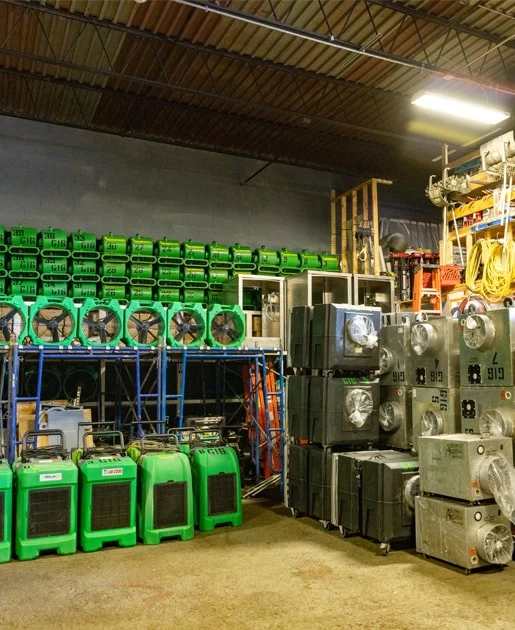
From there, industrial pumps remove standing water, commercial dehumidifiers and air movers begin structural drying, and moisture meters track what’s happening inside the walls not just what’s visible on the surface. If the assessment turns up materials that require asbestos or lead protocols (a real possibility in pre-1980 construction throughout Fort Salonga), that work happens under the same contract, with no handoff to a separate company. Once everything is dry and cleared, reconstruction drywall, flooring, insulation is handled in-house. Because Fort Salonga sits across two town boundaries, permits get pulled from whichever building department applies to your property. We handle that for you.
Flooded Basement Cleaning and Restoration Fort Salonga, NY
Every License the Job Requires Under One Roof
What sets us apart from most water damage companies isn’t a slogan. It’s the license stack. Most restoration contractors can extract water and run drying equipment. Far fewer can legally handle what a flood event in a 1950s or 1960s Fort Salonga home might uncover asbestos in floor tiles or pipe insulation, lead paint disturbed by water damage, or sewage contamination requiring full hazmat protocols. We hold every credential required for all of it: NYS DOL Asbestos, USEPA Lead, USEPA RRP, NYS DOL Mold, and a Suffolk County General Contractor license.
That matters for your insurance claim too. Proper documentation water categorization, moisture readings, photo records, scope of damage is what turns a legitimate claim into a paid one. We handle direct insurance billing and communicate with adjusters on your behalf. Multiple homeowners have specifically called this out in reviews as the reason they’d call again.
For Fort Salonga residents near Crab Meadow or in the lower-lying areas along Route 25A, where storm surge and drainage issues create recurring seasonal exposure, having one contractor who can go from water extraction through full reconstruction without farming pieces of the job out means the work actually gets finished. Not just started.
Does homeowners insurance cover basement flooding in Fort Salonga, NY?
It depends on the cause, and that distinction matters a lot. Standard homeowners insurance typically covers sudden, accidental water damage a burst pipe in winter, for example, which is a real and recurring event in Fort Salonga’s older housing stock during freeze-thaw cycles. What it usually does not cover is flooding that originates from outside the home, like storm surge from the Long Island Sound or surface water that enters through the foundation during a nor’easter. That type of damage generally requires a separate flood insurance policy through the National Flood Insurance Program (NFIP).
The good news is that documentation makes or breaks a claim either way. How the damage is categorized, photographed, and reported directly affects what gets covered. We handle insurance documentation and bill carriers directly, which takes the coordination burden off you during what is already a stressful situation. If you’re unsure what your policy covers, calling your carrier before the adjuster visit with a clear damage report in hand puts you in a much stronger position.
How fast does mold grow after a basement flood on Long Island?
Mold can begin growing within 24 to 48 hours of a flooding event and that timeline is the industry-standard window established by the IICRC, the body that sets the protocols for water damage restoration. In Fort Salonga’s coastal environment, where humidity levels run higher than inland communities for much of the year, conditions are even more favorable for rapid mold growth once moisture gets into walls, insulation, or subfloor materials.
The part that catches homeowners off guard is that mold doesn’t need standing water to grow. It needs moisture content in building materials to stay elevated which is exactly what happens when drying is delayed or done with inadequate equipment. Running a household dehumidifier after a flood is not the same as commercial structural drying with calibrated air movers and moisture meters tracking readings inside the wall cavity. Getting industrial drying equipment running within the first few hours of arrival is one of the most important things a restoration team can do for a Fort Salonga home and it’s standard protocol for us.
My Fort Salonga home was built in the 1960s should I worry about asbestos after a flood?
Yes, and it’s worth taking seriously. Homes built before 1980 which covers the majority of Fort Salonga’s housing stock commonly contain asbestos in floor tiles, pipe insulation, ceiling tiles, and certain drywall compounds. Under normal circumstances, these materials are not a health hazard if they’re intact and undisturbed. A flooding event changes that. Water damage can compromise the integrity of these materials, and the demolition work required to properly dry and restore a flooded basement removing drywall, pulling up flooring, cutting out insulation can disturb them further.
New York State law requires licensed asbestos abatement for this type of work. Most water damage companies are not licensed for it, which means they either skip the testing, ignore what they find, or stop work and refer you to a separate contractor adding time, cost, and coordination to an already difficult situation. We hold the NYS DOL Asbestos license and can handle testing, abatement, and restoration under one contract. If your home was built in the 1950s or 1960s, this isn’t a hypothetical risk. It’s something worth confirming before anyone starts tearing out walls.
What is Category 3 water damage and why does it matter for my basement?
Water damage is classified into three categories based on contamination level, and the category determines the cleanup protocol. Category 1 is clean water a supply line break or burst pipe. Category 2 is gray water, which carries some contaminants an overflowing washing machine or sump pump failure. Category 3 is blackwater, meaning grossly contaminated water that poses a real health risk. Sewage backups fall into this category, as does floodwater that has contacted the ground outside before entering your home.
This matters in Fort Salonga specifically because most of the hamlet runs on cesspools and septic systems rather than municipal sewage. During heavy rainfall events the kind that nor’easters and summer storms regularly deliver to this part of the North Shore saturated ground reduces the absorption capacity of cesspools, and sewage can back up into basements. That is a Category 3 event. It requires full containment protocols, proper PPE, antimicrobial treatment, and licensed disposal of contaminated materials. It is not a job for a wet vac and some bleach. Our environmental licensing covers Category 3 cleanup with the protocols the health risk actually demands.
How much does flooded basement cleanup typically cost in Fort Salonga?
For a small to medium basement with straightforward water damage, the average range runs between $2,000 and $8,000, with most homeowners landing around $5,000. That range shifts based on the size of the affected area, the water category, how long the water sat before cleanup began, and whether any hazardous materials asbestos, lead need to be addressed. In Fort Salonga, where homes are older and basements tend to be larger, it’s not unusual for the scope to expand once the walls come open and the full picture becomes clear.
The number that catches people off guard is what mold remediation adds if cleanup is delayed past 72 hours typically $2,000 to $8,000 on top of the base restoration cost, sometimes more. That’s why response time is not just a convenience factor. It’s a direct cost factor. On the insurance side, if your damage qualifies as a covered event, direct billing means you’re not fronting those costs and waiting for reimbursement. Getting an accurate assessment early before the scope grows is the best thing you can do for your budget and your claim.
Does Green Island Group handle permits for basement restoration in Fort Salonga?
Yes, and this is one of the details that matters more in Fort Salonga than in most other communities. Because the hamlet straddles the Town of Huntington and the Town of Smithtown, the building department that governs your property depends on exactly where your address falls within those boundaries. Any structural work following a flood replacing drywall, flooring, electrical components, or insulation legally requires a permit from the applicable town building department. Contractors who aren’t properly licensed in Suffolk County cannot pull those permits, which creates problems for your insurance claim and for your home’s record at resale.
We hold a Suffolk County General Contractor license that covers both jurisdictions. When the restoration work requires permits, they’re pulled from the correct building department for your specific property Huntington or Smithtown without you having to figure out which side of the line you’re on. It’s a small detail that becomes a significant one if it’s handled wrong, and it’s the kind of thing that separates a contractor who actually knows Fort Salonga from one running a generic service area page.