Flooded Basement Cleanup in Great Neck Estates, NY
When the Water Table Decides It's Time, You Have 72 Hours
Great Neck Estates basements flood — the village’s own building inspector put it in writing. We respond 24/7 with licensed flooded basement cleanup before mold makes the decision for you.
I needed a professional consultation explanation of procedure for safe removal of Asbestos in my apartment complex. Without having an account yet, I was very impressed with the caring, knowledgeable and generous advice offered by Jessica, and will look forward to doing business in the future. Thank you so much! I feel much more informed about a sometimes scary endeavor. Peace. Nancy Silva Mineola, NY.
Mia Munoz
Used this company to clean up some water flood in my house. They were fast and easy to work with.very professional, Would recommend to anyone!
Nini Valle
Great company, had a flood and they responded quickly and efficiently. Billed my insurance company directly. I highly recommend this company!
joe colapietro, jr
I had pipe freeze in my basement right before a snow storm and they made to within an hour to help start the clean up process. They we by our side throughout the entire process and even helped with the insurance company. They did such a great job with the cleanup, repair, remidiation, I contracted them to perform the repairs and finishes in the basement. They came with enough manpower and material to get the job done. Leo and Jessica were nothing but a pleasure to deal with!!
Cristian Arredondo c
I had some water damage in my home and Green Island was able to take care of my issue quickly and effectively. I am very pleased with the work they did. They responded quickly and were very professional.
Michael M
Outstanding service! From the office to the field crew everyone was friendly, helpful and responsive. I highly recommend Green Island Group.
Dry Basement, No Hidden Damage, No Second Contractor
Your basement is dry. The walls aren’t holding moisture behind the drywall. There’s no musty smell creeping into the first floor three weeks from now. That’s what a properly completed flooded basement cleanup actually looks like — and it’s a different result than what you get when a crew pulls the water out, sets up a few fans, and calls it done.
In Great Neck Estates, the flooding risk isn’t just about heavy rain. The village sits on a peninsula with water on three sides — Little Neck Bay, Manhasset Bay, and Long Island Sound — and the water table is shallow enough that the village’s own Building Inspector and Village Engineer formally determined, in local code, that a large area of the village is prone to extensive basement flooding because of the soil conditions and elevation. That’s not a marketing angle. That’s a matter of public record. When the ground is already saturated, even a moderate storm can push water up through foundation walls and floor joints in ways that aren’t visible until the damage is already done.
The other thing that matters here specifically: most homes in Great Neck Estates were built in the 1920s and 1930s. That means asbestos floor tiles, lead paint, and aging plaster are structural realities, not hypothetical concerns. Flooded basement cleanup in a pre-war Colonial isn’t just water extraction — it may require licensed hazardous material handling before a single piece of flooring gets touched. Getting that wrong creates health and legal liability that no homeowner wants on top of an already stressful situation.
We are a full-service disaster restoration and environmental remediation company serving Nassau County, Suffolk County, and the New York City metro area. The credential stack is what sets us apart in a meaningful way: NYS DOL Mold License, NYS DOL Asbestos License, USEPA Lead and RRP certifications, IICRC Water Damage Certification, and Nassau County General Contractor License — all held simultaneously. Most restoration companies have one or two of these. We hold all of them, which matters a great deal when you’re dealing with a flooded 1928 Tudor in Great Neck Estates and you need one company that can legally handle whatever that basement contains.
For Great Neck Estates homeowners specifically, that full license stack isn’t a resume item — it’s the difference between a job that gets done correctly in one pass and one that stalls because the water damage company can’t legally touch the asbestos floor tiles, and now you’re coordinating a second contractor while the clock runs on mold. We handle it all. Water extraction, structural drying, hazardous material handling, and full rebuild under the same Nassau County GC license. One call, one crew, one accountable contractor from start to finish.
What Happens From Your First Call to a Dry Basement in Great Neck Estates
When you call, someone answers — day or night. That first conversation matters because it sets the scope before anyone arrives. We ask the right questions: how long has the water been there, what’s the likely source, do you know if the home has original flooring or finishes that need to be flagged. For a Great Neck Estates home built in the 1920s, those early answers shape how our crew arrives prepared.
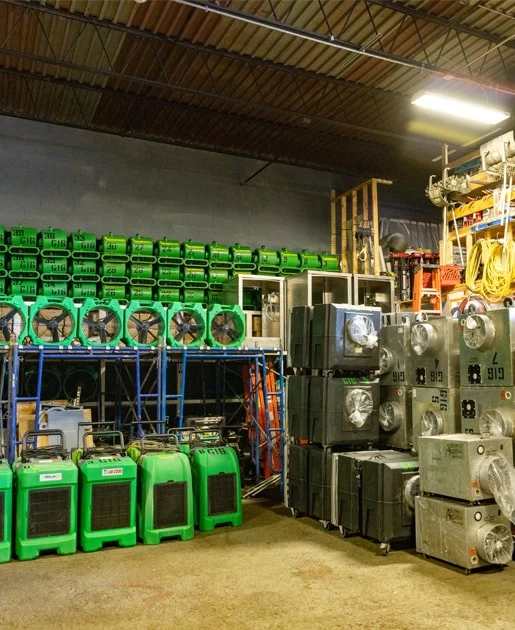
Once on site, our first step is assessment — not just what’s visible, but what the moisture meters and thermal imaging are telling us about the walls, subfloor, and foundation. Water in a pre-war basement doesn’t always stay where you can see it. It wicks into plaster, travels under original hardwood, and hides behind built-in cabinetry. Industrial extraction equipment pulls the standing water, and then the real drying process begins: commercial dehumidifiers, air movers, and targeted drying systems that work on a documented timeline, not a guess.
If the assessment turns up materials that require licensed handling — asbestos floor tiles disturbed by the flooding, lead paint on affected surfaces — that work happens before any restoration begins, in compliance with NYS DOL and USEPA regulations. Great Neck Estates has its own village building inspector, and any structural restoration work may require a village permit. We handle that process too. When the drying is complete and the clearance testing is done, the rebuild begins — new drywall, flooring, framing, and finishes — under the same contract. You don’t manage the handoff between contractors. We do.
Flooded Basement Cleaning, North Shore Long Island
What's Included When Your Great Neck Estates Basement Floods
Flooded basement cleanup in Great Neck Estates covers more ground than it does in most Nassau County towns, and that’s a direct result of the housing stock and the geography. Our service starts with water extraction and moisture mapping — using professional-grade equipment to document exactly where the water has traveled, not just where it’s standing. From there, structural drying runs on a monitored schedule with daily checks until the readings hit the target. No guessing, no “it looks dry enough.”
Because so many homes in Great Neck Estates were built before World War II, pre-work hazmat assessment is a standard part of our process here. Before any flooring, drywall, or plaster is disturbed, we assess for asbestos and lead-containing materials. If those materials are present and affected, licensed abatement happens first — NYS DOL for asbestos, USEPA RRP protocol for lead. This isn’t an upsell. It’s what the law requires, and it’s what protects your family and your home’s value.
Mold prevention treatment is applied to affected structural surfaces as part of every cleanup. If mold has already taken hold — which can happen within 24 to 48 hours of flooding — licensed mold remediation is handled under our NYS DOL Mold License, without bringing in a separate company. And when the remediation is complete, the rebuild is handled under our Nassau County General Contractor License. Finished basement, original architectural details treated with care, village permits pulled where required. The job is done when the basement is actually restored — not just when the water is gone.
Does homeowners insurance cover basement flooding in Great Neck Estates, NY?
It depends on the source of the water, and this is where a lot of Great Neck Estates homeowners get caught off guard. Standard homeowners insurance typically covers sudden and accidental water damage — a burst pipe, a failed water heater, an appliance malfunction. What it generally does not cover is natural flooding from groundwater, storm surge, or a rising water table. That type of coverage falls under separate flood insurance, usually through FEMA’s National Flood Insurance Program.
Here’s why that distinction matters specifically in Great Neck Estates: the Village of Great Neck’s own Building Inspector and Village Engineer have formally determined in local code that a large area of the village is prone to extensive basement flooding due to the water table, elevation, and soil conditions. If your basement floods during a heavy rain event and the source is groundwater coming up through the foundation — which is a documented, code-acknowledged risk in this area — your standard homeowners policy may deny the claim. Getting professional documentation of the water source from the moment cleanup begins is one of the most important things you can do for your insurance outcome. We help with that documentation process from the first hour on site.
How quickly does mold start growing after a basement floods?
Mold can begin growing within 24 to 48 hours of water exposure. The industry-standard window for preventing mold after a flood is 72 hours — meaning if the basement isn’t dried to professional standards within three days of the initial flooding event, mold remediation becomes a separate project on top of the water damage cleanup. That’s a significant cost difference and a significant health concern.
In Great Neck Estates, the chronic coastal humidity from Long Island Sound compounds this risk. Even in basements that haven’t experienced an acute flood, the persistent moisture that comes with living on a peninsula surrounded by water creates conditions where mold can establish in dark, warm spaces faster than it would in a drier inland environment. After an actual flooding event, that baseline humidity makes the 72-hour window even less forgiving. This is why 24/7 emergency response isn’t just a convenience — it’s the operational difference between preventing mold and remediating it.
What does flooded basement cleanup actually cost in Nassau County?
The honest range is wide because the variables are wide. A minor clean-water event in a small, unfinished basement might run $1,600 to $3,000. A contaminated water event — sewage backup, storm surge, or water that’s been sitting — in a larger finished basement can reach $10,000 to $12,000 or more for the cleanup alone, before any rebuild. FEMA estimates that just one inch of water can cause approximately $25,000 in property damage when you factor in structural and content losses.
For Great Neck Estates specifically, the pre-war housing stock adds variables that don’t apply in newer Nassau County communities. If asbestos floor tiles or lead paint are present and affected by the flooding, licensed abatement is required before restoration can proceed — and that’s a separate cost that needs to be scoped properly. Trying to cut corners on that step creates legal and health liability that costs far more in the long run. The most accurate number for your specific situation comes from an on-site assessment, which we provide as part of the emergency response.
Is it safe to be in my house while the basement is being cleaned up?
In most cases, yes — with some important caveats. If the flooding involved sewage backup or contaminated water, the basement area should be avoided entirely until it’s been properly cleaned and sanitized. Category 3 water, which includes sewage and floodwater that’s traveled through soil, carries bacteria and pathogens that make the space genuinely unsafe for occupants, particularly children and anyone with respiratory conditions or a compromised immune system.
The more specific concern for Great Neck Estates homes is the potential for airborne particles if asbestos-containing materials have been disturbed by the flooding. Pre-war homes built in the 1920s and 1930s commonly have asbestos in floor tiles, pipe insulation, and ceiling materials. If those materials are damaged or deteriorating, occupants should stay out of the affected area until a licensed assessment is completed. This isn’t a worst-case scenario framing — it’s a practical consideration for the housing stock that’s common in this village, and it’s one reason why having a contractor who holds the NYS DOL Asbestos License matters from the very first step of the cleanup.
Why is my Great Neck Estates basement flooding even when there's no burst pipe?
Because in Great Neck Estates, the ground itself is part of the problem. The village sits on a narrow peninsula with a shallow water table, and the village’s own Building Inspector and Village Engineer have formally noted in local ordinance that the combination of elevation, water table depth, and soil porosity makes basements in a large portion of the village prone to extensive flooding. What that means practically is that during sustained rainfall or a major storm, the water table rises and groundwater pushes up through foundation cracks, floor joints, and porous early-poured concrete — without any pipe failing and without any surface flooding visible from outside.
Homes built in the 1920s and 1930s weren’t engineered with modern waterproofing. Foundation walls in these homes are often fieldstone or early concrete, both of which are porous and not sealed to modern standards. Sump pump capacity and drainage provisions in many of these basements are minimal by today’s standards. A sump pump overwhelmed by volume, knocked out by a power outage during a storm, or simply past its service life is often the final link in the chain. If your basement has flooded without an obvious cause, groundwater emergence is the most likely explanation — and it’s a recurring risk, not a one-time event.
How long does the full flooded basement cleanup and restoration process take?
The water extraction itself typically takes a few hours depending on volume. The structural drying phase — the part that actually prevents mold and hidden moisture damage — generally runs three to five days with commercial equipment, and that timeline is monitored with daily moisture readings rather than estimated by eye. Rushing the drying phase is one of the most common mistakes in this industry, and it’s how hidden moisture ends up behind walls and under flooring, only to show up as mold six weeks later.
For Great Neck Estates homes, the full timeline from flooding to a restored basement depends on a few additional factors. If asbestos or lead abatement is required, that work follows its own regulatory timeline and must be completed and cleared before restoration begins. If the village building inspector requires a permit for structural work — which is possible given that Great Neck Estates has its own building department and active code enforcement — that process adds time to the rebuild phase. A finished basement in a pre-war Colonial with original details takes more care than a standard post-war renovation, and that’s accounted for in how we approach the work. A realistic full timeline from emergency response to completed restoration in a home like this is typically two to four weeks, depending on scope.