I needed a professional consultation explanation of procedure for safe removal of Asbestos in my apartment complex. Without having an account yet, I was very impressed with the caring, knowledgeable and generous advice offered by Jessica, and will look forward to doing business in the future. Thank you so much! I feel much more informed about a sometimes scary endeavor. Peace. Nancy Silva Mineola, NY.
Mia Munoz
Used this company to clean up some water flood in my house. They were fast and easy to work with.very professional, Would recommend to anyone!
Nini Valle
Great company, had a flood and they responded quickly and efficiently. Billed my insurance company directly. I highly recommend this company!
joe colapietro, jr
I had pipe freeze in my basement right before a snow storm and they made to within an hour to help start the clean up process. They we by our side throughout the entire process and even helped with the insurance company. They did such a great job with the cleanup, repair, remidiation, I contracted them to perform the repairs and finishes in the basement. They came with enough manpower and material to get the job done. Leo and Jessica were nothing but a pleasure to deal with!!
Cristian Arredondo c
I had some water damage in my home and Green Island was able to take care of my issue quickly and effectively. I am very pleased with the work they did. They responded quickly and were very professional.
Michael M
Outstanding service! From the office to the field crew everyone was friendly, helpful and responsive. I highly recommend Green Island Group.
Most neighborhoods flood after a bad storm. Hamilton Beach floods after a high tide. The civic association has documented tidal water pushing up to a foot into streets on a near-monthly basis. When your basement sits on what used to be Jamaica Bay marshland, the water table isn’t something you fight once. It’s something you manage. What that means for you is that the cleanup has to be done right the first time, because the next event may not be far off.
When we finish a flooded basement job in Hamilton Beach, you’re not just getting dry floors. You’re getting walls that have been checked for hidden moisture with thermal imaging, a basement that’s been properly dried to industry moisture standards not just surface-dry and a mold risk that’s been addressed before it becomes a problem you can smell. In a coastal environment with the ambient humidity levels Hamilton Beach carries year-round, mold can start colonizing inside wall cavities within 24 to 48 hours of a water event. That window is tighter here than it is in Flushing or Forest Hills.
The other outcome that matters: your insurance claim gets handled. Whether you’re working through a private carrier or an NFIP flood policy which many Hamilton Beach homeowners are required to carry given the FEMA Zone A designation the documentation, the adjuster communication, and the billing get managed on your behalf. You don’t have to become an expert in flood insurance paperwork on top of everything else.
Flooded Basement Remediation Company Hamilton Beach, NY
Licensed for the Work That Actually Needs to Be Done Here
After every major flood event in Hamilton Beach and there have been many since Sandy unlicensed contractors circulate through the neighborhood. Some do decent work. Some don’t. In New York State, any company performing mold assessment or remediation is legally required to hold an active NYS DOL Mold License. We hold that license, along with IICRC Water Damage certification, NYS DOL Asbestos certification, USEPA Lead, and USEPA RRP credentials. That last set matters here specifically: most of Hamilton Beach’s housing stock was built between 1940 and 1969, and those homes commonly contain asbestos pipe insulation and lead-based materials in the basement. A flood can disturb all of it.
We’ve served Hamilton Beach and the broader Howard Beach area with an established local presence not as a franchise that showed up after a storm and will disappear before the next one. Our team operates 24 hours a day, seven days a week, and handles the full scope of recovery from water extraction through complete reconstruction, under one roof, with one point of contact.
Basement Flooding Remediation Process Hamilton Beach, NY
From Standing Water to Finished Basement Here's the Whole Picture
The first thing that happens when you call is a rapid response not a callback window, an actual response. Hamilton Beach is accessible by one road, via the Hamilton Beach Bridge on 104th Street, and we know that. Getting to a peninsula with a single access point during or after a flooding event requires familiarity with the area, not a GPS guess. Once on-site, the priority is stopping the damage from compounding. Water gets extracted, and the scope of the intrusion gets assessed including areas you can’t see. Thermal imaging identifies moisture inside wall assemblies and under flooring that looks dry on the surface but isn’t.
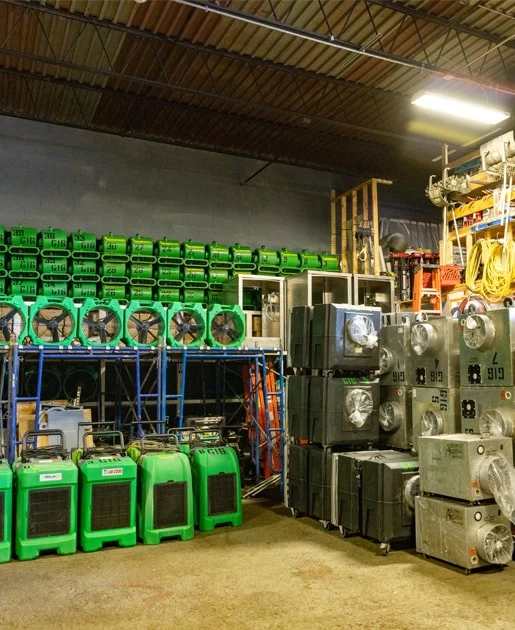
From there, commercial drying equipment goes in. This isn’t box fans it’s industrial air movers and dehumidifiers calibrated to the moisture readings taken during the assessment. In Hamilton Beach’s naturally humid coastal environment, drying timelines need to account for ambient conditions that are different from inland neighborhoods. Once the structure reaches target moisture levels, any mold risk is addressed under our NYS DOL Mold License. If hazardous materials asbestos tile, pipe insulation, lead paint are disturbed during the process, we handle those in-house under the appropriate certifications rather than stopping the job and telling you to find someone else.
The final phase is reconstruction. Damaged drywall, flooring, and structural elements get rebuilt to finished condition. One company, one job, start to finish.
Flooded Basement Cleaning Services Hamilton Beach, NY
What's Actually Included When Hamilton Beach Calls Us
Flooded basement cleanup in Hamilton Beach isn’t a single service it’s a sequence of them, and the sequence matters. The work starts with emergency water extraction using truck-mounted and portable equipment capable of handling the volume that a tidal surge or storm event produces. That’s followed by structural drying, moisture mapping, and a full mold assessment conducted under New York State’s required licensing. Because Hamilton Beach sits in FEMA Zone A and many homes here carry NFIP flood policies, every job includes thorough damage documentation the kind that holds up with adjusters and supports a full claim, not just a ballpark estimate.
For homes on Davenport Court, Russell Street, or Stanton Road where the original bungalow and cottage construction from the mid-20th century is still standing the scope often includes hazardous materials evaluation. Asbestos floor tiles, pipe insulation, and lead-based paint are common in pre-1980 construction throughout Hamilton Beach, and a basement flood can expose all of it. Our certifications cover that work legally and completely, so the job doesn’t stall when those materials turn up.
Reconstruction is included in our full-service scope. Whether it’s drywall, subfloor, framing, or finish work, the basement gets brought back to livable condition not just dried out and handed back to you as a gutted shell. For a community that has been managing chronic flooding for decades and is still waiting on the Army Corps of Engineers’ Spring Creek South project, getting the job done completely the first time is the only standard that makes sense.
Does homeowners insurance actually cover a flooded basement in Hamilton Beach?
It depends on the source of the water, and in Hamilton Beach, that distinction is critical. Standard homeowners insurance typically covers sudden, accidental water damage like a burst pipe or an appliance failure. It does not cover flooding from an external source, which includes tidal surges, storm surge, and rising groundwater. That kind of damage falls under flood insurance, which is a separate policy.
Because Hamilton Beach sits in FEMA Zone A a Special Flood Hazard Area many homeowners here are required to carry a flood insurance policy through the National Flood Insurance Program as a condition of their mortgage. NFIP claims average around $52,000, and they come with specific documentation requirements that differ from a standard homeowners claim. We handle the documentation, assessment reports, and adjuster communication directly, so you’re not navigating that process alone while also dealing with a flooded basement.
How quickly does mold actually start growing after a basement floods?
The industry standard answer is 24 to 72 hours, but in Hamilton Beach, the lower end of that range is more relevant. The neighborhood’s waterfront location along Jamaica Bay means ambient humidity levels run consistently higher than in inland Queens neighborhoods. Higher baseline humidity accelerates the conditions mold needs to establish itself particularly inside wall cavities, under flooring, and in any porous material that absorbed water during the event.
What that means practically is that waiting to see if things dry out on their own is a costly decision. Mold remediation added after the fact once colonies are visible or air quality is affected adds thousands of dollars to the total job cost. The faster professional drying equipment goes in, the more you contain the damage. Calling immediately after a flood event, rather than waiting a day or two, is genuinely the most cost-effective decision you can make.
My Hamilton Beach home was built in the 1950s does that change anything about the cleanup?
Yes, and it’s worth knowing before anyone starts pulling up flooring or cutting into walls. Homes built before 1980 in Hamilton Beach which covers the majority of the neighborhood’s housing stock commonly contain asbestos in floor tiles, pipe insulation, and ceiling materials, as well as lead-based paint on walls and trim. A basement flood can disturb all of these materials, and once disturbed, they require licensed handling under New York State and federal regulations.
We hold NYS DOL Asbestos certification, USEPA Lead certification, and USEPA RRP credentials. When these materials are encountered during a flooded basement cleanup, the work doesn’t stop it continues under the appropriate protocols. Many water damage companies are not equipped or licensed for this, which means they’ll stop the job and refer you elsewhere when hazardous materials turn up. That handoff costs you time and money. Having a company that can handle the full scope from the start is especially important in a neighborhood where older construction is the norm, not the exception.
What's the difference between tidal flooding and regular basement water damage?
It’s a meaningful difference, and it affects how the cleanup needs to be approached. A burst pipe or heavy rain event introduces relatively clean water Category 1 or Category 2 in restoration industry terms. Tidal flooding from Jamaica Bay introduces saltwater mixed with whatever is in the bay and the surrounding storm drain system, which can include sewage, sediment, and other contaminants. That’s Category 3 water, and it requires a more thorough decontamination process than standard water damage.
In Hamilton Beach, where tidal flooding pushes bay water into streets and, in the lowest-lying homes, into basements on a near-monthly basis, the contamination profile of a flooded basement is often more serious than it looks. Surfaces that appear to just need drying may need full decontamination first. This is one of the reasons why calling a company that understands the specific flooding conditions in this neighborhood not just water damage in general makes a practical difference in how the job gets done and whether the results hold up.
How long does a full flooded basement cleanup and restoration take?
The honest answer is that it varies based on how much water came in, how long it sat before extraction began, and what the scope of the damage looks like once drying is underway. A straightforward water extraction and structural drying job typically takes three to five days to reach target moisture levels. If mold remediation is needed, add time for that process. If reconstruction is involved replacing drywall, subfloor, or framing the full timeline can extend to two to three weeks depending on the scope.
In Hamilton Beach, one of the variables that affects timing is the home itself. Older bungalows and cottages with crawl spaces or low-clearance basements require different equipment positioning and airflow management than a standard full-height basement. Homes that have flooded before may have pre-existing moisture damage that extends the drying timeline. The assessment done at the start of the job gives you a realistic picture of what to expect not a generic estimate that gets revised every few days.
Why do so many Hamilton Beach homeowners end up calling a second company after the first one finishes?
Usually because the first company only did part of the job. A lot of water damage companies handle extraction and drying, but they’re not licensed for mold remediation in New York State, not certified to handle hazardous materials, and not set up to do reconstruction. So the homeowner ends up coordinating three separate contractors, managing three separate timelines, and dealing with gaps in accountability when something doesn’t get done right.
In a neighborhood like Hamilton Beach where flooding isn’t a one-time event, where older homes regularly turn up asbestos or lead during a cleanup, and where NFIP claims require thorough documentation the fragmented approach is especially costly. We handle the entire scope: extraction, drying, mold remediation, hazardous materials abatement, insurance documentation, and full reconstruction. For a homeowner commuting 45-plus minutes into the city each day, not having to manage multiple contractors across a weeks-long recovery isn’t a luxury it’s the only version of this process that’s actually manageable.