When the Nissequogue Rises, Your Hauppauge Basement Shouldn't Pay for It
Hauppauge sits on some of the highest water table ground on Long Island and your basement feels it every time the sky opens up. We respond within the hour, handle your insurance claim directly, and clear the water before the mold clock runs out.
I needed a professional consultation explanation of procedure for safe removal of Asbestos in my apartment complex. Without having an account yet, I was very impressed with the caring, knowledgeable and generous advice offered by Jessica, and will look forward to doing business in the future. Thank you so much! I feel much more informed about a sometimes scary endeavor. Peace. Nancy Silva Mineola, NY.
Mia Munoz
Used this company to clean up some water flood in my house. They were fast and easy to work with.very professional, Would recommend to anyone!
Nini Valle
Great company, had a flood and they responded quickly and efficiently. Billed my insurance company directly. I highly recommend this company!
joe colapietro, jr
I had pipe freeze in my basement right before a snow storm and they made to within an hour to help start the clean up process. They we by our side throughout the entire process and even helped with the insurance company. They did such a great job with the cleanup, repair, remidiation, I contracted them to perform the repairs and finishes in the basement. They came with enough manpower and material to get the job done. Leo and Jessica were nothing but a pleasure to deal with!!
Cristian Arredondo c
I had some water damage in my home and Green Island was able to take care of my issue quickly and effectively. I am very pleased with the work they did. They responded quickly and were very professional.
Michael M
Outstanding service! From the office to the field crew everyone was friendly, helpful and responsive. I highly recommend Green Island Group.
Water in your basement is not just an inconvenience. It is a 24-to-48-hour countdown before mold starts growing behind your walls, inside your insulation, and under your flooring and in Hauppauge, where most homes were built in the late 1960s, that insulation may already contain asbestos. Disturbing it without the right licensing does not fix the problem. It creates a new one.
What you actually get when the job is done right is a basement that has been fully extracted, dried with calibrated equipment, tested for hidden moisture behind walls, and cleared of any hazardous materials that the water disturbed. That is a different outcome than a crew showing up with fans and calling it done in an afternoon.
For homeowners in Hauppauge specifically, the groundwater situation matters. The Nissequogue River runs through this hamlet, and the “Northeast Branch of the Nissequogue River Basin” is a documented flooding zone not a hypothetical one. Your home sits in an area where water can push up through a basement slab even when the street outside looks completely dry. Knowing that changes how the cleanup needs to be done, and it changes what questions you should be asking the company you hire.
State-Vetted, Locally Present, and Fully Licensed for What's Behind Your Hauppauge Walls
We have been completing environmental restoration and water damage projects across Nassau and Suffolk Counties for over 12 years, with more than 5,000 completed projects across New York State. We already serve South Hauppauge and East Hauppauge, so when you call, we are not figuring out the area we know it.
What separates us from the franchise locations operating in western Suffolk is the licensing stack. We hold NYS DOL Asbestos, NYS DOL Mold, USEPA Lead, and USEPA RRP certifications which means we can legally and safely handle every hazard that a flooded basement in a pre-1980 Hauppauge home might uncover. Most water damage companies cannot say that, and most homeowners do not find out until after the crew has already left.
New York State has also approved us as an emergency response contractor through the NYS Office of General Services. That is an independent, third-party vetting process not a badge we gave ourselves. Our CEO Jessica Dussan and VP Leo Torres are personally involved in projects and appear by name in customer reviews. When accountability matters, that is what it looks like.
From Standing Water to Structural Dryness Here Is Our Actual Process
The first thing that happens when we arrive is an assessment not just of the visible water, but of where it came from and what it may have touched. In Hauppauge, where the median home was built in 1969, that means checking for disturbed pipe insulation, floor tile adhesive, and wall materials that may contain asbestos or lead before any demolition work begins. Skipping this step is how a water cleanup turns into a hazmat situation nobody budgeted for.
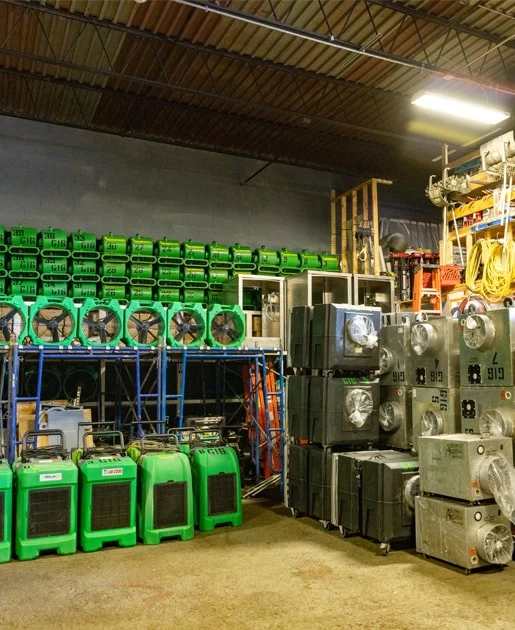
Once the assessment is complete, we extract the standing water using commercial-grade equipment and set industrial drying systems to begin pulling moisture from the structure itself not just the surface. We use thermal imaging cameras and calibrated moisture meters to map every area of intrusion, including wall cavities and subfloor materials that look dry but are not. This documentation also serves as evidence for your insurance claim, which we handle directly with your carrier.
If mold is found and after a flooding event in a Suffolk County home, it often is remediation is performed under our NYS DOL Mold license before any reconstruction begins. If structural repairs are needed, our General Contractor license for Suffolk County covers the full rebuild, whether your home sits on the Islip side or the Smithtown side of Townline Road. One company, one contract, start to finish.
Basement Flooding Remediation Services Hauppauge NY
Full-Scope Cleanup Built for Hauppauge's Older Housing Stock
Flooded basement cleanup in Hauppauge is not a one-size job. We provide emergency water extraction, structural drying, moisture mapping, sewage backup decontamination, mold remediation, asbestos and lead assessment, and full reconstruction all under one roof. You do not coordinate multiple contractors or manage separate insurance claims for each trade. We handle it as a single, documented project.
The asbestos and lead component is not a small detail for this community. Homes built before 1978 may contain lead-based paint in walls and trim. Homes built before 1980 which describes the majority of Hauppauge’s housing stock may have asbestos in pipe insulation, floor tile, ceiling tile, and duct wrapping. Under New York State’s Industrial Code Rule 56 and Article 32 mold law, this work must be performed by licensed contractors. We are licensed. Most competitors serving this area are not.
For commercial property owners and managers in the Long Island Innovation Park where many buildings date to the 1960s and 1970s the same rules apply, and the documentation requirements for commercial insurance claims add another layer of complexity. We have handled commercial restoration projects at that scale before, and we carry the environmental licensing to do it correctly. Whether it is a residential basement off Veterans Memorial Highway or a commercial space in the Innovation Park, the process is thorough, documented, and done right.
Why does my Hauppauge basement keep flooding even when it barely rains?
Hauppauge’s name literally comes from an Algonquian word meaning “land of sweet water” and that is not just a historical footnote. The hamlet sits above a network of underground springs and a notably high water table, and the Nissequogue River runs directly through the community. Researchers have specifically named the Northeast Branch of the Nissequogue River Basin as a documented groundwater flooding zone where hundreds of homes have been impacted.
What that means practically is that your basement can take in water from hydrostatic pressure pushing up through the slab or through foundation wall cracks even when there is no storm event and no surface flooding visible outside. This is especially common in spring when snowmelt and rain combine to saturate the ground faster than it can drain. If your basement floods repeatedly with no obvious source, groundwater intrusion is the most likely explanation, and it requires a different response than a burst pipe or appliance leak. A proper assessment will identify the entry points and help you understand what a long-term solution looks like.
How quickly does mold start growing after a basement flood in New York?
Mold can begin growing within 24 to 48 hours of water exposure and that timeline does not pause while you figure out who to call or wait for an insurance adjuster to schedule a visit. In a humid Long Island summer, the conditions are already favorable before the flood even happens. Once water gets into drywall, insulation, or subfloor material, the clock is running whether you can see anything yet or not.
The reason this matters so much in Hauppauge specifically is the housing stock. Homes built in the 1960s and 1970s often have fiberglass batt insulation in basement walls that absorbs moisture quickly and holds it for a long time. By the time visible mold appears on the surface, the colony behind the wall has often been growing for days. Getting extraction and drying started within the first few hours significantly reduces the likelihood of a full mold remediation project on top of the water damage cleanup and that is a meaningful cost difference, often $2,000 to $8,000 or more.
Does homeowners insurance cover basement flooding in Hauppauge, NY?
It depends on the cause, and the distinction matters. Standard homeowners insurance typically covers sudden and accidental water damage a burst pipe, a failed sump pump, an appliance leak. It generally does not cover flooding caused by groundwater seepage or rising surface water, which requires a separate flood insurance policy through the National Flood Insurance Program (NFIP).
For Hauppauge homeowners, this is a real distinction because the area’s most common flooding cause groundwater rising through the slab due to the high water table may fall outside standard policy coverage. That said, many homeowners do not know exactly what their policy covers until they file a claim, and the documentation you provide at that moment determines a lot. We photograph all damage, create moisture maps, and communicate directly with your insurance adjuster as part of every project. We bill your carrier directly, which means you are not fronting the cost and waiting for reimbursement while your basement is still being dried out.
My Hauppauge home was built in the 1960s should I be worried about asbestos during cleanup?
Yes, and it is worth taking seriously. Homes built before 1980 which covers the vast majority of Hauppauge’s housing stock, given the median construction year of 1969 commonly contain asbestos in pipe insulation wrapping, vinyl floor tiles, ceiling tiles, and duct tape used on HVAC systems. Lead-based paint is also common in homes built before 1978, particularly in walls, trim, and door frames.
When a basement floods, the water does not stay neatly on the floor. It wicks into walls, disturbs insulation, and can loosen floor tile adhesive. If those materials contain asbestos or lead, disturbing them without proper protocols creates a hazmat situation. Under New York State’s Industrial Code Rule 56, asbestos removal must be performed by a licensed contractor and under Article 32, mold remediation above a certain threshold also requires a licensed remediator. We hold both licenses, along with USEPA Lead and RRP certifications. We assess for these hazards before any demolition work begins, so you are not discovering the problem after the fact.
What is the difference between water extraction and actually drying out a basement?
Water extraction removes the standing water the visible puddles on the floor. Structural drying is what happens next, and it is the part that most homeowners do not realize is a separate, multi-day process. Even after the floor looks dry, moisture remains inside wall cavities, inside insulation, under flooring, and in the concrete slab itself. If that moisture is not removed with industrial drying equipment, it creates the conditions for mold growth and long-term structural damage.
The way to know whether drying is actually complete not just visually dry is through calibrated moisture meters and thermal imaging. These tools detect moisture levels inside walls and subfloor materials that you cannot see or feel. In a Hauppauge home where the basement walls may be concrete block with fiberglass insulation behind drywall, surface dryness can be completely misleading. A professional drying process involves setting the right equipment in the right locations, monitoring moisture readings over several days, and not calling the job done until the readings confirm structural dryness throughout the affected area.
How bad was the 2024 Blydenburgh dam failure, and could something like that happen again?
The August 2024 failure of the Blydenburgh Pond dam in Blydenburgh County Park was a significant event for the Hauppauge and Smithtown area. The dam which had stood since 1798 failed during Hurricane Ernesto, releasing hundreds of thousands of gallons of water into the Nissequogue River. The river overflowed its banks, flooding homes and streets throughout the area. Suffolk County Executive Ed Romaine called it a major catastrophe. Smithtown Town Hall itself took on nearly four feet of water in its basement.
What that event demonstrated is that basement flooding in Hauppauge is not always something you can predict or prevent at the property level. Infrastructure that had been stable for over two centuries failed under extreme weather, and the flooding affected entire neighborhoods at once not just individual homes with aging sump pumps or cracked foundations. As Long Island continues to see more intense storm events, the Nissequogue River watershed remains a real risk factor for this community. The practical takeaway for homeowners is that having a reliable, licensed restoration contractor you can call immediately before the water has time to set in is not an overreaction. It is the most useful thing you can do to protect a home in this market.