When Your Hicksville Basement Floods, We Respond Before Mold Does
Nassau County’s water table doesn’t care about your schedule. When your basement floods, Green Island Group responds 24/7 — before mold gets a foothold.
I needed a professional consultation explanation of procedure for safe removal of Asbestos in my apartment complex. Without having an account yet, I was very impressed with the caring, knowledgeable and generous advice offered by Jessica, and will look forward to doing business in the future. Thank you so much! I feel much more informed about a sometimes scary endeavor. Peace. Nancy Silva Mineola, NY.
Mia Munoz
Used this company to clean up some water flood in my house. They were fast and easy to work with.very professional, Would recommend to anyone!
Nini Valle
Great company, had a flood and they responded quickly and efficiently. Billed my insurance company directly. I highly recommend this company!
joe colapietro, jr
I had pipe freeze in my basement right before a snow storm and they made to within an hour to help start the clean up process. They we by our side throughout the entire process and even helped with the insurance company. They did such a great job with the cleanup, repair, remidiation, I contracted them to perform the repairs and finishes in the basement. They came with enough manpower and material to get the job done. Leo and Jessica were nothing but a pleasure to deal with!!
Cristian Arredondo c
I had some water damage in my home and Green Island was able to take care of my issue quickly and effectively. I am very pleased with the work they did. They responded quickly and were very professional.
Michael M
Outstanding service! From the office to the field crew everyone was friendly, helpful and responsive. I highly recommend Green Island Group.
When you get home from the LIRR and find water in your basement, the clock is already running. Mold can begin establishing within 24 to 48 hours of water exposure — and the critical window for stopping it is 72 hours from when the flooding started, not when you discovered it. Every hour between then and now matters.
Hicksville’s housing stock makes this especially important. About 90% of homes here were built before 1970 — capes, ranches, and splits with original plumbing, aging foundations, and basement materials that absorb water invisibly. What looks dry to the eye can be saturated inside the wall framing, under the subfloor, or behind old fiberglass insulation for days. That hidden moisture is exactly where mold takes hold, and it’s exactly what gets missed when someone shows up with just a wet-vac and a dehumidifier.
The right outcome isn’t just a dry floor. It’s a basement that’s been fully assessed, properly dried at the structural level, treated to prevent mold, and documented so your insurance claim has real support. That’s what a complete cleanup looks like — and it’s the difference between solving the problem and just moving the water around.
The License Stack That Sets Us Apart in Hicksville
Green Island Group is a full-service disaster restoration and environmental remediation company serving Nassau County, Suffolk County, and the greater New York metro area. When it comes to flooded basement cleanup in Hicksville, the credentials matter more than most homeowners realize — and we hold all of them.
New York State requires a dedicated Department of Labor mold license to legally perform mold remediation. We hold it. We also hold NYS DOL Asbestos Contractor licensure, USEPA Lead and RRP certifications, IICRC Water Damage Restoration certification, and General Contractor licenses for Nassau County, Suffolk County, and NYC. In a pre-1978 home — which describes roughly 90% of Hicksville — a flooded basement can disturb asbestos floor tiles, lead paint, and pipe insulation. Most cleanup companies aren’t licensed to handle that. We are.
From Old Country Road to the neighborhoods near the Plainview border, we’ve worked in Hicksville homes and know how water moves through this specific housing stock. One call covers everything from extraction to rebuild — no coordinating multiple contractors, no gaps in accountability.
What Happens From Your First Call to Final Walkthrough
When you call, you’re not reaching a national call center. You’re talking to someone who can dispatch a crew immediately — day or night. Given that Hicksville is one of the busiest LIRR commuter hubs on Long Island, a lot of homeowners discover basement flooding after 6 PM. Our 24/7 availability means a crew can be on the way before you’ve even pulled into your driveway.
Once on site, the first step is assessment — not just looking at what’s visible, but using thermal imaging and professional moisture meters to find saturation inside walls, under floors, and in structural cavities. In a 1950s Hicksville home, water doesn’t just sit on the floor. It wicks into wood framing, concrete block, and older insulation materials in ways that aren’t obvious without the right equipment. We also identify the water source — whether it’s Nassau County’s high water table pushing through the foundation, a burst pipe in an aging plumbing system, a sump pump failure, or a sewage backup — because the category of water determines the entire cleanup protocol.
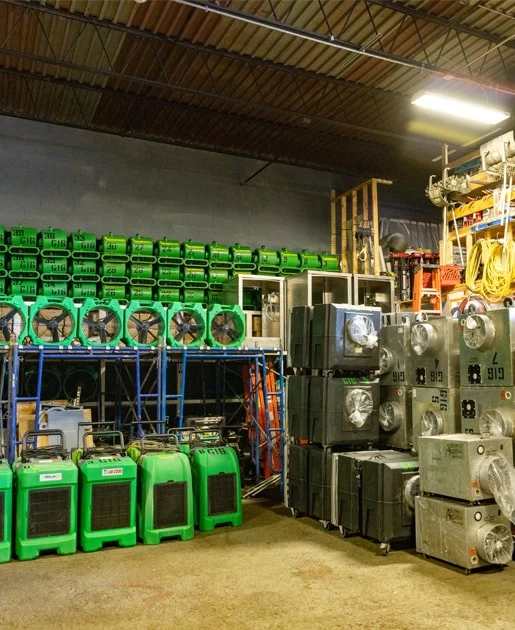
From there, we deploy industrial extraction equipment to remove standing water, followed by commercial-grade drying equipment staged throughout the space. Mold inhibitor treatments are applied during the drying phase. Any structural elements that need repair or replacement — framing, drywall, flooring — are handled by us directly under our Nassau County General Contractor license. Everything is documented throughout for your insurance claim. When the job is done, you walk through it together.
Built for What Hicksville Basements Actually Deal With
Nassau County’s shallow water table is one of the most common — and most underestimated — drivers of basement flooding in Hicksville. During heavy rain events, groundwater can rise to the level of your foundation and seep in through floor-wall joints, pipe penetrations, and hairline cracks that have been there for decades. It’s not dramatic. It’s slow, quiet, and often dismissed as minor until the damage is already done inside your walls.
Our flooded basement cleanup service covers the full range of what Hicksville homeowners actually face: water table infiltration, burst pipes in aging plumbing systems, sump pump failures, appliance leaks, storm drainage backups, and Category 3 sewage backups — which require full biohazard decontamination protocols, not just extraction. For homes built before 1978, our service includes licensed assessment and handling of asbestos-containing materials and lead paint that may have been disturbed by the water. That’s not a standard offering from most restoration companies operating in this area. It’s a legal requirement in New York State, and we’re licensed to do it properly.
All work is performed under our Nassau County General Contractor license, which means structural repairs — framing, drywall, flooring, insulation replacement — are handled in-house without subcontracting. The entire job is documented with photos, moisture readings, and written reports to support your homeowners insurance claim from start to finish.
What actually causes basement flooding in Hicksville, NY homes?
Hicksville sits in a part of Nassau County where the water table is naturally shallow. During periods of heavy or sustained rainfall, groundwater can rise to the level of your foundation and push through cracks, floor-wall joints, and gaps around utility pipes — even in a basement that has never flooded before. This isn’t a plumbing failure. It’s a hydrostatic pressure issue, and it’s one of the most common flooding causes in this area.
Beyond the water table, Hicksville’s older housing stock plays a big role. About 90% of homes here were built before 1970, which means aging plumbing systems prone to freeze-burst events in winter, sump pumps that may be original to the home or undersized for modern storm volumes, and foundation waterproofing that has long since degraded. Storm drainage backups during heavy rain events are also a documented issue in Nassau County — when the municipal system gets overwhelmed, water can back up through floor drains and sump discharge lines. Knowing the source matters because it determines what kind of cleanup is actually required.
Does homeowners insurance cover a flooded basement in Nassau County?
It depends on what caused the flooding, and this is one of the most common points of confusion for Hicksville homeowners. Standard homeowners insurance typically covers sudden and accidental water events — a burst pipe, a failed water heater, an appliance leak. It does not cover flooding caused by groundwater, rising water tables, or storm drainage backup, which are among the most common causes of basement flooding in Hicksville. That type of flooding requires separate flood insurance through the National Flood Insurance Program or a private flood policy.
The tricky part is that many homeowners don’t know which category their flooding falls into until after the fact. We document the source and category of the flooding as part of the assessment process and provide written reports that support your insurance claim — whether it’s covered under homeowners insurance or flood insurance. If you’re unsure what you have or what’s covered, that documentation gives you something concrete to bring to your insurer rather than trying to describe what happened from memory.
How quickly does mold grow after a basement flood on Long Island?
Mold can begin to establish within 24 to 48 hours of water exposure under the right conditions — and basements in older Hicksville homes tend to create exactly those conditions. Limited natural ventilation, older building materials that absorb and hold moisture, and the kind of persistent humidity that comes with Nassau County’s climate all accelerate mold development once water gets into the structure.
The 72-hour window is the benchmark we work against. If a basement is fully dried within 72 hours of the flooding event, mold growth is unlikely. Beyond that window, the scope of the job expands significantly — and so does the cost. The important thing to understand is that the clock starts when the flooding began, not when you discovered it. If you’re a commuter who came home to a flooded basement after a full workday, you may already be 10 to 12 hours into that window. Calling immediately — even from the train — is the right move.
My Hicksville home was built in the 1950s — does that affect the cleanup process?
Yes, and it’s one of the most important questions to ask before hiring any restoration company. Homes built before 1978 may contain asbestos in floor tiles, pipe insulation, ceiling tiles, and joint compound. They may also have lead paint on surfaces throughout the home, including in the basement. When a basement floods, water can disturb and spread these materials — creating a hazard that goes well beyond water damage.
In New York State, handling asbestos-containing materials requires a NYS Department of Labor Asbestos Contractor license. Working in a pre-1978 home where lead paint may be disturbed requires USEPA Lead and RRP certification. These are legal requirements, not optional credentials. We hold both, along with our NYS DOL Mold Remediator license and IICRC Water Damage Restoration certification. Many restoration companies operating in Hicksville do not hold the full suite of licenses required for a pre-1970 home. Before you hire anyone, ask specifically which licenses they hold — not just whether they’re “certified.”
How long does flooded basement cleanup take, and when can I use the space again?
For a straightforward water event — clean water from a burst pipe or appliance failure in an unfinished basement — the drying process typically takes three to five days with commercial-grade equipment running continuously. The space is generally safe to re-enter during that time, though the equipment will be running and the area will be disrupted.
More complex situations take longer. If the flooding involved sewage backup, the space requires full Category 3 biohazard decontamination before it’s safe to re-enter, and that adds time. If structural materials — framing, drywall, insulation, flooring — were saturated and need to be removed and replaced, the timeline extends into weeks depending on the scope. In a finished Hicksville basement, that rebuild phase is handled by us directly under our Nassau County General Contractor license, which means you’re not waiting on a second contractor to become available before work can resume. The full timeline is discussed during the initial assessment so you know what to expect before anything starts.
Is sewage backup in a Hicksville basement something I can clean up myself?
No. Sewage backup is classified as Category 3 water, which means it contains bacteria, viruses, and pathogens that pose a genuine health risk. Nassau County’s aging sewer infrastructure and the density of Hicksville’s residential neighborhoods make sewer line backups a real and recurring issue, particularly during heavy rain events when the municipal system gets stressed. What ends up in your basement is not just dirty water.
DIY cleanup of a sewage backup — even with protective gear and store-bought disinfectants — does not meet the decontamination standard required to make the space safe. Proper Category 3 cleanup requires licensed biohazard handling protocols, commercial-grade antimicrobial treatments, and thorough testing before the space is cleared for re-entry. Attempting to clean it yourself also creates documentation problems if you later need to file an insurance claim, since there’s no professional record of what was found, how it was treated, or what the post-remediation conditions were. Call a licensed contractor first. The health risk and the financial risk both point in the same direction.