When Hollow Brook's Legacy Shows Up in Your Basement
Holbrook was literally named for the water that ran through it and that relationship with groundwater hasn’t changed. If your basement is flooded, we respond in under an hour, handle your insurance, and clean up everything.
I needed a professional consultation explanation of procedure for safe removal of Asbestos in my apartment complex. Without having an account yet, I was very impressed with the caring, knowledgeable and generous advice offered by Jessica, and will look forward to doing business in the future. Thank you so much! I feel much more informed about a sometimes scary endeavor. Peace. Nancy Silva Mineola, NY.
Mia Munoz
Used this company to clean up some water flood in my house. They were fast and easy to work with.very professional, Would recommend to anyone!
Nini Valle
Great company, had a flood and they responded quickly and efficiently. Billed my insurance company directly. I highly recommend this company!
joe colapietro, jr
I had pipe freeze in my basement right before a snow storm and they made to within an hour to help start the clean up process. They we by our side throughout the entire process and even helped with the insurance company. They did such a great job with the cleanup, repair, remidiation, I contracted them to perform the repairs and finishes in the basement. They came with enough manpower and material to get the job done. Leo and Jessica were nothing but a pleasure to deal with!!
Cristian Arredondo c
I had some water damage in my home and Green Island was able to take care of my issue quickly and effectively. I am very pleased with the work they did. They responded quickly and were very professional.
Michael M
Outstanding service! From the office to the field crew everyone was friendly, helpful and responsive. I highly recommend Green Island Group.
Standing water is the part you can see. What you can’t see is the moisture that’s already moved into your walls, under your flooring, and behind the insulation and in Holbrook, where the water table sits naturally high and the soil holds water against your foundation, that hidden saturation is almost always there. A basement that looks dry to the naked eye can still be reading 40% moisture content inside the wall cavity. That’s where mold starts.
Most homes in Holbrook were built in the 1950s, ’60s, and ’70s. That means your basement walls, floor tiles, and pipe insulation may contain asbestos or lead materials that are completely harmless when left alone, but become a real problem the moment a flood forces demolition. Most water damage companies aren’t licensed to deal with that. They clean up what they can see and leave the rest for someone else to figure out.
When the job is done right, you get more than a dry floor. You get documented moisture readings, cleared air quality, and a basement that’s actually safe not just visually clean. For a home worth over half a million dollars in Holbrook, that difference matters.
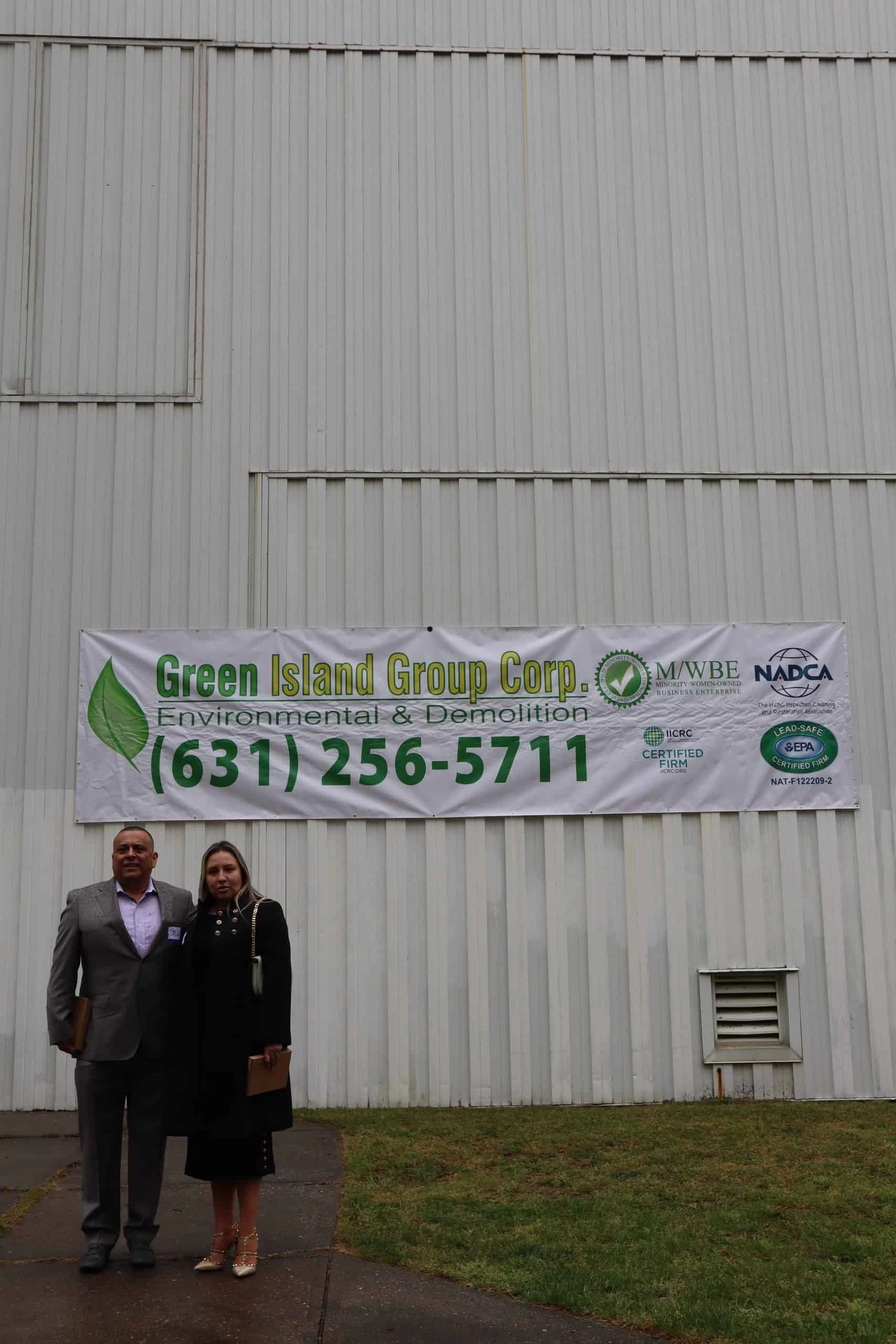
We are an approved emergency response contractor for the NYS Office of General Services. That’s not a marketing badge it means the State of New York independently reviewed our licensing, our track record, and our capabilities before putting us on that list. No competitor showing up in Holbrook search results holds that designation.
Led by CEO Jessica Dussan and VP Leo Torres both named by real customers in real reviews Green Island Group has completed more than 5,000 restoration projects across New York State over 12-plus years. We hold General Contractor licenses covering both the Town of Islip and Town of Brookhaven, which matters in Holbrook specifically because your home may fall under either jurisdiction depending on which side of the LIRR tracks you’re on.
We’re also NYS certified as both a Minority Business Enterprise and a Woman-Owned Business Enterprise. When you call us, you’re calling a company with named leadership, verified credentials, and a real track record not a franchise that opened a few years ago.
From the Call to the Final Clearance Here's Exactly What Happens
It starts with a phone call that actually gets answered. We operate 24/7, and when you call about a flooded basement in Holbrook, someone picks up not a voicemail, not an answering service that schedules a callback for tomorrow morning. We arrive in under an hour, assess the situation, and tell you exactly what you’re dealing with before any work begins.
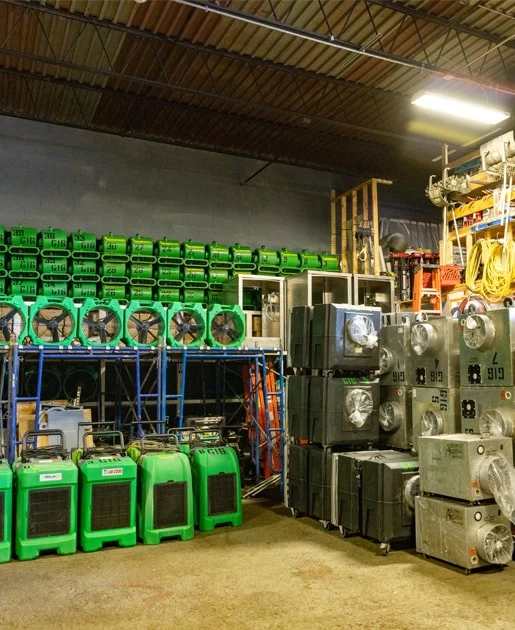
The first priority is stopping the source and extracting the standing water. From there, we use industrial-grade drying equipment and moisture meters to map where saturation has traveled inside your walls and subfloor because in a central Suffolk County home sitting on glacial outwash with clay underneath, water doesn’t just sit on the surface. It moves. We monitor moisture readings daily until structural drying is complete, and we don’t call a job done based on how it looks we call it done based on what the numbers say.
If your home was built before 1980 and the flood has disturbed finished materials, we’ll assess for asbestos and lead before any demolition happens. That step protects your family and keeps the job legally compliant under New York State law. Once remediation is complete, we handle reconstruction under the same contract and we bill your insurance directly throughout the entire process, coordinating with your adjuster so you’re not stuck in the middle.
One Company Handles It All Water, Mold, Hazmat, Rebuild
A flooded basement in Holbrook isn’t always just a water problem. Depending on the source a failed sump pump, hydrostatic pressure seeping through the foundation, a cracked clay sewer lateral, or a burst pipe during a January freeze the cleanup scope can vary significantly. We are equipped to handle all of it under one contract, which means you’re not managing three separate vendors while your basement sits wet.
Water extraction and structural drying are the foundation of every job. Beyond that, we carry NYS DOL Mold and Asbestos licenses, USEPA Lead and RRP certifications, and General Contractor licenses covering both municipal jurisdictions within Holbrook Town of Islip for most residential addresses, and Town of Brookhaven for homes north of the LIRR Main Line. That dual-jurisdiction licensing means we can pull permits and complete reconstruction without handing the job off to someone else.
Sewage backup is treated as the Category 3 biohazard event it actually is full containment, OSHA-compliant protocols, and proper disposal. For older Holbrook homes where cast iron and clay sewer lines have been in the ground for 50 or 60 years, backup events are not uncommon, especially during heavy rain when the municipal system gets overwhelmed. Whatever the source, whatever the scope, we document everything for your insurance claim and handle the billing directly.
Why does my Holbrook basement keep flooding even without heavy rain?
This is one of the most common questions we hear from homeowners in central Suffolk County, and the answer usually comes down to hydrostatic pressure. Holbrook sits on a glacial outwash plain with a naturally high water table and clay-heavy soil that doesn’t drain well below the surface. When the ground becomes saturated from extended rain, snowmelt, or even seasonal groundwater rise water builds up pressure against your foundation walls and slab. That pressure finds any crack, joint, or weak point and pushes through, even when it hasn’t rained in days.
The flat terrain throughout Holbrook makes this worse. There’s no meaningful elevation gradient to move water away from your foundation naturally, so it just accumulates in the soil around your home and presses inward. If your basement floods repeatedly without an obvious surface-water cause, the problem is almost certainly hydrostatic and no amount of mopping or shop-vaccing solves that. The fix starts with understanding the source, which is something we assess on every job before any work begins.
How quickly does mold start growing after a basement flood in Holbrook?
Mold can begin developing within 24 to 48 hours of a flooding event and in a Holbrook home during the summer months, when humidity is already elevated, that window can be even tighter. The tricky part is that mold doesn’t start where you can see it. It starts behind drywall, under flooring, and inside wall cavities where moisture has traveled but the surface still looks and feels dry. By the time you see visible mold growth, it’s been established for a while.
This is why the drying process matters as much as the extraction. Pulling out standing water is the first step, but if the structural materials aren’t brought down to safe moisture levels typically below 16% for wood framing you’ve only solved half the problem. We use industrial dehumidifiers, air movers, and daily moisture readings to confirm that drying is actually complete, not just visually convincing. In a community where homes are valued well above $500,000, cutting corners on drying is a risk that tends to show up later as a much more expensive mold remediation job.
Does homeowners insurance cover flooded basement cleanup in Holbrook, NY?
It depends on the cause, and that distinction matters more than most people realize. Standard homeowners insurance typically covers sudden and accidental water damage a burst pipe, a failed sump pump, an appliance that malfunctions. What it usually does not cover is flooding from outside sources, like groundwater rising through the foundation due to hydrostatic pressure or storm surge. For that type of flooding, you’d need a separate flood insurance policy, often through the National Flood Insurance Program.
In Holbrook specifically, where high water tables and clay soil create recurring groundwater pressure against foundations, the source of the flooding is an important detail to document accurately from the start. We work directly with insurance adjusters and handle the documentation process on your behalf we’ve done this thousands of times across New York State and know how to present a claim clearly and completely. If you’re unsure what your policy covers, we can help you understand what we’re seeing on-site and what it means for your claim before you file anything.
My Holbrook home was built in the 1960s should I be worried about asbestos during cleanup?
It’s a legitimate concern and one worth taking seriously. Homes built in the 1950s through the early 1980s commonly contain asbestos in floor tiles, pipe insulation, joint compound, and ceiling materials. In a basement specifically, asbestos pipe wrap around older heating pipes and asbestos-backed vinyl floor tiles are two of the most common locations. When those materials are intact and undisturbed, they don’t pose a health risk. The problem is that a flood event especially one that requires demolition of finished basement materials can disturb them.
New York State law requires that any asbestos remediation project above a certain threshold be handled by a licensed asbestos contractor. We hold the NYS DOL Asbestos license, which means we’re legally authorized to assess, contain, and properly dispose of asbestos materials found during a flood cleanup. Most general water damage companies are not licensed for this and will either skip the assessment or walk away from the job. If your Holbrook home was built before 1980 and your basement has finished walls, flooring, or older pipe insulation, ask any contractor you speak with whether they’re licensed to handle what they might find before you let them start tearing things out.
How long does flooded basement cleanup and drying actually take?
The honest answer is that it depends on how much water entered, how long it sat before extraction began, and what materials got saturated. For a minor water intrusion caught early a small seepage event in an unfinished basement drying can be complete in three to five days. For a significant flood in a finished basement where drywall, insulation, and flooring absorbed water for several hours or more, the full process from extraction through structural drying can take seven to ten days or longer.
In Holbrook, timing also matters seasonally. Spring jobs when snowmelt and rain are pushing the water table up simultaneously often involve ongoing moisture conditions that slow drying because the ground itself is still saturated. Summer jobs during high humidity periods require more aggressive dehumidification. We don’t set a fixed timeline at the start of a job and then call it done on day five regardless of the readings. Drying is confirmed by moisture meter data, and we monitor and document those readings throughout. The goal is a basement that’s genuinely dry not one that passes a visual inspection.
What's the difference between a water damage company and Green Island Group?
Most water damage companies are licensed to extract water and run drying equipment. That’s the scope of their work, and for a simple water intrusion in a newer home, that may be enough. The gap shows up when the job involves more than standing water and in Holbrook, where most of the housing stock is 50 to 70 years old, that gap shows up often.
We hold environmental licenses that most restoration companies don’t carry: NYS DOL Mold, NYS DOL Asbestos, USEPA Lead, and USEPA RRP certifications, alongside General Contractor licenses covering both Town of Islip and Town of Brookhaven. That means when a flood in a 1965 Holbrook ranch uncovers asbestos floor tile or requires permitted reconstruction work, we don’t have to stop the job and tell you to find someone else. We handle the full scope remediation, hazmat abatement, and rebuild under one contract, with one point of contact, billed directly to your insurance. For a homeowner dealing with a flooded basement, that’s not a small difference. It’s the difference between a job that gets finished and one that stalls halfway through.