Islandia's Aging Levitt Homes Need More Than a Shop Vac
When your basement floods in a home built around 1963, you need a licensed crew that knows what’s behind those walls and can handle all of it safely. We’ve completed thousands of basement restorations across Long Island, and we understand what makes Islandia different. The original Levitt & Sons development that defines this village comes with specific challenges: asbestos pipe insulation, lead paint, aging plumbing systems. When water gets in, you need contractors who can address all of it under one license.
I needed a professional consultation explanation of procedure for safe removal of Asbestos in my apartment complex. Without having an account yet, I was very impressed with the caring, knowledgeable and generous advice offered by Jessica, and will look forward to doing business in the future. Thank you so much! I feel much more informed about a sometimes scary endeavor. Peace. Nancy Silva Mineola, NY.
Mia Munoz
Used this company to clean up some water flood in my house. They were fast and easy to work with.very professional, Would recommend to anyone!
Nini Valle
Great company, had a flood and they responded quickly and efficiently. Billed my insurance company directly. I highly recommend this company!
joe colapietro, jr
I had pipe freeze in my basement right before a snow storm and they made to within an hour to help start the clean up process. They we by our side throughout the entire process and even helped with the insurance company. They did such a great job with the cleanup, repair, remidiation, I contracted them to perform the repairs and finishes in the basement. They came with enough manpower and material to get the job done. Leo and Jessica were nothing but a pleasure to deal with!!
Cristian Arredondo c
I had some water damage in my home and Green Island was able to take care of my issue quickly and effectively. I am very pleased with the work they did. They responded quickly and were very professional.
Michael M
Outstanding service! From the office to the field crew everyone was friendly, helpful and responsive. I highly recommend Green Island Group.
Your Islandia Basement Back to Normal Without the Guesswork
When water gets into your basement, the visible damage is only part of the problem. Moisture moves into walls, under flooring, and into framing and in a home built in 1963, that means you could be disturbing materials that weren’t safe to begin with. Asbestos floor tiles, pipe insulation, lead paint on the trim these aren’t hypotheticals in the original Levitt development. They’re common. And they change what cleanup actually requires.
Once the water is out and the space is properly dried, what you’re left with is a basement you can actually use again without wondering what got stirred up in the process. No lingering moisture that turns into a mold problem two weeks later. No half-finished walls because the contractor hit something they weren’t licensed to handle. Just a clean, dry, documented job from start to finish.
The Connetquot River runs through Islandia’s own backyard. Honeysuckle Pond sits inside Lakeland Park. When that water table rises after a heavy storm and it does it pushes against your foundation from the outside in. That’s not a pipe problem. That’s hydrostatic pressure, and it requires a different approach than most companies around here are equipped to take.
We’ve completed more than 5,000 restoration projects across New York State over the past 12-plus years. That’s not a volume stat it’s what happens when a company handles every phase of a job instead of walking away after the fans are set up. Jessica Dussan and Leo Torres lead our company personally. Our names are on the reviews. Our numbers are reachable. That matters in a village of 3,600 people where word travels fast.
For Islandia specifically, the licensing stack is what sets us apart. NYS DOL Asbestos license, USEPA Lead license, USEPA RRP certification, NYS DOL Mold license, and a Suffolk County General Contractor license all under one roof. No other company showing up in local search results for this area holds that combination. That means we can take your flooded Levitt home from water extraction through full reconstruction without handing you off to a second or third contractor who doesn’t know what the first one found.
We’re also an approved emergency response contractor for the NYS Office of General Services the same vetting standard the state applies to public emergency work, applied to every residential job in Suffolk County.
Basement Flooding Remediation Process near Islandia
What Actually Happens From Your First Call to a Finished Basement
The call comes in day, night, weekend, it doesn’t matter and someone answers. Not a call center. Not a voicemail. From there, we dispatch a crew to your Islandia address. The Long Island Expressway runs directly through the northern half of the village, which means our response time from our service area is real, not aspirational.
On arrival, the first priority is stopping the damage from spreading. That means water extraction, moisture readings throughout the affected space, and a full assessment of what’s actually in the walls and floor because in a home built around 1963, that assessment determines how the rest of the job gets handled. If hazardous materials are present, the work follows NYS DOL and USEPA protocols. That’s not optional, and it’s not something most companies in this market can legally do.
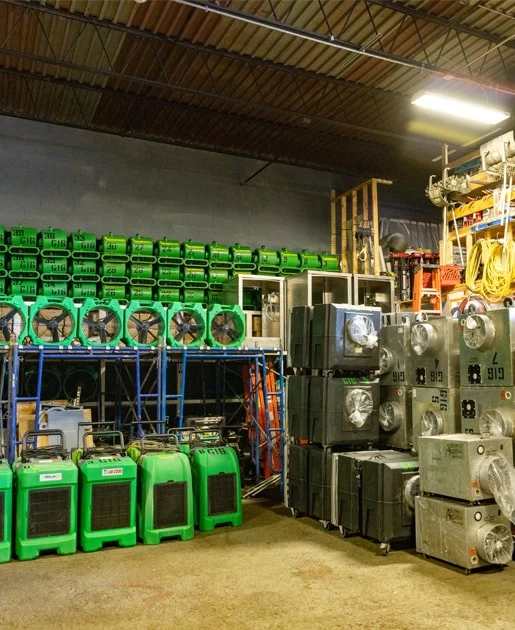
From there, we deploy industrial drying equipment. Air movers, dehumidifiers, and thermal imaging to confirm the moisture is actually gone not just gone from the surface. Every reading gets documented, because your insurance adjuster is going to want it. We handle that communication directly, which means you’re not spending your evenings translating contractor notes into insurance language. Once the space is dry and cleared, reconstruction begins under the same Suffolk County GC license that covered the remediation one company, one contract, no gaps.
If your home falls within Islandia’s Special Flood Hazard Area under the village’s own flood code (Chapter 80), any reconstruction work requires a floodplain development permit from the Village. We know that process and handle it as part of the job.
Flooded Basement Cleaning Services near Islandia, NY
Built for What Islandia Basements Actually Contain
Most water damage companies offer extraction and drying. That’s where their scope ends. For a newer home with modern materials, that might be enough. For a home in the original Levitt development built around 1963 with pipe insulation, 9×9 vinyl floor tiles, and painted surfaces that predate the 1978 lead ban extraction and drying is just the beginning.
Our flooded basement cleanup in Islandia covers the full scope: emergency water removal, structural drying with documented moisture readings, mold prevention treatment, hazardous material testing and remediation where required, and full reconstruction under a Suffolk County General Contractor license. Sewage backup events which are a real risk in aging Levitt-era plumbing, especially when the municipal system gets overwhelmed during a storm like the August 2024 flash flooding that triggered NYS recovery funds across Long Island are handled as the Category 3 health hazard they are, with proper containment and licensed disposal.
Every job includes direct insurance billing and claim documentation support. We communicate with your adjuster, organize the paperwork, and bill the carrier directly. For Islandia homeowners carrying close to $10,000 a year in property taxes on a home worth around $650,000, protecting that insurance claim is protecting a real financial asset and it’s something we treat as part of the service, not an add-on.
Does homeowners insurance cover basement flooding in Islandia, NY?
It depends on the cause, and the distinction matters a lot. Standard homeowners insurance typically covers sudden, accidental water damage a pipe that bursts overnight, a water heater that fails, a sump pump that gives out during a storm. What it generally does not cover is flooding from outside your home: rising groundwater, storm surge, or water that enters through the foundation due to hydrostatic pressure from saturated soil.
That second category is where many Islandia homeowners get caught off guard. When the water table rises near the Connetquot River corridor after a heavy rain event and water pushes through your foundation wall, that’s typically a flood insurance claim under FEMA’s National Flood Insurance Program not a standard homeowners claim. The Village of Islandia has its own Special Flood Hazard Area provisions codified in Chapter 80 of the Village Code, which means some properties here carry specific flood risk designations that affect coverage.
We document damage in the format insurance adjusters need, communicate with your carrier directly, and help you understand which policy applies to your specific event before the paperwork starts.
How fast does mold start growing after a basement flood?
The honest answer is 24 to 48 hours under the right conditions and basements in Suffolk County in the spring and summer provide exactly those conditions. Warm temperatures, elevated humidity, and organic materials like wood framing and drywall give mold everything it needs to establish quickly. By the time you’ve spent a day or two figuring out who to call, the remediation scope has already expanded.
This is why response time is the single most important variable in a basement flooding event. Getting water out fast and getting drying equipment running within the first few hours can be the difference between a cleanup job and a full mold remediation project. In a Levitt-era home where the framing and subfloor materials have been absorbing moisture for six decades, that timeline is compressed even further older wood is more porous and holds moisture longer than newer construction materials.
We operate 24/7/365. The call gets answered, we dispatch a crew, and the drying equipment goes in the same day. That’s not a marketing claim it’s the model we were built around, and it’s what the reviews reflect.
My Islandia home was built in the 1960s should I be worried about asbestos in my basement?
If your home is part of the original Levitt & Sons development built around 1963, then yes it’s a legitimate concern worth taking seriously. Homes built in that era commonly used asbestos-containing materials in places you’d encounter during a basement flood cleanup: pipe insulation wrapped around supply lines, 9×9 vinyl floor tiles, ceiling tiles, and joint compounds used in drywall finishing. None of this is visible to the eye, and none of it is dangerous if it’s left undisturbed. The problem is that a flooded basement cleanup often can’t avoid disturbing it.
Cutting into walls to check for moisture, removing damaged flooring, tearing out wet insulation all of that can release asbestos fibers if the material is present and not handled correctly. The legal requirement in New York is that any contractor performing work that may disturb asbestos-containing materials must hold the NYS DOL Asbestos license. Most water damage companies operating in this market do not hold that license and cannot legally complete a full remediation on a Levitt-era home.
We hold the NYS DOL Asbestos license, the USEPA Lead license, and the USEPA RRP certification. If your home has these materials, we can handle it legally and safely and document everything for your records.
What causes basement flooding in Islandia even when no pipes break?
The most common culprit is hydrostatic pressure and it’s something that affects Islandia specifically because of the village’s geography. When heavy rain saturates the ground around your foundation, the water pressure outside your basement walls builds up. If that pressure exceeds what your foundation can hold, water gets forced through cracks, porous concrete, and mortar joints even if everything inside your home is working perfectly. No broken pipe, no failed appliance. Just water finding the path of least resistance.
Islandia has active waterways within its own village boundaries. Honeysuckle Pond and portions of the Connetquot River run through Lakeland Park, which sits inside the village. During sustained rain events or rapid snowmelt, the water table in this area rises in ways that directly affect basement walls throughout the community. The Village’s own flood code acknowledges this Chapter 80 of the Islandia municipal code establishes Special Flood Hazard Area provisions precisely because the risk is real and regulated here.
Sump pump failure is the other common cause. In homes built in 1963, original or aging sump systems that have never been replaced are common. A pump that’s been running all winter and finally fails during the first major spring rain is one of the most predictable flooding scenarios in this housing stock.
How much does flooded basement cleanup typically cost in Suffolk County?
The range most homeowners in Suffolk County deal with runs from roughly $2,000 on the low end for a minor, contained water event to $8,000 or more for a larger loss with structural drying, mold treatment, and partial reconstruction. Most jobs land somewhere around $3,500 to $5,000 when the damage is caught quickly and addressed before mold sets in.
What pushes costs higher in Islandia specifically is the age of the housing stock. If your home is part of the original Levitt development, a flooded basement cleanup may require asbestos testing, lead-safe work practices, and licensed hazmat handling all of which add scope that a standard water damage job doesn’t include. That’s not a reason to avoid calling; it’s a reason to call a company that can handle all of it under one contract rather than discovering mid-job that the contractor you hired isn’t licensed for what they found.
Insurance coverage significantly affects out-of-pocket cost. If the event qualifies under your homeowners policy, we bill the carrier directly and handle the documentation. If it’s a flood insurance claim under FEMA’s NFIP, the process is different but the same documentation support applies. Either way, you’re not navigating that alone.
Do I need a permit to repair my basement after flooding in Islandia?
Potentially, yes and this is one area where Islandia differs from many surrounding communities. Because Islandia is an incorporated village with its own municipal government, building and flood hazard permits are administered at the village level, not just through the Town of Islip. The Village of Islandia has codified flood damage prevention regulations under Chapter 80 of the Village Code, which governs construction, alteration, and reconstruction in Special Flood Hazard Areas within the village boundaries.
If your property falls within a designated Special Flood Hazard Area, any post-flood reconstruction work replacing framing, finishing walls, installing new flooring may require a floodplain development permit from the Village before work begins. Skipping that step can create problems when you go to sell the home or file a future insurance claim. It’s not a bureaucratic technicality; it’s a real compliance issue that affects your property’s legal standing.
We hold a Suffolk County General Contractor license and are familiar with Islandia’s local permit process. If your job requires a village permit, that gets handled as part of the project not as a surprise at the end of it. You won’t be left figuring out the paperwork after the crew has already left.