Your Kensington Home Deserves More Than a Wet-Vac and a Prayer
When water hits the basement of a home worth over a million dollars on the Great Neck Peninsula, the clock starts immediately — and who you call in the next hour matters more than most people realize. We handle flooded basement cleanup in Kensington, NY with the licenses, equipment, and local knowledge to stop the damage before it compounds.
I needed a professional consultation explanation of procedure for safe removal of Asbestos in my apartment complex. Without having an account yet, I was very impressed with the caring, knowledgeable and generous advice offered by Jessica, and will look forward to doing business in the future. Thank you so much! I feel much more informed about a sometimes scary endeavor. Peace. Nancy Silva Mineola, NY.
Mia Munoz
Used this company to clean up some water flood in my house. They were fast and easy to work with.very professional, Would recommend to anyone!
Nini Valle
Great company, had a flood and they responded quickly and efficiently. Billed my insurance company directly. I highly recommend this company!
joe colapietro, jr
I had pipe freeze in my basement right before a snow storm and they made to within an hour to help start the clean up process. They we by our side throughout the entire process and even helped with the insurance company. They did such a great job with the cleanup, repair, remidiation, I contracted them to perform the repairs and finishes in the basement. They came with enough manpower and material to get the job done. Leo and Jessica were nothing but a pleasure to deal with!!
Cristian Arredondo c
I had some water damage in my home and Green Island was able to take care of my issue quickly and effectively. I am very pleased with the work they did. They responded quickly and were very professional.
Michael M
Outstanding service! From the office to the field crew everyone was friendly, helpful and responsive. I highly recommend Green Island Group.
A flooded basement in Kensington is not just a wet floor — it is a threat to a seven-figure asset sitting on a peninsula surrounded by Manhasset Bay and Little Neck Bay. The water table on the Great Neck Peninsula runs high, and homes built in the 1920s and 1930s were not engineered for the intensity of today’s nor’easters or the drainage demands of a fully developed neighborhood. When water gets in, it does not stay where you can see it.
That is the part that costs people the most. Water moves into wall cavities, under original hardwood floors, into insulation, and through concrete block foundation walls that have been absorbing moisture for decades. What looks dry to the eye is often still wet where it counts. Mold begins growing within 24 to 48 hours, and by 72 hours, you are no longer preventing it — you are remediating it. Those are not the same job, and they are not the same cost.
Getting the basement truly dry, documented, and cleared — not just visually clean — is what protects your home’s structural integrity, your indoor air quality, and the value of the property itself. In Kensington, where the median home value exceeds $1.4 million and nearly every resident owns rather than rents, there is no landlord absorbing this risk. It falls on you. The outcome you are paying for is certainty, not just cleanup.
Licensed Basement Flooding Remediation, Nassau County
Every License the Job Requires — Under One Roof
We are a full-service disaster restoration and environmental remediation company serving Nassau County, Suffolk County, and the New York City metro area. In Kensington specifically — a village with housing stock that dates back to its 1921 founding — basement flood jobs often involve more than water. They involve asbestos floor tiles, lead-painted surfaces, and pre-existing mold that was already behind the walls before the flood ever happened.
That is why the credential stack matters here. We hold the NYS DOL Mold License, the NYS DOL Asbestos License, the USEPA Lead and RRP certifications, the IICRC Water Damage certification, and a Nassau County General Contractor license — all under one company. You are not coordinating three separate contractors with three separate schedules and three separate sets of accountability gaps. One call covers the full scope, from water extraction through structural restoration.
Customers consistently describe the experience the same way: our office staff and our field crew are equally responsive, equally professional, and equally invested in the outcome. That consistency is not an accident — it is our standard.
When you call, you reach a real person — not a form, not a voicemail. We dispatch 24 hours a day, seven days a week, including nights and weekends, because basement floods in Kensington do not wait for business hours. The first priority on arrival is stopping any active water source and assessing the category of water involved. That distinction matters: a burst pipe is a very different situation from a sewer backup through a floor drain, which is a Category 3 biohazard event requiring full decontamination — not just drying.
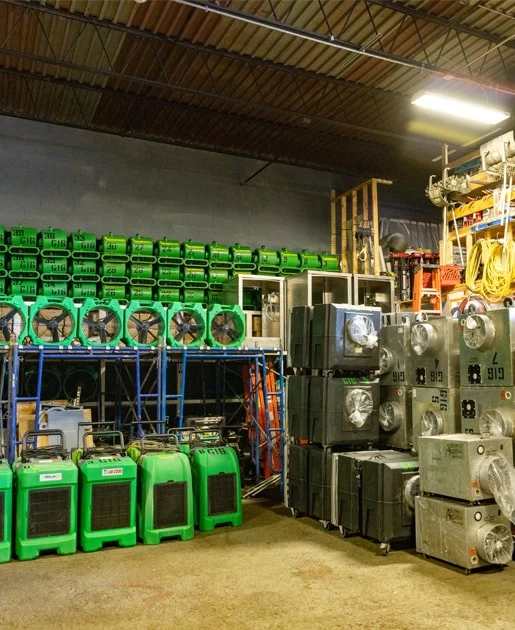
Once the water category is confirmed, the extraction begins. Industrial-grade pumps and vacuums remove standing water, followed by professional-grade air movers and dehumidifiers that run continuously until moisture readings confirm the space is genuinely dry. Moisture meters go into the walls, under the floors, and behind any material that water could have migrated into — because in the older homes along Kensington’s tree-lined streets, water finds its way into places that a visual inspection will never catch.
In homes built before 1978 — which covers most of Kensington’s housing stock — any disturbance of floor tiles, pipe insulation, or wall materials triggers NYS DOL Asbestos and USEPA Lead protocols before remediation proceeds. This is not optional. It is state and federal law, and it is the step that unlicensed operators skip. We do not skip it. When the work is complete, you receive full documentation of moisture readings, remediation scope, and clearance — exactly what your insurance carrier needs to process the claim.
Flooded basement cleanup in Kensington covers a wider scope than most homeowners expect when they first make the call. Because the Great Neck Peninsula’s coastal exposure and aging sewer infrastructure create multiple types of flooding events — groundwater seepage, storm surge, burst pipes, and sewer backflow — the service has to be equipped for all of them. We handle water extraction, structural drying, moisture mapping, mold remediation under the NYS DOL Mold License, asbestos and lead hazmat handling under the applicable state and federal licenses, and full structural restoration under the Nassau County General Contractor license.
For sewer backup events, which are a documented risk in Nassau County communities with mid-century sewer systems, the cleanup involves biohazard decontamination of all affected surfaces — not just water removal. This is a Category 3 situation and requires a different protocol entirely. If you are smelling sewage in your Kensington basement after a heavy rain event, that is the scenario you are in, and it is not one to address with standard cleanup methods.
Insurance documentation is part of our service from the first hour. We assist with damage reporting, carrier communication, and the written documentation that adjusters need to process claims accurately. Homeowners insurance typically covers sudden accidental events like burst pipes, while natural flooding requires a separate flood policy — a distinction that matters on the Great Neck Peninsula, where both types of events occur. Knowing which coverage applies before the claim is filed saves significant time and frustration.
Does homeowners insurance cover a flooded basement in Kensington, NY?
It depends on what caused the flooding, and this distinction trips up a lot of Kensington homeowners. Standard homeowners insurance covers sudden, accidental water damage — a burst pipe in January, a failed water heater, a washing machine overflow. It does not cover flooding that originates outside the home, such as storm surge from a nor’easter, groundwater seepage through foundation walls, or surface water entering through window wells. That type of flooding requires a separate flood insurance policy, typically through the National Flood Insurance Program (NFIP) or a private flood carrier.
On the Great Neck Peninsula, both types of events happen. A winter freeze can burst a pipe in an older Kensington home the same season a coastal storm pushes water through the foundation. Knowing which policy applies — and documenting the cause correctly from the start — is critical to getting a claim paid. We assist with damage documentation from the first hour on-site, so your claim is supported with the evidence adjusters actually need, not reconstructed after the fact.
How quickly does mold start growing after a basement floods on Long Island?
Mold can begin growing within 24 to 48 hours of water exposure under the right conditions — and basements in Kensington’s older homes tend to provide exactly those conditions. The combination of limited ventilation, organic materials like wood framing and drywall, and the naturally high groundwater levels of the Great Neck Peninsula creates an environment where mold establishes quickly once moisture is present. The critical threshold is 72 hours. After that point, you are no longer preventing mold — you are remediating an active growth situation, which is a different scope of work and a meaningfully higher cost.
This is why response time is not a marketing claim — it is a practical financial calculation. Calling us immediately after discovering standing water in your Kensington basement gives you the best chance of staying on the prevention side of that 72-hour line. We dispatch 24/7, including nights and weekends, specifically because basement floods do not wait for convenient timing.
My Kensington home was built in the 1930s — does that change the cleanup process?
Yes, significantly. Homes built before 1978 — which includes the majority of Kensington’s housing stock, given the village was developed starting in the early 1920s — commonly contain asbestos floor tiles, asbestos pipe insulation in the basement, and lead-based paint on walls and trim. Under normal conditions, these materials are stable and not a health concern. But when a basement floods, water disturbs these materials, and any cleanup activity that breaks, scrapes, or removes them without proper protocols creates a serious health and legal liability.
New York State law requires a NYS DOL Asbestos License for any company performing asbestos abatement, and federal law requires USEPA Lead and RRP certification for work involving lead-painted surfaces in pre-1978 homes. We hold both. Many restoration companies operating in the Kensington area do not — which means they are either skipping the hazmat step entirely or performing it illegally. Before you hire anyone to clean your flooded basement in an older Kensington home, ask to see their asbestos and lead credentials. It is a fair question and a necessary one.
What is the difference between water damage restoration and mold remediation?
Water damage restoration is the process of extracting water, drying the structure, and restoring it to its pre-loss condition. Mold remediation is the process of identifying, containing, and removing mold growth — and in New York State, it requires a separate NYS DOL Mold License that is distinct from any general contractor or restoration license. These are two different regulated activities, and not every company that handles one is legally authorized to handle the other.
In practice, the two often overlap after a basement flood. If water sat for more than 48 to 72 hours before extraction began — or if there was pre-existing moisture intrusion in an older Kensington home — mold may already be present when the restoration crew arrives. We hold both the IICRC Water Damage certification and the NYS DOL Mold License, so the full scope can be handled by one team without stopping the job to bring in a separate licensed subcontractor. That continuity matters for timeline, cost, and accountability.
What should I do first when I find standing water in my Kensington basement?
The first thing to do is not go into the water — at least not before checking whether any electrical panels, outlets, or appliances are in the flooded area. Water and live electrical current are a serious safety risk, and this is not an overstatement. If there is any possibility that electrical components are submerged or in contact with the water, stay out and call your utility provider before entering the space.
Once you have confirmed it is safe to enter, try to identify the water source if it is obvious — a burst pipe, an overflowing sump pump, a backed-up floor drain. Stop the source if you can do so safely. Then call us at 631-613-8945. Do not run household fans into the space thinking it will help — without professional drying equipment and moisture monitoring, fans can actually spread moisture into adjacent areas and accelerate mold growth in wall cavities. The faster a professional extraction team arrives, the more of the 72-hour window you preserve.
Why does sewer backup in a Kensington basement require a different cleanup approach?
Sewer backup is classified as Category 3 water — what the industry calls black water — because it contains bacteria, pathogens, and raw sewage. It is a biohazard event, not a water damage event, and it requires a completely different response protocol than a burst pipe or groundwater seepage. Standard drying and dehumidification are not sufficient. Every surface that came into contact with the backup needs to be decontaminated, and in many cases, porous materials like drywall, insulation, and carpet must be removed entirely rather than dried in place.
Nassau County’s sewer infrastructure, including systems serving the Great Neck Peninsula and Kensington, dates largely to the mid-20th century. During heavy rain events, these older combined systems can be overwhelmed and force wastewater back into homes through basement floor drains. It is a documented risk in this area — not a rare edge case. If you notice a sewage odor in your Kensington basement after a storm, that is the scenario you are dealing with, and it warrants an immediate call to a company equipped and licensed to handle it correctly. We have the protocols, the protective equipment, and the licensed team to manage Category 3 events safely from start to finish.