Lake Ronkonkoma basements don’t just flood during storms they flood because of where you live. We arrive in under an hour, handle your insurance directly, and take the job from water extraction to full restoration under one license.
I needed a professional consultation explanation of procedure for safe removal of Asbestos in my apartment complex. Without having an account yet, I was very impressed with the caring, knowledgeable and generous advice offered by Jessica, and will look forward to doing business in the future. Thank you so much! I feel much more informed about a sometimes scary endeavor. Peace. Nancy Silva Mineola, NY.
Mia Munoz
Used this company to clean up some water flood in my house. They were fast and easy to work with.very professional, Would recommend to anyone!
Nini Valle
Great company, had a flood and they responded quickly and efficiently. Billed my insurance company directly. I highly recommend this company!
joe colapietro, jr
I had pipe freeze in my basement right before a snow storm and they made to within an hour to help start the clean up process. They we by our side throughout the entire process and even helped with the insurance company. They did such a great job with the cleanup, repair, remidiation, I contracted them to perform the repairs and finishes in the basement. They came with enough manpower and material to get the job done. Leo and Jessica were nothing but a pleasure to deal with!!
Cristian Arredondo c
I had some water damage in my home and Green Island was able to take care of my issue quickly and effectively. I am very pleased with the work they did. They responded quickly and were very professional.
Michael M
Outstanding service! From the office to the field crew everyone was friendly, helpful and responsive. I highly recommend Green Island Group.
Your Basement Back Without the Guesswork or the Gaps
Living near the largest lake on Long Island isn’t just a selling point for your home it’s a hydrological reality that affects your foundation year-round. Lake Ronkonkoma sits approximately two miles south of Long Island’s regional groundwater divide, and the aquifer that feeds the lake has been documented to rebound cyclically as it recovers from decades of heavy pumping. When that water table rises, it creates hydrostatic pressure against your foundation walls and floor slab. That pressure doesn’t need a storm to build it just needs time and saturated soil conditions.
When we finish a basement flooding remediation job in Lake Ronkonkoma, you’re not left with a damp space and a dehumidifier rental receipt. The water is extracted, the structure is dried to IICRC moisture standards, and every hidden pocket of saturation behind walls, under flooring, inside cavities is identified with thermal imaging before anyone packs up. That matters here because the homes in this area were built predominantly in the 1950s through 1970s, and older construction holds moisture differently than newer builds.
The other thing that changes when the job is done right: you don’t get a call three weeks later from a mold remediation company telling you they found something we missed. We handle mold assessment and remediation under the same NYS DOL Mold license, the same contract, and the same crew so the handoff gap that creates those calls doesn’t exist.
Licensed Basement Flood Cleanup, Suffolk County NY
One Company That Can Handle Everything Your Basement Reveals
Green Island Group has been doing environmental restoration work across Long Island and New York City for over 12 years, with more than 5,000 completed projects behind us. We’re independently owned, New York State certified as a minority and woman-owned business, and approved by the NYS Office of General Services as an emergency response contractor which means the State of New York has already vetted us before you ever make the call.
For Lake Ronkonkoma specifically, that licensing depth matters more than it might in other communities. The median home here was built in 1969. That’s the era of asbestos pipe insulation, 9-by-9 vinyl floor tiles, and lead-based paint on basement walls materials that a flooded basement can disturb in ways that turn a cleanup job into a hazmat situation overnight. We hold NYS DOL Asbestos, NYS DOL Mold, USEPA Lead, and USEPA RRP certifications alongside our Suffolk County General Contractor license. Whether your home is on the Brookhaven side or the Smithtown side of the hamlet, we’re licensed to work it and handle whatever we find.
CEO Jessica Dussan and VP Leo Torres are named in customer reviews not as a branding exercise, but because we’re actually reachable and accountable to the jobs we take on.
Basement Flooding Remediation Process, Lake Ronkonkoma
From the First Call to a Dry, Safe Basement Here's What Happens
When you call, you’re not leaving a message or waiting for a callback window. We run 24/7, 365 days a year, and our documented arrival time in Lake Ronkonkoma is under one hour. The first thing that happens on-site is an assessment not just of the standing water you can see, but of where the water came from, what category it falls under, and whether the source is still active. In Lake Ronkonkoma, that source is often hydrostatic pressure from a saturated water table rather than a broken pipe or a roof leak, and identifying that correctly shapes everything that follows.
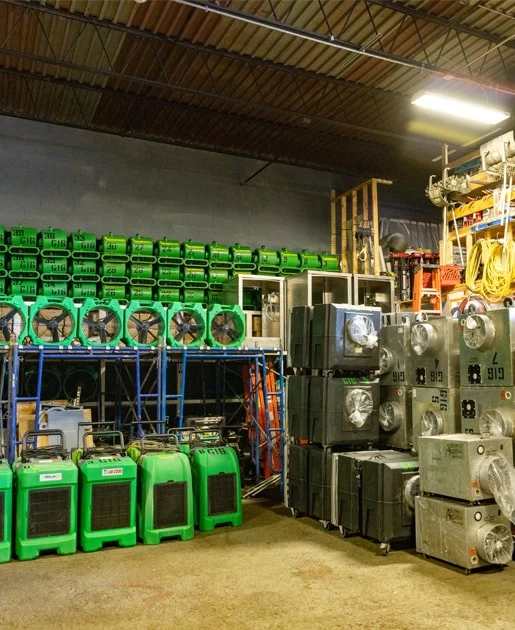
Once the source is understood, extraction begins. Industrial pumps pull the standing water, and high-velocity air movers and commercial dehumidifiers are staged throughout the affected space. Thermal imaging is used to find moisture that’s migrated into wall cavities, subfloor material, and framing the kind of saturation you can’t see but that feeds mold within 24 to 48 hours if it’s left alone. In homes built before 1978, the drying and demolition phases are approached carefully: if asbestos-containing materials or lead paint are present, the licensed protocols kick in before anything is disturbed.
Throughout the job, we document the damage in the format your insurance adjuster needs. We bill your insurer directly, which means you’re not fronting costs and waiting for reimbursement. When the job is complete, you get a dry, tested, documented space not a verbal assurance and a handshake.
Flooded Basement Cleaning Services, Lake Ronkonkoma NY
What's Actually Included When We Take the Job
Flooded basement cleanup in Lake Ronkonkoma isn’t a single service it’s a sequence of them, and the sequence matters. Our scope covers water extraction, structural drying, moisture mapping, mold assessment, mold remediation, asbestos and lead evaluation where the housing age warrants it, debris and material removal, and reconstruction. That’s the full arc from emergency response to a finished, livable space. You don’t need to coordinate multiple contractors or explain the situation from scratch to a new crew every week.
The category of water in your basement determines a significant part of what’s required. Clean water from a burst supply line is a different job than gray water from an appliance overflow, which is different again from Category 3 sewage backup or outside floodwater. Lake Ronkonkoma’s aging infrastructure and documented storm drainage stress make Category 3 events a real possibility here, not a hypothetical. That level of contamination requires OSHA-compliant handling, proper containment, and licensed disposal. Our environmental licensing covers all three categories.
For homes in the Sachem school district area, the Town of Brookhaven side of the hamlet, and the Smithtown section near the lake’s northwest reach, our Suffolk County General Contractor license covers the permitting and reconstruction side of the work. You’re not dealing with a company that can clean but can’t rebuild, or that can dry but can’t touch the mold. Everything is under one roof, one license, and one point of contact.
Why does my Lake Ronkonkoma basement keep flooding even without heavy rain?
This is one of the most common questions from homeowners in Lake Ronkonkoma, and the answer is specific to where you live. Lake Ronkonkoma sits approximately two miles south of Long Island’s regional groundwater divide, and the lake itself is fed by an aquifer that has been documented to rebound meaning water table levels rise cyclically as the aquifer recovers from decades of heavy pumping. When that water table rises, it creates hydrostatic pressure against your foundation walls and floor slab. That pressure doesn’t need a storm to build it just needs time and saturated soil conditions.
The practical result is that basements in Lake Ronkonkoma can take on water through hairline cracks, floor joints, and sump overflow points even during dry stretches, particularly in spring when snowmelt has already saturated the ground. If your sump pump is running constantly or your basement walls show efflorescence that white mineral deposit left by water moving through concrete that’s the aquifer talking. A proper remediation addresses the water intrusion pathway, not just the water that’s already on the floor.
Does homeowners insurance cover a flooded basement in Lake Ronkonkoma, NY?
It depends on the source of the water, and this is where a lot of Lake Ronkonkoma homeowners get caught off guard. Standard homeowners insurance typically covers sudden, accidental water damage a burst pipe, a failed water heater, an appliance overflow. What it generally does not cover is water that enters from outside the home, including groundwater seepage, surface flooding, and storm drainage backup. For those events, you’d need a separate flood insurance policy through the National Flood Insurance Program or a private carrier.
The complication in Lake Ronkonkoma is that the source isn’t always obvious. Water coming up through a floor crack could be a plumbing failure or hydrostatic groundwater pressure and the distinction matters enormously for your claim. We document the source, the water category, and the extent of damage in the format insurance adjusters require, and we bill your insurer directly. That documentation is often the difference between a covered claim and a denied one. If you’re unsure what your policy covers, the best first step is getting a professional assessment that creates a clear, documented record of what happened and why.
How fast does mold start growing after a basement floods in New York?
Mold can begin developing within 24 to 48 hours of a flooding event and in Lake Ronkonkoma’s environment, where baseline humidity levels near the lake are already elevated, that window can feel even shorter. The issue isn’t just visible mold on a wall surface. It’s the mold that starts in wall cavities, behind drywall, and under flooring where moisture has migrated but airflow hasn’t reached. By the time you can smell it, it’s already been growing for days.
That’s why the drying phase of basement flood cleanup isn’t optional or something you can delay until a more convenient time. Industrial dehumidifiers and air movers need to be running within that first 24-hour window, and thermal imaging should be used to confirm that hidden moisture pockets are being addressed not just the visible wet areas. New York State requires a NYS DOL Mold license for any mold assessment or remediation above 10 square feet. If a contractor is doing mold work in your home without that license, they’re operating illegally and you could be left with liability for any health or property issues that follow.
My Lake Ronkonkoma home was built in the 1960s should I worry about asbestos in my flooded basement?
Yes, and it’s worth taking seriously. The median construction year for homes in Lake Ronkonkoma is 1969, which places the majority of the housing stock squarely in the era when asbestos-containing materials were standard in residential construction. The most common locations in a basement of that era: pipe wrap insulation around heating pipes, 9-by-9 vinyl floor tiles and their adhesive backing, ceiling tiles, and joint compound used on drywall seams. None of these materials are necessarily dangerous when they’re intact and undisturbed but a flooding event changes that.
Water damage that saturates pipe insulation, lifts floor tiles, or causes wall materials to degrade can disturb asbestos-containing materials in ways that release fibers into the air. A drying or demolition process that isn’t conducted by a licensed contractor can make that significantly worse. New York State requires a NYS DOL Asbestos license for any contractor handling or removing asbestos-containing materials. We hold that license and conduct a material evaluation as part of the initial assessment on any pre-1980 home so if something needs to be handled differently, you know before work begins, not after.
How much does flooded basement cleanup typically cost in Suffolk County?
The range is wide, and the honest answer is that the final number depends on several factors: the size of the affected area, the category of water involved, how long the water sat before cleanup began, and whether hazardous materials like mold, asbestos, or lead are present. For a straightforward clean water event in a typical Lake Ronkonkoma basement extraction, drying, and basic restoration costs generally fall somewhere between $2,000 and $5,000. When mold remediation is required, that range can extend to $8,000 or more. A Category 3 sewage backup with contaminated materials adds further scope and cost.
The most important variable within your control is timing. Every hour of delay compounds the damage water migrates further into structural materials, mold risk increases, and the cost of remediation rises accordingly. Homeowners who call within the first few hours of a flooding event almost always face a smaller scope of work than those who wait a day or two hoping it will dry on its own. If your flooding event is covered by homeowners insurance, we handle the documentation and direct billing which removes the out-of-pocket uncertainty from the equation for many Lake Ronkonkoma residents.
Do I need a permit for basement restoration work in the Town of Brookhaven or Smithtown?
Lake Ronkonkoma sits across two town jurisdictions most of the hamlet falls within the Town of Brookhaven, while the northwestern section near the lake falls within the Town of Smithtown. Each town has its own building department, code enforcement process, and permit thresholds, so the answer to the permit question depends on exactly where your property sits and what scope of work is involved. Emergency water extraction and drying typically don’t require a permit. Structural repairs, drywall replacement, and reconstruction work above certain thresholds generally do.
We’re a licensed Suffolk County General Contractor which means we navigate both jurisdictions as a matter of routine. We know when a permit is required, which department to file with, and how to keep the project moving without delays caused by paperwork gaps. If you hire an unlicensed contractor or a company that isn’t familiar with Brookhaven and Smithtown’s separate processes, permit issues can surface mid-project and stop work entirely. It’s one of the less visible but genuinely practical reasons why licensing and local experience matter for basement restoration work in Lake Ronkonkoma.