When Hempstead Lake's Water Table Comes for Your Basement
Lakeview’s proximity to Hempstead Lake means your basement is under more pressure — literally — than most Nassau County homes. When water gets in, we get it out fast, before the 72-hour mold window closes.
I needed a professional consultation explanation of procedure for safe removal of Asbestos in my apartment complex. Without having an account yet, I was very impressed with the caring, knowledgeable and generous advice offered by Jessica, and will look forward to doing business in the future. Thank you so much! I feel much more informed about a sometimes scary endeavor. Peace. Nancy Silva Mineola, NY.
Mia Munoz
Used this company to clean up some water flood in my house. They were fast and easy to work with.very professional, Would recommend to anyone!
Nini Valle
Great company, had a flood and they responded quickly and efficiently. Billed my insurance company directly. I highly recommend this company!
joe colapietro, jr
I had pipe freeze in my basement right before a snow storm and they made to within an hour to help start the clean up process. They we by our side throughout the entire process and even helped with the insurance company. They did such a great job with the cleanup, repair, remidiation, I contracted them to perform the repairs and finishes in the basement. They came with enough manpower and material to get the job done. Leo and Jessica were nothing but a pleasure to deal with!!
Cristian Arredondo c
I had some water damage in my home and Green Island was able to take care of my issue quickly and effectively. I am very pleased with the work they did. They responded quickly and were very professional.
Michael M
Outstanding service! From the office to the field crew everyone was friendly, helpful and responsive. I highly recommend Green Island Group.
Most Lakeview residents don’t discover a flooded basement until they get home from a 48-minute commute — and by then, the water has been sitting for hours. That’s not just a mess. That’s a mold clock that’s already been running. The difference between a cleanup job and a full remediation project is often just a few hours, and we’re built to move fast enough to keep you on the right side of that line.
Lakeview’s housing stock tells a story that most water damage companies ignore. When your home was built in the 1950s or earlier — and roughly 27% of homes in this hamlet were — a flooded basement doesn’t just mean wet floors. It can mean disturbed asbestos tile, compromised lead paint on foundation walls, and pipe insulation that was never meant to get wet. A company that only does water extraction leaves you holding the bag on everything else. We’re licensed to handle all of it under one roof, from the water out to the walls back up.
What you’re left with after we’re done isn’t just a dry basement. It’s verified dry — confirmed by thermal imaging and moisture meters, not a visual guess. No hidden moisture feeding mold behind your drywall weeks later. No lingering smell. No failed home inspection when it’s time to sell. With median home values in Lakeview now sitting around $570,000, that kind of thoroughness isn’t a luxury. It’s the whole point.
We hold a credential stack that almost no competitor serving Lakeview can match: NYS DOL Mold License, NYS DOL Asbestos License, USEPA Lead and RRP certifications, IICRC Water Damage certification, and a Nassau County General Contractor license. That last one matters more than most people realize. Post-flood structural work in Lakeview falls under Town of Hempstead building codes, and pulling the permits required for drywall, framing, and subfloor restoration requires a licensed GC. Most water damage companies can’t do that. We can.
This isn’t a national franchise with a landing page and a rerouted phone number. We serve Nassau County and know the difference between a home on Woodfield Road and one on the South Shore. When we say we’ve worked in Lakeview, we mean it — high water tables, older foundations, and pre-1978 materials included.
From Standing Water to Solid Ground — Here's the Sequence
The first call triggers everything. We’re available 24 hours a day, and our response is fast — because we understand that every hour water sits in a Lakeview basement is another hour it’s wicking into concrete block walls, soaking into wood framing, and saturating whatever insulation is behind your drywall. When we arrive, the first step isn’t extraction. It’s assessment. We use thermal imaging cameras and moisture meters to map where water has traveled — not just where it’s visible.
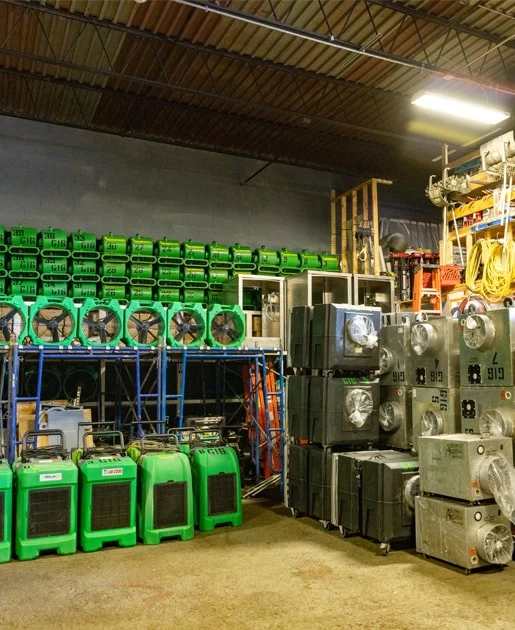
Once we know the full picture, extraction begins with industrial-grade equipment sized for the actual volume of water, not a residential shop-vac. Structural drying comes next — commercial air movers and dehumidifiers positioned based on the moisture map, not guesswork. In homes built before 1978, which covers most of Lakeview’s housing stock, we conduct material testing before any demolition begins. If asbestos tile or lead paint is present, we handle containment and removal under our NYS DOL and USEPA certifications before any restoration work starts.
When structural repairs are needed — new drywall, subfloor, framing — we pull the required Town of Hempstead building permits and complete the work under our Nassau County General Contractor license. You don’t coordinate a second contractor. You don’t chase a permit on your own. The job runs start to finish under one company, and we don’t call it done until the moisture readings confirm it.
Basement Flooding Remediation Services Lakeview NY
What's Actually Included When Your Basement Floods in Lakeview
Flooded basement cleanup in Lakeview isn’t a one-size situation. A burst pipe in a 1990s-era home is a different job than a sewage backup in a 1948 foundation with original tile floors and galvanized plumbing. We assess the water source and contamination level first, because that determines everything — what equipment we use, what materials can be saved, and what has to come out.
Category 1 water — clean supply line breaks — allows for aggressive drying and material preservation where possible. Category 2 and Category 3 events, which include sewage backups and heavily contaminated groundwater intrusion, require full biohazard decontamination protocols. In a hamlet where the sewer infrastructure is as old as the homes it serves, Category 3 events aren’t rare. We’re equipped and licensed for all three, and we document everything for your insurance carrier. We bill directly when coverage applies, so you’re not fighting that battle while your basement is still wet.
Beyond extraction and drying, our scope includes mold assessment and remediation under our NYS DOL Mold License, asbestos and lead testing and abatement for Lakeview’s older homes, HVAC inspection under our NADCA certification when ductwork has been exposed, and full structural restoration under our Nassau County GC license. From the first inch of standing water to the final permit-closed restoration — that’s the full scope of what we do.
Does homeowners insurance cover basement flooding in Lakeview, NY?
It depends entirely on the source of the water — and this is one of the most misunderstood distinctions in insurance. Standard homeowners insurance typically covers sudden, accidental water damage from internal sources: a burst pipe, a failed washing machine hose, an overflowing water heater. What it does not cover is natural flooding — water that enters your basement from the outside due to storm runoff, groundwater intrusion, or an overflowing body of water. For that, you need a separate flood insurance policy, typically through the National Flood Insurance Program.
This matters in Lakeview specifically because the hamlet sits adjacent to Hempstead Lake State Park, and the elevated local water table means some basement flooding events are groundwater-driven rather than plumbing-driven. Knowing which category your event falls into affects your claim significantly. We help document the source and scope of damage accurately, and we bill insurance carriers directly when coverage applies — so you’re not navigating that process alone while your basement is still wet.
How quickly does mold start growing after a basement flood?
Mold can begin developing within 24 to 48 hours of water exposure under the right conditions — and basements provide almost all of those conditions: limited airflow, organic materials like wood framing and drywall, and consistent moisture. The 72-hour mark is the critical threshold. If a basement is fully dried and dehumidified within 72 hours of flooding, mold growth is unlikely. Beyond that window, remediation becomes a separate and significantly more involved project.
The challenge for most Lakeview homeowners is that the average commute runs close to 49 minutes each way. A basement that floods at 8 a.m. may not be discovered until 7 p.m. — meaning the clock has been running for 11 hours before anyone even makes a call. That’s why our response operates around the clock. The faster extraction and drying equipment is in place, the better your odds of staying on the right side of that 72-hour line. If mold has already established, we’re licensed under the NYS DOL Mold License to remediate it — but the goal is always to get there before it does.
My Lakeview home was built in the 1950s — does that affect the cleanup process?
Yes, significantly. Homes built before 1978 — which covers the majority of Lakeview’s housing stock, given a median construction year of 1961 — may contain asbestos floor tiles, lead-based paint on basement walls and trim, and pipe insulation materials that were common in that era but are now classified as hazardous. When a basement floods, the water disturbs these materials. Removing wet flooring, cutting into drywall, or replacing pipe insulation in a home of this age without proper testing and containment is a health risk and a legal violation.
Before any demolition work begins in a pre-1978 Lakeview home, we conduct material testing. If asbestos or lead is present, we handle containment, removal, and disposal under our NYS DOL Asbestos License and USEPA Lead/RRP certifications. Most water damage companies don’t hold these credentials and will stop work when hazmat materials are found, leaving you to find a separate contractor mid-job. We don’t stop. We’re licensed for the full scope, and we keep the project moving.
Why does my Lakeview basement keep flooding even without a plumbing problem?
Hydrostatic pressure is the most common culprit, and Lakeview’s geography makes it a particularly relevant issue here. The hamlet sits immediately southwest of Hempstead Lake State Park, and the lake and surrounding ponds maintain a consistently elevated water table in the area. When Nassau County gets heavy rainfall — especially during spring nor’easters when the ground is already saturated from winter snowmelt — that water table rises and pushes directly against your foundation walls. Concrete block foundations, which are common in homes of Lakeview’s age, develop hairline cracks and deteriorating parging over decades, giving that pressurized groundwater a path in.
This type of flooding isn’t a plumbing failure — it’s a structural and hydrological issue. Extraction and drying will address the immediate damage, but if the foundation isn’t assessed and the entry points aren’t identified, the next heavy rain brings the same problem. Our assessment process includes identifying how and where water entered, not just removing what’s already inside. That information is also critical for documenting the claim correctly with your insurance carrier.
How long does flooded basement cleanup actually take from start to finish?
The extraction phase — getting standing water out — is typically completed within a few hours depending on the volume. The drying phase is where most of the timeline lives. Structural drying in a basement environment generally takes three to five days with commercial-grade air movers and dehumidifiers running continuously. In Lakeview’s older homes, where concrete block walls absorb and hold moisture differently than poured concrete, that timeline can extend if the walls have significant saturation.
If material testing is required — which it is in any pre-1978 home before demolition begins — that adds time before structural work starts. Asbestos and lead abatement, if needed, follows its own protocol timeline. Structural restoration, including drywall, subfloor, and framing, comes after drying is confirmed by moisture readings. For a straightforward clean-water event in a finished basement, the full process from extraction to restored walls might run one to two weeks. For a more complex event involving contaminated water, hazmat materials, or significant structural damage, three to four weeks is realistic. We give you an honest timeline at the assessment stage — not a number designed to win the job.
What's the difference between water damage cleanup and mold remediation — and do I need both?
Water damage cleanup addresses the immediate event: extracting standing water, drying out structural materials, and preventing further damage. Mold remediation is a separate process that addresses biological growth — and it’s only necessary if mold has already established, or if conditions existed long enough that mold is likely even if not yet visible. The two aren’t always the same job, but in practice they’re closely linked. If water sat for more than 48 to 72 hours before drying began, or if there was pre-existing moisture in the basement from prior intrusion events, mold assessment is warranted even if the walls look clean.
In Lakeview, where many basements have experienced repeated water intrusion over decades due to the area’s water table and aging foundations, it’s not uncommon to find existing mold growth that predates the current flooding event. Our assessment process includes both moisture mapping and mold inspection, so you get a clear picture of what’s actually there — not an assumption in either direction. If remediation is needed, we handle it under our NYS DOL Mold License. If it’s not, we tell you that too.