When Mill Neck Creek Rises, Your Basement Shouldn't Pay for It
Water in your basement moves fast — and so does mold. We respond 24/7 with the licenses, equipment, and local knowledge to handle flooded basement cleanup in Lattingtown before the damage compounds.
I needed a professional consultation explanation of procedure for safe removal of Asbestos in my apartment complex. Without having an account yet, I was very impressed with the caring, knowledgeable and generous advice offered by Jessica, and will look forward to doing business in the future. Thank you so much! I feel much more informed about a sometimes scary endeavor. Peace. Nancy Silva Mineola, NY.
Mia Munoz
Used this company to clean up some water flood in my house. They were fast and easy to work with.very professional, Would recommend to anyone!
Nini Valle
Great company, had a flood and they responded quickly and efficiently. Billed my insurance company directly. I highly recommend this company!
joe colapietro, jr
I had pipe freeze in my basement right before a snow storm and they made to within an hour to help start the clean up process. They we by our side throughout the entire process and even helped with the insurance company. They did such a great job with the cleanup, repair, remidiation, I contracted them to perform the repairs and finishes in the basement. They came with enough manpower and material to get the job done. Leo and Jessica were nothing but a pleasure to deal with!!
Cristian Arredondo c
I had some water damage in my home and Green Island was able to take care of my issue quickly and effectively. I am very pleased with the work they did. They responded quickly and were very professional.
Michael M
Outstanding service! From the office to the field crew everyone was friendly, helpful and responsive. I highly recommend Green Island Group.
The moment water enters your basement, a clock starts. The EPA is clear: mold can begin growing within 24 to 48 hours of water exposure. On the North Shore of Long Island, where the aquifer system fills fast in wet years and properties near Mill Neck Creek sit at genuine flood risk, that window closes quicker than most homeowners expect. Getting ahead of it — not reacting after the fact — is what separates a contained cleanup from a mold remediation project that stretches into weeks.
What you get when the job is done right isn’t just a dry floor. It’s a basement that’s been fully extracted, dried with industrial equipment, tested for moisture behind walls and under subflooring, and cleared for safety. No lingering humidity. No hidden damage waiting to surface six months later. That’s the standard every Lattingtown home deserves — especially when nearly one in three homes in this village were built before 1940, where aged pipe systems and older construction materials make a thorough, licensed response non-negotiable.
For homeowners in Lattingtown Ponds, along Lattingtown Harbor, or anywhere on the lower-elevation stretches of the village, flooding isn’t a hypothetical. It’s a documented risk. And when it happens, the outcome you need is complete — not surface-level.
Licensed Basement Flooding Remediation, Nassau County
Every License This Job Actually Requires — Under One Roof
We hold the full credential stack that flooded basement cleanup in Nassau County legally demands: NYS DOL Mold License, NYS DOL Asbestos License, USEPA Lead/RRP Certification, IICRC Water Damage Certification, and a Nassau County General Contractor License. That combination isn’t common. Most restoration companies hold one or two of those. We hold all of them — which means we can legally and completely handle every phase of your project without handing you off to a second or third contractor.
That matters especially in Lattingtown, where the housing stock includes a significant share of pre-war estate construction. When water disturbs aging floor tiles, pipe insulation, or wall materials in a home built before 1940, you’re not just dealing with a flooded basement — you’re dealing with a potential asbestos or lead situation that requires licensed abatement. We’re equipped for exactly that, from the first call through the final walkthrough.
Available 24 hours a day, every day of the year, with emergency dispatch across Nassau County’s North Shore.
What Actually Happens From First Call to Finished Basement
When you call, we dispatch immediately — day or night. The first thing our crew does on arrival isn’t extract water. It’s assess. We identify the source of intrusion, check for electrical hazards, and determine whether the water is clean, gray, or black. That distinction matters because sewage backup — which is a real risk in Lattingtown’s older infrastructure during heavy rain events — requires a completely different response than a burst pipe. You need to know what you’re dealing with before anything else happens.
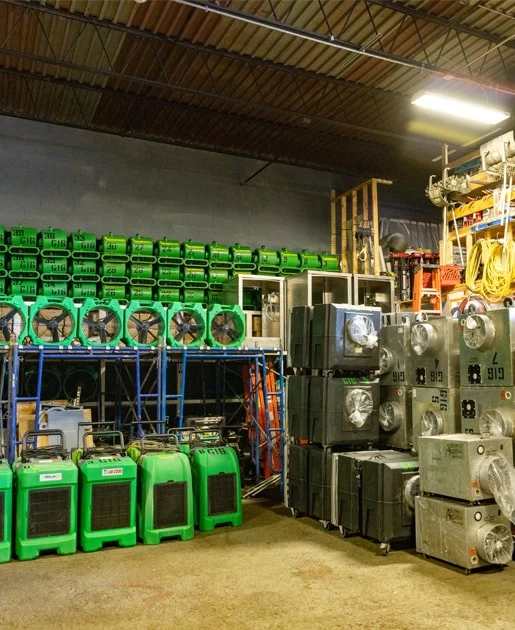
Once the assessment is complete, extraction begins using truck-mounted and portable equipment designed for the scale of a full basement. In Lattingtown, where finished basements in estate-scale homes can be large and complex, portable units alone often aren’t enough. After extraction, industrial air movers and dehumidifiers are placed to begin structural drying — a process that typically takes two to five days depending on the extent of saturation and the construction of the space. Moisture readings are taken throughout, not just at the surface.
If the assessment reveals hazardous materials — asbestos floor tiles, lead paint disturbed by water — we handle licensed abatement as part of the same project. Once everything is dry and cleared, the rebuild begins: drywall, flooring, framing. Because we hold a Nassau County General Contractor license, we can pull the permits the Village of Lattingtown requires and complete the structural restoration without you coordinating a separate contractor.
Flooded Basement Cleaning Services, Lattingtown NY
Built for North Shore Homes, Not Generic Checklists
Flooded basement cleanup in Lattingtown isn’t a one-size situation. The village’s combination of waterfront exposure, pre-war housing stock, and large-footprint estate homes creates conditions that demand more than a standard extraction-and-dry response. Our process accounts for that from the start.
Every job includes emergency water extraction, structural drying with calibrated industrial equipment, continuous moisture monitoring, and antimicrobial treatment of all affected surfaces. For Category 3 events — sewage backup, which can occur when storm drains overflow during heavy rain on Long Island’s North Shore — the response includes full decontamination protocols, removal of unsalvageable materials, and hospital-grade treatment of the affected area. This is a biohazard response, not a cleanup, and it requires the training and licensing to handle it correctly.
For homes along Mill Neck Creek or in the lower-elevation sections of the village where FEMA flood insurance requirements apply, we also assist with damage documentation and insurance communication — helping you build the record your carrier needs to process a claim, whether it falls under a standard homeowners policy or NFIP flood coverage. And because the Village of Lattingtown administers its own building permits separately from the Town of Oyster Bay, having a Nassau County licensed general contractor on your team means the rebuild is permitted, inspected, and documented — which protects your property value and keeps the project moving without gaps.
Does homeowners insurance cover flooded basement cleanup in Lattingtown, NY?
It depends entirely on what caused the flooding — and this is where a lot of Lattingtown homeowners get caught off guard. Standard homeowners insurance typically covers sudden, accidental water damage: a burst pipe, a failed water heater, an appliance malfunction. What it does not cover is natural flooding — water that enters your basement from groundwater rise, storm surge, or overflow from Mill Neck Creek. That type of flooding requires separate flood insurance, typically through the National Flood Insurance Program.
Several properties in Lattingtown — particularly those in lower-elevation areas near Mill Neck Creek — carry FEMA flood insurance requirements precisely because of this documented risk. If you’re not sure which policy applies to your situation, the most useful thing you can do right now is pull both policies and look at the cause-of-loss language. We can also help you document the damage in a way that supports whichever claim applies, and our team is experienced in communicating with carriers on behalf of homeowners going through this process.
How quickly does mold start growing after a basement floods on Long Island?
The EPA’s guidance puts it at 24 to 48 hours. That’s not a worst-case estimate — that’s the standard window under normal indoor conditions. On Long Island’s North Shore, where humidity levels are already elevated due to coastal exposure and the aquifer system keeps groundwater close to the surface in wet seasons, conditions in a flooded basement can accelerate that timeline.
The practical implication is that 72 hours is the outside window for preventing mold growth entirely. If your basement is fully dried within that timeframe, the risk of mold is dramatically reduced. If it isn’t — whether because you waited to call, or because a less-equipped company left moisture behind walls or under flooring — you’re likely looking at a mold remediation project on top of the original water damage cleanup. In Lattingtown’s older homes, where construction materials and wall cavities can hold moisture in ways that aren’t visible from the surface, getting industrial drying equipment in place quickly isn’t optional. It’s the difference between a contained event and a compounding one.
My Lattingtown home was built before 1940 — does that affect the cleanup process?
Yes, and it’s one of the most important questions to ask before any contractor touches your basement. Approximately 27 percent of homes in Lattingtown were built before 1940. Homes of that era commonly contain asbestos in floor tiles, pipe insulation, ceiling materials, and roofing — and lead-based paint in interior finishes. When water floods a basement in a pre-war home, it can disturb these materials. Once disturbed, asbestos fibers and lead dust become airborne hazards that require licensed abatement — not just cleanup.
Under New York State law, asbestos abatement requires a NYS Department of Labor Asbestos License. Lead work in residential settings requires USEPA Lead/RRP Certification. A contractor who proceeds with water extraction and demolition in a pre-war Lattingtown home without these credentials isn’t just cutting corners — they’re operating illegally and potentially creating a health hazard for your family. We hold both licenses and conduct hazardous material assessment as part of every job in older homes, so nothing gets disturbed without being properly identified and handled first.
What is the difference between water damage restoration and flood damage restoration?
The terms get used interchangeably, but they mean different things — both in terms of the work involved and how your insurance applies. Water damage restoration typically refers to cleanup and drying after an internal source: a burst pipe, a failed sump pump, a leaking appliance. The water is usually clean or lightly contaminated, and the primary goal is extraction, drying, and mold prevention.
Flood damage restoration refers to intrusion from an external natural source — storm surge, groundwater rise, creek overflow. In Lattingtown, that means events like a Mill Neck Creek overflow during a heavy rain event, or the kind of North Shore flash flooding that hit Long Island in August 2024. Flood damage often involves contaminated water carrying debris, sediment, and bacteria, which changes the decontamination requirements significantly. It also falls under a different insurance category, as noted above. The restoration process for true flood damage is more involved — more thorough decontamination, more material removal, more documentation — and it requires a contractor who understands the distinction and is equipped to handle both scenarios.
How long does flooded basement cleanup and drying typically take?
The extraction itself — getting the standing water out — usually takes a few hours depending on volume and basement size. The drying process is what takes time. Structural drying with industrial air movers and dehumidifiers typically runs two to five days for a standard basement. Larger, more complex spaces — and Lattingtown’s estate-scale homes can have extensive finished basements with multiple rooms, built-in features, and varied flooring materials — can take longer.
The key thing to understand is that visible dryness and actual dryness are not the same thing. Moisture trapped inside wall cavities, under subflooring, or within concrete block can persist long after the surface looks dry — and that’s where mold takes hold. We use calibrated moisture meters throughout the drying process to confirm that readings are within safe thresholds before equipment is removed. The job isn’t done when the floor looks dry. It’s done when the numbers confirm it.
Does Green Island Group handle the full basement rebuild after water damage, or just the cleanup?
We handle both — and that’s genuinely uncommon in this market. Most water damage companies stop at extraction and drying. Once your basement is dry, they hand you a referral to a general contractor for the structural rebuild, which means a second scheduling process, a second unknown crew, and a gap in accountability between the two phases of the project.
We hold a Nassau County General Contractor License, which means we can complete the full restoration: drywall replacement, flooring, framing, and finishing work. For Lattingtown homeowners with finished basements — home offices, media rooms, wine cellars — this matters. It also matters from a permitting standpoint. The Village of Lattingtown administers its own building permits separately from the Town of Oyster Bay, and any structural work following a flooding event requires those permits to be pulled correctly. Having a Nassau County licensed GC on your project from day one means the rebuild is permitted, inspected, and documented — which protects your property value and keeps the project moving without gaps.