When Your Locust Valley Basement Floods, the Clock Starts Immediately
Mold can take hold in as little as 72 hours. We respond 24/7 to flooded basement emergencies across Locust Valley and the surrounding North Shore communities — with the licenses to handle whatever your basement reveals.
I needed a professional consultation explanation of procedure for safe removal of Asbestos in my apartment complex. Without having an account yet, I was very impressed with the caring, knowledgeable and generous advice offered by Jessica, and will look forward to doing business in the future. Thank you so much! I feel much more informed about a sometimes scary endeavor. Peace. Nancy Silva Mineola, NY.
Mia Munoz
Used this company to clean up some water flood in my house. They were fast and easy to work with.very professional, Would recommend to anyone!
Nini Valle
Great company, had a flood and they responded quickly and efficiently. Billed my insurance company directly. I highly recommend this company!
joe colapietro, jr
I had pipe freeze in my basement right before a snow storm and they made to within an hour to help start the clean up process. They we by our side throughout the entire process and even helped with the insurance company. They did such a great job with the cleanup, repair, remidiation, I contracted them to perform the repairs and finishes in the basement. They came with enough manpower and material to get the job done. Leo and Jessica were nothing but a pleasure to deal with!!
Cristian Arredondo c
I had some water damage in my home and Green Island was able to take care of my issue quickly and effectively. I am very pleased with the work they did. They responded quickly and were very professional.
Michael M
Outstanding service! From the office to the field crew everyone was friendly, helpful and responsive. I highly recommend Green Island Group.
Standing water is the part you can see. The real damage is what hides inside the walls, beneath the subfloor, and behind the insulation after the water recedes. In Locust Valley, where more than half the housing stock was built before 1950, that hidden moisture doesn’t just sit there — it feeds mold colonies inside stone foundation walls, aged framing, and basement materials that were never designed to be waterproofed the way modern construction is.
Getting the basement dry — actually dry, not just visually dry — means the air quality in your home stays safe, the structural integrity of your foundation stays intact, and you’re not dealing with a mold remediation project three months from now because someone missed moisture behind a finished wall. That outcome matters in any home, but it matters more when the home is worth close to $900,000 and sits on a North Shore lot that drains through glacial moraine soil with unpredictable subsurface water movement.
The other thing that changes after a proper cleanup is your confidence. You know the job was done correctly, the documentation is ready for your insurance carrier, and you’re not waiting to see what grows. That peace of mind is what a thorough flooded basement cleanup actually delivers — not just a dry floor.
Licensed Basement Flood Remediation, Locust Valley NY
Every License the Job Requires — Under One Roof in Locust Valley
We hold a credential stack that is genuinely rare in the restoration industry: NYS DOL Mold License, NYS DOL Asbestos License, USEPA Lead and RRP certifications, IICRC Water Damage certification, and a Nassau County General Contractor license. That matters everywhere, but it matters especially in Locust Valley — where a flooded basement in a pre-war home can expose asbestos floor tiles, lead paint, and aged pipe insulation all at once. Most water damage companies aren’t licensed to touch those materials. We are.
We serve Locust Valley and the surrounding North Shore villages — Lattingtown, Mill Neck, Bayville, Matinecock, and beyond — and we’ve worked in the older estate homes, the finished basements, and the complex mechanical rooms that define this part of Nassau County. When you call, a real person answers. When our crew arrives, they’re equipped for whatever the job actually requires — not just what it looks like on the surface.
Basement Flooding Cleanup Process, Locust Valley NY
From First Call to Final Walkthrough — Here's Exactly How We Handle It
When you call us about a flooded basement in Locust Valley, the first thing that happens is a real conversation — not a voicemail. We ask the right questions to understand what you’re dealing with: how much water, where it’s coming from, what’s in the basement, and how long it’s been sitting. That information shapes the crew and equipment we dispatch, and it helps us give you an honest picture of what the cleanup will involve before anyone sets foot in your home.
Once on-site, we start with water extraction using industrial-grade pumps and wet vacuums — removing standing water as quickly as possible to stop the damage clock. After extraction, we use professional moisture meters and thermal imaging to find water that’s migrated into walls, flooring, and structural cavities. This is the step most homeowners don’t know to ask about, and it’s the step that separates a real restoration from a surface-level dry-out. In Locust Valley’s older homes, moisture inside a stone foundation wall or behind original plaster can stay active for weeks if it’s not identified and addressed.
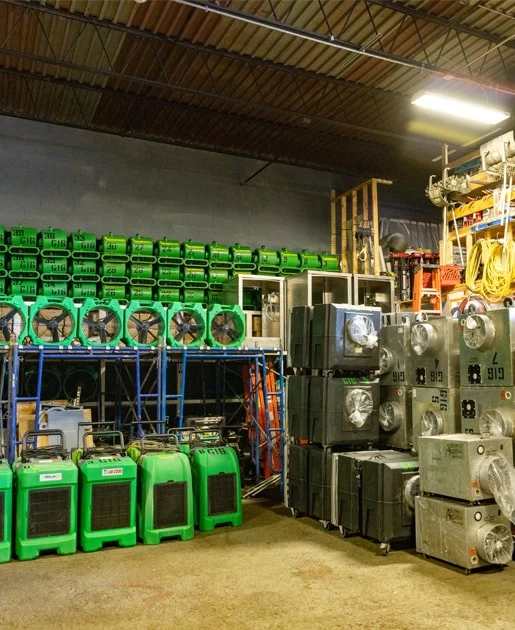
From there, we set up commercial drying equipment — air movers, dehumidifiers, and where needed, desiccant systems — and monitor daily until structural readings confirm the space is genuinely dry. If mold remediation, asbestos handling, or structural restoration is required, we handle all of it under our existing licenses. Because we hold a Nassau County General Contractor license, we can also pull the necessary permits through the Town of Oyster Bay Building Department for any structural work — so you’re not left coordinating a second contractor to finish the job.
Basement Water Cleanup Services, Nassau County North Shore
Built for the Homes That Actually Exist in Locust Valley
Flooded basement cleanup in Locust Valley isn’t a single-step job. Depending on the source of the water and what’s in your basement, the scope can range from straightforward extraction and drying to full multi-hazard remediation. We’re equipped for the full range — which is why homeowners across the North Shore call us instead of starting with one company and finishing with three.
For clean water events — a burst pipe, a failed sump pump, an appliance leak — the process centers on rapid extraction, structural drying, and moisture verification. For Category 2 or Category 3 events involving gray water or sewage backup, we add full decontamination protocols, because sewage in a basement isn’t just a cleanup problem — it’s a biological health hazard that requires licensed handling. Sewage backup during heavy rain events is a real and recurring issue in Locust Valley, where older lateral sewer connections can be overwhelmed when storm systems saturate the ground.
For homes built before 1978 — which describes the majority of Locust Valley’s housing stock — we assess for asbestos-containing materials and lead paint before any demolition or drywall removal begins. This isn’t optional in New York State, and it isn’t something an unlicensed crew can legally perform. Our NYS DOL Asbestos and USEPA Lead certifications mean we can handle what the job actually requires, not just the parts that are easy. Every job also includes insurance documentation support — detailed damage reports, photo documentation, and carrier communication — so your claim process starts on solid footing from day one.
Does homeowners insurance cover a flooded basement in Locust Valley, NY?
It depends on what caused the flooding — and that distinction matters more than most homeowners realize. Standard homeowners insurance typically covers sudden, accidental water damage: a burst pipe, a washing machine hose that fails, a water heater that cracks. What it generally does not cover is natural flooding — groundwater intrusion, storm surge, or surface water that enters your basement during a heavy rain event. For that type of coverage, you need a separate flood insurance policy, typically through the National Flood Insurance Program (NFIP) or a private flood carrier.
In Locust Valley, the distinction gets complicated quickly. The North Shore’s glacial moraine geology means that during a significant storm, water can enter a basement through multiple pathways simultaneously — through the foundation wall from saturated soil, through a failed sump pump, and through a floor drain — making it genuinely unclear which coverage applies. We assist with insurance documentation from the start, including detailed damage reports and photo evidence that help your carrier understand exactly what happened and why. Getting that documentation right at the beginning of the process is one of the most important things you can do for your claim.
How quickly does mold start growing after a basement floods?
The EPA recommends beginning cleanup within 24 to 48 hours of a water intrusion event. Mold can begin developing within 24 to 72 hours under the right conditions — and a wet basement in a Locust Valley home, especially one with older plaster walls, wood framing, or finished drywall, provides exactly the right conditions: moisture, organic material, and limited airflow. Once mold establishes itself inside a wall cavity or beneath a subfloor, the remediation scope and cost increase significantly compared to what a timely cleanup would have required.
The 72-hour window is the number to keep in mind. It’s not a guarantee — mold can move faster in warmer months or slower in a cold, well-ventilated space — but it’s the threshold that defines the difference between a drying job and a remediation job. That’s why we operate 24/7 for emergency response. Calling at 11 p.m. after discovering a flooded basement is not an inconvenience — it’s exactly when you should call, because every hour you wait narrows the window for the cleanest possible outcome.
My Locust Valley home is older — does that change what cleanup involves?
Yes, significantly. Locust Valley has one of the oldest housing concentrations in Nassau County, with more than 42% of homes built before 1940 and over half predating 1950. Homes of that age were commonly built with materials that require licensed handling during any demolition or remediation work: asbestos floor tiles in basement utility areas, asbestos insulation on older steam and boiler pipe systems, and lead paint on basement walls, window frames, and trim. These materials are stable when undisturbed — but a flood event that requires tearing out drywall, pulling up flooring, or removing damaged insulation changes that equation entirely.
In New York State, mold remediation requires a licensed contractor under the NYS Department of Labor. Asbestos abatement requires a separate NYS DOL Asbestos license. Lead work in pre-1978 homes falls under USEPA Lead and RRP certification requirements. We hold all of these credentials, which means we can legally and safely handle what your pre-war Locust Valley basement may reveal — without stopping the job to source a separate licensed hazmat contractor. For homeowners in the surrounding estate villages of Lattingtown, Matinecock, and Mill Neck, where many properties are even older and more architecturally complex, this matters considerably.
What does flooded basement cleanup actually cost in Nassau County?
The range is wide, and the honest answer is that cost depends heavily on the size of the space, the source of the water, how long it sat, and what materials are involved. Industry data puts the general range at roughly $4 to $12 per square foot for cleanup and drying, with total costs ranging from around $1,600 for a minor clean-water event in a small unfinished space to $12,000 or more for a larger basement with contaminated water. Full structural restoration after a significant flood — drywall replacement, flooring, framing repair — can push costs considerably higher, particularly in finished basements.
For Locust Valley homeowners, the more useful frame is the cost of inaction. FEMA data indicates that just one inch of water can cause approximately $25,000 in property damage when the full scope of structural and material loss is accounted for. Delaying cleanup past the 72-hour mold threshold typically adds remediation costs on top of restoration costs — a combination that is almost always more expensive than acting immediately. We provide a clear, detailed assessment before any work begins so you understand exactly what the job involves and what it will cost — no surprises after the fact.
What's the difference between water extraction and full basement flood remediation?
Water extraction is one step in a larger process — it’s the removal of standing water using pumps and wet vacuums. It’s necessary, but it’s not the same as remediation. A basement can look completely dry after extraction and still have significant moisture trapped inside wall cavities, beneath flooring, inside insulation, and within concrete block or stone foundation walls. That hidden moisture is what drives mold growth, structural deterioration, and air quality problems in the weeks and months after a flood.
Full basement flood remediation includes extraction, but it also includes moisture mapping with professional meters and thermal imaging, structural drying with commercial air movers and dehumidifiers, and verification testing to confirm the space has reached acceptable moisture levels before the job is closed. In older Locust Valley homes — particularly those with stone or brick foundation walls, original plaster, or finished basement spaces — the drying process takes longer and requires more monitoring than a newer home with poured concrete and modern materials. If mold is found during the process, or if hazardous materials like asbestos or lead are present, remediation expands to include those scopes as well. We handle all of it without requiring you to bring in additional contractors.
Can basement flooding in Locust Valley be prevented after cleanup is done?
In many cases, yes — and understanding why your basement flooded in the first place is the starting point. Locust Valley sits on glacial moraine terrain, which means the soil beneath and around your foundation is a mix of clay, silt, sand, and gravel that drains unpredictably. During heavy rain events or prolonged nor’easters — the kind that park over the Long Island Sound for two or three days — that soil becomes saturated and water migrates laterally toward foundation walls rather than draining downward. Sump pump failure during these events is one of the most common causes of basement flooding across the North Shore.
After cleanup is complete, we can walk you through what actually caused the intrusion and what mitigation options are worth considering — whether that’s a sump pump upgrade with a battery backup, improved drainage around the foundation perimeter, or sealing work on foundation wall cracks that allowed water in. For homes in lower-lying areas near Bayville Road or properties at the base of Locust Valley’s rolling hills, the conversation about drainage is especially relevant because topography actively directs stormwater toward certain foundations. We’re not here to upsell you on work you don’t need — but we’ll give you an honest read on what’s likely to happen again if the underlying conditions aren’t addressed.