Most homes in Manhasset Hills were built around 1962 — and flooded basement cleanup in a house that old is a different job entirely. We handle it all, from water extraction to structural drying, with every license New York requires.
I needed a professional consultation explanation of procedure for safe removal of Asbestos in my apartment complex. Without having an account yet, I was very impressed with the caring, knowledgeable and generous advice offered by Jessica, and will look forward to doing business in the future. Thank you so much! I feel much more informed about a sometimes scary endeavor. Peace. Nancy Silva Mineola, NY.
Mia Munoz
Used this company to clean up some water flood in my house. They were fast and easy to work with.very professional, Would recommend to anyone!
Nini Valle
Great company, had a flood and they responded quickly and efficiently. Billed my insurance company directly. I highly recommend this company!
joe colapietro, jr
I had pipe freeze in my basement right before a snow storm and they made to within an hour to help start the clean up process. They we by our side throughout the entire process and even helped with the insurance company. They did such a great job with the cleanup, repair, remidiation, I contracted them to perform the repairs and finishes in the basement. They came with enough manpower and material to get the job done. Leo and Jessica were nothing but a pleasure to deal with!!
Cristian Arredondo c
I had some water damage in my home and Green Island was able to take care of my issue quickly and effectively. I am very pleased with the work they did. They responded quickly and were very professional.
Michael M
Outstanding service! From the office to the field crew everyone was friendly, helpful and responsive. I highly recommend Green Island Group.
Basement Water Damage Restoration, Manhasset Hills
What Changes When the Water Is Actually Gone
A wet basement isn’t just an inconvenience — it’s a clock that started the moment water touched your floor. Mold can begin colonizing porous materials within 24 to 48 hours. In a home built in the early 1960s with original wood framing, drywall, and insulation, that window closes fast. Getting ahead of it means the difference between a cleanup and a full remediation project.
What most homeowners in Manhasset Hills don’t realize is that the risk doesn’t stop at visible water. Moisture hides inside wall cavities, under original hardwood floors, and behind the kind of plaster and lath construction common in the mid-century split-levels throughout this hamlet. A surface that looks dry can still be holding enough moisture to feed mold for weeks. Professional moisture detection finds what a fan and a dehumidifier from the hardware store won’t.
There’s also the hazard layer that comes with older construction. Homes built before 1978 frequently contain asbestos floor tiles, pipe insulation, and joint compound — materials that are completely stable until water disturbs them. At that point, the cleanup requires licensed handling under New York State law. That’s not a formality. It’s the difference between a safe remediation and a health risk that outlasts the flood itself. When your home in Manhasset Hills was built in an era when these materials were standard, that credential check isn’t optional.
Licensed Basement Flooding Remediation, Nassau County
Every License the Job Actually Requires
Green Island Group is a full-service disaster restoration and environmental remediation company serving Nassau County, Suffolk County, and the New York City metro area. We serve homeowners throughout Manhasset Hills and the Town of North Hempstead with the complete credential stack this work demands.
That means the NYS Department of Labor Mold Remediation License, the NYS DOL Asbestos Contractor License, USEPA Lead/RRP certification, IICRC Water and Fire Damage certification, and a General Contractor license covering Nassau County. New York is one of only a handful of states that requires a dedicated mold remediation license. Most companies advertising water damage restoration in this area hold one or two of these credentials. We hold all of them — which means you’re not stopping mid-project to bring in a separate licensed contractor when something unexpected turns up in a 60-year-old basement.
We handle water extraction, structural drying, mold prevention, hazmat handling, and full restoration under one roof. One call, one company, one job done right.
Emergency Flooded Basement Cleaning, North Hempstead
From the First Call to a Dry, Safe Basement
When you call, someone answers — around the clock, every day. That’s not a marketing line; it’s the operational reality of doing emergency restoration work. Sump pump failures in Manhasset Hills don’t wait for business hours, and neither do we. The 72-hour mold window starts the moment water enters your home, so the first call matters.
Once we’re on-site, we start with a full assessment before anything else. That means moisture readings inside wall cavities, under flooring, and along the foundation — not just the visible standing water. In a mid-century split-level, water can travel through the structure in ways that aren’t obvious from a visual scan. We use professional detection equipment to map exactly where the moisture is before we start drying, because drying the wrong areas first doesn’t solve the problem — it just delays it.
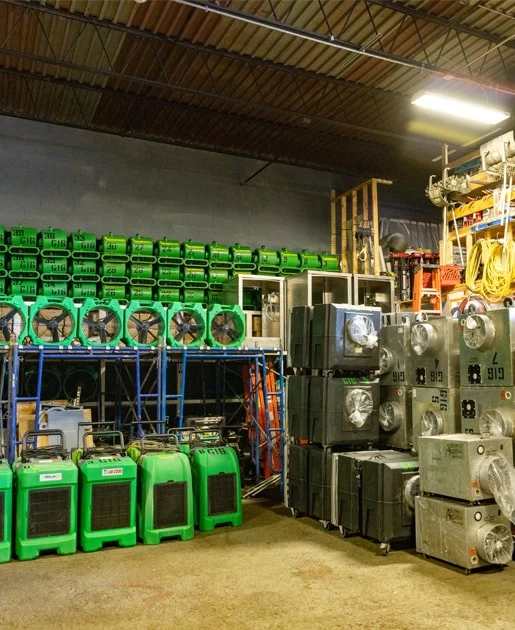
From there, we extract the water, set up industrial drying equipment, and monitor moisture levels until the structure is genuinely dry — not surface dry. If the assessment turns up asbestos-containing materials or lead-painted surfaces that were disturbed by the water, we handle that under our NYS DOL licenses before any restoration work begins. Any structural work that follows — drywall replacement, framing repair, flooring — is permitted through the Town of North Hempstead Building Department, which our Nassau County General Contractor license covers. You don’t have to manage that process. We do.
Basement Water Cleanup Services, Manhasset Hills NY
Built for Older Homes, Not Generic Checklists
Flooded basement cleanup in Manhasset Hills isn’t a one-size-fits-all job. The housing stock here — predominantly split-levels and ranches built between 1940 and 1969, including the original Cherrywood Homes development off the Northern State Parkway corridor — presents a specific set of conditions that a standard drying company isn’t equipped to handle. We are.
Every job starts with a Category assessment. Clean water from a burst supply line is handled differently than gray water from a backed-up drain, and differently again from Category 3 black water — which is what you’re dealing with when Nassau County’s aging sewer infrastructure backs up through your floor drain during a heavy rain event. That distinction determines the decontamination protocol, the disposal requirements, and the level of protective handling your home needs.
From there, the scope covers water extraction, structural drying with industrial equipment, moisture verification, mold prevention treatment, and — where applicable — asbestos or lead handling under our state and federal licenses. Structural restoration, including drywall, framing, flooring, and any required electrical work, is completed under our Nassau County General Contractor license with all required Town of North Hempstead permits pulled on your behalf. Your home at the end of this process isn’t just dry. It’s documented, permitted, and restored to a condition your insurance carrier and a future buyer can both verify.
Does homeowners insurance cover a flooded basement in Manhasset Hills, NY?
This is one of the most important things to understand before an event happens, not after. Standard homeowners insurance covers sudden and accidental water damage — a burst pipe, a failed water heater, an appliance that malfunctions. It does not cover flooding from natural sources: groundwater intrusion, rising water table, storm drainage backup, or surface water entering your home. Those events require a separate flood insurance policy, typically through the National Flood Insurance Program.
For Manhasset Hills specifically, the flood risk profile is driven by inland conditions — groundwater pressure against aging foundations, storm drains overwhelmed during heavy nor’easters, and sump pump failures during extended power outages — rather than coastal storm surge. If your sump pump fails during a power outage and groundwater floods your basement, that may fall outside your standard homeowners policy entirely. Knowing what you have before the water rises is worth the 20-minute call to your insurance agent. We help document damage and communicate with carriers once an event happens, but the coverage question is one to resolve now.
How quickly does mold grow after a basement floods on Long Island?
The EPA recommends starting cleanup within 24 to 48 hours of water intrusion. If the affected area is dried out within 72 hours, mold growth is unlikely. Beyond that window, mold begins colonizing porous materials — drywall, wood framing, insulation, stored belongings — and what started as a water damage event becomes a mold remediation project with a significantly higher cost and scope.
In a home built around 1962, the way moisture moves through the structure makes this window even more critical. Original wood framing, plaster walls, and older insulation absorb and hold water differently than modern materials. The surface can appear dry while moisture is still active inside the wall cavity. That’s why professional moisture detection matters — and why calling immediately, rather than waiting to see if things dry on their own, is almost always the right call. In Manhasset Hills, where the average home is worth over $1 million, the cost of a same-day response is a small fraction of what secondary mold damage can cost to remediate.
My basement has old floor tiles — is asbestos a concern during cleanup?
If your home was built before 1978, there’s a real possibility that your basement contains asbestos-containing materials. Floor tiles, pipe insulation, ceiling tiles, and joint compound were all commonly manufactured with asbestos through the 1970s. In Manhasset Hills, where the median construction year is 1962, this applies to the majority of homes in the hamlet.
Asbestos-containing materials that are intact and undisturbed generally don’t pose an immediate health risk. The problem is that flooding disturbs them. Water can loosen floor tile adhesive, saturate pipe insulation, and compromise ceiling materials — all of which can release asbestos fibers if handled incorrectly during cleanup. New York State law requires a licensed NYS DOL Asbestos Contractor to handle and dispose of these materials. We hold that license. If a cleanup crew without that credential disturbs asbestos materials in your basement, they’re creating a health hazard and a legal liability. Before anyone starts pulling up wet tiles or cutting out wet drywall in a pre-1978 home, confirm they’re licensed for what they might find.
What causes basement flooding in Manhasset Hills when it's not a burst pipe?
This is a common situation in inland Nassau County communities, and the cause is usually one of a few things. The most frequent is sump pump failure — either because the pump itself failed mechanically or because a nor’easter or tropical storm knocked out power long enough for the pit to overflow. Mid-century homes throughout Manhasset Hills were built with basement drainage systems that weren’t designed for the storm intensity Long Island sees today, and a pump that’s been in place for 20 years may not be reliable when it’s needed most.
The second common cause is hydrostatic pressure. During prolonged wet periods — particularly the late winter and spring snowmelt season — the water table in Nassau County can rise close enough to basement floor level that water pushes through foundation cracks and floor joints under pressure. This isn’t a plumbing problem; it’s a groundwater problem, and it won’t be fixed by a plumber. The third cause is storm drain backup: when the municipal drainage system is overwhelmed during heavy rain, water can reverse through floor drains. That’s a Category 3 contamination event that requires full decontamination, not just drying.
How much does flooded basement cleanup cost in Nassau County?
The honest answer is that it depends heavily on the source of the water, how long it sat, and what materials were affected. For a straightforward clean-water event — a burst pipe caught quickly, minimal standing water, no secondary damage — professional extraction and drying typically runs in the range of $1,600 to $4,000. A more significant event with deeper water, saturated walls, and flooring damage can run $5,000 to $12,000 or more.
Where costs escalate significantly is when cleanup is delayed. If the 72-hour mold window passes before professional drying begins, you’re now looking at mold remediation on top of water damage restoration — a scope that can reach $30,000 or more depending on how far the mold has spread. In a home in Manhasset Hills worth over $1 million, that’s a real financial exposure. Add in asbestos abatement if disturbed materials are found, and the cost of acting slowly compounds quickly. The cost of calling immediately is almost always lower than the cost of waiting.
Can I clean up a flooded basement myself in an older Manhasset Hills home?
For a very minor, clean-water event — a small appliance leak, minimal water, caught within an hour — basic DIY drying is reasonable. But for anything beyond that, especially in a home built in the 1960s, the risks of doing it yourself outweigh the savings by a wide margin.
The core issue is what you can’t see and what you might not know to look for. Moisture inside wall cavities, under original hardwood floors, and behind baseboards won’t be found with a towel and a fan. If it’s left there, mold follows. If the flood disturbed asbestos floor tiles or lead-painted surfaces — both common in Manhasset Hills homes of this era — improper handling creates a genuine health hazard and potential liability. New York State law requires licensed contractors for mold remediation and asbestos abatement; that’s not something a homeowner can legally self-perform on a property they plan to sell or rent. Beyond the health and legal considerations, insurance documentation matters too. A professionally documented and permitted restoration protects your claim and your home’s value in ways that a DIY cleanup simply doesn’t.