When Manhasset Bay Pushes Water Into Your Home, Every Hour Counts
Manorhaven sits on the water — and that means flooding isn’t a worst-case scenario, it’s a recurring reality. We respond 24/7 with the licenses, equipment, and experience to stop the damage before it compounds.
I needed a professional consultation explanation of procedure for safe removal of Asbestos in my apartment complex. Without having an account yet, I was very impressed with the caring, knowledgeable and generous advice offered by Jessica, and will look forward to doing business in the future. Thank you so much! I feel much more informed about a sometimes scary endeavor. Peace. Nancy Silva Mineola, NY.
Mia Munoz
Used this company to clean up some water flood in my house. They were fast and easy to work with.very professional, Would recommend to anyone!
Nini Valle
Great company, had a flood and they responded quickly and efficiently. Billed my insurance company directly. I highly recommend this company!
joe colapietro, jr
I had pipe freeze in my basement right before a snow storm and they made to within an hour to help start the clean up process. They we by our side throughout the entire process and even helped with the insurance company. They did such a great job with the cleanup, repair, remidiation, I contracted them to perform the repairs and finishes in the basement. They came with enough manpower and material to get the job done. Leo and Jessica were nothing but a pleasure to deal with!!
Cristian Arredondo c
I had some water damage in my home and Green Island was able to take care of my issue quickly and effectively. I am very pleased with the work they did. They responded quickly and were very professional.
Michael M
Outstanding service! From the office to the field crew everyone was friendly, helpful and responsive. I highly recommend Green Island Group.
When the water is gone and the basement is genuinely dry — not just surface dry, but structurally dry — you stop worrying. You stop checking the walls. You stop wondering if something was missed behind the drywall or under the subfloor. That’s what a properly completed flooded basement cleanup actually delivers, and it’s the difference between moving on and spending the next six months dealing with mold.
In Manorhaven, that window is tight. The village sits on the Cow Neck Peninsula, surrounded by Manhasset Bay, and when a nor’easter rolls through or storm surge pushes inland, multiple homes flood at once. Mold can begin developing within 24 to 48 hours in the right conditions. If the basement isn’t fully dried within 72 hours, what started as a water removal job becomes a significantly more expensive remediation project — one that disrupts your home, your family, and your schedule far longer than the original flood would have.
There’s also the older housing stock to consider. A large portion of Manorhaven’s homes were built before 1978, which means asbestos floor tiles, pipe insulation, and lead paint are more common than most homeowners realize. Floodwater doesn’t stay in one place — it disturbs materials, it spreads contamination, and it creates risks that a standard cleanup crew isn’t licensed to handle. Getting this right the first time means you don’t find out six months later that something was left behind.
Licensed Basement Flooding Remediation, Nassau County
Every License This Job Actually Requires — Under One Roof
We hold the NYS Department of Labor Mold License, NYS DOL Asbestos License, USEPA Lead and RRP certifications, IICRC Water Damage certification, and a Nassau County General Contractor license. New York is one of only a handful of states in the country that requires a dedicated state mold license to legally perform remediation work. Most restoration companies operating in Nassau County hold one or two relevant credentials. We hold all of them.
That matters in Manorhaven specifically. When you’re dealing with a pre-1978 home near the bay, a sewage backup through the Port Washington Water Pollution Control District’s infrastructure, or a storm surge event that’s simultaneously affecting your neighbors on Manorhaven Boulevard — you need one company that can legally and competently handle every layer of the problem. Water extraction, mold prevention, hazardous material management, structural restoration. One call, one contractor, one point of accountability from start to finish.
What Actually Happens From First Call to Final Walkthrough
The first call gets a real person. You describe what you’re seeing, and we dispatch — 24 hours a day, seven days a week. In a coastal village like Manorhaven, where major highways are several miles south and storm events can create regional demand spikes across all of Nassau County’s North Shore simultaneously, that dispatch commitment matters. You’re not getting triaged to the back of a queue because you’re on the peninsula.
On arrival, the first step is assessment — not just how much water, but what kind. A storm surge event from Manhasset Bay carries different contamination risk than a sump pump failure during a nor’easter, and the cleanup protocol changes accordingly. Water is categorized, the source is identified, and the scope is documented. This documentation also serves as the foundation for your insurance claim, whether you’re filing under a standard homeowners policy for a burst pipe or a separate flood policy for a coastal event.
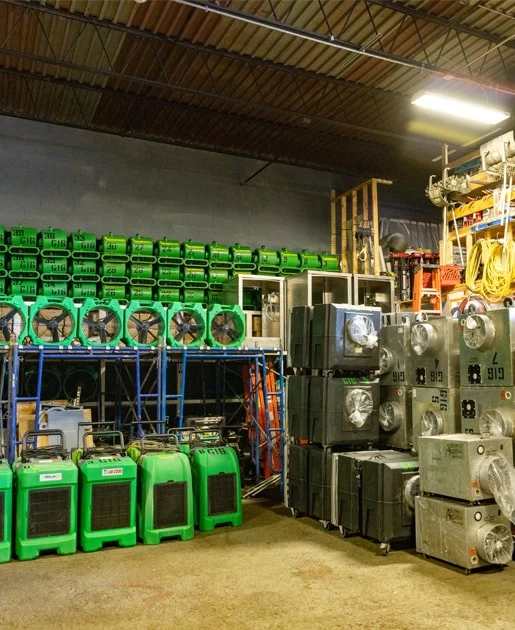
From there, industrial pumps handle extraction, followed by commercial-grade dehumidifiers and high-velocity air movers that pull moisture out of walls, concrete, and subfloor materials — not just the visible surface. Moisture readings are taken throughout the drying process, not just at the end. If your home was built before 1978, any materials that may contain asbestos or lead are identified and handled under the appropriate licensed protocols before the restoration phase begins. When the structural work is complete, a final walkthrough confirms the job is actually done.
Flooded Basement Cleaning and Restoration, Manorhaven
Built for the Specific Risks Manorhaven Homeowners Actually Face
Flooded basement cleanup in Manorhaven isn’t a one-size-fits-all job, and our service reflects that. Every cleanup begins with water extraction and contamination assessment, followed by full structural drying using industrial equipment — not consumer-grade dehumidifiers. Hidden moisture inside walls and under flooring is located using professional moisture meters, because surface dryness and structural dryness are not the same thing, and confusing the two is how mold problems develop weeks after the water is gone.
For homes in Manorhaven’s older residential stock — many of which were built mid-20th century — our service includes licensed assessment and handling of any materials that may contain asbestos or lead paint disturbed by the flooding. This is not a subcontracted add-on. Our NYS DOL Asbestos License and USEPA Lead certifications mean this is handled in-house, under one contract, without the coordination gap that comes from bringing in a second company.
Sewage backup cleanup, which is a real risk in a village connected to aging combined sewer infrastructure, is treated as the biohazard event it actually is — full decontamination, proper material disposal, and bacterial clearance verification. And because we hold a Nassau County General Contractor license, the restoration phase — drywall, flooring, framing — is completed by the same team that did the cleanup. You don’t hand off to a third party once the water is gone. The job gets finished.
Does homeowners insurance cover flooded basement cleanup in Manorhaven, NY?
It depends on the source of the water, and this distinction matters more in Manorhaven than in most Nassau County communities. Standard homeowners insurance typically covers sudden and accidental water damage — a burst pipe, a washing machine overflow, a water heater failure. What it generally does not cover is flooding from an external natural source, which includes storm surge from Manhasset Bay, rising groundwater, or surface water entering through foundation cracks during a heavy rain event. That type of flooding typically requires a separate flood insurance policy, either through the National Flood Insurance Program (NFIP) or a private carrier.
Because Manorhaven sits on the Cow Neck Peninsula with direct bay exposure, many homeowners here carry both types of coverage — sometimes as a mortgage requirement. The practical challenge is knowing which policy applies to your specific event and documenting the damage in a way that supports the claim. We assist with damage documentation and can help you present a clear, organized case to your insurance carrier. Getting that documentation right from the start significantly reduces the risk of a disputed or denied claim.
How quickly does mold start growing after a basement floods?
Mold can begin developing within 24 to 48 hours under the right conditions — and a wet basement in a coastal village like Manorhaven, where humidity levels are already elevated from proximity to Manhasset Bay, provides exactly those conditions. The commonly cited 72-hour window is real, but it’s a ceiling, not a guarantee. If the basement is warm, the water has reached porous materials like drywall or wood framing, and airflow is limited, growth can begin earlier.
What most homeowners don’t realize is that mold doesn’t need to be visible to be a problem. It can establish behind walls, under flooring, and inside insulation long before it shows up on a surface. By the time you see it, it’s already been growing for a while. This is why the drying process matters as much as the extraction — getting the water out quickly is step one, but confirming that structural materials have reached safe moisture levels is what actually stops mold from developing. Professional moisture readings at multiple points throughout the drying process are the only way to confirm the job is genuinely complete.
What's the difference between Category 1, 2, and 3 basement flooding?
The water category determines the cleanup protocol, the health risk level, and what can be salvaged versus what has to be removed. Category 1 is clean water — a burst supply line, a failed water heater, a clean-source sump pump overflow. It’s the least hazardous and the most straightforward to address. Category 2 is gray water, which contains some level of contamination — think washing machine discharge or a toilet overflow without solid waste. It requires more careful handling and more thorough disinfection. Category 3 is black water, which is fully contaminated — sewage backup, floodwater that has contacted the ground surface, or storm surge from Manhasset Bay that has picked up contaminants along the way.
In Manorhaven, Category 3 events are not rare. A nor’easter that pushes bay water across low-lying areas near the waterfront, or a sewer backup during a heavy storm when the system is overwhelmed, both qualify. Category 3 flooding requires full decontamination protocols — not just extraction and drying, but treatment of all affected surfaces, proper disposal of contaminated materials, and verification that bacterial contamination has been eliminated. It’s a meaningfully different scope of work than a Category 1 cleanup, and treating them the same way is how health risks get left behind.
My Manorhaven home was built in the 1950s — does that affect the cleanup process?
Yes, and it’s worth understanding before any work begins. Homes built before 1978 — which covers a significant portion of Manorhaven’s housing stock, given that the village developed primarily through the mid-20th century — commonly contain asbestos floor tiles, asbestos pipe insulation, and lead paint. Under normal conditions, these materials are stable and don’t pose an immediate risk. But when a basement floods, water disturbs things. Floor tiles crack and lift. Insulation gets saturated. Drywall compounds that contain older materials break down. The result can be hazardous particles in the water and air that a standard cleanup crew is not licensed to handle.
We hold both the NYS Department of Labor Asbestos License and USEPA Lead and RRP certifications. That means if hazardous materials are identified during the cleanup — and in a pre-1978 Manorhaven home, they often are — they’re handled in-house under the appropriate licensed protocols, without bringing in a separate contractor. This matters practically because it eliminates a coordination gap that can delay your project and create liability questions about who’s responsible for what. One company handles the full scope, beginning to end.
How long does flooded basement cleanup and drying actually take?
The honest answer is that it depends on the scope — how much water, how long it sat, what materials were affected, and what category the water falls into. A straightforward Category 1 event in a smaller basement with no structural damage can be extracted and dried within three to five days using commercial equipment. A larger event, a Category 3 contamination situation, or a basement where water sat for an extended period before cleanup began can take significantly longer — particularly if structural materials need to be removed and replaced before the drying phase can be completed.
In Manorhaven, timing is especially relevant during spring nor’easter season and the late-summer hurricane window, when multiple properties in the village may flood simultaneously. The density of the village — more than 14,000 people per square mile in under a square mile of land — means that a single storm event affects a lot of households at once. Starting the process as quickly as possible, rather than waiting to see if the water recedes on its own, is what keeps a manageable cleanup from becoming a mold remediation project. The equipment and the response time are both part of the equation.
Can I clean up a flooded basement myself instead of hiring a professional?
For a very small, clean-water event — a minor appliance leak, a small amount of water that hasn’t reached walls or flooring — some homeowners manage it themselves. But for anything beyond that, the risks of a DIY cleanup in a Manorhaven home outweigh the savings pretty quickly. The core issue is equipment. A shop vac and a box fan do not dry a basement to a structurally safe moisture level. They remove visible water and create the appearance of dryness while moisture remains trapped inside concrete, wall cavities, and subfloor materials — exactly where mold establishes itself.
There’s also the contamination question. If your basement flooded during a storm event and the water came in from outside, from a sewer backup, or from any source other than a clean supply line, you’re likely dealing with Category 2 or Category 3 water. That requires proper disinfection and disposal, not just drying. And in a pre-1978 Manorhaven home, disturbing floor tiles or insulation without knowing whether asbestos is present creates a hazmat situation that no amount of DIY effort can resolve safely. The cost of professional cleanup is real — but it’s consistently less than the cost of remediating a mold outbreak or addressing a health issue that developed because the original cleanup wasn’t complete.