When South Shore Flooding Hits, Your Massapequa Basement Needs More Than a Wet-Vac
Massapequa homes were built in a different era — and when they flood, the cleanup often goes deeper than water. We handle flooded basement cleanup in Massapequa, NY with the full licensing stack to manage whatever your basement is hiding.
I needed a professional consultation explanation of procedure for safe removal of Asbestos in my apartment complex. Without having an account yet, I was very impressed with the caring, knowledgeable and generous advice offered by Jessica, and will look forward to doing business in the future. Thank you so much! I feel much more informed about a sometimes scary endeavor. Peace. Nancy Silva Mineola, NY.
Mia Munoz
Used this company to clean up some water flood in my house. They were fast and easy to work with.very professional, Would recommend to anyone!
Nini Valle
Great company, had a flood and they responded quickly and efficiently. Billed my insurance company directly. I highly recommend this company!
joe colapietro, jr
I had pipe freeze in my basement right before a snow storm and they made to within an hour to help start the clean up process. They we by our side throughout the entire process and even helped with the insurance company. They did such a great job with the cleanup, repair, remidiation, I contracted them to perform the repairs and finishes in the basement. They came with enough manpower and material to get the job done. Leo and Jessica were nothing but a pleasure to deal with!!
Cristian Arredondo c
I had some water damage in my home and Green Island was able to take care of my issue quickly and effectively. I am very pleased with the work they did. They responded quickly and were very professional.
Michael M
Outstanding service! From the office to the field crew everyone was friendly, helpful and responsive. I highly recommend Green Island Group.
Dry Floors Are Just the Beginning — Here's What Actually Gets Fixed
A flooded basement in Massapequa is rarely just a wet floor. When storm drains back up along the flat South Shore terrain, or when South Oyster Bay pushes water into Biltmore Shores and Nassau Shores during a coastal storm, what comes in through your foundation isn’t clean. It’s Category 2 or Category 3 water — and it needs to be treated accordingly, not just dried and forgotten.
The bigger issue is what happens in the 72 hours after the water shows up. Mold doesn’t wait. If your basement isn’t fully dried — walls, subfloor, insulation, framing — mold growth becomes highly likely, and the cleanup cost grows fast. One inch of standing water can cause roughly $25,000 in damage. The average flood insurance claim runs nearly $46,000. Getting the job done right the first time isn’t just about your basement. It’s about protecting a home worth close to $900,000 in one of Nassau County’s most established neighborhoods.
What you get when the job is done correctly: a basement that’s dry all the way through, not just on the surface. Moisture readings confirmed with professional equipment. Air quality that’s been tested, not assumed. And if your home was built in the 1950s — which most Massapequa homes were — a team that’s actually licensed to handle what flooding disturbs in walls and floors of that era.
One Company Holds Every License Your Massapequa Basement Actually Needs
We’re a Long Island-based restoration and remediation company serving Nassau and Suffolk Counties. When you call the 631 number, you reach us — not a national call center routing your job to whoever’s available. We’ve been responding to South Shore flooding events, including the August 2024 storm that dumped over 9 inches of rain across Nassau County in a single day, and we know what basement flooding in Massapequa actually looks like.
What separates us isn’t a tagline. It’s the license stack. NYS DOL Mold License. NYS DOL Asbestos License. USEPA Lead and RRP Certifications. IICRC Water Damage Certification. Nassau County General Contractor License. No competitor in the Massapequa market holds all of these simultaneously — and in a community where the median home was built in 1956, that matters more than most homeowners realize until it’s too late.
We’re also a certified Minority- and Women-Owned Business (NYS MBE, NYS WBE, NYC MWBE, NYS SBE). That’s not a footnote — it’s part of who we are and how we operate.
From Standing Water to Confirmed Dry — What the Process Actually Looks Like
The first call matters. When you reach us, we’re assessing before we even arrive — asking about the water source, how long it’s been sitting, and whether your home is a candidate for hazardous material exposure. In Massapequa, where the majority of homes were built between the 1940s and 1960s, that last question isn’t routine caution. It’s a required step. Asbestos floor tiles and lead-based paint were standard in homes of that era, and flooding can disturb both.
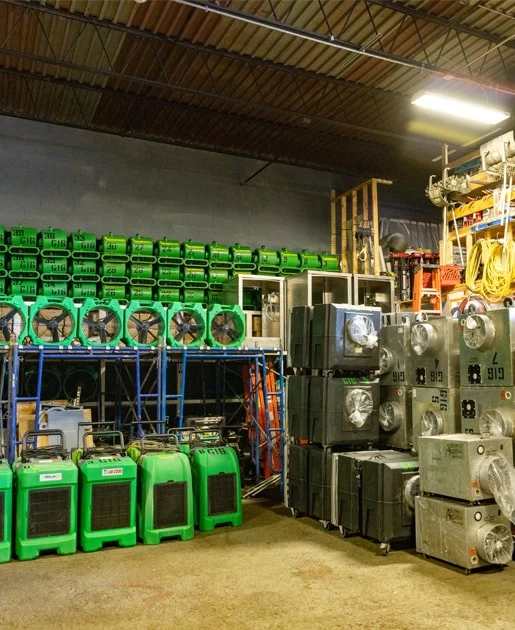
Once on site, we extract standing water immediately using industrial-grade equipment, then begin the drying process — not with a rental dehumidifier, but with commercial air movers and dehumidifiers positioned based on the specific layout of your space. Thermal imaging lets us see moisture inside walls and under floors that you can’t see with your eyes. We don’t call the job done until moisture readings confirm it.
If mold is present — or if the water source was a drain backup or storm surge event — we handle remediation after drying, and it’s done by the same licensed team. No subcontractors, no handoffs, no gaps in accountability. If your basement needs structural repair after everything is cleared, our Nassau County General Contractor license covers that too. One team, one contract, start to finish.
What's Included When Your Massapequa Basement Has a 70-Year History Behind the Walls
Flooded basement cleanup in Massapequa isn’t a one-size situation. A sump pump failure in a North Massapequa ranch is a different job than storm surge pushing Category 3 water into a Biltmore Shores home that fronts South Oyster Bay. The service adapts to what’s actually in front of us — and in Nassau County, that means accounting for the age of the home, the source of the water, and the materials that were standard when your house was built.
Every job includes water extraction, structural drying, moisture verification with professional equipment, and air quality assessment. If your home is pre-1978 — which covers most of Massapequa’s housing stock — we conduct a hazardous material evaluation before any demolition or material removal begins. That’s not something most cleanup companies do, because most cleanup companies aren’t licensed to. Under New York State law, mold remediation requires a NYS DOL Mold License. Asbestos disturbance requires a NYS DOL Asbestos Contractor License. We hold both.
For homes that need it, we provide full reconstruction under our Nassau County General Contractor license — drywall, flooring, framing, finished basement restoration. Insurance documentation is prepared from the moment we arrive, including water source categorization that matters when you’re navigating what your homeowners policy does and doesn’t cover after a South Shore storm event.
Does homeowners insurance cover basement flooding after a storm in Massapequa?
This is one of the most important questions to understand before you file anything — and the answer depends entirely on where the water came from. Standard homeowners insurance covers sudden and accidental water damage: a burst pipe, a failed appliance, an internal plumbing issue. It does not cover natural flooding — meaning storm surge from South Oyster Bay, groundwater intrusion, or surface water coming in through your foundation during a heavy rain event. That type of flooding requires a separate flood insurance policy, typically through the National Flood Insurance Program (NFIP).
Massapequa’s South Shore location puts a significant portion of the community — particularly neighborhoods south of Merrick Road like Biltmore Shores and Nassau Shores — in areas where this distinction is not theoretical. Hurricane Sandy made it very real for a lot of families here. When we arrive at your property, we document the water source, categorize the damage, and prepare the kind of detailed documentation that helps you make an accurate, defensible claim. We can’t guarantee coverage — but we can make sure you have everything you need to pursue it correctly.
How quickly does mold start growing after a basement floods on Long Island?
Mold can begin developing within 24 to 48 hours of a flooding event under the right conditions — and basements in Massapequa tend to provide exactly those conditions. High humidity, limited airflow, porous materials like drywall and wood framing, and the warm months that define peak storm season here all accelerate the process. The EPA and industry standards both point to 72 hours as the critical window. If your basement isn’t fully dried within that timeframe, mold growth becomes highly likely — not just on surfaces you can see, but inside walls, under flooring, and in insulation.
The challenge in Massapequa is that many flooding events — especially those tied to storm drain backups or nor’easters — happen when multiple households are dealing with the same problem simultaneously. That makes response time a real competitive factor. We operate 24/7 specifically because a 3 a.m. sump pump failure during a nor’easter doesn’t stop the mold clock. The sooner extraction and drying begin, the better your outcome — and the lower your total cost.
My Massapequa home was built in the 1950s — does that affect basement cleanup?
Yes, significantly — and this is something most cleanup companies won’t tell you upfront because they’re not equipped to handle it. Homes built in Massapequa during the 1940s, 1950s, and 1960s — which is the majority of the housing stock here, with a median construction year of 1956 — commonly contain asbestos floor tiles, asbestos pipe insulation, and lead-based paint. These materials were standard construction components at the time and are still present in many homes throughout the community.
When a basement floods and cleanup begins, disturbing these materials — pulling up flooring, removing drywall, cutting into pipe insulation — can release hazardous particles that require licensed handling under New York State law. A contractor without a NYS DOL Asbestos License cannot legally perform that work. A contractor without USEPA Lead/RRP Certification cannot legally disturb lead-painted surfaces. If you hire an unlicensed company and they disturb these materials improperly, the liability falls back on you as the homeowner. We hold every required license and conduct a hazardous material evaluation on all pre-1978 Massapequa homes before any removal work begins.
What's the difference between water extraction and actually drying out a flooded basement?
Water extraction removes the standing water you can see. Drying removes the moisture you can’t — and that second part is where most of the real damage prevention happens. After a basement floods, water absorbs into drywall, wood framing, concrete block, insulation, and subfloor materials. A shop vac or a consumer-grade dehumidifier won’t reach it. The surface can feel dry while the interior of your walls is still holding enough moisture to grow mold for weeks.
Professional structural drying uses industrial air movers, commercial dehumidifiers, and thermal imaging cameras to locate and eliminate moisture in places that aren’t visible to the eye. We take baseline moisture readings when we arrive and final readings before we leave — and we don’t close the job until the numbers confirm the space is dry, not just dry-looking. In a Massapequa home where finished basement space may represent a significant portion of your livable square footage and home value, that verification step isn’t optional. It’s the whole point.
How does Massapequa Creek or nearby water affect basement flooding risk in my neighborhood?
Massapequa Creek runs through the Massapequa Preserve and serves as a natural drainage corridor for the community — which is part of what makes it a beloved local landmark and, during sustained heavy rain, a flooding risk for homes in adjacent residential areas. When rainfall is significant enough, the creek can overflow its banks and contribute to localized flooding that isn’t tied to storm surge or a failing sump pump. It’s a different source, which means it requires a different assessment when it comes to cleanup and insurance documentation.
The broader point is that Massapequa’s flat South Shore topography — the same landscape that makes the Preserve so accessible and the neighborhood so walkable — also means water has fewer natural places to drain quickly during a heavy storm. Municipal drainage infrastructure in this area was built decades ago and can be overwhelmed by modern rainfall events, including the August 2024 storm that dropped over 9 inches of rain in 24 hours across Nassau County. Knowing where your water came from is the first step in knowing how to clean it up correctly.
How much does flooded basement cleanup typically cost in Nassau County?
The honest answer is that it depends on three things: how much water came in, how long it sat, and what’s behind your walls. A straightforward sump pump failure caught within a few hours in a finished basement might run a few thousand dollars for extraction and drying. A storm surge event in a waterfront neighborhood like Biltmore Shores, where Category 3 contaminated water has been sitting for 24 hours or more in a home with original 1950s materials, is a significantly larger scope — potentially $15,000 to $30,000 or more depending on the extent of structural damage and remediation required.
What drives cost up most consistently is delay and incomplete work. Every hour water sits, more material absorbs it. Every wall that gets dried on the surface but not the interior becomes a future mold problem. In Nassau County, where home values average close to $900,000, the cost of doing the job incompletely — and then dealing with mold remediation, structural repair, or disclosure issues at sale — almost always exceeds the cost of doing it right the first time. We provide a detailed assessment and documentation from the first visit so you understand exactly what you’re looking at before any work begins.