When the Forge River Area Floods, Hours Matter Most
We respond to flooded basements in Mastic within the hour handling everything from water extraction to mold and sewage contamination, so you’re not left managing it alone.
I needed a professional consultation explanation of procedure for safe removal of Asbestos in my apartment complex. Without having an account yet, I was very impressed with the caring, knowledgeable and generous advice offered by Jessica, and will look forward to doing business in the future. Thank you so much! I feel much more informed about a sometimes scary endeavor. Peace. Nancy Silva Mineola, NY.
Mia Munoz
Used this company to clean up some water flood in my house. They were fast and easy to work with.very professional, Would recommend to anyone!
Nini Valle
Great company, had a flood and they responded quickly and efficiently. Billed my insurance company directly. I highly recommend this company!
joe colapietro, jr
I had pipe freeze in my basement right before a snow storm and they made to within an hour to help start the clean up process. They we by our side throughout the entire process and even helped with the insurance company. They did such a great job with the cleanup, repair, remidiation, I contracted them to perform the repairs and finishes in the basement. They came with enough manpower and material to get the job done. Leo and Jessica were nothing but a pleasure to deal with!!
Cristian Arredondo c
I had some water damage in my home and Green Island was able to take care of my issue quickly and effectively. I am very pleased with the work they did. They responded quickly and were very professional.
Michael M
Outstanding service! From the office to the field crew everyone was friendly, helpful and responsive. I highly recommend Green Island Group.
There’s a difference between a basement that looks dry and one that actually is. After a flood in Mastic, moisture hides inside wall cavities, under flooring, and behind insulation and if it stays there, mold follows within 24 to 48 hours. What you want when this is over is a basement that’s been properly dried, tested, and cleared not just one where the visible water is gone.
Mastic’s flooding risk isn’t like what inland Suffolk County towns deal with. The Forge River is tidal, which means storm surge from Moriches Bay can push saltwater into the southern sections of the hamlet. Saltwater behaves differently than freshwater it accelerates corrosion in pipes, electrical components, and appliances, and it creates a more aggressive environment for mold growth. Getting the drying process right the first time here isn’t optional.
For homes in the older sections of Mastic many built between the 1940s and 1960s there’s another layer to consider. Flooding that disturbs walls, insulation, or floor tiles in a home that age can expose asbestos or lead paint. A complete cleanup in Mastic often means more than water removal. It means knowing what’s behind those walls and having the credentials to handle it safely.
Licensed for Every Layer of What Mastic Flooding Leaves Behind
We’re a Suffolk County-based environmental restoration company that has worked in Mastic through flooding events that most companies around here never had to face. Our team holds a Suffolk County General Contractor license, NYS DOL Mold and Asbestos licenses, and USEPA Lead certification the full stack of credentials needed to legally and safely handle what a flood in an older Mastic home can uncover.
Jessica Dussan (CEO) and Leo Torres (VP) lead the company directly. When you call, you reach people who are accountable for the outcome of your job not a dispatcher three states away assigning whoever’s available.
We’re also a New York State approved emergency response contractor through the NYS Office of General Services. That’s not a self-declared credential it’s a public record that the state has vetted our company to respond to emergencies. For Mastic residents who remember the wave of unvetted contractors that flooded the area after Sandy, that distinction matters.
When you call, someone picks up any hour, any day. The first thing that happens is a rapid response dispatch. For Mastic, that means a crew is on the way, typically within an hour. While you wait, we’ll walk you through what not to touch and whether it’s safe to be in the space, especially if there’s any chance of sewage contamination which is a real consideration in Mastic, where most homes rely on septic systems rather than municipal sewers. When flooding and septic inundation mix, you’re dealing with Category 3 contaminated water, and that changes the safety protocols immediately.
On arrival, our crew assesses the water category, identifies the source, and begins extraction. Industrial-grade equipment removes standing water fast. Then comes the part most companies skip or rush: moisture mapping. Using thermal imaging cameras and calibrated moisture meters, we trace exactly where water has traveled behind walls, under subfloor, inside insulation cavities. In Mastic’s older housing stock, that step is especially important because water moves differently through cast iron plumbing and older framing than it does through modern construction.
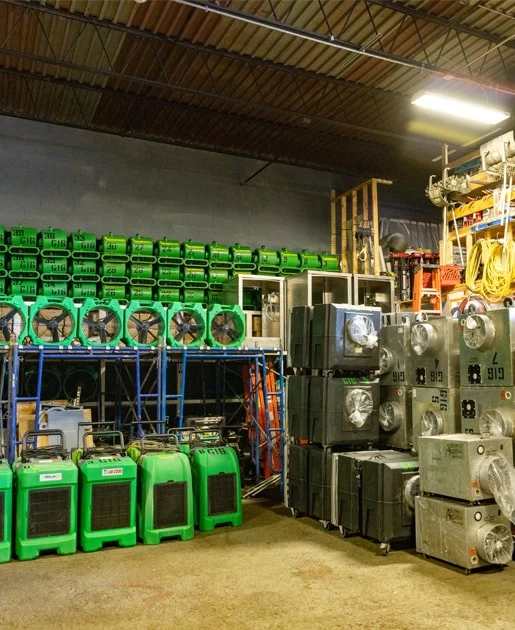
Drying happens with commercial dehumidifiers and air movers positioned based on the moisture map not guesswork. Every reading is documented throughout the process. If the job requires mold remediation, asbestos handling, or structural reconstruction, we handle that under the same contract. When the work is done, you get a clearance reading, not just a visual check. And if you’re filing an insurance claim, we handle the documentation and communicate directly with your adjuster.
Built for Mastic's Basements Not a Generic Restoration Checklist
Flooded basement cleanup in Mastic covers a wider range of scenarios than it does in most Long Island communities. You might be dealing with freshwater from a burst pipe, groundwater intrusion from a water table that the area’s recharge basins can’t keep up with, tidal backflow from the Forge River, or storm surge from Moriches Bay. Each of those situations requires a different approach different water classification, different equipment, different drying strategy, and in some cases, different licensing requirements.
We handle the full range. Water extraction and structural drying are the baseline. Mold remediation is included when needed and in Mastic, where the community has seen what incomplete post-flood cleanup looks like in the years following Sandy, it often is. For homes in the Old Mastic area built before 1970, we’re equipped and licensed to identify and handle asbestos-containing materials and lead paint that flooding may have disturbed. That’s not something most restoration companies in this market can legally do themselves.
All work we perform in Mastic falls under Town of Brookhaven building department jurisdiction. If your restoration requires permitted structural work removing and replacing load-bearing elements, drywall, or flooring we hold the Suffolk County General Contractor license to pull those permits and execute that work legally. You won’t need a second contractor. We also bill insurance directly, document everything for your adjuster, and can help you understand the difference between what your homeowners policy covers versus what requires a separate flood insurance claim a distinction that trips up a lot of Mastic homeowners every year.
Is the water in my flooded Mastic basement contaminated with sewage?
It depends on what caused the flooding and how your property handles waste. Mastic and much of the surrounding area doesn’t have municipal sanitary sewers most homes here run on septic systems. When a major storm, high tide, or heavy rainfall event floods your basement, there’s a real possibility that septic system overflow has mixed into the floodwater. That makes it Category 3 water, which is the most serious classification contaminated with bacteria and pathogens that you can’t see and can’t safely handle without proper protective equipment and environmental protocols.
This is a practical distinction that changes how the cleanup needs to be approached. Category 3 conditions require specific containment, extraction, and disposal procedures that go beyond standard water removal. If there’s any chance your flooding involved septic overflow or sewage backup, the safest move is to stay out of the space until a licensed crew can assess it. We’re equipped and credentialed to handle Category 3 water safely and legally and we’ll tell you upfront exactly what you’re dealing with when we arrive.
How quickly does mold start growing after a basement floods?
Mold can begin developing within 24 to 48 hours of a flooding event sometimes faster if the conditions are right. Warm temperatures, organic materials like wood framing and drywall, and residual moisture create exactly the environment mold needs to establish itself. In Mastic, where summer humidity is already high and many homes have older construction materials that hold moisture longer, that window can close faster than people expect.
The more important point is that mold doesn’t announce itself. It grows inside wall cavities, behind baseboards, and under subfloor places you can’t see until the problem is already significant. By the time you notice visible mold or a musty smell, it’s typically been there for a while. This is why moisture mapping with thermal imaging matters so much after a flood. Visual drying isn’t enough. The only way to confirm a basement is truly dry is with calibrated moisture meters and a systematic reading of every affected surface not just the ones that look wet.
Does homeowners insurance cover flooded basement cleanup in Mastic, NY?
It depends on what caused the flood. Standard homeowners insurance typically covers sudden, accidental water damage a burst pipe, a failed sump pump, an appliance leak. What it generally does not cover is flooding from outside sources: storm surge, groundwater intrusion, or rising water from the Forge River or Moriches Bay. That type of flooding requires a separate flood insurance policy, usually through the National Flood Insurance Program (NFIP).
This distinction trips up a lot of Mastic homeowners, particularly after major storm events when the source of flooding isn’t always obvious. If your basement flooded during a storm and water came in from multiple directions through a window well, up through the floor drain, and from a failed sump pump simultaneously different portions of the damage may fall under different coverage types. We handle insurance documentation directly and communicate with your adjuster on your behalf. We can help you understand what’s covered, what needs to be separated in the claim, and how to document everything properly so you’re not leaving money on the table.
What happens if my Mastic home was built before 1978 and the flood damaged my walls?
If your home was built before 1978 and a large portion of the Old Mastic housing stock was built between the 1940s and 1960s flooding that damages your walls, insulation, or floor tiles may have disturbed asbestos-containing materials or lead paint. Both were common in homes of that era: asbestos in pipe insulation, floor tiles, and joint compound; lead in paint on walls, trim, and window frames.
When those materials are disturbed whether by water damage, remediation work, or demolition they become a health and legal issue. Most water damage companies are not licensed to handle them. We hold the NYS DOL Asbestos license, USEPA Lead certification, and USEPA RRP certification required to identify, contain, and legally remediate these materials as part of the restoration process. That means you don’t need to pause the job, find a separate abatement contractor, and wait for another crew to come out before reconstruction can begin. It’s handled under one contract, which matters when you’re trying to get your home back to normal as quickly as possible.
How long does flooded basement cleanup typically take in Mastic?
The honest answer is that it depends on the scope but most residential basement flooding jobs in Mastic fall somewhere between three and seven days for the drying phase alone. Water extraction can typically be completed within the first few hours. The drying process, which requires commercial dehumidifiers and air movers running continuously, takes longer and the timeline extends if moisture has traveled deep into wall assemblies or under flooring.
If the job involves mold remediation, asbestos handling, or structural reconstruction, the timeline extends further. For a home in the older sections of Mastic that sustained significant flooding, a full remediation and rebuild can take two to four weeks depending on the extent of the damage and permit timelines through the Town of Brookhaven’s building department. The most important thing is not rushing the drying phase. Equipment comes out when the moisture readings confirm the space is dry not when it looks dry. Pulling equipment too early is one of the most common reasons mold problems develop after what seemed like a completed cleanup.
Why should I call a professional instead of handling the cleanup myself?
For minor water intrusion a small leak, a manageable spill a shop vac and some fans might be enough. But for anything involving significant flooding in Mastic, doing it yourself carries real risks that most people don’t fully account for until something goes wrong later.
The first issue is contamination. If your flooding involved any sewage component which is a genuine possibility in Mastic given the area’s reliance on septic systems you’re dealing with bacteria and pathogens that require proper protective equipment and disposal protocols. The second issue is hidden moisture. Consumer-grade fans don’t dry wall cavities or subfloor assemblies. Moisture that stays trapped in those spaces feeds mold growth that you won’t see for weeks. By the time it’s visible, you’re looking at a remediation job that costs significantly more than the original cleanup would have. And in a home built before 1970, disturbing walls or insulation without knowing what’s inside them creates an asbestos or lead exposure risk that no amount of DIY effort can safely manage. A professional crew arrives with the equipment, the testing tools, and the credentials to handle all of it correctly the first time.