When your basement floods in Matinecock, the clock starts immediately — and in a home built during the Gold Coast era, what’s at risk goes well beyond wet carpet. We respond 24/7 with the licenses, equipment, and expertise to handle it completely.
I needed a professional consultation explanation of procedure for safe removal of Asbestos in my apartment complex. Without having an account yet, I was very impressed with the caring, knowledgeable and generous advice offered by Jessica, and will look forward to doing business in the future. Thank you so much! I feel much more informed about a sometimes scary endeavor. Peace. Nancy Silva Mineola, NY.
Mia Munoz
Used this company to clean up some water flood in my house. They were fast and easy to work with.very professional, Would recommend to anyone!
Nini Valle
Great company, had a flood and they responded quickly and efficiently. Billed my insurance company directly. I highly recommend this company!
joe colapietro, jr
I had pipe freeze in my basement right before a snow storm and they made to within an hour to help start the clean up process. They we by our side throughout the entire process and even helped with the insurance company. They did such a great job with the cleanup, repair, remidiation, I contracted them to perform the repairs and finishes in the basement. They came with enough manpower and material to get the job done. Leo and Jessica were nothing but a pleasure to deal with!!
Cristian Arredondo c
I had some water damage in my home and Green Island was able to take care of my issue quickly and effectively. I am very pleased with the work they did. They responded quickly and were very professional.
Michael M
Outstanding service! From the office to the field crew everyone was friendly, helpful and responsive. I highly recommend Green Island Group.
The goal isn’t just to get the water out. It’s to make sure that three weeks from now, you’re not dealing with mold growth behind a finished wall or discovering that a floor tile disturbed during cleanup contained asbestos that nobody was licensed to handle. That’s the difference between a cleanup and a real remediation.
Matinecock’s housing stock is unlike most of Nassau County. Many of the estates here were built in the 1920s and 1930s — decades before modern waterproofing standards, and long before anyone stopped using asbestos in floor tiles, pipe insulation, and ceiling materials. When a basement floods in a home like that, water doesn’t just damage drywall. It can disturb materials that require licensed hazmat handling to address safely and legally. Most restoration companies operating in this area don’t hold those certifications. We do — NYS DOL Asbestos, USEPA Lead, and USEPA RRP, alongside IICRC Water Damage certification and a Nassau County General Contractor license.
Beyond the hazmat piece, Long Island’s North Shore geology works against your basement in ways that aren’t obvious. The glacial clay subcrops beneath Matinecock limit downward drainage, which means groundwater rises and pushes directly against foundation walls and floors after heavy rain or snowmelt. What looks like a one-time flooding event can be a recurring pressure problem if the underlying moisture isn’t fully extracted and documented. You leave here with a completely dried, tested, and restored basement — not a surface fix.
Every License That Matinecock Estate Homes Actually Require
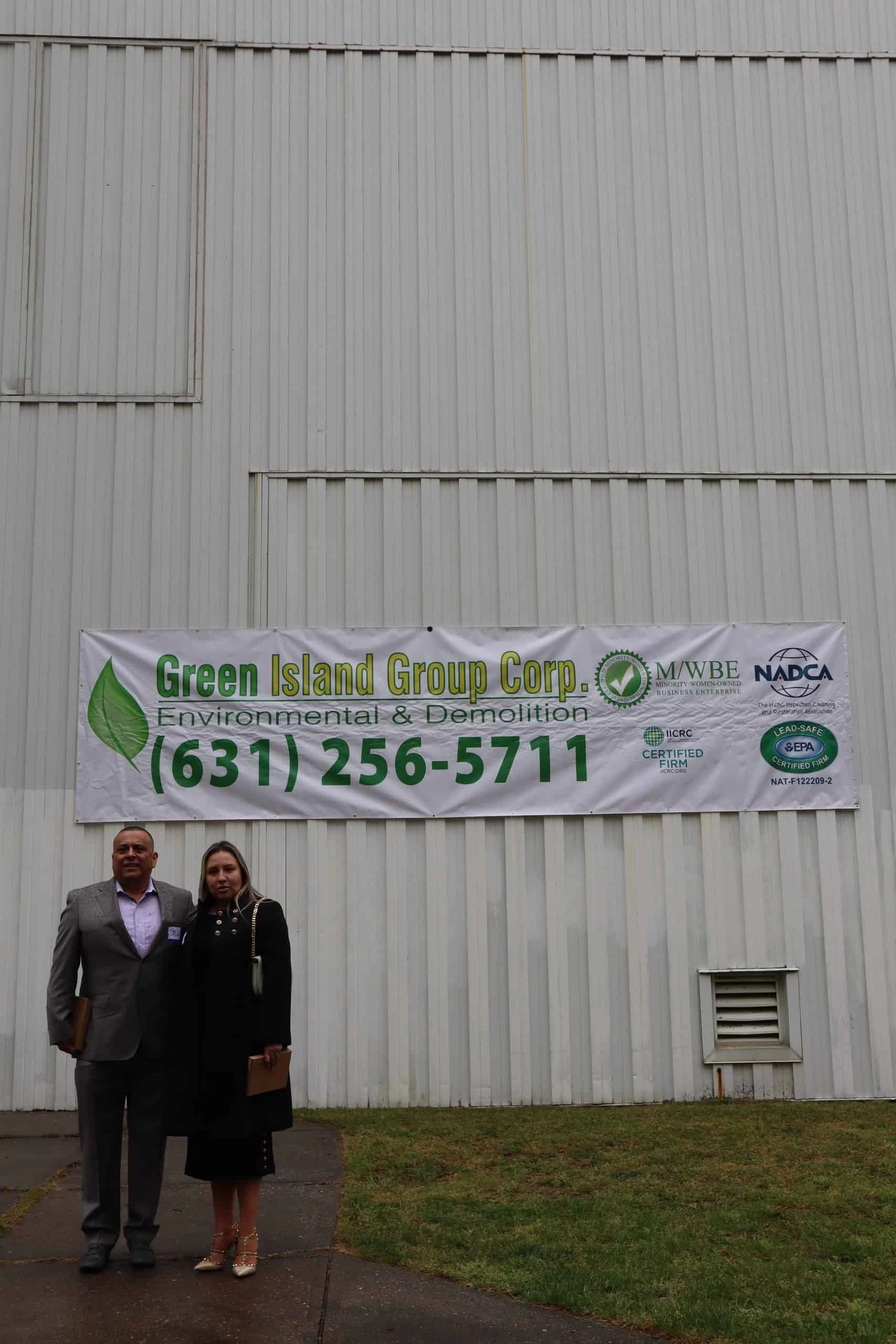
We are a full-service disaster restoration and environmental remediation company serving Nassau County, Suffolk County, and the New York City metro area. What sets us apart isn’t a single credential — it’s the complete stack. NYS DOL Mold, NYS DOL Asbestos, USEPA Lead, USEPA RRP, IICRC Water and Fire Damage, and General Contractor licenses for Nassau County, Suffolk County, and NYC. That combination under one roof, on one invoice, without subcontracting, is genuinely rare in this market.
For homeowners in Matinecock — where properties along Piping Rock Road and the surrounding estate corridors often date back nearly a century — that credential depth isn’t a nice-to-have. It’s what makes a complete, legally compliant restoration possible. We are also NYS MBE, NYS WBE, and NYC MWBE certified, making us one of the only certified-diverse restoration companies in this space with a license stack this deep. The team that answers your call and the crew that shows up to your property operate at the same standard — and that consistency is something customers come back to mention specifically in reviews.
What Happens From Your First Call to Final Walkthrough
When you call, someone answers — not a form, not a callback queue. From that first conversation, you’ll know what’s coming, when it’s coming, and what to expect at each stage. For a basement flooding situation, response time matters more than almost anything else. The 72-hour window before mold growth becomes a serious risk is real, and our 24/7 dispatch is built specifically around it.
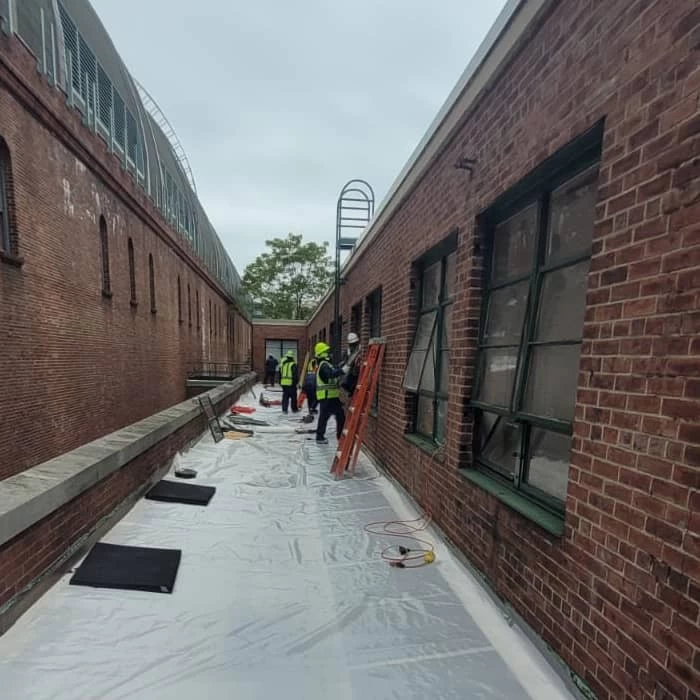
Once on-site, the first step is assessment — not just visual, but with professional moisture detection equipment that finds what’s hiding inside walls, under flooring, and behind original plaster. In older Matinecock homes, this step also includes identifying whether any materials disturbed by the water may contain asbestos or lead, which determines the correct remediation protocol before anything is removed or dried. Skipping this step isn’t just a shortcut — in New York State, it’s a liability.
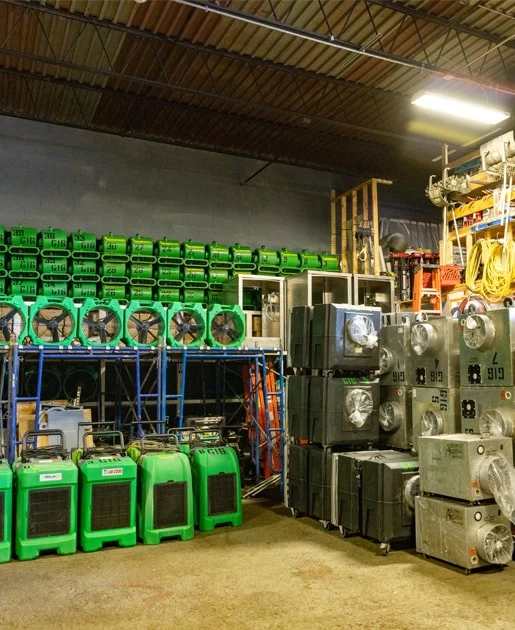
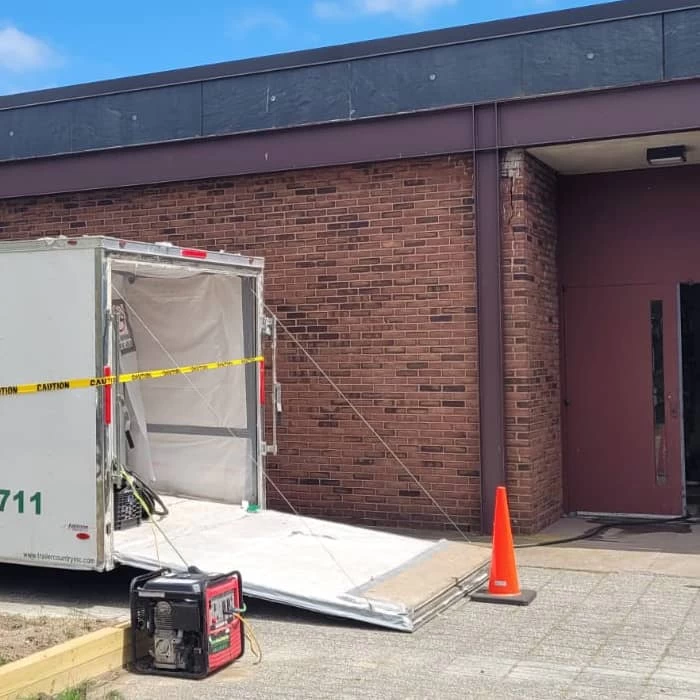
From there, industrial extraction equipment removes standing water, followed by commercial-grade dehumidifiers and air movers calibrated for the scale of an estate basement — not a 600-square-foot utility room. Moisture readings are documented throughout. Once the space is confirmed dry and clear, structural restoration begins: framing, drywall, flooring, and finishing, all handled in-house under our Nassau County General Contractor license. You don’t coordinate a second contractor. The job doesn’t hand off. One team, start to finish.
Basement Flooding Remediation North Shore Long Island
Built for Historic Estates. Backed by Every Required License.
Flooded basement cleanup in Matinecock isn’t a single service — it’s a sequence of licensed, documented steps that account for what these homes actually contain. Water extraction and structural drying are the foundation. But in a village where a significant portion of the housing stock predates 1940, the work frequently extends into asbestos assessment, lead-safe handling protocols, and mold prevention measures that New York State requires be performed by specifically licensed contractors. We carry every one of those licenses and handle all of it under one engagement.
The scope of what’s included depends on what the assessment finds, but the process always covers emergency water extraction, industrial drying and dehumidification, moisture documentation for insurance purposes, mold prevention treatment, and full structural restoration through our Nassau County GC license. For Category 3 events — sewage backup, which older estate homes with aging lateral connections are particularly vulnerable to during heavy storm events — the response includes full biohazard decontamination protocols, not just extraction and drying.
Insurance documentation is also part of the process. Standard homeowners insurance typically covers sudden and accidental events like burst pipes, but does not cover natural flooding from groundwater or storm surge — a gap that catches many Nassau County homeowners off guard. We help you build the documentation trail your carrier needs to process the claim accurately, which on a property valued above $1 million is not a minor administrative detail. It’s the difference between a covered loss and a disputed one.
Does my homeowners insurance actually cover a flooded basement in Matinecock?
It depends entirely on the cause, and this is where a lot of Matinecock homeowners get caught off guard. Standard homeowners insurance typically covers sudden and accidental water damage — a burst pipe, a failed water heater, an appliance malfunction. What it does not cover is flooding caused by groundwater intrusion, storm surge, or rising water from outside the home. For that, you’d need a separate flood insurance policy, typically through FEMA’s National Flood Insurance Program or a private carrier.
In Matinecock specifically, the most common flooding scenarios involve groundwater rising through the foundation after heavy rain or snowmelt — which is precisely the category standard homeowners policies exclude. If you’re unsure what you have, the first thing to do is pull your declarations page and look at the water damage exclusions before you assume you’re covered. We document damage, moisture readings, and the cause of loss in a format that supports an accurate claim submission — which matters significantly when the property value is what it is in this village.
How quickly does mold start growing after a basement floods on Long Island?
Mold can begin developing within 24 to 48 hours of a moisture event under the right conditions — and Long Island’s climate in spring and summer provides exactly those conditions. Warm temperatures, high ambient humidity, and the kind of saturated building materials common in older estate construction create an environment where mold moves fast. The 72-hour threshold is the industry benchmark: if a space is professionally dried and treated within that window, mold growth is unlikely. Beyond it, the remediation becomes a separate, more involved project.
The complicating factor in Matinecock’s older homes is that moisture doesn’t stay where you can see it. It moves into original plaster walls, under historic flooring, and behind finished basement sections — and it stays there long after the surface appears dry. Professional moisture detection equipment is the only reliable way to confirm a space is actually dry versus visually dry. That distinction is what separates a completed remediation from a mold problem that shows up six weeks later.
Do I need asbestos testing before starting basement flood cleanup in an older home?
If your home was built before 1980 — and in Matinecock, a substantial portion of the housing stock dates to the 1920s and 1930s — asbestos-containing materials may be present in floor tiles, pipe insulation, ceiling tiles, or joint compound. When a basement floods, those materials can be disturbed during cleanup, which creates an exposure risk that requires licensed handling under New York State Department of Labor regulations. Proceeding without an assessment isn’t just a safety concern — it’s a legal one.
In New York State, asbestos remediation must be performed by a contractor holding a valid NYS DOL Asbestos license. Most standard water damage restoration companies do not hold this credential and are not equipped to handle it. We hold this license, which means the assessment, any required abatement, and the subsequent restoration all happen under one engagement. You don’t need to find a separate asbestos contractor, coordinate sequencing, or manage two timelines. The process is handled in the correct order, by a team licensed to do all of it.
Why does my Matinecock basement keep flooding even without a major storm?
This is one of the most common questions from North Shore homeowners, and the answer is almost always the same: groundwater. Long Island sits on a complex geology of sand, glacial deposits, and clay subcrops — particularly on the North Shore in areas like Matinecock — that limits how far and how fast water can drain downward. After a significant rainfall, the water table rises. When it rises high enough, it pushes directly against basement floors and foundation walls through a process called hydrostatic pressure. The water doesn’t need a crack to find its way in; sustained pressure will eventually force it through.
For Matinecock estates, this is compounded by the age of the foundations. Homes built in the 1920s and 1930s were constructed before modern waterproofing membranes and drainage systems existed. The U.S. Geological Survey has also documented that rising groundwater levels across Long Island — driven in part by sea-level rise along the Sound — are making this worse over time, not better. If your basement floods repeatedly after rain without any obvious pipe or appliance failure, hydrostatic pressure is the most likely cause, and it needs to be addressed at the foundation level, not just cleaned up after each event.
What's the difference between water damage cleanup and full basement flood remediation?
Cleanup typically refers to extracting standing water and running drying equipment until the space appears dry. Remediation goes further — it’s a documented, licensed process that addresses not just the visible water but the moisture trapped inside structural materials, the potential for mold growth, any hazardous materials disturbed during the event, and the structural restoration needed to return the space to its pre-loss condition.
For a straightforward flooding event in a newer home with no hazmat concerns, cleanup may be sufficient. For a Matinecock estate with a 1930s foundation, original plaster walls, and a finished basement that may contain asbestos-era materials, remediation is the appropriate scope. The difference in cost can be significant, but so can the difference in outcome. A cleanup that leaves moisture behind a wall or fails to identify disturbed asbestos materials isn’t a completed job — it’s a deferred problem. Our process is built around full remediation from the start, with documentation at every stage.
How long does basement flood cleanup and restoration take for a large estate home?
The honest answer is that it depends on what the assessment finds. For a straightforward water intrusion event with no hazmat concerns and no structural damage, the drying process alone typically takes three to five days with industrial equipment running continuously. Structural restoration — replacing drywall, flooring, framing, or finished surfaces — adds time depending on the scope and the materials involved.
For the kind of estate homes common in Matinecock, where basements are larger, often partially finished, and may involve historic materials or custom finishes, a complete remediation and restoration can reasonably take one to three weeks from initial response to final walkthrough. The variables that extend timelines most are the presence of asbestos or lead materials that require licensed abatement before drying and restoration can proceed, and the complexity of the finished space being restored. We scope the full timeline at assessment so you have a clear picture from day one — not a moving target that keeps extending. Every step, including insurance documentation, runs in parallel where possible to keep the overall timeline as tight as the work allows.