I needed a professional consultation explanation of procedure for safe removal of Asbestos in my apartment complex. Without having an account yet, I was very impressed with the caring, knowledgeable and generous advice offered by Jessica, and will look forward to doing business in the future. Thank you so much! I feel much more informed about a sometimes scary endeavor. Peace. Nancy Silva Mineola, NY.
Mia Munoz
Used this company to clean up some water flood in my house. They were fast and easy to work with.very professional, Would recommend to anyone!
Nini Valle
Great company, had a flood and they responded quickly and efficiently. Billed my insurance company directly. I highly recommend this company!
joe colapietro, jr
I had pipe freeze in my basement right before a snow storm and they made to within an hour to help start the clean up process. They we by our side throughout the entire process and even helped with the insurance company. They did such a great job with the cleanup, repair, remidiation, I contracted them to perform the repairs and finishes in the basement. They came with enough manpower and material to get the job done. Leo and Jessica were nothing but a pleasure to deal with!!
Cristian Arredondo c
I had some water damage in my home and Green Island was able to take care of my issue quickly and effectively. I am very pleased with the work they did. They responded quickly and were very professional.
Michael M
Outstanding service! From the office to the field crew everyone was friendly, helpful and responsive. I highly recommend Green Island Group.
What a Dry, Cleared Basement Actually Means for Your Miller Place Home
When Hurricane Ernesto dropped nearly 10 inches of rain on Miller Place in August 2024, a lot of homeowners learned something the hard way water in a basement is not a wait-and-see situation. Mold starts growing within 24 to 48 hours. What starts as a cleanup becomes a remediation. What starts as a remediation can become a reconstruction. The faster you act, the more you protect.
For homes along North Country Road and the streets surrounding Mount Sinai Harbor, the flooding risk is real and recurring. The North Shore’s clay-heavy soil doesn’t drain the way sandy South Shore ground does water pools, saturates, and pushes through foundation walls. Many of the homes in Miller Place were built in the 1950s and 60s, with older waterproofing systems that were never designed for the kind of rainfall this area has seen in recent years. That combination aging foundations, slow-draining soil, and increasingly intense storms means your basement is more vulnerable than it might look on a dry day.
What you get on the other side of a proper cleanup isn’t just a dry floor. It’s the confidence that the moisture is actually gone not just on the surface, but inside the walls, under the subfloor, and behind any materials that absorbed water during the event. That’s the difference between a cleanup that holds and one that quietly grows a mold problem you won’t notice until it’s significantly worse.
Basement Flooding Remediation Serving Miller Place
New York State Approved Licensed to Handle What Miller Place Homes Actually Need
We are a New York State-approved emergency response contractor through the NYS Office of General Services a designation that requires independent vetting of our licensing, insurance, and track record. That’s not a badge we printed ourselves. It means the State of New York has reviewed what we do and put us on their approved list for public emergency response. No competitor currently showing up in Miller Place search results holds that same designation.
We’re also NYS-certified as both a Minority Business Enterprise and a Woman-Owned Business Enterprise, led by CEO Jessica Dussan and VP Leo Torres. Our team holds a Suffolk County General Contractor license alongside NYS DOL Mold, NYS DOL Asbestos, USEPA Lead, and USEPA RRP certifications the full licensing stack required to safely handle what a flooded basement in a Miller Place home built in the 1960s can actually uncover.
With over 5,000 completed restoration projects across New York State and more than 12 years of operation, we’ve worked through the kind of flooding that hits the North Shore of Brookhaven the nor’easters, the storm surge events, the sudden pipe failures in homes that have been standing since the 1960s. We know Miller Place. We know what’s in these homes. And we know what it takes to do this right.
From Standing Water to Dry and Documented Our Process for Miller Place Basements
The first thing that happens when you call is simple someone actually picks up. We’re available 24 hours a day, every day of the year, and our target response time is under one hour. When our crew arrives, the first priority is assessing what you’re dealing with. Not all basement flooding is the same. A burst pipe is a different situation than a sewage backup, which is a different situation than storm surge pushing through your foundation during a nor’easter. The source matters because it determines the safety protocols, the equipment, and what your insurance will cover.
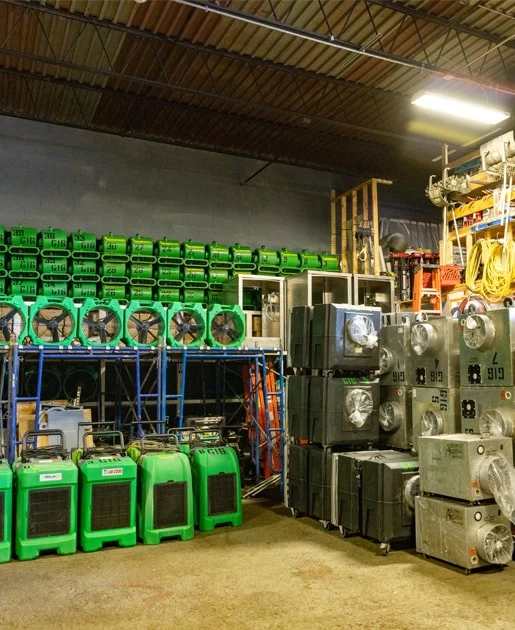
Once we’ve assessed the water category and the scope of the damage, we begin extraction. Industrial-grade equipment pulls standing water out fast. From there, we set up commercial drying systems not box fans and place moisture detection equipment throughout the space to track what’s happening inside your walls and under your flooring, not just what you can see on the surface. In Miller Place homes, especially those built before 1980, we also test for asbestos-containing materials and lead paint before any demolition or removal begins. That step protects you, your family, and our crew and it’s required by law for pre-1980 construction. Most water damage companies skip this or aren’t licensed to handle it. We are.
Throughout the process, we document everything for your insurance claim photos, moisture readings, scope of damage, and remediation records. If reconstruction is needed after the drying phase, our Suffolk County General Contractor license means we can handle that too, under the same contract, without handing you off to a third party.
Basement Flood Damage Services in Miller Place, NY
Full-Scope Cleanup Built for What North Shore Homes Actually Face
Flooded basement cleanup in Miller Place isn’t a one-size situation. The service covers emergency water extraction, structural drying, moisture mapping, mold assessment, and where needed, full mold remediation under our NYS DOL Mold certification. For homes near the harbor or in low-lying areas off Route 25A that took on Category 3 water meaning sewage backup or outside floodwater we follow OSHA-compliant containment and disposal protocols. That’s not optional. It’s what the work legally and safely requires.
For homes built before 1980, which includes a significant portion of Miller Place’s housing stock, our scope automatically includes pre-remediation testing for asbestos and lead. If those materials are present and have been disturbed by water or the remediation process, we handle abatement in-house under our USEPA Lead, USEPA RRP, and NYS DOL Asbestos certifications. You don’t need to find a separate contractor for that. It’s already covered.
On the insurance side, we handle direct billing to your carrier and provide the documentation your adjuster needs to process the claim correctly. If you’re dealing with a coastal flood event and carry NFIP coverage through FEMA rather than a standard homeowners policy, that’s a distinction we understand and navigate regularly. The Town of Brookhaven also offers grants up to $50,000 for health and safety home repairs not covered by insurance for eligible homeowners we can walk you through what that process looks like if it applies to your situation.
Does homeowners insurance actually cover basement flooding in Miller Place, NY?
It depends on what caused the flooding. Standard homeowners insurance typically covers sudden and accidental water damage a burst pipe, a failed water heater, an appliance overflow. What it generally does not cover is flooding from outside your home, which includes storm surge, rising groundwater, and surface water intrusion from heavy rain events like the one Miller Place experienced during Hurricane Ernesto in August 2024. That type of flooding falls under the National Flood Insurance Program, which is a separate federal policy administered through FEMA.
If you’re in a flood-prone area near Mount Sinai Harbor or in one of the lower-elevation streets in Miller Place, there’s a real chance you need both policies to be fully covered. The distinction matters because the documentation requirements, adjuster process, and coverage limits are different for each. When we respond to a job in Miller Place, we assess the source of the water, document accordingly, and bill the appropriate carrier directly. We work with both standard homeowners policies and NFIP claims regularly, so you’re not left figuring that out on your own.
How quickly does mold start growing after a basement flood?
Mold can begin colonizing within 24 to 48 hours of water intrusion sometimes faster if the space is warm and the humidity is high. That timeline is not an exaggeration. It’s the documented biological reality of how mold spores behave in wet environments. By the time you can see mold growth on a surface, it’s already been growing behind that surface for a while.
This is especially relevant in Miller Place because the August 2024 flooding from Hurricane Ernesto left many basements saturated for extended periods while residents were still dealing with the immediate aftermath of the storm. Homes that weren’t professionally dried within that first 48-hour window faced a significantly higher likelihood of mold development not just on visible surfaces, but inside wall cavities, under flooring, and in insulation. Professional cleanup that includes moisture mapping and commercial drying equipment closes that window before mold gets a foothold. A shop vac and household fans do not.
What is Category 3 water damage and why does it require a licensed contractor?
Category 3 is the most serious classification of water damage under the IICRC S500 standard the industry benchmark for water damage restoration. It refers to water that is grossly contaminated and carries bacteria, sewage, or other hazardous materials. This includes sewage backups, toilet overflows, and outside floodwater that has contacted the ground before entering your home. During heavy storm events on the North Shore, Category 3 contamination is common because the flooding often pushes groundwater and sewer system overflow into basements simultaneously.
Cleaning up Category 3 water is not a DIY situation and it’s not something every water damage company is properly equipped to handle. It requires OSHA-compliant personal protective equipment, containment protocols to prevent cross-contamination to the rest of the home, and proper disposal of contaminated materials. We hold the environmental licensing required to handle Category 3 events legally and safely in Suffolk County. Hiring a contractor who isn’t properly licensed for this type of work doesn’t just create a health risk it can also void your insurance coverage if the remediation isn’t documented and performed to code.
My Miller Place home was built in the 1960s does that affect the cleanup process?
Yes, and it’s one of the most important questions to ask before any contractor starts pulling out wet drywall or insulation. Homes built before 1980 which covers a large portion of Miller Place’s housing stock frequently contain asbestos in pipe insulation, floor tiles, ceiling tiles, and joint compound. They also commonly have lead paint on walls and trim. Neither of those materials is a problem when they’re intact. They become a problem when they’re disturbed which is exactly what happens during water damage remediation.
Under federal and New York State law, contractors are required to test for these materials before performing demolition or removal work in pre-1980 homes. Many water damage companies are not licensed to do this testing or to perform the abatement if hazardous materials are found which means they either skip the step illegally, stop work and leave you to find another contractor, or create a hazmat situation without realizing it. We hold USEPA Lead, USEPA RRP, and NYS DOL Asbestos certifications. We test before we demo, and if hazardous materials are present, we handle abatement in-house under the same job scope. You don’t need to coordinate a separate vendor for that.
Can you handle the insurance claim so I don't have to manage the paperwork myself?
Yes. We bill your insurance carrier directly and provide the full documentation package your adjuster needs photos, moisture readings, scope of damage reports, and remediation records. You don’t have to be the middleman between us and your insurance company. That’s not a minor convenience. After a flooding event, you’re already dealing with a disrupted home, potentially displaced family members, and the stress of not knowing how bad the damage actually is. Managing insurance paperwork on top of that is genuinely overwhelming for most people.
The direct billing process also reduces the risk of claim errors. When documentation is incomplete or the scope of damage isn’t properly recorded, adjusters can deny portions of a claim or undervalue the loss. Because we document everything from the moment we arrive and because we understand the difference between what a standard homeowners policy covers versus an NFIP flood policy the claim is built correctly from the start. Multiple customers have confirmed this process in independent reviews, specifically noting that we handled the insurance side without requiring them to chase anyone down.
Is the flooding problem in Miller Place getting worse, or was 2024 just a bad year?
The honest answer is that the data points toward a structural problem, not a one-time event. Hurricane Ernesto in August 2024 produced some of the highest rainfall totals on all of Long Island right here in Miller Place and the surrounding Sound Beach area NBC New York specifically named Miller Place as one of the hardest-hit communities, with up to 10 inches of rain falling in a matter of hours. Suffolk County Executive Ed Romaine declared a state of emergency for North Shore communities as a result.
What followed that storm is telling: in 2026, Congressman Nick LaLota secured federal funding specifically for a Miller Place and Sound Beach drainage infrastructure project a direct acknowledgment that the existing drainage systems in this area are not adequate for the rainfall patterns the community is now experiencing. The North Shore’s clay-heavy soil, aging municipal infrastructure, and direct exposure to Long Island Sound storm events create conditions that don’t improve on their own. If your basement flooded in 2024, the underlying vulnerability that allowed it to flood is still there. Understanding that it could happen again and making sure your home is properly assessed and protected is equally important.