Most New Hyde Park basements were never built to handle what storms deliver today. When yours floods, you have about 72 hours before mold becomes the next problem — we respond now, not tomorrow.
I needed a professional consultation explanation of procedure for safe removal of Asbestos in my apartment complex. Without having an account yet, I was very impressed with the caring, knowledgeable and generous advice offered by Jessica, and will look forward to doing business in the future. Thank you so much! I feel much more informed about a sometimes scary endeavor. Peace. Nancy Silva Mineola, NY.
Mia Munoz
Used this company to clean up some water flood in my house. They were fast and easy to work with.very professional, Would recommend to anyone!
Nini Valle
Great company, had a flood and they responded quickly and efficiently. Billed my insurance company directly. I highly recommend this company!
joe colapietro, jr
I had pipe freeze in my basement right before a snow storm and they made to within an hour to help start the clean up process. They we by our side throughout the entire process and even helped with the insurance company. They did such a great job with the cleanup, repair, remidiation, I contracted them to perform the repairs and finishes in the basement. They came with enough manpower and material to get the job done. Leo and Jessica were nothing but a pleasure to deal with!!
Cristian Arredondo c
I had some water damage in my home and Green Island was able to take care of my issue quickly and effectively. I am very pleased with the work they did. They responded quickly and were very professional.
Michael M
Outstanding service! From the office to the field crew everyone was friendly, helpful and responsive. I highly recommend Green Island Group.
When the water is gone, the real work is confirming nothing was missed. A basement that looks dry and a basement that actually is dry are two different things — especially in New Hyde Park homes built in the 1940s or 1950s, where poured concrete foundations and aging drainage tile make hidden moisture a near-certainty after a flood event.
New Hyde Park’s housing stock is older than most people realize. The majority of homes here were built between 1939 and 1969, and those foundations were never designed with modern waterproofing in mind. When groundwater pushes through after a heavy storm — or when a sump pump fails at 2 a.m. — the water doesn’t just sit on the floor. It moves into wall cavities, under subfloor material, and behind anything porous. If it isn’t found and dried completely, mold follows within 24 to 48 hours.
What you get after a proper cleanup isn’t just an empty, mopped-out basement. It’s a space with confirmed moisture readings, documented drying progress, and zero question marks left for later. For a home worth close to $900,000 — which is right around the median in New Hyde Park — that level of certainty isn’t a luxury. It’s exactly what the job should include from the start.
We are a full-service disaster restoration and environmental remediation company serving Nassau County, Suffolk County, and the surrounding metro area. We hold the NYS DOL Mold License, NYS DOL Asbestos License, USEPA Lead and RRP certifications, IICRC Water and Fire Damage certification, and a Nassau County General Contractor license — all of them active, all of them verifiable.
That credential stack matters in New Hyde Park specifically. When a basement floods in a pre-1978 home — which describes most of the housing in this community, including throughout Manhasset Hills and Lakeville Estates — there is a real possibility that floodwater has disturbed asbestos floor tiles, lead paint, or aging pipe insulation. A company that isn’t licensed to handle those materials legally cannot do the complete job. We can.
We also hold the General Contractor license that covers both the Town of Hempstead and Town of North Hempstead portions of New Hyde Park — the dual-municipality split that affects permitting here and that many contractors aren’t even aware of. One call gets you a team that can take the job from water extraction all the way through full structural restoration without handing you off to anyone else.
Basement Flooding Remediation Process, Nassau County
What Actually Happens From First Call to Final Walkthrough
The first call is the most important one. When you reach us — any time, day or night — we ask the right questions to understand what you’re dealing with: how much water, what likely caused it, whether there are any visible signs of sewage backup or hazardous materials. That conversation lets us dispatch the right team with the right equipment, not a generic crew with a wet vac.
When we arrive, the first step is assessing the full scope before anything gets moved or extracted. Thermal imaging cameras and calibrated moisture meters tell us where water has traveled — not just where it’s visible. In older New Hyde Park homes, that often means checking wall cavities, under flooring, and around the base of any masonry or concrete block walls where water infiltration is common. If there are materials that may contain asbestos or lead — and in a home built before 1978, there very likely are — we identify them before disturbing anything.
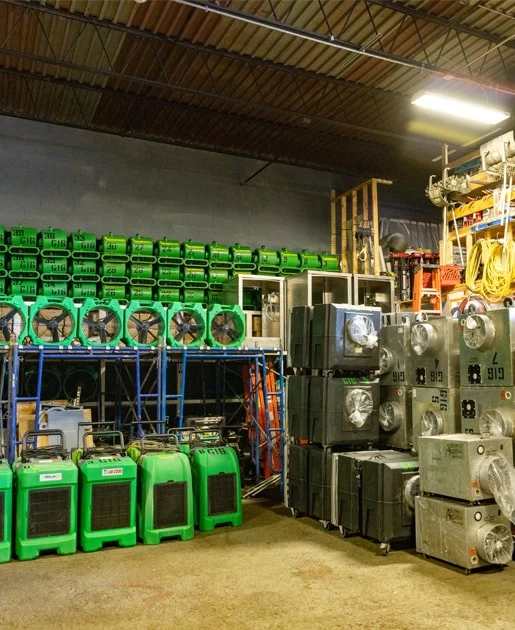
From there, extraction and industrial drying begin. We use commercial-grade air movers and dehumidifiers, not residential equipment, and we monitor moisture readings throughout the drying period until every surface hits the target range. If mold remediation, asbestos abatement, or structural reconstruction is needed, we handle it under the same license and the same roof. Before we leave, you get a complete walkthrough and documentation — including everything your insurance adjuster will need.
Everything the Job Requires, Not Just the Easy Parts
Flooded basement cleanup in New Hyde Park isn’t a single-step job, and anyone telling you otherwise is leaving something out. The full scope — depending on what your basement contains and how long the water sat — can include water extraction, structural drying, mold assessment and remediation, asbestos testing and abatement, lead-safe work practices under EPA RRP protocols, sewage decontamination for Category 3 black water events, and full reconstruction of damaged walls, flooring, and framing. We handle every one of those phases in-house.
The asbestos and lead piece is something New Hyde Park homeowners specifically need to understand. If your home was built before 1978 — and the data shows that the vast majority of homes in this community were — then 9-inch vinyl floor tiles, pipe insulation, and certain ceiling materials in your basement may contain asbestos. Floodwater doesn’t respect that. It disturbs those materials and can spread fibers throughout the space. Legally and safely addressing that requires the NYS DOL Asbestos License. We hold it. Many of the companies you’ll find in a quick search do not.
Because New Hyde Park spans both the Town of Hempstead and the Town of North Hempstead, restoration work that involves structural repairs requires permits pulled from the correct municipal jurisdiction depending on your address. Our Nassau County General Contractor license covers both sides of that line, so there’s no gap in what we can legally perform or permit — from Garden City Park to Herricks to Manhasset Hills, we handle it start to finish.
Does homeowners insurance cover flooded basement cleanup in New Hyde Park, NY?
This is one of the most common — and most frustrating — discoveries homeowners make after a flood. Standard homeowners insurance typically covers sudden and accidental water damage, like a burst pipe or a failed appliance. What it generally does not cover is flooding caused by storms, groundwater intrusion, or a backed-up municipal sewer system overwhelming your drain — which is exactly what happens to many New Hyde Park basements during heavy rain events or after storms like the remnants of Hurricane Ida in September 2021.
If you have a separate flood insurance policy through the National Flood Insurance Program, that coverage applies to rising water from external sources. But many homeowners in this area don’t carry it, because they weren’t in a designated high-risk flood zone when they bought the policy.
What matters most right away is documentation. Before anything gets moved, extracted, or dried, the damage needs to be thoroughly photographed and recorded in a format your adjuster can work with. We assist with that documentation process from the start, so whatever coverage you do have is supported by a clear, complete record — not a gap-filled claim that gives the insurance company room to push back.
How fast does mold grow after a basement flood, and why does it matter?
Mold can begin growing within 24 to 48 hours of water exposure — and in a basement that wasn’t fully dried within 72 hours, growth becomes significantly more likely. That window is tight, and it’s the reason emergency response time matters more than almost anything else when your basement floods.
In New Hyde Park’s older housing stock, the risk is compounded. Homes built in the 1940s through 1960s often have wood framing, older drywall or plaster, and organic materials behind finished walls that mold feeds on quickly once moisture reaches them. The problem isn’t always visible from the surface, which is why moisture readings and thermal imaging are part of the assessment — not optional add-ons.
If mold does develop, remediation in New York State must be performed by a company holding the NYS DOL Mold License. This isn’t a voluntary credential — it’s a legal requirement under New York law. We hold this license. If you’re evaluating other companies for basement flooding remediation in Nassau County, it’s one of the first things worth asking about, because not every company advertising mold cleanup in this area is actually licensed to do it.
My New Hyde Park basement flooded after a storm — could there be asbestos in it?
If your home was built before 1978, the honest answer is: possibly, yes. Asbestos-containing materials were standard in residential construction through the mid-1970s, and basements in homes from that era commonly contain 9-inch vinyl floor tiles, pipe insulation around older boiler systems, and certain ceiling materials that may have asbestos in them. The majority of homes in New Hyde Park — including throughout Manhasset Hills and Lakeville Estates — fall into this age range.
When a basement floods, water disturbs those materials. It can loosen tile adhesive, saturate insulation, and spread particles through the space in ways that aren’t visible to the eye. A contractor who isn’t licensed for asbestos abatement cannot legally or safely remediate those conditions — and attempting to do so without proper protocols creates a health risk for your household.
We hold the NYS DOL Asbestos License, which means we can assess, test, and properly abate asbestos-containing materials as part of the same restoration project — not as a separate engagement that delays your cleanup. If you’re uncertain whether your basement contains these materials, the right move is to have a licensed professional assess it before any demolition or drying work disturbs the surfaces in question.
What causes basement flooding in New Hyde Park, and is it preventable?
There are a few common causes, and they’re not all the same problem. The most frequent ones in New Hyde Park specifically are groundwater intrusion through aging foundation walls, sump pump failures during power outages or heavy rain events, sewer backup when the municipal system gets overwhelmed, and burst pipes in older homes — particularly during cold snaps when pipes run through uninsulated exterior walls or crawlspaces common in pre-war and early postwar construction.
The groundwater issue is particularly relevant here. Nassau County’s water table in certain areas sits close enough to the surface that saturated soil after a storm can push water directly through older concrete block or poured concrete foundations — foundations that were never designed with modern waterproofing membranes. Homes in Manhasset Hills and the surrounding areas with 1940s–1960s construction see this regularly.
Some of it is preventable with the right upgrades — a battery backup sump pump, foundation waterproofing, updated drainage tile. But when the flood has already happened, prevention is the second conversation. The first one is stopping the damage from getting worse, drying the space completely, and making sure nothing is left behind that turns into a mold or structural problem six months from now.
How long does flooded basement cleanup actually take in Nassau County?
The honest answer is that it depends on how much water entered, how long it sat, what materials got wet, and whether there are hazardous materials involved. A straightforward clean-water event — say, a burst supply line caught within a few hours — might be fully dried and documented within three to five days. A basement that sat in several inches of water for 24 hours or more, with wet drywall, saturated insulation, and potential mold or asbestos involvement, is a longer project.
The drying phase alone typically takes two to four days of continuous equipment operation with daily moisture monitoring. Structural work — replacing drywall, flooring, or framing — comes after the space is confirmed dry, and that timeline depends on scope. In New Hyde Park, where most homes are older and basements often have finished or semi-finished spaces, the reconstruction phase can add meaningful time to the overall project.
What we can tell you is that rushing any phase of this creates problems later. A basement that appears dry but still reads elevated moisture behind the walls is going to grow mold. We don’t sign off on a job until the numbers confirm it’s actually done — not just visually clean.
Can I clean up a flooded basement myself, or do I need a professional in New Hyde Park?
For a very minor event — a small amount of clean water from a known source, caught immediately, with no finished materials affected — some homeowners manage it themselves. But that’s a narrow scenario, and most basement floods in New Hyde Park don’t fit that description.
The bigger issue is what you can’t see. Moisture behind walls, under flooring, and inside wall cavities doesn’t show up without the right equipment. Neither does early-stage mold growth. And in a home built before 1978, attempting to tear out wet drywall or pull up old floor tiles without knowing what’s in them creates a real asbestos and lead exposure risk — not just for you, but for anyone in the house. Under EPA RRP rules, renovation work that disturbs painted surfaces in pre-1978 homes must be performed by a certified contractor.
There’s also the insurance documentation piece. If you start cleaning before the damage is properly recorded, you may lose your ability to support a claim for covered losses. A licensed professional documents everything before work begins, extracts and dries with equipment that actually confirms results, and gives you a paper trail that holds up with an adjuster. For a home in New Hyde Park worth close to $900,000, that process is worth doing right the first time.