When North Hills Basements Flood, the Clock Starts Immediately
One inch of water can cause $25,000 in damage — in a North Hills home with finished lower levels and luxury finishes, that number climbs fast. We provide certified flooded basement cleanup before the 72-hour mold window closes.
I needed a professional consultation explanation of procedure for safe removal of Asbestos in my apartment complex. Without having an account yet, I was very impressed with the caring, knowledgeable and generous advice offered by Jessica, and will look forward to doing business in the future. Thank you so much! I feel much more informed about a sometimes scary endeavor. Peace. Nancy Silva Mineola, NY.
Mia Munoz
Used this company to clean up some water flood in my house. They were fast and easy to work with.very professional, Would recommend to anyone!
Nini Valle
Great company, had a flood and they responded quickly and efficiently. Billed my insurance company directly. I highly recommend this company!
joe colapietro, jr
I had pipe freeze in my basement right before a snow storm and they made to within an hour to help start the clean up process. They we by our side throughout the entire process and even helped with the insurance company. They did such a great job with the cleanup, repair, remidiation, I contracted them to perform the repairs and finishes in the basement. They came with enough manpower and material to get the job done. Leo and Jessica were nothing but a pleasure to deal with!!
Cristian Arredondo c
I had some water damage in my home and Green Island was able to take care of my issue quickly and effectively. I am very pleased with the work they did. They responded quickly and were very professional.
Michael M
Outstanding service! From the office to the field crew everyone was friendly, helpful and responsive. I highly recommend Green Island Group.
When your basement is fully dried, decontaminated, and restored by our licensed team, the problem is actually over — not just paused. No lingering moisture hiding behind finished walls. No mold developing under a custom floor weeks after the water is gone. That’s what complete cleanup looks like, and it’s the only version worth paying for.
North Hills sits on glacially deposited, clay-heavy terrain — the same rolling hills that give the village its name also concentrate runoff directly toward foundations after a heavy storm. Unlike the sandy soils on Long Island’s South Shore that drain relatively quickly, the North Shore’s clay holds moisture against your foundation walls for days. That means hydrostatic pressure continues pushing water into your basement long after the rain stops, and surface-level drying isn’t enough.
Many homes in North Hills also date back to the mid-20th century — some to the original estate era. Older construction means older materials: asbestos floor tiles, lead paint, aging drainage systems. When a basement floods in a home like that, the cleanup isn’t just about water. It’s about knowing what you’re dealing with before you disturb it. That’s where licensing matters, and it’s where most general restoration companies fall short.
Licensed Basement Flooding Remediation North Hills NY
Every License the Job Requires, Under One Roof
We are a fully licensed disaster restoration and environmental remediation company serving Nassau County, including North Hills and the surrounding North Shore communities. Our credential stack is not typical: NYS DOL Mold License, NYS DOL Asbestos License, USEPA Lead and RRP Certifications, IICRC Water Damage Certification, NADCA HVAC Cleaning Certification, and a Nassau County General Contractor License — all held by our company, all applicable to what a flooded basement in North Hills can require.
That matters because most restoration companies that show up in a North Hills search can handle water extraction and drying. What they cannot legally do is perform mold remediation in New York State without a NYS DOL Mold License, or disturb asbestos materials without state certification. When those conditions show up mid-job — and in older North Shore homes, they often do — most companies have to stop and refer out. We don’t. The full scope gets handled by one team, on one timeline, with one point of contact from start to finish.
The moment you call, the clock is already running. Mold can begin developing within 24 to 48 hours of water exposure, and the critical threshold for preventing it is 72 hours of thorough drying. We operate 24/7, and with direct access via the Long Island Expressway and Northern State Parkway — both of which run through North Hills — our emergency dispatch reaches the village quickly, regardless of time of day.
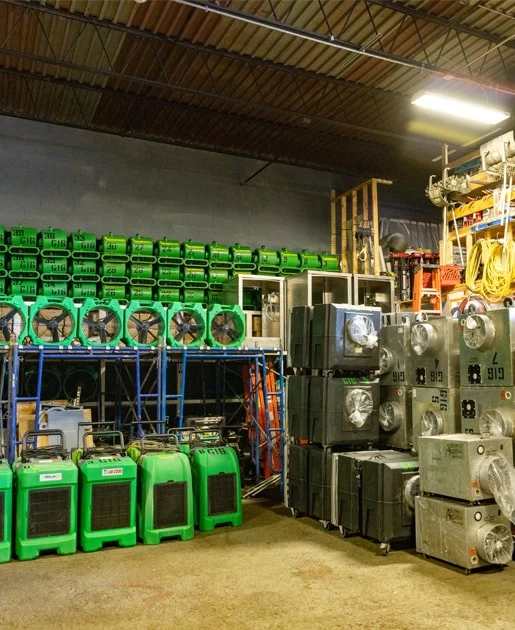
On arrival, our team assesses the water source and contamination level first. A burst pipe is a very different situation than a sewage backup or storm-driven groundwater intrusion, and the cleanup protocol changes accordingly. Category 3 flooding — contaminated water from sewage or storm overflow — requires full decontamination, not just drying. We deploy industrial extraction equipment to remove standing water, then commercial-grade drying systems and moisture detection tools address what’s left behind walls, under flooring, and in the structural framing.
Before any materials are removed or disturbed in an older North Hills property, our team checks for asbestos-containing materials and lead paint — both common in pre-1978 construction and both legally regulated under New York State and federal law. If those conditions are present, we handle them in-scope, not hand them off. Once the space is fully dried and cleared, our Nassau County General Contractor license covers the complete structural restoration — drywall, flooring, framing — so you’re not left coordinating a second contractor to finish the job.
Flooded Basement Cleaning and Mold Remediation North Hills
The Full Scope, Not Just the Easy Part
Flooded basement cleanup in North Hills covers a wider range of conditions than most homeowners expect when they first make the call. Water extraction and structural drying are the starting point — not the finish line. Depending on what the assessment reveals, the full scope can include Category 3 sewage decontamination, mold remediation under NYS DOL licensing requirements, asbestos abatement for pre-1980 materials, lead paint handling under USEPA RRP protocols, HVAC cleaning if moisture reached the duct system, and complete structural restoration under Nassau County General Contractor licensing. We handle every one of those services directly — no subcontractors, no handoffs, no gaps in accountability.
For homeowners in North Hills communities like The Chatham, Hamlet Estates, or the Ritz-Carlton Residences, the finished lower-level spaces and premium building materials involved raise the stakes considerably. Hardwood floors, custom cabinetry, home theaters, and wine storage areas require careful handling throughout the drying and restoration process — not just a fast extraction and a dehumidifier left running for a few days.
We also assist with insurance documentation throughout the process. Standard homeowners insurance covers sudden and accidental events like burst pipes but does not cover natural flooding from groundwater or storm intrusion — a distinction that catches many North Hills homeowners off guard. We provide detailed damage assessments and documentation that support the claims process and give your adjuster what they need to move forward.
Does homeowners insurance cover basement flooding in North Hills, NY?
It depends entirely on the cause of the flooding, and this is where a lot of North Hills homeowners get caught off guard. Standard homeowners insurance covers sudden and accidental water damage — a burst pipe, a failed water heater, an appliance malfunction. What it does not cover is natural flooding from groundwater intrusion, storm-driven surface water, or a rising water table pushing through your foundation. For that type of flooding, you’d need a separate flood insurance policy, typically through the National Flood Insurance Program (NFIP).
North Hills is an interior North Shore community, and most properties here fall outside designated high-risk flood zones — which means many homeowners never purchased flood insurance because they didn’t think they needed it. The problem is that the clay-heavy soils and hillside topography of North Hills create real basement flooding risk even without a nearby body of water. If your basement flooded after a heavy storm and you don’t have flood coverage, the claim outcome depends heavily on how the cause is documented. We provide detailed damage assessment reports that help establish the cause clearly, which is often the deciding factor in how an adjuster handles the claim.
How quickly does mold start growing after a basement floods?
Mold can begin developing within 24 to 48 hours of water exposure under the right conditions — and a wet basement in a North Hills home provides exactly those conditions: moisture, organic building materials, and limited airflow. The 72-hour window is the industry benchmark. If a basement is thoroughly dried within that timeframe, mold growth is unlikely. Beyond it, you’re dealing with a remediation project on top of a cleanup project, which is a more involved and more expensive process.
The reason fast response matters so much here is that finished basement spaces — which are common in North Hills homes — trap moisture behind walls and under flooring in ways that an unfinished utility basement doesn’t. Water gets into the wall cavity, the insulation absorbs it, and the framing stays wet long after the floor looks dry. Standard fans and consumer dehumidifiers don’t address that. Industrial drying equipment with moisture meters that read inside wall assemblies is what actually gets the space dry within the window. That’s what we deploy on emergency calls, and it’s the difference between a cleanup job and a mold remediation project.
What causes basement flooding in North Hills even without heavy rain?
The most common culprit is hydrostatic pressure — groundwater pushing upward through the basement floor or inward through foundation walls due to a saturated water table. Nassau County’s groundwater sits relatively close to the surface, and after a prolonged wet period, the water table rises enough to push moisture through even intact foundations. You don’t need a storm event for this to happen; a few weeks of above-average rainfall is enough.
North Hills compounds this with its specific geology. The North Shore’s clay-heavy glacial soils hold moisture far longer than the sandy soils of Long Island’s South Shore. When those soils become saturated — whether from snowmelt in early spring or a sustained rain pattern — they stay wet against your foundation walls for days. The hilly terrain that defines North Hills also means water flows downhill and concentrates at lower-lying foundation areas. If your basement is at the base of one of North Hills’ characteristic slopes, you may be receiving runoff from a much larger surface area than just your own property. Sump pump failure during these conditions is one of the most common emergency calls in this area.
My North Hills home was built in the 1950s — does that change the cleanup process?
Yes, and it’s an important distinction. Homes built before 1978 — which covers a significant portion of North Hills’ housing stock, including many of the mid-century properties and homes subdivided from the original estate parcels — may contain asbestos-containing materials and lead paint. Common locations include floor tiles, pipe insulation, ceiling materials, and wall paint in basement spaces. When those materials are wet or disturbed during a flooding event, they can become a health hazard that requires licensed handling under New York State and federal law.
In New York State, asbestos abatement requires a NYS DOL Asbestos Contractor License. Lead paint disturbance requires USEPA Lead/RRP Certification. Most water damage restoration companies are not licensed for either. That means when they encounter these materials mid-job, they have to stop work and refer you to a separate contractor — adding days to the timeline and a second point of coordination during an already stressful situation. We hold both licenses, so if those conditions are identified during the assessment, the work continues without interruption. For older North Hills properties, this isn’t an edge case — it’s something our team checks for on every job.
How long does flooded basement cleanup and restoration take?
The water extraction phase typically takes a few hours depending on the volume of standing water and the size of the space. The drying phase is where most of the time goes — commercial drying equipment generally runs for three to five days to bring moisture levels in walls, flooring, and structural framing down to acceptable levels. Moisture readings are taken throughout to confirm the space is actually dry, not just surface-dry.
If mold remediation, asbestos abatement, or structural restoration is required, the overall timeline extends accordingly. A straightforward cleanup in an unfinished basement can be resolved in under a week. A finished basement in a North Hills home with custom materials, older construction, and contaminated water involved could take two to three weeks from start to full restoration. The honest answer is that the timeline depends on what the assessment reveals — and that’s exactly why the assessment happens before any promises are made. What we can tell you upfront is that every phase of the process, from extraction through final restoration, is handled in-house, which keeps the overall timeline as tight as possible.
Is it safe to stay in my North Hills home while the basement is being cleaned up?
In most cases, yes — but it depends on the type of flooding and what’s been found during the assessment. If the flooding involved Category 1 water (clean water from a burst pipe or supply line), the rest of the home is generally safe to occupy while the basement is being dried and restored. The equipment running during the drying phase is loud and the basement itself should be avoided, but the living areas above are typically unaffected.
If the flooding involved Category 3 water — sewage backup, storm-driven contaminated water, or anything with visible biological material — the situation is different. Pathogens from sewage can become airborne during the cleanup process, and depending on the layout of the home and the HVAC system, there’s a real risk of cross-contamination to the living areas above. In those cases, temporary relocation during the active decontamination phase is something our team will discuss with you honestly based on what we find. The same applies if asbestos-containing materials are being disturbed — NYS DOL regulations govern containment and air quality protocols during abatement, and we follow those procedures to the letter. The goal is always to give you a straight answer about what’s safe, not to minimize the situation or overcomplicate it.