Pre-War Basements in North Lynbrook Need More Than a Shop Vac
Most of North Lynbrook was built before 1939. When those basements flood, the cleanup isn’t simple — and the wrong company can make it worse. We handle flooded basement cleanup the right way, with every license the job actually requires.
I needed a professional consultation explanation of procedure for safe removal of Asbestos in my apartment complex. Without having an account yet, I was very impressed with the caring, knowledgeable and generous advice offered by Jessica, and will look forward to doing business in the future. Thank you so much! I feel much more informed about a sometimes scary endeavor. Peace. Nancy Silva Mineola, NY.
Mia Munoz
Used this company to clean up some water flood in my house. They were fast and easy to work with.very professional, Would recommend to anyone!
Nini Valle
Great company, had a flood and they responded quickly and efficiently. Billed my insurance company directly. I highly recommend this company!
joe colapietro, jr
I had pipe freeze in my basement right before a snow storm and they made to within an hour to help start the clean up process. They we by our side throughout the entire process and even helped with the insurance company. They did such a great job with the cleanup, repair, remidiation, I contracted them to perform the repairs and finishes in the basement. They came with enough manpower and material to get the job done. Leo and Jessica were nothing but a pleasure to deal with!!
Cristian Arredondo c
I had some water damage in my home and Green Island was able to take care of my issue quickly and effectively. I am very pleased with the work they did. They responded quickly and were very professional.
Michael M
Outstanding service! From the office to the field crew everyone was friendly, helpful and responsive. I highly recommend Green Island Group.
Here’s what most homeowners don’t realize until it’s too late: the water you can see is only part of the problem. What’s hiding inside your walls, under your floor, and behind your insulation is what causes mold weeks after the basement looks fine. In North Lynbrook — where summer humidity is already high and the water table rises fast during a nor’easter — that hidden moisture doesn’t take long to become a serious issue.
The other thing worth knowing is what’s inside the walls and floors of a home built before 1939. Asbestos floor tiles, lead-based paint, original pipe insulation — these materials are common in the housing stock that defines this neighborhood. A standard cleanup crew without the right certifications can’t legally or safely touch them. That’s a real liability for you as a homeowner.
When the job is done right, you get a basement that’s genuinely dry, tested, and cleared — not just mopped out and dried with a rental dehumidifier. You get documentation your insurance carrier will actually accept, a clear picture of what was found and what was done, and the confidence that nothing was left behind to become a problem six months from now.
We hold a credential stack that most restoration companies in Nassau County can’t match: NYS DOL Mold License, NYS DOL Asbestos License, USEPA Lead and RRP Certifications, IICRC Water and Fire Damage Certification, and a Nassau County General Contractor License. That last one matters specifically for North Lynbrook homeowners — any structural restoration work after a flood requires permits through the Town of Hempstead, and we can pull those permits legally and perform the work from start to finish.
We already serve the communities that bracket North Lynbrook on both sides — Lynbrook to the south and Malverne to the north. We know the housing stock in this corridor. We know the drainage patterns. We know what a pre-war basement in North Lynbrook looks like and what it takes to bring it back correctly. One call covers everything from water extraction through final reconstruction, with no subcontractors and no gaps in accountability.
What Actually Happens From First Call to Final Walkthrough
When you call, someone picks up — any time of day or night. You tell us what’s happening, and we give you an honest read on urgency. For most flooded basements, the EPA recommends beginning cleanup within 24 to 48 hours to prevent mold. In North Lynbrook’s humid South Shore summers, that window is even tighter. We move accordingly.
On arrival, the first thing we do is assess — not just the standing water, but the full picture. We use professional moisture meters to find what’s saturated inside your walls, under your floors, and behind any insulation. In a home built before 1939, we’re also looking for signs of disturbed asbestos materials or lead paint that need to be handled separately before any drying or demolition begins. Skipping that step is how a water damage job becomes a hazmat situation.
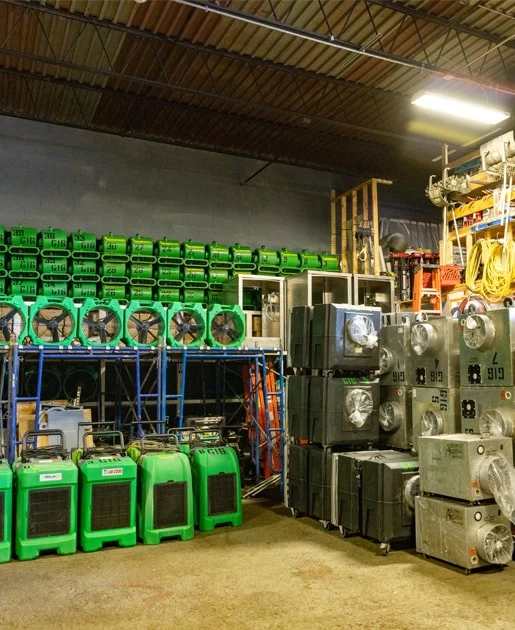
Once the assessment is complete, we extract the water, set commercial-grade drying equipment, and monitor moisture levels until the structure reaches safe readings — not just surface-dry, but genuinely dry throughout. If mold is present or structural materials need to come out, we handle that under our NYS DOL Mold License. Reconstruction — new drywall, flooring, framing — is completed under our Nassau County General Contractor License, with all required Town of Hempstead permits pulled and documented. You get a full paper trail for your insurance claim and for your records.
Basement Flooding Remediation Services Nassau County
The Full Scope, Not Just the Easy Parts
Flooded basement cleanup in North Lynbrook isn’t a one-size job. What’s included depends on what we find — and in a neighborhood where the majority of homes predate World War II, what we find is often more than just water. We’re equipped to handle the complete range: water extraction, structural drying, mold testing and remediation, asbestos abatement, lead handling, HVAC assessment, and full General Contractor reconstruction of damaged walls, floors, and framing.
The reason that matters here specifically is the age of the housing stock. Homes built before 1939 — and there are many of them in North Lynbrook — frequently contain asbestos vinyl floor tiles, lead-based paint on basement walls and trim, and original pipe insulation that becomes a regulated material the moment it’s disturbed by water damage. Nassau County homeowners who hire a company without the proper licenses for those materials are taking on real legal and health exposure. We hold every license required for every phase of this work, which means you’re not coordinating three different contractors or hoping someone handles the hazmat piece correctly.
We also assist with insurance documentation throughout the process. Standard homeowners insurance covers sudden accidental events like burst pipes, but it does not cover natural flooding from storms or groundwater — a distinction that catches a lot of Nassau County homeowners off guard. If you carry NFIP flood insurance alongside your homeowners policy, we understand how to document for both and help you submit correctly.
Does homeowners insurance cover basement flooding in North Lynbrook, NY?
This is one of the most common points of confusion for Nassau County homeowners, and the answer depends entirely on what caused the flooding. Standard homeowners insurance covers sudden, accidental water events — a burst pipe, a failed appliance, a water heater that gives out. It does not cover natural flooding from storms, groundwater intrusion, or a rising water table, which are exactly the scenarios that hit North Lynbrook hardest during nor’easters and heavy summer rain events.
For natural flood coverage, you need a separate NFIP flood insurance policy. Many North Lynbrook homeowners carry both, but not everyone realizes the two policies cover different causes of loss — and submitting a claim under the wrong policy, or without proper documentation, can result in a denial. We assist with damage documentation and carrier communication for both policy types so you’re not navigating that on your own at the worst possible moment.
How fast does mold grow after a basement floods on Long Island?
Faster than most people expect. The EPA recommends beginning cleanup within 24 to 48 hours of water intrusion to prevent mold growth from taking hold. The outer boundary most restoration professionals work with is 72 hours — after that point, mold becomes likely regardless of conditions. On Long Island’s South Shore, where summer humidity is already elevated and North Lynbrook sits in a naturally wet corridor, that timeline compresses further. A flooded basement in North Lynbrook in July or August can show visible mold growth in as little as 24 hours if the air is warm and the space isn’t being actively dried.
What makes this worse in older homes is that mold doesn’t just grow on surfaces you can see. It grows inside wall cavities, behind insulation, and under flooring — places a standard visual inspection won’t catch. That’s why professional moisture metering matters. If a crew dries your basement to the point where it looks fine but leaves residual moisture inside the wall assembly, you may not see the mold until it’s already a significant problem.
Why does my North Lynbrook basement keep flooding during heavy rainstorms?
There are a few things working against you at once. Nassau County’s South Shore sits on a naturally shallow water table, which means water is already close to the surface before a storm even starts. When heavy rain hits, that water table rises quickly and pushes against basement walls and floors from the outside. In a home built before 1939 — which describes most of the housing stock in North Lynbrook — original concrete and masonry construction wasn’t built to modern waterproofing standards. Aging mortar joints, original poured concrete, and decades-old drainage systems weren’t designed to handle the volume of water that a major nor’easter or summer thunderstorm can produce.
There’s also a runoff dynamic specific to this area. Rain that falls on higher-elevation parts of Nassau County flows downhill toward the South Shore during intense storms. North Lynbrook, positioned between Lynbrook and Malverne in this drainage corridor, sits in the path of that moving water. Your basement may be absorbing runoff from a much larger area than just your own property — which is why sump pumps in this neighborhood frequently get overwhelmed during major storm events even when they’re in good working condition.
Do I need an asbestos test before basement water damage cleanup in an older home?
If your home was built before 1980, it’s worth taking seriously — and if it was built before 1939, which applies to the majority of homes in North Lynbrook, the likelihood of asbestos-containing materials in the basement is genuinely high. The most common locations are vinyl floor tiles (particularly the 9-inch and 12-inch tiles common in mid-century construction), pipe insulation, and certain types of joint compound and ceiling texture.
When a basement floods, these materials can become disturbed, submerged, or damaged. A cleanup crew that doesn’t hold a NYS DOL Asbestos License cannot legally handle them — and if they proceed without proper abatement, they can spread asbestos fibers through the space in a way that creates a much larger problem than the water damage itself. We hold the NYS DOL Asbestos License and perform proper assessment before any demolition or drying work begins in homes where regulated materials may be present. This isn’t an upsell — it’s the legally required process for this type of property.
Can I clean up a flooded basement myself instead of hiring a professional?
For a small, clean water event — say, a minor pipe drip that’s been caught quickly in a newer home — DIY cleanup is sometimes manageable. But in North Lynbrook, where most homes were built before 1939 and the flooding is often caused by groundwater intrusion or storm runoff, the DIY route carries real risk. First, water from storms or groundwater is not clean water. It can carry contaminants, sewage backup, and biological material that require proper handling and disposal. Second, rental dehumidifiers and shop vacs don’t reach the moisture that’s absorbed into wall framing, subfloor, and insulation — the moisture that causes mold weeks after the basement appears dry.
Third, and most importantly for this neighborhood: if your basement contains asbestos floor tiles or lead paint — which is entirely possible in a pre-war home — disturbing those materials without proper licensing puts you and your family at real health and legal risk. The cost of professional cleanup is significant, but it’s a fraction of what remediation costs when mold has been allowed to spread or when a hazmat situation is discovered after the fact. FEMA data puts the average damage from just one inch of standing water at around $25,000. Getting the cleanup right the first time is the less expensive path.
How long does flooded basement cleanup and restoration take in Nassau County?
The honest answer is that it depends on what’s found once the work begins — and in North Lynbrook’s older housing stock, the scope can expand once walls come open and the full picture becomes clear. For a straightforward water extraction and structural drying job with no mold or hazmat involvement, the drying phase alone typically takes three to five days using commercial-grade equipment. Moisture levels are monitored throughout, and work doesn’t stop until readings confirm the structure is genuinely dry — not just surface-dry.
If mold remediation is needed, that adds time depending on the extent of growth and the materials affected. If asbestos abatement is required — which is a real possibility in homes built before 1939 — that phase follows its own regulatory timeline and must be completed before reconstruction begins. Full reconstruction of damaged walls, flooring, and framing under a Nassau County General Contractor permit adds additional time but delivers a finished result that will pass inspection and hold up to scrutiny from your insurance carrier. Most complete restoration projects in this area run anywhere from one to three weeks depending on scope. We give you a clear timeline at the assessment stage so you’re not guessing.