When Plainview's Aging Basements Flood, the Clock Starts Immediately
Most homes in Plainview were built in the 1950s and 1960s — and those basements weren’t designed to handle what Long Island’s weather throws at them today. We respond fast, work clean, and handle everything from water extraction to full restoration under one roof.
I needed a professional consultation explanation of procedure for safe removal of Asbestos in my apartment complex. Without having an account yet, I was very impressed with the caring, knowledgeable and generous advice offered by Jessica, and will look forward to doing business in the future. Thank you so much! I feel much more informed about a sometimes scary endeavor. Peace. Nancy Silva Mineola, NY.
Mia Munoz
Used this company to clean up some water flood in my house. They were fast and easy to work with.very professional, Would recommend to anyone!
Nini Valle
Great company, had a flood and they responded quickly and efficiently. Billed my insurance company directly. I highly recommend this company!
joe colapietro, jr
I had pipe freeze in my basement right before a snow storm and they made to within an hour to help start the clean up process. They we by our side throughout the entire process and even helped with the insurance company. They did such a great job with the cleanup, repair, remidiation, I contracted them to perform the repairs and finishes in the basement. They came with enough manpower and material to get the job done. Leo and Jessica were nothing but a pleasure to deal with!!
Cristian Arredondo c
I had some water damage in my home and Green Island was able to take care of my issue quickly and effectively. I am very pleased with the work they did. They responded quickly and were very professional.
Michael M
Outstanding service! From the office to the field crew everyone was friendly, helpful and responsive. I highly recommend Green Island Group.
Here’s what most Plainview homeowners don’t realize until it’s too late: the visible water is only part of the problem. Once your basement floods, moisture moves into the walls, under the subfloor, and into the framing — and in a home built in the 1950s or 1960s, that framing has been absorbing Long Island winters for over sixty years. By the time it looks dry, it may not be.
Mold can begin growing within 24 to 48 hours of a flood event. That window doesn’t care about your schedule or your insurance adjuster’s availability. Professional extraction and structural drying within 72 hours is the difference between a contained cleanup job and a mold remediation project that costs three times as much and takes three times as long.
What you get on the other side of this process is straightforward: a dry, documented, and fully restored basement — with no hidden moisture left behind, no mold risk that was missed, and no unlicensed guesswork about the asbestos floor tiles that are common in homes of this era throughout Plainview. One company, one scope, one outcome.
Licensed Basement Flood Cleanup Company Plainview, NY
Every License This Job Actually Requires
We hold a NYS DOL Mold License, NYS DOL Asbestos License, USEPA Lead and RRP certifications, IICRC Water Damage certification, and a Nassau County General Contractor license — the specific credential required to pull permits and perform structural restoration work in Plainview, which sits within the Town of Oyster Bay. That’s not a list of marketing credentials. That’s the full stack of licenses a flooded basement job in a 1950s Plainview home can legally and safely require.
Most water damage companies hold one or two of those. When the job involves asbestos floor tiles, lead paint on the walls, or a sewage backup that crossed into biohazard territory, the companies without those licenses either stop short or proceed illegally. We don’t have that problem.
We serve Nassau County homeowners across Plainview, Hicksville, Syosset, Woodbury, and the surrounding area. Our team has handled the full range of what Long Island’s older housing stock throws at a basement — from chronic groundwater infiltration to acute storm flooding to sump pump failure at 2 a.m. on a Saturday.
What Actually Happens From First Call to Final Walkthrough
When you call, you reach a real person — not a form, not a callback queue. From there, we dispatch a crew to your Plainview address with industrial extraction equipment, moisture detection tools, and the full picture of what a Nassau County basement job typically involves. The first priority is getting the water out and assessing the full scope of damage, including what’s behind the walls and under the floor — not just what’s visible.
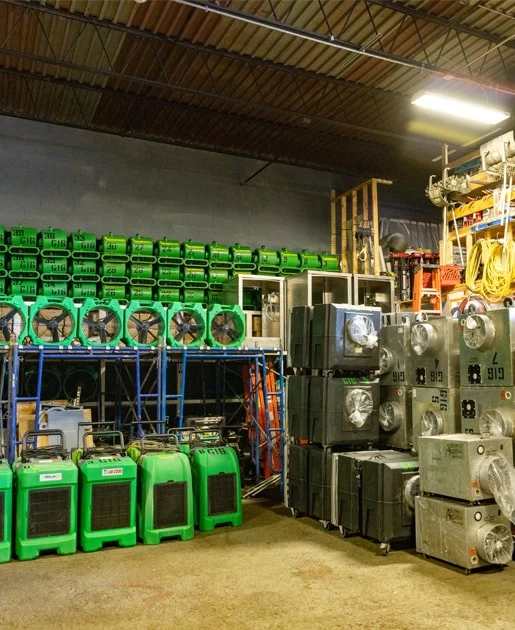
From there, the drying process begins. This isn’t fans on the floor and a follow-up call in a week. It’s calibrated structural drying using commercial-grade dehumidifiers and air movers, with moisture readings tracked throughout the process. If the home was built before 1978 — which describes the overwhelming majority of Plainview’s housing stock — we assess for asbestos-containing materials and lead paint before any demolition or debris removal begins. That step is not optional under New York State law, and it protects both you and our crew.
Once the space is dry and cleared, restoration work begins. Drywall, flooring, framing — whatever the water damaged. Because we hold a Nassau County General Contractor license, permits are pulled through the Town of Oyster Bay and the work is done legally, inspected, and documented. Throughout the entire process, we help you build the damage record your insurance carrier will need.
Basement Flooding Remediation Services Plainview, NY
Built for What Plainview Basements Actually Deal With
Flooded basement cleanup in Plainview isn’t a single-scope job. The age of the housing stock, the soil conditions, and the chronic groundwater infiltration that affects homes throughout this area mean that a complete response covers more ground than water extraction alone. Our service includes emergency water removal, structural drying, moisture mapping, mold prevention treatment, and full structural restoration — all under one contract.
For homes with pre-1978 construction — which is most of Plainview — the scope also includes licensed asbestos assessment and abatement if vinyl asbestos floor tiles or pipe insulation are disturbed, and lead-safe work practices throughout any demolition or rebuild. These aren’t add-ons. They’re legal requirements in New York State that most competitors either skip or subcontract out. We hold the NYS DOL Asbestos License and USEPA Lead/RRP certification to handle both in-house.
Sewage backup events — which happen in Plainview during heavy rain when older municipal infrastructure gets overwhelmed — are handled as Category 3 biohazard cleanups with full decontamination protocols. And because sump pump failure is one of the most common causes of basement flooding in this community, we’re familiar with the specific conditions that follow: fast-rising water, saturated concrete, and moisture that travels farther than it looks. Every job includes insurance documentation support so you’re not navigating your carrier alone.
Does homeowners insurance cover basement flooding from a sump pump failure in Plainview?
This is one of the most common points of confusion for Plainview homeowners, and the short answer is: it depends on your specific policy, but many standard homeowners policies do not automatically cover sump pump failure or groundwater intrusion. Standard homeowners insurance typically covers sudden and accidental water damage — a burst pipe, a failed appliance — but flooding that enters from outside the home, or from a failed sump pump, often falls into a coverage gap unless you’ve added a water backup rider or separate flood policy.
Because Plainview is an inland community and not in a coastal flood zone, most homeowners here aren’t required to carry NFIP flood insurance — and many don’t. That means when the sump pump fails during a storm and the basement takes on two feet of water, the coverage question can get complicated fast. We help you document the damage thoroughly from the start, giving you the strongest possible foundation for whatever claim you file — and helping you understand what your carrier is likely and unlikely to cover before you’re caught off guard.
How fast does mold actually start growing after a basement floods on Long Island?
Mold can begin growing within 24 to 48 hours of a water event — and in a Plainview basement, the conditions are often already favorable before the flood even happens. Homes built in the 1950s and 1960s frequently have older insulation, wood framing that has absorbed decades of humidity, and basements that have experienced minor moisture infiltration for years. That existing organic material gives mold a head start the moment standing water is introduced.
The 72-hour window is the industry benchmark for professional drying — if the space is fully extracted and dried within that window, mold growth can typically be prevented. Beyond 72 hours, the likelihood of mold taking hold increases significantly, and remediation becomes a separate, more involved, and more expensive process than the original cleanup. This is why the response timeline matters as much as the technical scope of the work. Waiting a day or two to “see how it dries out” is one of the most common and costly decisions homeowners make after a basement flood.
My Plainview home was built in the 1950s — is asbestos a concern during basement cleanup?
Yes, and it’s worth taking seriously. Homes built in the 1950s and 1960s — which describes the vast majority of Plainview’s housing stock — commonly contain asbestos in floor tiles, pipe insulation, and joint compound. The 9-inch vinyl floor tiles that were standard in basement construction during that era are a known asbestos-containing material. Under normal conditions, intact asbestos materials aren’t an immediate hazard. But when a basement floods and cleanup involves breaking up damaged flooring, disturbing insulation, or removing drywall, those materials can become airborne.
New York State requires a NYS DOL Asbestos License to legally perform asbestos abatement — and that license applies directly to residential work in Plainview. We hold that license. Before any demolition or debris removal begins in a pre-1978 home, our team assesses for asbestos-containing materials and follows the legally required handling procedures. Hiring a water damage company that doesn’t hold this license — and there are many operating in Nassau County — means either the asbestos gets ignored or it gets disturbed without proper containment, creating a health and liability issue that outlasts the flood damage itself.
What's the difference between water extraction and full basement flood cleanup?
Water extraction is one step in the process — it’s the removal of standing water using industrial pumps and wet-vacs. Full basement flood cleanup goes significantly further. After extraction, the real work is structural drying: removing moisture from the walls, subfloor, framing, and concrete using commercial dehumidifiers and air movers, with moisture readings tracked over time to confirm the space is genuinely dry — not just surface dry.
From there, a complete cleanup includes mold prevention treatment, removal of any materials that can’t be dried (saturated drywall, flooring, insulation), and in Nassau County homes of typical Plainview vintage, assessment and handling of any hazardous materials disturbed during the process. The final phase is structural restoration — replacing what was removed so the basement is returned to its pre-loss condition. Many companies that advertise “flooded basement cleanup” handle extraction and basic drying, then leave you to find a separate contractor for the rebuild. We handle the full scope, which matters when you’re trying to get your home back to normal without managing three different vendors on a timeline that’s already stressful.
How much does flooded basement cleanup typically cost in Plainview, NY?
The range is wide because the scope varies significantly depending on the source of the water, how long it sat, and what materials were affected. A smaller clean-water event — a failed appliance or a minor pipe leak — can run in the $1,600 to $3,500 range for extraction and drying. A larger event involving contaminated water, sewage backup, or significant structural damage can reach $10,000 to $12,000 or more, and full restoration including drywall, flooring, and framing can push higher from there.
For Plainview specifically, the age of the housing stock adds variables that don’t apply in newer-construction towns. If asbestos floor tiles are present and need to be abated, that’s a licensed, regulated process with its own cost. If the basement has had chronic moisture issues for years — which is common throughout the hamlet — the scope of hidden damage may be larger than the visible flood suggests. The most useful thing you can do after a flood is get a thorough assessment done quickly, before hidden moisture has time to compound the damage and the cost.
How do I know if my basement is actually dry after a flood, or just looks dry?
This is exactly the right question to ask, and the answer is: you can’t tell by looking. Concrete and drywall can appear dry on the surface while holding significant moisture inside. Wood framing absorbs water and releases it slowly — sometimes over weeks. Insulation behind walls can stay saturated long after the visible floor has dried. In a Plainview home with older construction and potentially years of minor moisture history already in the walls, the gap between “looks dry” and “is dry” can be substantial.
Professional moisture detection uses calibrated meters and thermal imaging to read moisture levels inside walls, under flooring, and in structural materials — not just on the surface. We track moisture readings throughout the drying process and don’t consider a job complete until the numbers confirm the space has reached acceptable levels. This matters because mold doesn’t grow on the surface you can see — it grows in the wet space behind it. Getting a professional moisture assessment after any basement flood in Plainview, regardless of how minor it appears, is the single most reliable way to know whether the problem is actually resolved or just hidden.