Your Port Jefferson Basement Flooded Here's What Happens Next
When water hits your basement on the North Shore, every hour matters. We respond fast, handle your insurance, and get your home back to safe no runaround.
I needed a professional consultation explanation of procedure for safe removal of Asbestos in my apartment complex. Without having an account yet, I was very impressed with the caring, knowledgeable and generous advice offered by Jessica, and will look forward to doing business in the future. Thank you so much! I feel much more informed about a sometimes scary endeavor. Peace. Nancy Silva Mineola, NY.
Mia Munoz
Used this company to clean up some water flood in my house. They were fast and easy to work with.very professional, Would recommend to anyone!
Nini Valle
Great company, had a flood and they responded quickly and efficiently. Billed my insurance company directly. I highly recommend this company!
joe colapietro, jr
I had pipe freeze in my basement right before a snow storm and they made to within an hour to help start the clean up process. They we by our side throughout the entire process and even helped with the insurance company. They did such a great job with the cleanup, repair, remidiation, I contracted them to perform the repairs and finishes in the basement. They came with enough manpower and material to get the job done. Leo and Jessica were nothing but a pleasure to deal with!!
Cristian Arredondo c
I had some water damage in my home and Green Island was able to take care of my issue quickly and effectively. I am very pleased with the work they did. They responded quickly and were very professional.
Michael M
Outstanding service! From the office to the field crew everyone was friendly, helpful and responsive. I highly recommend Green Island Group.
The immediate problem is the water. The real problem is what happens after the water’s gone. In Port Jefferson sitting right on Long Island Sound ambient humidity doesn’t give your basement walls a chance to dry on their own. What looks dry to the eye is often still saturated inside the drywall, behind the insulation, and under the subfloor. That’s where mold starts, and by the time you see it, it’s already been growing for days.
If your Port Jefferson home was built before the 1980s and roughly one in five homes in the village was built before 1950 there’s another layer to this. Flooding disturbs things. It loosens pipe insulation, lifts floor tiles, and soaks textured ceilings. In older homes, those materials can contain asbestos. That’s not something a general handyman or a franchise pump truck is licensed to handle. It requires specific state certifications that most water damage companies in this area simply don’t carry.
When the job is done right, you get more than a dry floor. You get documentation your insurance adjuster can actually use, clearance testing that confirms the air is safe, and the confidence that nothing was left behind to become a bigger problem in six months.
Licensed Basement Flood Restoration near Port Jefferson
Every License That a Port Jefferson Home Actually Demands
We are an independently owned environmental restoration company serving Port Jefferson, the North Shore, and across Long Island and New York City. Led by CEO Jessica Dussan and VP Leo Torres, our team holds a full stack of licenses that matter here: NYS DOL Mold, NYS DOL Asbestos, USEPA Lead, General Contractor licenses in Suffolk and Nassau Counties, and NYS OGS approval as an emergency response contractor the same credential New York State requires to deploy on public emergencies.
That last one isn’t a marketing badge. It means the state has independently vetted us to respond when things go seriously wrong. For homeowners near the Port Jefferson waterfront, in Harbor Hills, or anywhere along the North Shore drainage corridors that flooded during the August 2024 storm event, that standard of accountability is exactly what you want behind the crew walking into your basement.
We are also a New York State certified MBE and WBE independently verified, not self-declared. Over 5,000 completed restoration projects across New York State back up everything on our credentials list.
Basement Flooding Remediation Process near Port Jefferson
What a Real Cleanup Looks Like From First Call to Final Check
The first call gets someone moving not a call center scheduling you for two days out. Our verified response times run under an hour, including during severe weather. When we arrive, the first step isn’t pulling out equipment. It’s assessment. Moisture meters, thermal imaging, and a visual inspection of the full space determine where the water came from, how far it traveled, and what materials it affected. In Port Jefferson’s older housing stock, that inspection includes checking for hazardous materials before anything gets disturbed.
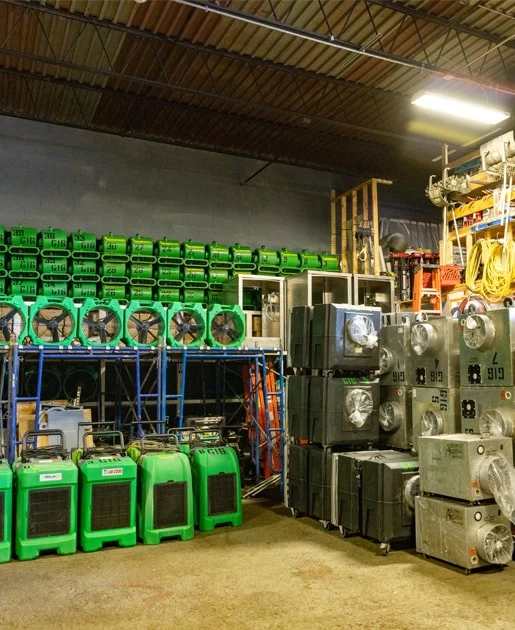
From there, water extraction begins industrial-grade equipment that removes standing water and starts pulling moisture from walls, floors, and structural cavities. Then come the dehumidifiers and air movers, calibrated for coastal Long Island’s humidity levels. This isn’t a detail drying equipment that performs adequately in an inland town like Hauppauge will underperform here. Port Jefferson’s proximity to the Sound keeps ambient humidity elevated, and that directly extends drying time if the wrong equipment is used.
Once the space is dry and confirmed clean, we compile documentation for your insurance claim. If your basement restoration requires a building permit through the Village of Port Jefferson’s Building Department which applies to work involving structural elements or drywall replacement we handle that process as part of the job. You don’t get handed a folder and told to figure it out.
Flooded Basement Cleaning Services near Port Jefferson, NY
Built for North Shore Homes Not a One-Size Cleanup
Flooded basement cleanup in Port Jefferson isn’t a single service it’s a sequence of them, and the right sequence depends on what kind of water came in and what your home is made of. Stormwater from a nor’easter that overwhelmed Port Jefferson’s drainage system is a different situation than a burst pipe in January. Sewage backup from the Port Jefferson Sewer District during a heavy rain event is a Category 3 hazard that requires containment, antimicrobial treatment, and proper disposal not a mop and a bottle of bleach.
We handle the full scope: water extraction, structural drying, mold testing and remediation, asbestos and lead assessment in pre-1980 homes, sewage backup cleanup, and full reconstruction through to final inspection. If your home is in a designated flood zone under the Village of Port Jefferson’s Flood Damage Prevention Ordinance Chapter 145 of the Village Code the work has to meet specific standards before reconstruction begins. That’s not something you want to discover after a contractor has already started tearing out drywall.
Direct insurance billing is standard. We document everything your adjuster needs moisture readings, affected materials, scope of work and communicate with your carrier directly. If you’re navigating both a homeowners policy and a separate NFIP flood insurance policy, which is common for Port Jefferson properties near the harbor, we sort that complexity out for you, not hand it back to you.
Does homeowners insurance cover basement flooding in Port Jefferson, NY?
It depends on where the water came from and that distinction matters more in Port Jefferson than almost anywhere else on Long Island. Standard homeowners insurance typically covers sudden, internal water events: a burst pipe, a failed water heater, a washing machine overflow. It does not cover water that enters from outside storm surge from Port Jefferson Harbor, groundwater pushed in by hydrostatic pressure after a heavy rain, or tidal flooding from Long Island Sound. That type of damage falls under flood insurance, which is a separate policy issued through FEMA’s National Flood Insurance Program.
Many Port Jefferson homeowners carry both, especially properties near the waterfront or in Lower Port Jefferson. The tricky part is knowing which policy to file under and filing under the wrong one can result in a denied claim. When we respond to your home, part of the process is documenting the water source clearly so your claim goes to the right carrier the first time. We bill insurance directly and work with your adjuster, so you’re not left sorting through policy language while your basement is still wet.
How quickly does mold start growing after a basement floods?
The standard answer is 24 to 48 hours but that window assumes average indoor humidity. In Port Jefferson, where the air off Long Island Sound keeps ambient humidity elevated year-round, materials stay wet longer than they would in an inland community. That effectively compresses the timeline. A basement that might have a full 48 hours before mold takes hold in Hauppauge or Holbrook may be closer to 24 hours in a coastal North Shore home especially in summer months when outdoor humidity is at its peak.
The other factor is hidden moisture. What you can see and touch in your basement after a flood is only part of the picture. Water wicks into wall cavities, saturates insulation, and sits under flooring long after the visible surface appears dry. Mold doesn’t need much it needs moisture and an organic surface, and your drywall, wood framing, and subfloor provide both. Professional moisture testing with thermal imaging identifies where water is hiding so drying equipment can be positioned correctly. Skipping that step and assuming the basement is dry because the floor feels dry is one of the most common reasons homeowners end up with a mold problem weeks after a flood cleanup.
What makes basement flooding in Port Jefferson different from other Long Island towns?
A few things make Port Jefferson specifically challenging. The village sits at the head of Port Jefferson Harbor, which opens directly into Long Island Sound meaning coastal storm surge, nor’easters, and tidal flooding are recurring events, not rare ones. The village’s original name was “Drowned Meadow,” changed in the 1830s because the harborfront flooded at high tide until a causeway was built. The geography hasn’t changed.
The housing stock adds another layer. About 21% of homes in Port Jefferson village were built before 1950, and the median construction year is 1972. That means a significant portion of basements have pipe insulation, floor tiles, or textured surfaces that may contain asbestos materials that become a regulated hazard the moment they’re disturbed by floodwater or a cleanup crew. Most water damage companies operating on Long Island are not licensed to handle those materials. The Village of Port Jefferson also administers its own Building Department and has a formal Flood Damage Prevention Ordinance, so restoration work that involves structural changes requires navigating village permits not just county-level requirements. These aren’t obstacles if your contractor already knows the process. They become obstacles if your contractor doesn’t.
Can I clean up a flooded basement myself in Port Jefferson?
For minor water intrusion a small amount of clean water from a known source, caught quickly some homeowners can manage initial steps like removing standing water with a wet vac and running fans. But there are real limits to that, and in Port Jefferson those limits come up fast.
If the water sat for more than a few hours, if it came from outside the home, if there’s any chance of sewage involvement from the Port Jefferson Sewer District’s system backing up during a storm, or if your home was built before 1980, this is not a DIY situation. Category 3 water which includes any sewage-contaminated water requires containment and disposal protocols that aren’t accessible to homeowners. Asbestos-containing materials that get disturbed during a cleanup require a NYS DOL licensed contractor to handle legally. And if you’re filing an insurance claim, undocumented DIY cleanup can complicate or void that claim entirely. Insurance adjusters want to see professional moisture readings, scope documentation, and licensed contractor involvement. A shop vac and a few box fans don’t produce that paper trail.
What should I do the moment I discover my basement is flooded?
The first thing is safety don’t walk into standing water if you don’t know whether electrical outlets, appliances, or your electrical panel are submerged or near the water line. If there’s any question, cut power to the basement from your breaker panel before entering. Then call us immediately not in the morning, not after you’ve tried to clean it up yourself.
While you’re waiting for our crew to arrive, take photos and video of everything. Document the water level, the affected materials, any visible damage to walls, flooring, and belongings. This documentation is the foundation of your insurance claim, and the more you capture before anything is moved or removed, the better. If you have a sump pump and it’s still operational, make sure it’s running. Do not run standard box fans in a Port Jefferson basement during summer months the coastal humidity outside is often higher than the humidity inside, and you can inadvertently pull more moisture into the space. Leave the mechanical drying to equipment that’s calibrated for these conditions.
Does Green Island Group handle basement flood cleanup in Port Jefferson Station too?
Yes Port Jefferson Station is a regular part of our service area. While Port Jefferson Station is technically a separate hamlet in the Town of Brookhaven rather than part of the incorporated village, it shares the same flooding vulnerabilities and the same North Shore climate conditions. During the August 2024 storm event that dropped up to 10 inches of rain on northern Suffolk County, Port Jefferson Station was among the hardest-hit communities some homes were deemed uninhabitable after storm erosion left them structurally compromised.
We also regularly serve the surrounding communities: Belle Terre, Poquott, Old Field, and Mount Sinai. Homes in these areas share the coastal exposure, the older housing stock, and the same drainage challenges that make basement flooding on this stretch of the North Shore a recurring issue rather than a one-time event. Response times hold regardless of which side of the LIRR tracks you’re on the same sub-one-hour standard applies across our full service area.