Flooded Basement Cleanup in Port Washington North, NY
When the Peninsula Pushes Water In, You Need It Gone Fast
Port Washington North sits on the Cow Neck Peninsula — water on both sides, a high water table underneath, and older homes that weren’t built to handle any of it. When your basement floods, we’re available 24/7 to extract, dry, and restore it completely.
I needed a professional consultation explanation of procedure for safe removal of Asbestos in my apartment complex. Without having an account yet, I was very impressed with the caring, knowledgeable and generous advice offered by Jessica, and will look forward to doing business in the future. Thank you so much! I feel much more informed about a sometimes scary endeavor. Peace. Nancy Silva Mineola, NY.
Mia Munoz
Used this company to clean up some water flood in my house. They were fast and easy to work with.very professional, Would recommend to anyone!
Nini Valle
Great company, had a flood and they responded quickly and efficiently. Billed my insurance company directly. I highly recommend this company!
joe colapietro, jr
I had pipe freeze in my basement right before a snow storm and they made to within an hour to help start the clean up process. They we by our side throughout the entire process and even helped with the insurance company. They did such a great job with the cleanup, repair, remidiation, I contracted them to perform the repairs and finishes in the basement. They came with enough manpower and material to get the job done. Leo and Jessica were nothing but a pleasure to deal with!!
Cristian Arredondo c
I had some water damage in my home and Green Island was able to take care of my issue quickly and effectively. I am very pleased with the work they did. They responded quickly and were very professional.
Michael M
Outstanding service! From the office to the field crew everyone was friendly, helpful and responsive. I highly recommend Green Island Group.
There’s a difference between a basement that looks dry and one that actually is. Moisture hides inside block foundation walls, under subfloors, and behind drywall — and in a pre-war or mid-century Port Washington North home, those materials absorb water fast and hold it longer than you’d expect. If that moisture isn’t fully extracted and dried, mold follows within 24 to 48 hours.
What you get when the job is done right is a basement you can actually use again. No musty smell creeping upstairs. No soft spots in the flooring. No visible growth appearing on the walls six weeks later. For a home worth over a million dollars on the Cow Neck Peninsula, the difference between a complete cleanup and a rushed one isn’t cosmetic — it’s financial. Undisclosed water damage and mold are material defects that follow a property through every future sale, refinance, and inspection.
The other thing worth knowing: Port Washington North’s older housing stock — a significant portion of which was built before 1939 — often contains asbestos floor tiles, pipe insulation, or lead paint. Flooding disturbs these materials. A crew that isn’t licensed to handle them shouldn’t be touching your basement. We hold both the NYS DOL Asbestos License and the USEPA Lead/RRP certification, so that question is answered before anyone sets foot in your home.
We’re a full-service disaster restoration and environmental remediation company serving Nassau County, including the North Shore communities of Port Washington North, Manorhaven, Sands Point, and Baxter Estates. The reason homeowners in Port Washington North call us — and stay with us — is simple: we can handle everything under one contract. Water extraction, structural drying, mold remediation, asbestos abatement, lead stabilization, and full rebuild. Most companies stop at the cleanup phase and hand you off to someone else. We don’t.
Our licensing stack is what separates a real restoration company from a crew with a wet-vac and a dehumidifier. We hold the NYS DOL Mold License, NYS DOL Asbestos License, USEPA Lead/RRP certification, IICRC Water Damage certification, and a Nassau County General Contractor license. In an incorporated village like Port Washington North — where the village building inspector administers floodplain development permits and the village code governs how water discharge is handled — having the right licenses isn’t optional. It’s what keeps your restoration compliant and your property protected.
Flooded Basement Remediation Process, Nassau County
From Standing Water to Finished Space — Here's the Sequence
The first call triggers an immediate dispatch. We don’t schedule assessments for the next morning — water damage is time-sensitive, and the 72-hour window before mold conditions develop is real. When we arrive, the first priority is understanding what you’re dealing with: where the water came from, how long it’s been there, and what category it falls into. Clean water from a burst pipe is handled differently than groundwater seeping through a foundation wall after a nor’easter saturates the glacial till beneath your property — and very differently from a sewage backup, which is a biohazard situation that requires full decontamination.
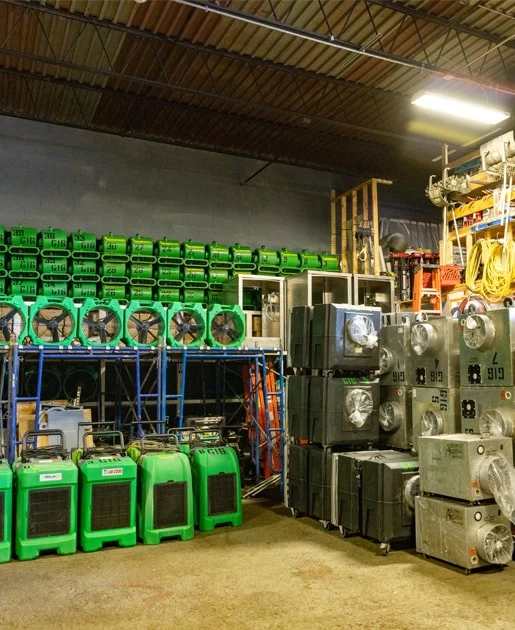
Once the water source is identified, we extract standing water with industrial-grade equipment, then use professional moisture detection tools to map what’s hidden inside walls, under flooring, and in concrete block cavities. This step matters more than most people realize. The visible water is the easy part. The moisture you can’t see is what causes the long-term damage. Structural drying equipment — commercial dehumidifiers and air movers — runs until moisture readings confirm the space is genuinely dry, not just surface-dry.
If mold is present or if building materials need to be removed, that work happens under our NYS DOL Mold License and in compliance with Port Washington North’s village code, including any floodplain development permit requirements that apply to your property. Once the space is clean, dry, and clear, our Nassau County General Contractor license covers the full structural restoration — drywall, framing, flooring, and finish work — so you’re not coordinating a second contractor to bring your basement back to livable condition.
Basement Flooding Remediation, Port Washington North NY
What's Actually Included When We Handle Your Basement
Flooded basement cleanup in Port Washington North isn’t a single service — it’s a sequence of connected work that needs to be handled by one team with the range to do all of it. Here’s what that looks like in practice.
Emergency water extraction comes first, using truck-mounted and portable equipment capable of removing significant volumes of standing water quickly. After extraction, we deploy commercial-grade drying systems and monitor moisture levels daily until the space meets IICRC drying standards — not until it feels dry, but until the numbers confirm it. For homes near the Manhasset Bay waterfront or on lower-lying lots where the water table stays elevated after storm events, this process takes longer than it does in inland communities, and we account for that.
If your home was built before 1978 — which describes the majority of Port Washington North’s housing stock — we conduct a hazardous materials assessment before any demolition or material removal begins. Disturbing asbestos floor tiles or lead paint without proper protocols is a health risk and a legal liability. We’re licensed for both, so that step happens in-house, not as an add-on from a third party. Mold remediation, when needed, is performed under our NYS DOL Mold License with post-remediation verification testing to document that the space is clear. And when it’s time to rebuild, our Nassau County General Contractor license means we handle permits, inspections, and finish work through to completion — including any floodplain development permits required by Port Washington North’s village building inspector for properties in designated flood hazard areas.
Does homeowners insurance cover basement flooding in Port Washington North, NY?
It depends on what caused the flooding — and that distinction matters more in Port Washington North than in most Nassau County communities. Standard homeowners insurance typically covers sudden, accidental water damage: a burst pipe, a failed water heater, or an appliance leak. What it generally does not cover is flooding caused by groundwater rising through your foundation, storm surge, or surface water entering the home from outside. Those events fall under flood insurance, which is a separate policy issued through the National Flood Insurance Program (NFIP) or a private carrier.
Port Washington North participates in the NFIP under Community Number 361562, and properties in designated flood hazard areas — particularly those near the Manhasset Bay waterfront — may be required to carry flood insurance as a condition of their mortgage. If you have both policies, understanding which one applies to your specific event is critical for getting a complete claim paid. We assist with damage documentation and insurance coordination for both standard homeowners claims and NFIP flood claims, so you’re not navigating that process alone while also dealing with a flooded basement.
How quickly does mold start growing after a basement flood on Long Island?
Mold can begin developing within 24 to 48 hours of water exposure under the right conditions — and basements in Port Washington North’s older housing stock tend to create those conditions quickly. Pre-war and mid-century homes were built with materials that absorb moisture readily: wood framing, plaster, older drywall, and concrete block foundations that wick water from the surrounding soil. When the water table rises after a heavy storm and stays elevated — which happens frequently on the Cow Neck Peninsula due to its limited drainage paths — ambient humidity in a wet basement stays high even after standing water is removed.
The practical implication is that the 72-hour window from flooding to mold prevention isn’t a guarantee — it’s a ceiling, and in a high-humidity coastal environment it can be shorter. That’s why speed of response matters as much as the quality of the work itself. If extraction and structural drying don’t begin within the first day, you’re increasingly likely to be dealing with both a water damage cleanup and a mold remediation project. Getting a crew on-site the same day you call isn’t just convenient — it’s the difference between two scopes of work and one.
Do I need a permit for basement restoration work in Port Washington North?
Yes, in most cases. Port Washington North is an incorporated village with its own building permit requirements, and any structural restoration work — replacing drywall, framing, flooring, or making changes to drainage — requires a permit from the village building inspector. The village code also requires that no building permit be issued without an approved drainage plan, which is a requirement that catches many homeowners off guard when they’re trying to move quickly after a flood.
Beyond the standard building permit, properties in designated flood hazard areas are subject to Port Washington North’s Flood Damage Prevention ordinance (Chapter 98 of the village code). Restoration work in those areas requires a floodplain development permit, and the work must comply with NFIP standards. The village also has a Stormwater Management ordinance (Chapter 142) that governs how water discharge is handled during and after restoration work. We hold a Nassau County General Contractor license and are familiar with the permit requirements specific to Port Washington North’s village code — we handle the permitting process as part of the job, not as an afterthought.
What causes basement flooding in Port Washington North specifically?
The Cow Neck Peninsula’s geography creates flooding conditions that don’t exist in most inland Nassau County communities. Port Washington North sits between Manhasset Bay to the west and Hempstead Harbor to the east, which means the water table is influenced by tidal waters on multiple sides and responds quickly to storm events. The soil beneath the village is glacially deposited till from the Harbor Hill Moraine — a mix of clay, sand, gravel, and boulders that drains unevenly from lot to lot. Some properties drain well after a storm; others retain water for days, creating sustained hydrostatic pressure against basement walls and floor slabs.
The most common causes of basement flooding in Port Washington North are groundwater intrusion through foundation walls and floor drains during periods of elevated water table, surface water backup during extreme rainfall events like Tropical Storm Ida in 2021, and storm surge from Long Island Sound during nor’easters and tropical storms. Older homes on lower-lying lots near the waterfront are the most vulnerable, but the variable drainage of the moraine soil means that properties further inland can flood unexpectedly too. Frozen pipe bursts during winter are also a factor in the village’s pre-war housing stock, where older plumbing systems are more vulnerable to freeze events.
What's the difference between Category 1, 2, and 3 basement flooding?
Water damage is classified into three categories based on contamination level, and the category determines how the cleanup is handled — not just what equipment is used, but what safety protocols are required and what materials can be salvaged versus removed.
Category 1 is clean water from a supply line, water heater, or appliance. It’s the most straightforward to address, though it still requires proper extraction and drying to prevent mold. Category 2 — often called gray water — comes from sources like washing machine overflow, dishwasher discharge, or sump pump failure. It contains biological contaminants and requires more careful handling of affected materials. Category 3, or black water, is the most serious: sewage backup, rising floodwater, or any water that has been standing long enough to become heavily contaminated. In Port Washington North, where older sewer infrastructure serves pre-war and mid-century homes, sewage backup during heavy storm events is a real and recurring risk. Category 3 flooding requires full biohazard decontamination protocols — not just drying equipment — and materials that contact black water typically cannot be salvaged. The category of your flooding event also affects your insurance claim, so accurate documentation from the start matters.
Can asbestos be a concern during basement flood cleanup in older Port Washington North homes?
Yes, and it’s one of the most overlooked risks in post-flood cleanup for this area specifically. A significant portion of Port Washington North’s housing stock was built before 1939, with the majority constructed before 1970. Homes from that era commonly contain asbestos in floor tiles, pipe insulation, joint compound, and ceiling texture. Lead-based paint is also standard in pre-1978 construction. Under normal conditions, these materials are not a health hazard as long as they’re intact. Flooding changes that.
When water saturates older floor tiles, they can loosen and break. When pipe insulation gets wet, it deteriorates. When drywall or plaster soaked in water gets removed during cleanup, it can disturb materials that were otherwise stable. A crew that isn’t licensed to identify and handle these materials should not be doing demolition or material removal in a pre-1970 home — full stop. We hold the NYS DOL Asbestos License and the USEPA Lead/RRP certification. We assess for hazardous materials before any demo work begins, handle abatement in-house when it’s needed, and document everything — so you know exactly what was found, how it was handled, and that your home is safe when we leave.