Ridgewood's Old Basements Need More Than a Shop Vac
When a century-old rowhouse basement floods in Ridgewood, what’s in the water matters as much as how fast you remove it. We respond in under an hour licensed for everything your building’s walls might be hiding.
I needed a professional consultation explanation of procedure for safe removal of Asbestos in my apartment complex. Without having an account yet, I was very impressed with the caring, knowledgeable and generous advice offered by Jessica, and will look forward to doing business in the future. Thank you so much! I feel much more informed about a sometimes scary endeavor. Peace. Nancy Silva Mineola, NY.
Mia Munoz
Used this company to clean up some water flood in my house. They were fast and easy to work with.very professional, Would recommend to anyone!
Nini Valle
Great company, had a flood and they responded quickly and efficiently. Billed my insurance company directly. I highly recommend this company!
joe colapietro, jr
I had pipe freeze in my basement right before a snow storm and they made to within an hour to help start the clean up process. They we by our side throughout the entire process and even helped with the insurance company. They did such a great job with the cleanup, repair, remidiation, I contracted them to perform the repairs and finishes in the basement. They came with enough manpower and material to get the job done. Leo and Jessica were nothing but a pleasure to deal with!!
Cristian Arredondo c
I had some water damage in my home and Green Island was able to take care of my issue quickly and effectively. I am very pleased with the work they did. They responded quickly and were very professional.
Michael M
Outstanding service! From the office to the field crew everyone was friendly, helpful and responsive. I highly recommend Green Island Group.
Most basement floods in Ridgewood aren’t clean water events. When the combined sewer system that runs under this neighborhood backs up and Queens Community Board 5 has documented it overflowing 25 to 40 times a year what comes up through your floor drain isn’t just rainwater. It’s sewage. That changes everything about how the cleanup needs to be handled, what certifications the crew needs, and what your insurance company is going to require as documentation.
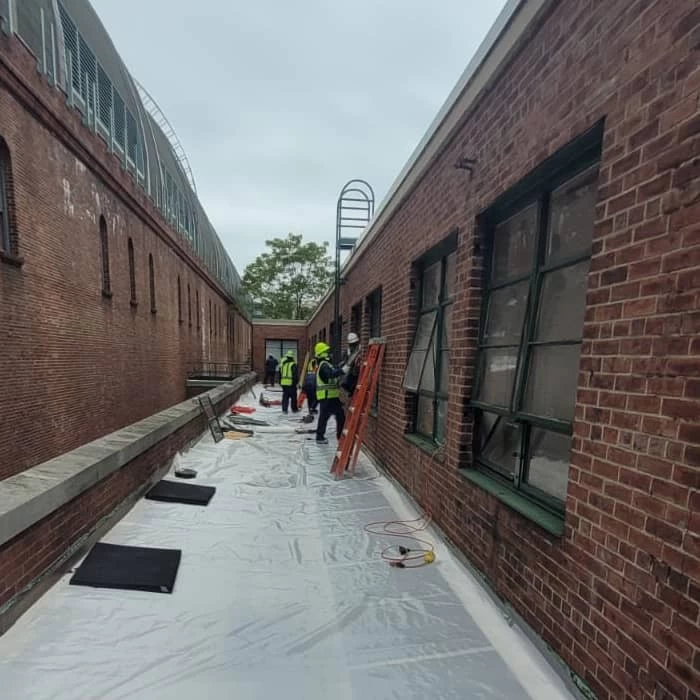
The other thing that makes Ridgewood different is the buildings themselves. Nearly 3,000 structures in this neighborhood are landmarked, and the overwhelming majority were built before 1927. That means asbestos pipe insulation, lead paint on basement walls and trim, and plumbing systems that were designed for a different era. When a remediation crew starts cutting into walls to assess damage, they’re legally required to handle those materials under strict New York State protocols. Most water damage companies aren’t licensed to do that. We are.
When the job is done right, you’re not just getting a dry basement. You’re getting a basement that’s been fully assessed, properly dried using thermal imaging to catch moisture your eyes can’t see, and cleared of any contamination documented thoroughly enough to satisfy your insurance adjuster and, if you’re a landlord, your tenants and HPD.
Every License This Job Actually Requires We Have It
We’re not a franchise. There’s no national call center routing your emergency to whoever’s available. We’re a fully certified remediation and restoration company that holds the NYS DOL Mold License, NYS DOL Asbestos License, USEPA Lead Certification, IICRC Water Damage Certification, and an NYC General Contractor License every credential required to legally and safely handle a flooded basement in Ridgewood’s most regulated environment.
That combination matters specifically in this neighborhood. The four historic districts here Central Ridgewood, Ridgewood North, Ridgewood South, and Stockholm Street mean that almost every basement job in Ridgewood involves pre-1930 construction. The certifications aren’t a marketing checklist. They’re what makes the work legal, insurable, and safe in buildings that were standing before modern safety standards existed.
We work directly with your insurance adjuster, handle documentation from extraction through reconstruction, and don’t hand you off to a separate contractor when the drying phase ends. One company, start to finish.
What Actually Happens From the First Call to a Finished Basement
The first call triggers a response 24 hours a day, every day of the year. A crew heads to your Ridgewood address immediately, with industrial extraction equipment already loaded. There’s no assessment call scheduled for the next morning. In a neighborhood of attached rowhouses sharing foundation walls, water that sits overnight doesn’t stay in one unit.
Once on site, we do a full assessment before anything is removed or disturbed. That includes thermal imaging to locate moisture trapped inside Ridgewood’s characteristically thick masonry walls the kind that can hold water for weeks behind plaster that looks completely dry. If there’s any indication of asbestos-containing materials or lead paint which is a realistic probability in any pre-1930 building here the crew follows NYS DOL and USEPA protocols before proceeding. This step protects you legally and protects your family physically.
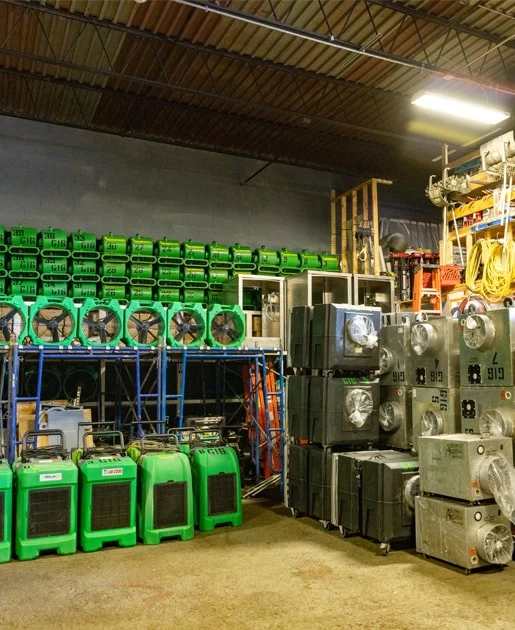
From there, it’s extraction, structural drying, air quality testing, mold prevention treatment, and full documentation for your insurance claim. If reconstruction is needed flooring, drywall, framing we handle that too under our NYC General Contractor license. You don’t need to find a second company. The process runs from emergency response through a finished, habitable space, with your insurance adjuster kept in the loop the entire time.
Built for What Ridgewood Basements Actually Throw at You
Flooded basement cleanup in Ridgewood covers a wider scope than most homeowners expect going in. Because the neighborhood’s combined sewer system regularly backs up during heavy rain and because events like Hurricane Ida’s remnants in September 2021 caused some of the worst basement flooding Queens has ever recorded the contamination category of most Ridgewood floods is gray or black water. That requires licensed sewage remediation, not just water extraction and a few fans running for three days.
Every job we handle includes complete water removal, thermal imaging moisture mapping, structural drying, antimicrobial treatment, and air quality verification. For buildings in Ridgewood’s historic districts, we also conduct a pre-remediation assessment for regulated materials asbestos and lead before any walls are opened or flooring is disturbed. This isn’t optional in New York State. It’s the law, and skipping it creates liability that falls on the property owner.
For landlords managing multi-unit rowhouses or tenements near Fresh Pond Road or along the Myrtle Avenue corridor, we provide full insurance documentation and direct adjuster billing. If a basement apartment needs to be restored to habitable condition framing, drywall, flooring, and finishes we handle that reconstruction in-house. No subcontractors, no coordination headaches, no gap between the mitigation company and the general contractor.
Why does my Ridgewood basement flood every time it rains hard?
Ridgewood sits on a glacial moraine ridge, and almost every surface in the neighborhood streets, sidewalks, rooftops is impervious. When rain falls, there’s nowhere for it to go except the sewer system. The problem is that Ridgewood, like most of the older Queens and Brooklyn urban core, uses a combined sewer system one set of pipes handles both stormwater runoff and sanitary sewage. When a heavy storm hits and the system hits capacity, it backs up through the lowest available point in any connected building. In most cases, that’s the basement floor drain.
Queens Community Board 5, which governs Ridgewood, held a public hearing in October 2025 specifically about this problem. The proposed Newtown Creek CSO Storage Tunnel is designed to reduce overflow events from 25 to 40 times per year down to about 7. But that tunnel won’t be complete until 2040. Until then, if your basement floods during a rainstorm, it’s almost certainly because the sewer system backed up and that means the water contains sewage contamination, not just rainwater. That distinction matters enormously for how the cleanup needs to be handled.
Is it safe to go into my flooded basement before the cleanup crew arrives?
It depends on what caused the flooding, but in most Ridgewood scenarios, the honest answer is: be cautious and limit your exposure. If the flood came during or after a heavy rainstorm, there’s a high probability it involves sewage contamination from a sewer backup. Sewage water carries bacteria, viruses, and pathogens that are genuinely hazardous not in a theoretical way, but in a real health risk way. If you have to go in to turn off a valve or move something critical, wear rubber boots and gloves, don’t touch your face, and get out quickly.
Beyond the contamination risk, flooded basements in Ridgewood’s pre-1930 buildings can also disturb asbestos-containing materials pipe insulation, floor tiles, joint compound if you start moving things around or pulling up flooring. Disturbing those materials without proper containment creates an airborne hazard. The safest approach is to document what you can from the doorway with your phone camera, turn off power to the basement at the breaker if you can do so safely from outside the flooded area, and let the licensed crew handle the rest.
Does homeowners insurance cover basement flooding in Ridgewood, NY?
This is one of the most misunderstood questions in the water damage world, and it’s worth being direct about. Standard homeowners insurance typically covers sudden and accidental internal water damage a burst pipe, a washing machine overflow, a water heater failure. It does not cover flooding caused by external water entering the home, which is what happens when Ridgewood’s combined sewer system backs up during a storm. That type of event is generally only covered by a separate flood insurance policy through the National Flood Insurance Program or a private carrier.
There’s an important exception worth knowing: sewer backup coverage. Some homeowners policies include it as an endorsement, and some don’t. If you’ve never checked your policy for that specific language, now is a good time. For Ridgewood landlords with commercial property policies, the coverage landscape is different and often more complex. We work directly with insurance adjusters and can help identify what your policy actually covers based on the documented cause of the flood which is exactly why thorough documentation from the first hour of the job matters so much.
How quickly does mold start growing after a basement flood in an old building?
Mold can begin establishing within 24 to 48 hours of a flood event under the right conditions. In Ridgewood’s basement-level apartments common in the neighborhood’s six-family tenements and converted rowhouses those conditions are almost always present: limited natural light, restricted airflow, and proximity to the ground create an environment where mold moves fast once moisture is in the walls and flooring.
The 72-hour window is the number you need to hold onto. After that point, what might have been a contained remediation job starts expanding in scope and cost typically by $2,000 to $8,000 or more, depending on how far the mold has spread and what materials are affected. In Ridgewood’s thick masonry walls, moisture can stay trapped long after the visible water is gone, which is why thermal imaging is part of every job. A basement that reads dry to the eye can still have active moisture feeding mold growth inside the wall cavity. Finding that before it becomes a full remediation problem is the whole point.
Does Green Island Group handle the insurance claim, or do I have to deal with the adjuster myself?
We handle the insurance communication directly. We document every phase of the job water extraction, moisture readings, contamination assessment, drying progress, and reconstruction with the level of detail that insurance adjusters require to process a claim. That documentation goes to your carrier, not to you to forward along. You’re not the middleman in that conversation.
For Ridgewood landlords managing multi-unit properties under commercial policies, this matters even more. Commercial water damage claims involve more variables than a standard homeowners claim tenant displacement, habitability determinations, potential HPD involvement and having a remediation company that understands how to document for that environment makes a real difference in how the claim is processed. The goal is to get you a fair settlement without you spending weeks on the phone with an adjuster explaining what a floor drain is.
Can a flooded basement in Ridgewood affect the neighbors in attached rowhouses?
Yes, and this is one of the most underappreciated risks in Ridgewood’s housing stock specifically. The neighborhood’s rowhouses are built with shared party walls continuous masonry construction that runs from one end of the block to the other with no gap between buildings. Water doesn’t respect property lines when it’s moving through a shared foundation or wicking through a shared brick wall. A basement flood in one unit can migrate laterally into the adjacent unit within hours, especially if the flooding is significant and the wall materials are already aged and porous.
This is one of the reasons response time matters so much in this neighborhood. A flood that’s contained to one basement at 9 PM can become a problem for two or three units by morning if nothing is done overnight. It’s also why our thermal imaging step is particularly valuable in attached Ridgewood buildings it can identify whether moisture has already crossed into an adjacent space, so the scope of remediation is accurate from the start rather than discovered after the fact. If you’re a landlord with multiple units in a single building, that early detection is the difference between a contained claim and a much larger one.