I needed a professional consultation explanation of procedure for safe removal of Asbestos in my apartment complex. Without having an account yet, I was very impressed with the caring, knowledgeable and generous advice offered by Jessica, and will look forward to doing business in the future. Thank you so much! I feel much more informed about a sometimes scary endeavor. Peace. Nancy Silva Mineola, NY.
Mia Munoz
Used this company to clean up some water flood in my house. They were fast and easy to work with.very professional, Would recommend to anyone!
Nini Valle
Great company, had a flood and they responded quickly and efficiently. Billed my insurance company directly. I highly recommend this company!
joe colapietro, jr
I had pipe freeze in my basement right before a snow storm and they made to within an hour to help start the clean up process. They we by our side throughout the entire process and even helped with the insurance company. They did such a great job with the cleanup, repair, remidiation, I contracted them to perform the repairs and finishes in the basement. They came with enough manpower and material to get the job done. Leo and Jessica were nothing but a pleasure to deal with!!
Cristian Arredondo c
I had some water damage in my home and Green Island was able to take care of my issue quickly and effectively. I am very pleased with the work they did. They responded quickly and were very professional.
Michael M
Outstanding service! From the office to the field crew everyone was friendly, helpful and responsive. I highly recommend Green Island Group.
When water gets into your basement in Ronkonkoma, the clock starts immediately. Mold can begin forming within 24 to 48 hours and in Ronkonkoma’s older housing stock, where cinder block foundations and aging drywall absorb moisture faster than newer construction, that window closes even quicker. The longer you wait, the more expensive and complicated the job becomes.
Here’s what most homeowners in Ronkonkoma don’t realize until it’s too late: a lot of homes here aren’t in a designated flood zone. That means when a storm overwhelms the drainage system which was only designed for five to eight inches of rain, and has been exceeded significantly in recent years standard homeowners insurance may not cover a dime. You’re left managing the damage, the cleanup, and the paperwork all at once, usually while you’re already stressed and short on time.
What you actually need is someone who can show up fast, assess the full picture water damage, mold risk, potential hazardous materials in older walls and floors and handle it all without you having to coordinate three separate contractors. That’s the difference between a basement that’s truly restored and one that looks fine on the surface but has a mold problem six weeks later.
Licensed Basement Flooding Remediation Ronkonkoma, NY
Every License the Job Requires All Under One Roof
We are a licensed environmental restoration company serving Ronkonkoma and the broader Suffolk County area. We hold a Suffolk County General Contractor license, a NYS DOL Mold license, a NYS DOL Asbestos license, and USEPA Lead and RRP certifications which matters significantly in Ronkonkoma, where more than half the housing stock was built before 1970. When flood cleanup requires removing water-damaged materials in a 1960s ranch or cape cod near Lake Hills or Lakeland, those credentials aren’t optional. They’re what separates a legal, complete job from one that creates liability.
We are also a NYS-certified Minority and Woman-Owned Business Enterprise, and an approved emergency response contractor for the NYS Office of General Services the same vetting standard used when Suffolk County declared a disaster emergency after the 2024 storms that triggered water rescues directly in Ronkonkoma. We’ve completed more than 5,000 restoration projects across New York State, and our CEO Jessica Dussan and VP Leo Torres are reachable by name not a call center.
The first call gets someone moving not a voicemail, not a callback window. We operate 24/7/365, and response times under one hour are the norm, not the exception. When our crew arrives, the first priority is assessing what type of water you’re dealing with. Clean water from a burst pipe is handled differently than groundwater pushed up through your foundation by hydrostatic pressure which is a common scenario in Ronkonkoma neighborhoods close to Lake Ronkonkoma, a kettle lake that rises and falls directly with the regional water table.
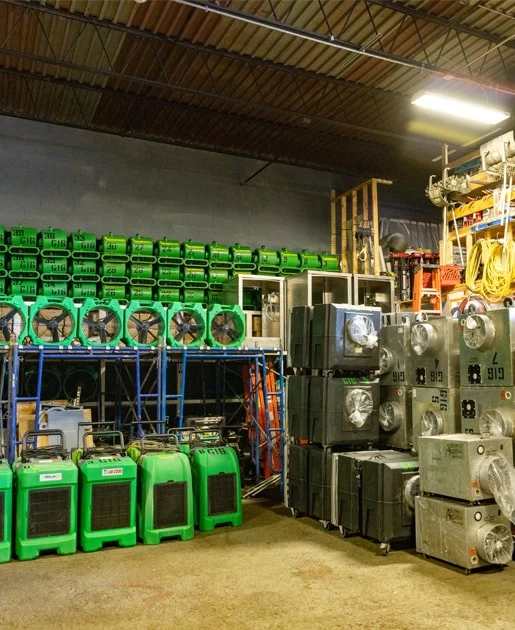
Once the source and category are identified, water extraction begins. We use industrial-grade equipment to remove standing water, and then the structural drying process starts dehumidifiers, air movers, and moisture monitoring to make sure the drying reaches behind walls and under flooring, not just the surface. If your home was built before 1978, materials like flooring, pipe insulation, or drywall joint compound may contain asbestos or lead. We are licensed to assess and handle both, which means the job doesn’t stall or require a second contractor.
Any structural work that follows drywall removal, subfloor replacement, reconstruction is performed under our Suffolk County General Contractor license, which covers permitted work within the Town of Islip. Throughout the entire process, we document everything for your insurance claim and bill the carrier directly when coverage applies.
One Call Covers Everything From Extraction to Rebuild
Flooded basement cleanup in Ronkonkoma isn’t always a straightforward water extraction job. The town’s proximity to Lake Ronkonkoma, the Connetquot River corridor running through the western edge of the CDP, and an aging housing stock that includes a significant share of pre-1970 construction means jobs here regularly involve more than a pump and a dehumidifier. We are built to handle the full scope and that’s not a common thing in this market.
Our services cover emergency water extraction, structural drying with moisture verification, mold assessment and remediation under NYS DOL licensing, asbestos and lead evaluation and abatement where required, odor treatment, and complete reconstruction permitted through the Town of Islip Building Department. Sewage backup events which can occur when Ronkonkoma’s municipal system is overwhelmed during heavy storms are handled as the Category 3 hazmat events they legally are, with proper containment, PPE, and licensed disposal.
Direct insurance billing is a standard part of our process, not an add-on. We manage documentation, moisture readings, photos, and adjuster communication from the first hour through final sign-off. For homeowners near the Station Yards development area, where active construction has altered drainage patterns in surrounding neighborhoods, that kind of complete, documented process is especially important when it comes time to file or dispute a claim.
Does homeowners insurance cover basement flooding in Ronkonkoma, NY?
It depends on the cause, and this is where a lot of Ronkonkoma homeowners get caught off guard. Standard homeowners insurance typically covers sudden internal water damage a burst pipe, a failed water heater, an appliance leak. What it usually does not cover is groundwater intrusion or surface flooding from a storm event, which requires a separate flood insurance policy through the NFIP or a private carrier.
The complication in Ronkonkoma specifically is that many homes here aren’t in a FEMA-designated flood zone, so residents often assume they don’t need flood insurance. But the town’s drainage infrastructure was designed for five to eight inches of rain in a 24-hour period, and recent storms have delivered significantly more than that. When the system gets overwhelmed, water ends up in basements regardless of flood zone status. If you’re not sure what your policy covers, we can help you document the damage correctly from the start which is critical if you end up needing to make a case to your adjuster.
How quickly does mold start growing after a basement floods?
Mold can begin colonizing within 24 to 48 hours of water exposure and in many cases, you won’t see it until it’s already well established behind walls, under flooring, or inside insulation. The visible surface is usually the last place it shows up.
In Ronkonkoma’s older homes particularly those built in the 1950s through 1970s, which make up a large share of the local housing stock this timeline can feel even tighter. Older cinder block foundations, original drywall, and less efficient basement ventilation all retain moisture longer than newer materials. That retained moisture is exactly what mold needs to spread. Getting industrial drying equipment in place within the first few hours isn’t about being overly cautious it’s the difference between a manageable cleanup and a mold remediation job that costs several thousand dollars more and takes significantly longer to resolve.
My Ronkonkoma home was built in the 1960s is that a problem for basement cleanup?
It can be, and it’s something most water damage companies aren’t equipped to handle properly. Homes built before 1978 may contain lead paint, and homes built before 1980 may have asbestos in pipe insulation, floor tiles, ceiling tiles, or drywall joint compound. When basement flooding requires removing water-damaged materials which it almost always does those materials can be disturbed and become a hazard.
Standard water damage contractors are not licensed to handle asbestos or lead. We hold NYS DOL Asbestos and USEPA Lead and RRP certifications, which means we can legally assess and remediate both within the same job. You don’t have to pause the cleanup, find a separate abatement contractor, and restart. In a town where more than half the housing stock predates 1970, this isn’t an edge case it’s a routine part of the job that needs to be accounted for from the beginning.
What's the difference between water damage cleanup and mold remediation?
Water damage cleanup focuses on removing standing water, extracting moisture from affected materials, and drying the structure to prevent further damage. Mold remediation is a separate, licensed process that addresses mold that has already begun to colonize containing the affected area, removing contaminated materials, treating surfaces, and verifying clearance through post-remediation testing.
In New York State, mold remediation requires a NYS DOL Mold license under Article 32 of the Labor Law. Not every water damage company holds this license, which means they may clean up the water but leave you without a legally qualified contractor to address what grows afterward. We hold both capabilities under one license stack, so if mold is found during or after the drying process, the job doesn’t stop and restart with a different company. That continuity matters when you’re trying to get your basement back to a livable, insurable condition as quickly as possible.
How long does flooded basement cleanup typically take?
The water extraction itself usually takes a few hours depending on the volume of water and the size of the space. The structural drying process which is the part that actually prevents mold and structural damage typically takes three to five days, sometimes longer if the flooding was significant or if the materials involved are dense and slow to release moisture.
If the job involves mold remediation, asbestos or lead abatement, or structural reconstruction, the timeline extends accordingly. A straightforward pipe burst in a finished basement is a different job than a storm-driven groundwater event in a 1965 ranch with original flooring and pipe insulation. In Ronkonkoma, where hydrostatic pressure from the elevated water table near Lake Ronkonkoma can push moisture through foundation walls even after surface water is removed, thorough moisture monitoring throughout the drying phase isn’t optional it’s what prevents a callback job three weeks later.
Why does it matter that we bill insurance directly?
When your basement floods, you’re already dealing with displaced belongings, potential safety concerns, and the stress of figuring out what comes next. Adding insurance documentation, adjuster calls, and claim paperwork on top of that while also trying to coordinate a cleanup is a real burden, and mistakes in that process can cost you money.
We handle the documentation from the first hour: moisture readings, photographs, scope of damage, and all communication with your insurance carrier. We bill the insurer directly when coverage applies, which removes the back-and-forth that often delays reimbursement or leads to underpaid claims. For Ronkonkoma homeowners who went through the 2024 storm events and discovered mid-crisis that their coverage situation was unclear, having a contractor who actively manages that process rather than handing you a bill and wishing you luck is a meaningful part of what makes the experience manageable.