When Hempstead Harbor Storms Hit Your Basement, Speed Matters
When your basement floods on the North Shore, every hour you wait is an hour closer to mold. We respond fast, handle everything — including what older Roslyn Harbor homes require — and don’t leave until the job is done right.
I needed a professional consultation explanation of procedure for safe removal of Asbestos in my apartment complex. Without having an account yet, I was very impressed with the caring, knowledgeable and generous advice offered by Jessica, and will look forward to doing business in the future. Thank you so much! I feel much more informed about a sometimes scary endeavor. Peace. Nancy Silva Mineola, NY.
Mia Munoz
Used this company to clean up some water flood in my house. They were fast and easy to work with.very professional, Would recommend to anyone!
Nini Valle
Great company, had a flood and they responded quickly and efficiently. Billed my insurance company directly. I highly recommend this company!
joe colapietro, jr
I had pipe freeze in my basement right before a snow storm and they made to within an hour to help start the clean up process. They we by our side throughout the entire process and even helped with the insurance company. They did such a great job with the cleanup, repair, remidiation, I contracted them to perform the repairs and finishes in the basement. They came with enough manpower and material to get the job done. Leo and Jessica were nothing but a pleasure to deal with!!
Cristian Arredondo c
I had some water damage in my home and Green Island was able to take care of my issue quickly and effectively. I am very pleased with the work they did. They responded quickly and were very professional.
Michael M
Outstanding service! From the office to the field crew everyone was friendly, helpful and responsive. I highly recommend Green Island Group.
A Dry Basement and a Clear Head — Here's What That Looks Like
When the water is gone and the basement is professionally dried, you stop guessing. You stop wondering if there’s moisture hiding behind the drywall or under the subfloor. You know the job was done completely — not just the visible part.
For Roslyn Harbor homeowners, that peace of mind carries real financial weight. Homes here are valued well above $1.5 million. A finished basement with hardwood floors, built-ins, or custom millwork isn’t just a comfort — it’s a significant part of what you’ve built. The flooding itself is already a disruption. A cleanup that misses hidden moisture turns that disruption into a six-month mold problem and a much larger repair bill.
The North Shore’s high water table and the Hempstead Harbor watershed create conditions that don’t exist in most other parts of Nassau County. Saturated ground pushes water through foundation cracks and around sump inlets even in homes that have never had a visible leak. When we handle your Roslyn Harbor basement restoration, we understand that specific dynamic — not just generic basement flooding — which is why the work gets done more thoroughly and you can move forward with confidence.
Every License New York Requires — All Under One Roof
We hold the full stack of credentials required to handle flooded basement cleanup in New York State: NYS DOL Mold License, NYS DOL Asbestos License, USEPA Lead/RRP certification, IICRC Water and Fire Damage certification, and a General Contractor license specifically for Nassau County. Those aren’t marketing claims — they’re named, verifiable licenses that most companies operating in Roslyn Harbor simply don’t carry.
That matters here more than most places. Many homes in Roslyn Harbor were built in the early-to-mid 20th century, during the Gold Coast estate era and the postwar subdivisions that followed. Water damage in a home of that age can disturb asbestos floor tiles, pipe insulation, or lead-based paint — materials that require licensed handling under New York State and federal law. A crew without those credentials cannot legally or safely touch them.
We serve the full North Shore corridor, with a dedicated focus on Nassau County. From the Greenvale LIRR corridor through the neighborhoods backing onto the Engineers Country Club, we know what these homes are made of — and what proper restoration actually requires.
No Guesswork — Just a Clear Process From First Call to Finished Basement
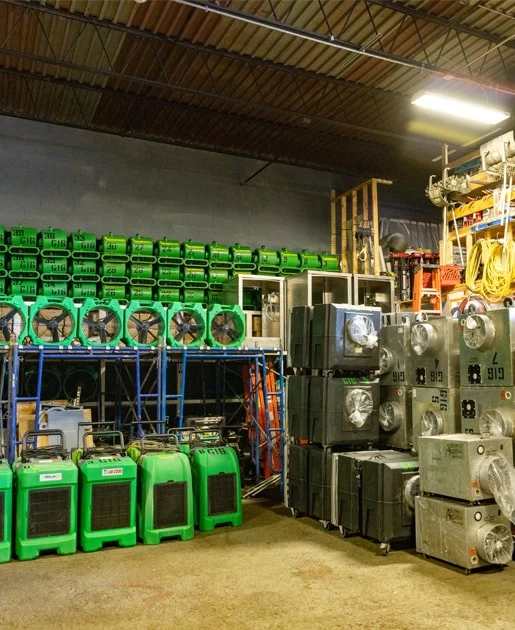
It starts the moment you call. You’ll speak with someone who actually knows what flooded basement cleanup involves — not a call center reading from a script. From there, a crew is dispatched with industrial extraction equipment, air movers, and professional moisture detection tools. The goal on day one is to stop the damage clock, not just remove the standing water.
Once extraction is complete, the real assessment begins. Moisture meters map every affected surface — walls, subflooring, framing, insulation — because water travels further than it looks. In Roslyn Harbor’s larger homes, that mapping process is more involved than in a typical mid-century ranch. A 2,000-square-foot finished basement with built-in shelving and multiple rooms requires a thorough read, not a quick walkthrough. Structural drying runs until every reading confirms true dryness — not surface-level dry, but dry through.
If the assessment turns up asbestos-containing materials, lead paint, or mold — all real possibilities in pre-1978 North Shore homes — we handle that within the same scope of work. No subcontracting. No coordination gap. And with our Nassau County General Contractor license, we can rebuild what needs rebuilding: drywall, flooring, framing, finishes. One company carries the work from emergency call to final walkthrough.
What's Actually Included When We Handle Your Basement
Flooded basement cleanup in Roslyn Harbor isn’t a single task — it’s a sequence of decisions that each affect the outcome. Water extraction is the starting point, but it’s the steps after that determine whether your basement stays dry and mold-free six months from now. We cover the full sequence: extraction, structural drying, moisture mapping, mold prevention, hazardous material handling where required, and complete structural restoration.
The hazardous material piece is specific to this area and worth understanding. Roslyn Harbor’s housing stock includes a significant number of homes built before 1978 — the federal cutoff for lead-based paint — and many built before 1980, when asbestos was still commonly used in floor tiles, pipe wrap, and ceiling materials. When flooding disturbs those materials, New York State requires a licensed contractor to handle them. We hold both the NYS DOL Asbestos License and USEPA Lead/RRP certification, which means this part of the job doesn’t get handed off to a separate crew or skipped over.
For waterfront and near-waterfront properties along Hempstead Harbor, sewage backup during storm events is also a documented risk. That’s a Category 3 contamination scenario — black water — and it requires full biohazard-level decontamination, not just drying. We’re equipped and licensed for that scope as well. Whatever your basement is dealing with, the answer is the same: one call, one company, complete resolution.
Does homeowners insurance cover basement flooding in Roslyn Harbor, NY?
It depends on what caused the flooding — and the distinction matters a lot. Standard homeowners insurance typically covers sudden, accidental water damage: a burst pipe, a failed water heater, an appliance malfunction. What it does not cover is natural flooding — groundwater intrusion, storm surge from Hempstead Harbor, or water that enters because the ground became saturated and overwhelmed your foundation. That type of flooding requires a separate flood insurance policy, typically through the National Flood Insurance Program (NFIP).
For Roslyn Harbor homeowners, this is worth knowing before you file a claim. Properties near the harbor’s edge or in low-lying areas along the Hempstead Harbor watershed may be in designated flood zones, and some mortgage lenders require flood insurance for those parcels. If you’re unsure which policy applies to your situation, the type of water damage documentation you submit matters — and getting it wrong can delay or reduce your claim. We assist with damage documentation and can help you understand what the evidence supports before you contact your carrier.
How quickly does mold start growing after a basement floods?
The EPA’s guidance is 24 to 48 hours — that’s the window within which mold can begin to establish under the right conditions. Warm temperatures, organic materials like drywall and wood framing, and standing or residual moisture create exactly those conditions. In practice, the 48-hour mark is not a hard deadline so much as a risk threshold: the longer water sits, the more likely mold becomes, and the more expensive remediation gets.
On Long Island’s North Shore, where summer humidity is already elevated and many basements have limited airflow, that window can close faster than homeowners expect. A finished basement with drywall, carpet, and built-in cabinetry gives mold more surface area to work with than an unfinished concrete space. The priority after any basement flooding event — regardless of how much water came in — is to get professional drying equipment running as quickly as possible. A box fan and a dehumidifier from the hardware store won’t move enough air volume to prevent mold in a large finished basement. Industrial equipment is a different category entirely.
Can I clean up a flooded basement myself if the water wasn't that deep?
You can remove standing water on your own, and for very minor events — a small appliance leak caught within an hour, for example — consumer-grade equipment might be sufficient. But the problem with DIY basement cleanup isn’t usually the water you can see. It’s the moisture that moves into walls, under subflooring, and behind insulation that you can’t see or measure without professional equipment. That moisture doesn’t evaporate on its own in a closed basement environment. It stays, and mold follows.
In Roslyn Harbor specifically, there’s an additional consideration for older homes. If your home was built before 1978, water damage that disturbs walls, flooring, or ceiling materials may have exposed asbestos or lead paint. Attempting to clean or remove those materials without proper licensing is illegal under New York State law and creates real health risk. A professional assessment doesn’t just tell you whether the basement is dry — it tells you what the water touched and whether any of it requires licensed remediation before the space is safe to use again.
What causes basement flooding in Roslyn Harbor even when it hasn't rained that hard?
The answer is usually hydrostatic pressure. When the ground surrounding your foundation becomes saturated — from a sustained rain event, spring snowmelt, or a prolonged wet period — the water-logged soil exerts pressure against your foundation walls and floor. That pressure can force water through hairline cracks, around the base of the foundation, and through the joint where the floor meets the wall, even if there’s no single dramatic failure point. Homes that have never had a flooding problem can experience it for the first time after an unusually wet season.
Roslyn Harbor’s position on the Hempstead Harbor watershed makes this dynamic more pronounced than in many inland Nassau County communities. The North Shore’s hilly terrain channels runoff northward toward the harbor from multiple directions, and the water table in this area runs relatively high compared to South Shore communities. After events like the August 2024 flash flooding — which produced record rainfall across Nassau County and triggered New York State emergency repair funds — hydrostatic pressure was the primary mechanism behind many of the basement flooding calls on the North Shore. It’s not a dramatic failure. It’s physics, and it happens gradually enough that homeowners sometimes don’t notice until there’s already significant moisture in the walls.
How long does professional flooded basement cleanup actually take?
The extraction phase — removing standing water — typically takes a few hours depending on volume and basement size. But the structural drying phase, which is the part that actually prevents mold, runs considerably longer. For a finished basement in a large Roslyn Harbor home, professional drying typically takes three to five days with industrial air movers and dehumidifiers running continuously. Moisture readings are taken daily to track progress, and equipment stays in place until every reading confirms the structure is genuinely dry — not just surface-dry.
If hazardous materials are identified during the assessment — asbestos, lead paint, or active mold — that adds time to the overall scope, because those materials require specific handling protocols before reconstruction can begin. The full timeline from emergency call to a restored, move-in-ready basement varies depending on the extent of damage and what the assessment turns up. For a straightforward water intrusion with no contamination, you’re typically looking at one to two weeks from first call to completed restoration. For a more complex event involving sewage backup or significant mold growth, the timeline extends accordingly. What doesn’t change is the sequence: assess thoroughly, dry completely, remediate what needs remediating, then rebuild.
Do I need mold testing after my Roslyn Harbor basement floods, or is it optional?
Mold testing isn’t always legally required after a flooding event, but for Roslyn Harbor homeowners it’s worth understanding when it actually helps you. Professional mold testing — air sampling and surface sampling by a licensed assessor — gives you documented evidence of whether mold is present, what type it is, and at what concentration. That documentation matters for two reasons: insurance claims and health decisions. If your carrier requires proof of mold remediation before closing a claim, a pre- and post-remediation test provides that paper trail. And if anyone in your household has respiratory sensitivities, knowing the specific mold species present helps inform how urgently and extensively remediation needs to proceed.
In New York State, mold remediation work above a certain threshold must be performed by a licensed mold remediator — the NYS DOL Mold License is a state-specific requirement that doesn’t exist in most other states. We hold that license, which means the remediation itself is done by a contractor who is legally authorized to perform it in Nassau County. For a home in Roslyn Harbor — where the housing stock is older, the basements are larger, and the property values are high — skipping the assessment to save a few hundred dollars is rarely the right call. The cost of discovering mold three months later, after drywall has been reinstalled, is significantly higher than the cost of confirming it’s not there before you close the walls back up.