When the North Shore Floods, Russell Gardens Basements Take the Hardest Hit
Russell Gardens sits on three sides of water — and when the North Shore gets hit, basements in homes built before 1970 take the brunt of it. We handle flooded basement cleanup from water extraction to wall restoration, fully licensed for everything your older home might be hiding. The peninsula’s geography means groundwater doesn’t just appear during storms — it can seep through concrete block foundations even on dry days. When it does, you need a team that understands why Russell Gardens floods the way it does, not just how to pump it out.
I needed a professional consultation explanation of procedure for safe removal of Asbestos in my apartment complex. Without having an account yet, I was very impressed with the caring, knowledgeable and generous advice offered by Jessica, and will look forward to doing business in the future. Thank you so much! I feel much more informed about a sometimes scary endeavor. Peace. Nancy Silva Mineola, NY.
Mia Munoz
Used this company to clean up some water flood in my house. They were fast and easy to work with.very professional, Would recommend to anyone!
Nini Valle
Great company, had a flood and they responded quickly and efficiently. Billed my insurance company directly. I highly recommend this company!
joe colapietro, jr
I had pipe freeze in my basement right before a snow storm and they made to within an hour to help start the clean up process. They we by our side throughout the entire process and even helped with the insurance company. They did such a great job with the cleanup, repair, remidiation, I contracted them to perform the repairs and finishes in the basement. They came with enough manpower and material to get the job done. Leo and Jessica were nothing but a pleasure to deal with!!
Cristian Arredondo c
I had some water damage in my home and Green Island was able to take care of my issue quickly and effectively. I am very pleased with the work they did. They responded quickly and were very professional.
Michael M
Outstanding service! From the office to the field crew everyone was friendly, helpful and responsive. I highly recommend Green Island Group.
Dry Basement, Protected Home, No Surprises Left Behind
When the water is gone, the real work begins. What you actually need after a flooded basement isn’t just a dry floor — it’s confirmation that the moisture hiding inside your walls, under your subfloor, and behind your insulation is gone too. That’s what separates a cleanup from a real restoration.
Russell Gardens homes are predominantly from the 1940s through the 1960s. That era of construction means concrete block foundations that absorb water like a sponge, older drainage systems that weren’t built for today’s rainfall intensity, and materials — floor tiles, pipe insulation, joint compound — that may contain asbestos. When those materials get saturated, you’re not just dealing with water damage anymore. Most companies aren’t equipped to handle that. We are.
The Great Neck Peninsula’s elevated water table also means groundwater can push up through your basement floor and walls even without a visible crack or pipe failure. After Tropical Depression Ida dropped five inches on the North Shore in a single night, Nassau County’s own executive confirmed this area saw more flooding than anywhere else in the county. That’s not a fluke — it’s geography. When you call us, you get a team that understands exactly why your Russell Gardens basement flooded, not just how to pump it out.
Licensed Basement Flooding Remediation, Nassau County
Every License This Job Could Possibly Require — We Hold Them All
We serve Nassau County as a primary service area, and Russell Gardens is territory we know well. We hold the NYS DOL Mold License, NYS DOL Asbestos License, USEPA Lead and RRP certifications, IICRC Water Damage certification, and a General Contractor license for Nassau County. That combination is genuinely rare in this industry, and it matters most in a village like Russell Gardens, where a flooded basement in a pre-1970 home can involve hazardous materials that most restoration companies aren’t legally allowed to touch.
What that means for you is simple: one call, one company, start to finish. We don’t extract water and hand you off to someone else to figure out the mold, the asbestos tiles, or the rebuild. We handle all of it — under license, with documentation, and with the accountability that comes from a team that’s been doing this work across Nassau County for years.
Emergency Basement Water Removal, Russell Gardens NY
What Happens From Your First Call to the Final Walkthrough
When you call, we pick up — 24 hours a day, seven days a week. The first thing we do is ask the right questions: how much water, what type of water, how long it’s been sitting. That information tells us what equipment to bring and whether we’re dealing with a clean-water event, a gray-water situation, or a Category 3 sewage backup. The Belgrave Sewer District serves Russell Gardens, and when storm events overwhelm sewer capacity on the peninsula, backups into basement drains are not uncommon. That’s a biohazard situation, and it requires a completely different response than a burst pipe.
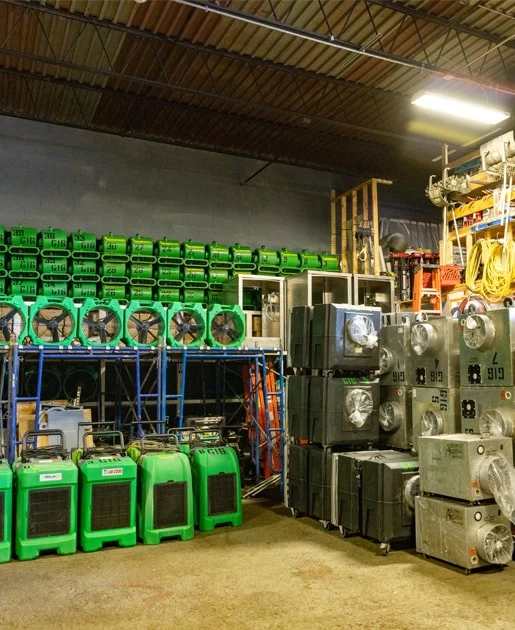
Once on-site, we extract standing water, then set industrial drying equipment — not rental-grade fans, but commercial dehumidifiers and air movers calibrated to the square footage and moisture load of your specific space. We use moisture meters to read inside your walls and under your floor, because visible dry doesn’t mean actually dry. In a concrete block foundation common to Russell Gardens homes of this era, moisture can sit trapped in the block cavities long after the surface looks fine.
If your home was built before 1980, we assess for asbestos and lead before any demolition begins. New York State’s Article 32 mold law also requires that any mold remediation disturbing more than 10 square feet be performed by a licensed remediator — we hold that license. Once the structure is confirmed dry and any hazardous materials are properly handled, we rebuild. Drywall, flooring, framing — whatever your basement needs to be right again.
Flooded Basement Cleaning and Mold Prevention, Russell Gardens
Built for Older Homes on the North Shore — Not Generic Restoration
Flooded basement cleanup in Russell Gardens isn’t a one-size situation. The age of the housing stock, the peninsula’s water table, the coastal storm exposure, and the presence of pre-1980 building materials all shape what a proper restoration actually requires here. That’s why the service we deliver in Russell Gardens goes further than what most companies offer.
Water extraction and structural drying are the foundation — commercial-grade equipment, moisture verification, and documentation at every stage. But because the majority of homes in this village were built between 1940 and 1969, we also assess for asbestos-containing materials before any demolition occurs. If your basement has original vinyl floor tiles, pipe insulation, or ceiling tiles, those need to be tested and handled under our NYS DOL Asbestos License before they’re disturbed. The same applies to lead paint under our USEPA Lead and RRP certifications. These aren’t add-ons — they’re part of what a complete, legally compliant restoration looks like in a home of this age.
We also handle the insurance side. We document damage from day one, communicate with your carrier, and make sure the file reflects everything that happened — because the difference between a smooth claim and a denied one is often just the quality of the documentation. In a village where median property values sit at $1.42 million, the cost of incomplete paperwork is not a small thing.
How quickly does mold start growing after a basement floods in Russell Gardens?
Mold can begin developing within 24 to 48 hours of water exposure — and in a Russell Gardens basement, that timeline is compressed by a few local factors. The peninsula’s naturally elevated water table means moisture doesn’t just come from the flood event itself; it can continue seeping through concrete block walls and floors even after standing water is removed. That sustained moisture environment is exactly what mold needs to establish.
The 72-hour window is real and it matters. If your basement is thoroughly dried within that timeframe, mold growth is unlikely. Once that window closes, what started as a water cleanup becomes a remediation project — more complex, more expensive, and more disruptive to your home. That’s why our 24/7 response isn’t a marketing feature — it’s the only way to actually protect your Russell Gardens home from crossing that threshold. When we arrive, we’re not just removing water; we’re racing a biological clock.
Does homeowners insurance cover flooded basement cleanup in Nassau County, NY?
This is one of the most common points of confusion for Nassau County homeowners, and the answer depends entirely on the source of the water. Standard homeowners insurance typically covers sudden, accidental events — a burst pipe, a washing machine overflow, a water heater failure. It does not cover flooding from natural sources like storm surge, groundwater intrusion, or heavy rainfall backing up through your foundation. That type of flooding requires a separate flood insurance policy, usually through FEMA’s National Flood Insurance Program.
For Russell Gardens homeowners, this distinction is especially important. The peninsula’s geography — surrounded by Long Island Sound, Little Neck Bay, and Manhasset Bay — creates flooding scenarios that can fall into either category depending on the specific event. A sewer backup through the Belgrave Sewer District may be covered under a sewer backup rider, which is separate from both homeowners and flood insurance. We help you document the damage accurately and communicate with your carrier from day one, so your claim is built on the right foundation — not reconstructed after the fact.
My Russell Gardens home was built in the 1950s — does that change what cleanup involves?
Yes, significantly. Homes built before 1980 — and most Russell Gardens residences were built between 1940 and 1969 — frequently contain asbestos in floor tiles, pipe insulation, ceiling tiles, and joint compound. They may also have lead paint on basement walls, window frames, and structural elements. When a basement floods and those materials get saturated, or when demolition is needed to replace damaged components, those materials can become a hazard if they’re not handled correctly.
New York State requires a licensed contractor to assess and abate asbestos before any disturbing work begins. The USEPA requires RRP-certified handling for lead paint in pre-1978 homes. Most water damage restoration companies hold neither of these certifications and will either skip the assessment or subcontract it — adding time, cost, and a gap in accountability. We hold both the NYS DOL Asbestos License and USEPA Lead and RRP certifications, which means we can assess, abate, and restore your 1950s Russell Gardens basement without bringing in a second company or leaving you exposed.
What causes basement flooding on the Great Neck Peninsula even when there's no storm?
The Great Neck Peninsula has a naturally elevated water table, and when the ground becomes saturated — whether from sustained rainfall, spring snowmelt, or a prolonged wet season — groundwater rises and presses against your basement walls and floor from the outside. This is called hydrostatic pressure, and it can force water through concrete block walls, floor cracks, and cove joints even in a home with no structural damage and no pipe failures.
For Russell Gardens homeowners, this is a year-round risk, not just a storm-season one. The area also has a documented subsurface drainage feature — an unnamed stream running through the Wensley Drive corridor — that affects how quickly groundwater moves through the local soil during heavy rain events. Older drainage systems in homes of this era were not designed to manage the kind of hydrostatic pressure that builds up during a modern storm event. If your basement seeps regularly without an obvious source, it’s likely a groundwater issue, and the fix starts with understanding exactly where the water is entering — not just removing what’s already inside.
How long does flooded basement cleanup and drying actually take?
Water extraction itself can often be completed in a few hours depending on the volume. The drying process is a different story. Structural drying — getting the moisture out of your walls, subfloor, and concrete — typically takes three to five days with commercial-grade equipment running continuously. We use moisture meters to track progress inside the structure, not just on the surface, so we know when drying is actually complete rather than just visually acceptable.
In a Russell Gardens basement with concrete block walls, drying can take longer than a poured-concrete or framed basement because block construction traps moisture in the cavities between blocks. We account for that. If mold remediation, asbestos abatement, or structural repairs are also required, the total project timeline extends accordingly — but we walk you through the full scope on day one so you’re never guessing where things stand. Every phase is documented, and you know what’s happening at each step.
Is sewage backup cleanup different from regular flooded basement cleanup in Russell Gardens?
Completely different, and it’s important to understand why. A sewage backup is classified as Category 3 water — also called black water — because it contains bacteria, pathogens, and biological contaminants that pose a direct health risk. This isn’t a situation where you extract the water, run some fans, and move on. Full decontamination protocols are required, including the proper disposal of any porous materials that came into contact with the sewage, antimicrobial treatment of all affected surfaces, and air quality verification after the cleanup is complete.
Russell Gardens is served by the Belgrave Sewer District, and during major storm events on the North Shore, sewer systems can become overwhelmed — pushing sewage back up through basement floor drains. It happens, and when it does, the response has to match the actual hazard. We are equipped and licensed for biohazard cleanup at this level. If you’ve had a sewage backup in your basement, the worst thing you can do is treat it like a regular water event — the health risk to your family and the liability to your property are real, and they don’t go away just because the water does.