When the Nissequogue Pushes Water In, We Push Back Fast
Smithtown basements flood the town’s own engineers have said so publicly. When yours does, we arrive within the hour, extract the water, and handle your insurance claim directly so you’re not drowning in paperwork on top of everything else.
I needed a professional consultation explanation of procedure for safe removal of Asbestos in my apartment complex. Without having an account yet, I was very impressed with the caring, knowledgeable and generous advice offered by Jessica, and will look forward to doing business in the future. Thank you so much! I feel much more informed about a sometimes scary endeavor. Peace. Nancy Silva Mineola, NY.
Mia Munoz
Used this company to clean up some water flood in my house. They were fast and easy to work with.very professional, Would recommend to anyone!
Nini Valle
Great company, had a flood and they responded quickly and efficiently. Billed my insurance company directly. I highly recommend this company!
joe colapietro, jr
I had pipe freeze in my basement right before a snow storm and they made to within an hour to help start the clean up process. They we by our side throughout the entire process and even helped with the insurance company. They did such a great job with the cleanup, repair, remidiation, I contracted them to perform the repairs and finishes in the basement. They came with enough manpower and material to get the job done. Leo and Jessica were nothing but a pleasure to deal with!!
Cristian Arredondo c
I had some water damage in my home and Green Island was able to take care of my issue quickly and effectively. I am very pleased with the work they did. They responded quickly and were very professional.
Michael M
Outstanding service! From the office to the field crew everyone was friendly, helpful and responsive. I highly recommend Green Island Group.
The water is gone, but that’s not actually the finish line. What matters is what happens in the 48 to 72 hours after because that’s when mold takes hold, when subfloors start warping, and when the damage that wasn’t visible on day one becomes the expensive problem you’re dealing with six months later. Getting the basement dry is step one. Making sure it stays that way is the job.
For Smithtown homeowners specifically, the risk profile is different than most of Long Island. The Nissequogue River system, Smithtown’s naturally elevated groundwater table, and the older housing stock throughout Kings Park, Nesconset, and St. James all combine to create flooding conditions that go deeper than surface water. In many of these homes particularly those built before 1980 a flood event can disturb asbestos floor tiles, pipe insulation, or lead-based paint behind the walls. That’s not a water damage job anymore. That’s an environmental remediation job, and it requires a contractor licensed for both.
When the work is done right, you get a basement that’s genuinely dry, documented for your insurance carrier, tested for mold, and cleared for reconstruction if needed. That’s the outcome not just a wet vac and a dehumidifier rental.
Basement Flooding Remediation Company Smithtown, NY
Licensed for Everything Smithtown Basements Can Throw at Us
We’re a Long Island-based environmental restoration company with 12-plus years of experience and more than 5,000 completed projects across New York State. Our CEO Jessica Dussan and VP Leo Torres run the operation and our names show up in real customer reviews, not just on a website header. When you call at 2 AM with four inches of water rising in your Smithtown basement, you’re reaching people who are accountable for what happens next.
We hold a Suffolk County General Contractor license, which means we can pull permits through the Town of Smithtown Building Department and take a job from water extraction all the way through full reconstruction one contract, no gaps. We’re also licensed for NYS DOL Asbestos, NYS DOL Mold, USEPA Lead, and USEPA RRP, which matters significantly in Smithtown where a large portion of the housing stock predates 1980. On top of that, we’re an approved emergency response contractor for the NYS Office of General Services a state-vetted credential that most homeowners don’t know to ask for, but should.
From Standing Water to Signed Off Here's the Full Picture
The first call triggers same-day emergency response. We arrive, assess the situation, and categorize the water because not all basement flooding is the same. Clean water from a burst pipe is handled differently than gray water from a backed-up drain, and both are handled very differently than Category 3 sewage backup, which requires full hazmat protocols, proper PPE, and licensed disposal. In Smithtown, where portions of Kings Park, St. James, and the Smithtown hamlet itself are still transitioning from septic systems to municipal sewer connections, sewage backup is a more common scenario than most homeowners expect.
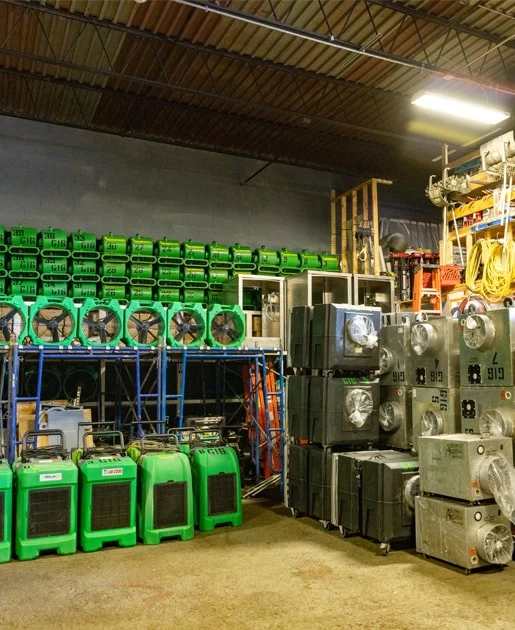
Once the water type is confirmed, we deploy industrial extraction equipment not consumer-grade units, but commercial extractors and air movers designed to pull moisture out of concrete, subfloor, and wall cavities. Thermal imaging and moisture meters track what you can’t see with your eyes. The drying phase typically runs several days, with readings taken at each visit to confirm progress. If any materials need to come out drywall, flooring, insulation that work is done under our Suffolk County GC license, with permits pulled through the Town of Smithtown where required.
Throughout the entire process, we document everything for your insurance carrier. Photos, moisture readings, scope of work, material removal logs all of it is compiled and submitted directly to your adjuster. You don’t have to chase paperwork while your basement is being dried out.
Our full scope covers emergency water extraction, structural drying, moisture monitoring, antimicrobial treatment, mold prevention, and where needed complete material removal and reconstruction. Every job includes direct insurance billing and full documentation, which is not a courtesy add-on; it’s a standard part of how we operate on every project in Smithtown and throughout Long Island.
For Smithtown homes with pre-1980 construction which includes a significant portion of the colonials in Kings Park and the older homes throughout St. James and Head of the Harbor the environmental licensing piece is not optional. If asbestos or lead is present and gets disturbed during remediation, you’re now in a situation that requires NYS DOL-licensed contractors for legal and safe handling. We carry that licensing and perform that work in-house. There’s no subcontracting it out to a third party and hoping they’re qualified.
Mold remediation is also handled under one roof, under our NYS DOL Mold license. If the August 2024 flooding or any subsequent storm event left moisture in your walls that wasn’t fully addressed at the time, that’s a conversation worth having now before what’s behind the drywall becomes a much larger problem. We serve all hamlets within the Town of Smithtown, including Kings Park, Nesconset, St. James, Fort Salonga, Commack, and the incorporated villages of Nissequogue, Head of the Harbor, and Village of the Branch.
Does homeowners insurance cover basement flooding from the Nissequogue River overflowing?
This is one of the most important questions Smithtown homeowners face after a major storm, and the answer depends entirely on the cause of the flooding not just the fact that your basement flooded. Standard homeowners insurance typically covers sudden, accidental water damage from internal sources like burst pipes or appliance failures. It does not cover flooding caused by surface water, storm surge, or river overflow that falls under flood insurance, specifically the National Flood Insurance Program (NFIP) or a private flood policy.
The August 2024 storm that breached the Blydenburgh County Park dam and sent water through large portions of Smithtown is a clear example of the coverage gap. Many Smithtown homeowners discovered after the fact that their standard policy excluded the damage entirely. If you’re in a flood-prone zone near the Nissequogue River corridor or in a low-lying area of Nesconset or Kings Park, it’s worth reviewing your coverage before the next storm not after. We can document your damage thoroughly regardless of which policy applies, and we bill insurance carriers directly to make the claims process as straightforward as possible.
How quickly does mold actually start growing after a basement floods?
Mold can begin developing within 24 to 48 hours of a flooding event under the right conditions and basements in Smithtown’s climate provide exactly those conditions. Humidity, warmth, and organic material like drywall, wood framing, and carpet give mold everything it needs to establish quickly. Once it’s behind a wall or under a subfloor, it’s no longer a surface problem you can clean with bleach it’s a remediation job that requires licensed contractors and proper containment.
Delaying cleanup by even a few days can add thousands of dollars to the total cost of restoration. The rule of thumb in the industry is that mold remediation costs escalate significantly after the 72-hour mark. For a Smithtown home with a median value approaching $900,000, that’s not a small financial consideration. The practical answer is: if your basement flooded, the clock is already running, and getting a professional crew in within the first 24 hours is the single most effective thing you can do to control the total cost of the damage.
My Smithtown basement keeps flooding every spring is there a permanent fix?
Smithtown has a documented groundwater problem that the town’s own engineering department has publicly acknowledged. The multi-phase Nissequogue River dredging project was designed to help lower the local water table, but town engineers have been clear that it won’t eliminate basement flooding for everyone it will reduce the frequency and severity for some residents, but the underlying hydrology of this area means that certain homes will remain vulnerable during heavy rainfall and snowmelt seasons.
What we can do is address the damage after a flooding event and help you understand the source whether it’s groundwater pushing up through the slab, water entering through foundation cracks, or a drainage issue around the perimeter of your home. Identifying the cause accurately is important because the fix is different in each case. A sump pump upgrade, exterior waterproofing, or foundation crack repair might be the right answer, or it might be a combination. We can assess the situation, document the damage, and point you toward the right solution for your specific home and its position within Smithtown’s drainage landscape.
What's the difference between water damage cleanup and mold remediation are they the same thing?
They’re related but not the same, and the distinction matters when it comes to both the work required and what your insurance covers. Water damage cleanup also called water mitigation is the immediate response: extracting standing water, drying out the structure, removing saturated materials, and preventing further damage. Mold remediation is what happens when mold has already established itself, either because the water damage wasn’t addressed quickly enough or because moisture was left behind in wall cavities or subfloor areas after a previous flood.
In Smithtown’s older housing stock, particularly in homes that may have had water intrusion events over many years, it’s not uncommon to open a wall during a remediation job and find mold that predates the current flooding event. That’s a separate scope of work that requires a NYS DOL Mold license to perform legally. We hold that license and handle both phases under one contract so if the water damage job reveals a mold problem, you’re not starting over with a new contractor. The documentation for both phases is compiled together and submitted to your insurance carrier as a complete claim.
How much does professional flooded basement cleanup typically cost in Smithtown, NY?
The range is wide because the scope varies significantly depending on the size of the basement, the category of water involved, how long the water sat before cleanup began, and whether any hazardous materials like asbestos or mold are present. A straightforward water extraction and drying job in a smaller basement with clean water and no structural damage might run in the $2,000 to $4,000 range. A larger finished basement with Category 3 sewage contamination, mold involvement, and material removal can reach $8,000 to $15,000 or more.
For Smithtown homeowners specifically, the age of the housing stock is a cost factor worth understanding upfront. Pre-1980 homes which make up a significant portion of the inventory in Kings Park, Nesconset, and St. James may contain asbestos floor tiles or pipe insulation that requires licensed abatement if disturbed during the cleanup. That adds to the scope and the cost, but it’s not optional improper handling of asbestos is a legal and health liability. The good news is that if the damage is covered by your homeowners policy or flood insurance, we bill the carrier directly and work with your adjuster on the documented scope, which takes the out-of-pocket uncertainty off your plate from the start.
Can I clean up my flooded Smithtown basement myself, or do I need a professional?
For a small amount of clean water say, a slow leak from a supply line that you caught quickly basic cleanup with a wet vac, fans, and a dehumidifier can work if you’re thorough and fast. But most basement flooding events that prompt a Google search at midnight are not that scenario. If the water came from outside, from a backed-up drain, or from a storm event like the ones Smithtown has seen in recent years, you’re likely dealing with contaminated water, saturated structural materials, and moisture that’s already moved into places you can’t see or reach with consumer equipment.
The specific risk in Smithtown is that DIY cleanup often addresses what’s visible and misses what’s behind the wall or under the subfloor. Moisture meters and thermal imaging cameras the tools we use to confirm a structure is actually dry are not something most homeowners have access to. A basement that feels dry and smells fine after a DIY cleanup can still have elevated moisture readings inside the wall cavity, which is exactly the environment where mold establishes itself over the following weeks. For a home worth $800,000 or more in a community like Smithtown, the cost of getting it wrong significantly outweighs the cost of getting it done right the first time.