When Your 1940s Basement Fills Up, Hours Matter More Than You Think
Stewart Manor homes were built for a different era — and when one of them floods, the clock starts immediately. We handle flooded basement cleanup fast, with the full licensing to manage whatever your older home reveals.
I needed a professional consultation explanation of procedure for safe removal of Asbestos in my apartment complex. Without having an account yet, I was very impressed with the caring, knowledgeable and generous advice offered by Jessica, and will look forward to doing business in the future. Thank you so much! I feel much more informed about a sometimes scary endeavor. Peace. Nancy Silva Mineola, NY.
Mia Munoz
Used this company to clean up some water flood in my house. They were fast and easy to work with.very professional, Would recommend to anyone!
Nini Valle
Great company, had a flood and they responded quickly and efficiently. Billed my insurance company directly. I highly recommend this company!
joe colapietro, jr
I had pipe freeze in my basement right before a snow storm and they made to within an hour to help start the clean up process. They we by our side throughout the entire process and even helped with the insurance company. They did such a great job with the cleanup, repair, remidiation, I contracted them to perform the repairs and finishes in the basement. They came with enough manpower and material to get the job done. Leo and Jessica were nothing but a pleasure to deal with!!
Cristian Arredondo c
I had some water damage in my home and Green Island was able to take care of my issue quickly and effectively. I am very pleased with the work they did. They responded quickly and were very professional.
Michael M
Outstanding service! From the office to the field crew everyone was friendly, helpful and responsive. I highly recommend Green Island Group.
Here’s what most homeowners don’t realize: a basement that looks dry after cleanup may still have dangerous moisture levels trapped inside concrete block walls, under subflooring, and inside framing that was built decades before modern waterproofing standards existed. In Stewart Manor, where the majority of homes were constructed between the 1920s and 1950s, that hidden moisture has more places to hide — and it doesn’t take long to turn into a mold problem.
The water table across the Hempstead Plains is naturally high. After a sustained rain event, groundwater doesn’t just come in through obvious cracks — it pushes laterally through aging foundation walls that have been through 70 or 80 years of freeze-thaw cycles. That’s a different kind of flooding than a burst pipe, and it requires a different level of response than a shop vac and a few fans.
When the job is done right, you get documented dryness confirmed with professional moisture meters — not just a visual check. You get walls, floors, and structural framing that are actually dry. And if your home has asbestos floor tiles or lead paint in that basement — which is common in Stewart Manor homes of this era — you get a licensed team that can handle it legally and completely, without stopping work to call in a third party.
Licensed Basement Flooding Remediation Stewart Manor NY
One License Stack That Covers Everything Stewart Manor's Older Homes Require
We hold a Nassau County General Contractor license, a NYS DOL Mold License, a NYS DOL Asbestos License, USEPA Lead and RRP certifications, and IICRC Water Damage certification — all under one roof. That’s not a credential list for show. In Stewart Manor, where most homes predate 1960 and basements routinely contain hazardous materials from the original construction era, it’s the difference between a contractor who can legally finish the job and one who has to stop halfway through.
We serve Stewart Manor and the surrounding Greater Garden City area — Garden City, New Hyde Park, Floral Park, and the broader Nassau County corridor. We know the housing stock here. We know what a 1930s Tudor basement looks like after a nor’easter, and we know what Stewart Manor’s storm sewer system was and wasn’t designed to handle. When you call us, you’re not getting a crew that’s guessing at your situation.
What Actually Happens From Your First Call to a Fully Dry Basement
When you call, you reach a real person — not a voicemail. We gather the basics about what you’re dealing with, and if it’s an emergency, we dispatch the same day. For Stewart Manor homeowners who commute into the city on the LIRR Hempstead Branch and discover a flooded basement when they get home at 7 PM, that same-evening response isn’t a luxury — it’s the difference between catching the damage inside the 72-hour mold window and missing it entirely.
Once we’re on-site, the first thing we do is assess the water source and category. Clean water from a burst pipe is handled differently than groundwater intrusion through a foundation wall, and both are handled differently than a sewage backup through a floor drain — which is a Category 3 biohazard requiring full decontamination protocols. Stewart Manor’s aging sewer infrastructure, some of which dates to the village’s original 1920s development, makes that last scenario more common than most homeowners expect.
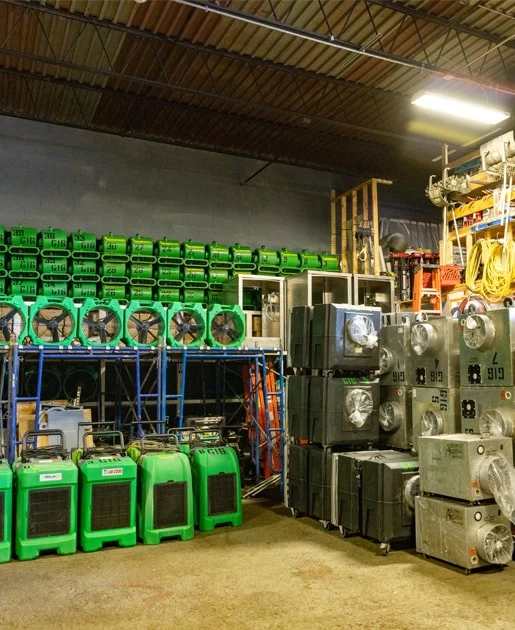
After extraction, we set up industrial air movers and dehumidifiers and monitor moisture levels with professional meters over the drying period. We don’t call a job done based on how it looks — we call it done when the numbers confirm it. If the basement has asbestos floor tiles, lead paint, or other hazardous materials disturbed by the flooding, we handle remediation in-house under our NYS DOL Asbestos and USEPA Lead certifications. Once everything is dry and clear, our Nassau County GC license means we can go straight into structural restoration — drywall, flooring, framing — without handing you off to another contractor.
Basement Flooding Remediation Services Stewart Manor NY
Built for Stewart Manor's Older Homes, Not Generic Basements
The flooded basement cleanup service we provide in Stewart Manor is built around what these homes actually contain and what Nassau County’s environment actually does to them. That means water extraction and structural drying as the foundation, followed by professional moisture verification — not just a visual inspection. It means mold assessment and remediation under our NYS DOL Mold License, which New York State requires by law for any contractor performing this work. A lot of companies operating in Stewart Manor and Nassau County don’t hold this license. That’s worth knowing before you hire anyone.
For homes built before 1978 — which is most of Stewart Manor — we conduct hazardous material assessments as part of the cleanup process. If asbestos floor tiles are disturbed by flooding, or if lead paint is present on basement walls, those materials require licensed handling under our NYS DOL Asbestos and USEPA Lead certifications. Skipping that step doesn’t make the hazard disappear; it just creates a liability for you and a health risk for your family.
We also assist with insurance documentation from day one. Standard homeowners insurance in Nassau County typically covers sudden and accidental events — a burst pipe, a failed appliance — but does not cover groundwater flooding or storm runoff. Understanding that distinction early, and having a licensed contractor documenting the damage properly, gives you the best position when you’re working through a claim. We handle the paperwork so you can focus on getting your home back.
Why do basements flood so often in Stewart Manor and Nassau County?
The short answer is geology. Long Island sits on glacial deposits with a naturally high water table across most of Nassau County, and Stewart Manor is located on the flat Hempstead Plains with no significant elevation advantage over that water table. After prolonged rain, groundwater pressure builds laterally and vertically against basement walls and floor slabs — and it doesn’t need a major crack to find its way in. Even a well-maintained home on a quiet street in Stewart Manor can end up with inches of water on the basement floor after a sustained storm.
The August 2024 flash flooding event across Nassau and Suffolk Counties was a direct example of this. Record rainfall overwhelmed storm drains throughout the region, and New York State made emergency home repair funds available to impacted Nassau County homeowners. Stewart Manor’s storm sewer system, like most on Long Island, was designed for an earlier era of precipitation intensity. Today’s storms are more concentrated and more intense, and the infrastructure hasn’t kept pace. That gap is why flooded basement calls in Stewart Manor aren’t rare — they’re routine.
How quickly does mold grow after a basement floods, and what should I do first?
The EPA identifies 24 to 48 hours as the window in which mold can begin to develop after water intrusion. The industry standard for full structural drying to prevent mold growth is 72 hours. Those aren’t conservative estimates — they’re the thresholds that determine whether you’re dealing with a cleanup job or a mold remediation project.
The first thing you should do is call a licensed restoration contractor, not a general handyman or a junk removal company. While you’re waiting, if it’s safe to do so, remove standing water with whatever you have available and open windows to increase airflow. Do not run a standard household fan over wet carpet or drywall — it moves air but doesn’t remove moisture from materials. What actually dries a flooded basement is industrial extraction equipment, high-capacity dehumidifiers, and professional moisture metering to confirm that structural materials — not just surfaces — have reached acceptable dryness levels. For Stewart Manor homeowners who commute and may not discover flooding until the evening, getting a crew on-site the same night is critical to staying within that window.
Does my homeowners insurance cover a flooded basement in Stewart Manor, NY?
It depends entirely on the cause of the flooding, and this is one of the most common sources of confusion for Nassau County homeowners. Standard homeowners insurance typically covers sudden and accidental water damage — a burst pipe, a washing machine overflow, a water heater failure. What it does not cover is flooding from groundwater, storm runoff, or rising water from outside the home. For that, you would need a separate flood insurance policy through the National Flood Insurance Program or a private carrier.
The distinction matters a lot in Stewart Manor, where a significant portion of basement flooding is driven by groundwater pressure through aging foundation walls — not by a plumbing failure. If your basement flooded because the water table rose after three days of rain, that’s likely not covered under a standard policy. If it flooded because a pipe burst in January, it probably is. Having a licensed contractor document the damage correctly from the start — including the source, the category of water, and the extent of structural impact — gives you the strongest possible position when working through a claim, regardless of which type of coverage applies.
My Stewart Manor home was built in the 1940s — are there extra risks I should know about?
Yes, and they’re worth taking seriously. Homes built in the 1920s through the 1950s — which covers the vast majority of Stewart Manor’s housing stock from the original Sunrise Gardens development era — commonly contain asbestos floor tiles, asbestos pipe insulation, and lead-based paint. Under normal conditions, these materials are stable and don’t pose an immediate risk. But when a basement floods, water disturbs those materials. Asbestos floor tiles can crack and release fibers. Lead paint on walls can flake and contaminate the water. Once that happens, you’re no longer dealing with a standard cleanup.
New York State requires a NYS DOL Asbestos License and USEPA Lead certification to legally handle these materials during remediation. A general contractor or standard cleanup crew without those licenses cannot legally perform this work — and if they do it anyway, the liability falls on the homeowner. We hold both certifications, which means we can assess and remediate hazardous materials in-house without stopping the job or handing you off to a third party. In a pre-1960 Stewart Manor home, that’s not a minor detail — it’s a core part of doing the job right.
How much does flooded basement cleanup typically cost in Nassau County?
The range is wide because the scope varies significantly depending on the size of the basement, the category of water involved, and what’s found during the cleanup. For minor clean-water extraction in a smaller space, costs can start around $1,600. A larger basement with contaminated water — a sewage backup, for example — can run $12,000 or more for the cleanup alone, with full repair costs potentially reaching well beyond that if structural damage is extensive.
In Stewart Manor specifically, a few factors tend to push costs toward the higher end of the range. The age of the housing stock means hazardous material assessment is frequently part of the job. Older foundation walls and subflooring take longer to dry and are more likely to require replacement. And because Nassau County property values are high — median home values in Stewart Manor are around $794,567 — the cost of not doing the job thoroughly tends to be far greater than the cost of doing it right. Hidden moisture that leads to mold growth a month later, or a structural issue that surfaces during a home sale inspection, is a much more expensive problem than a complete professional cleanup upfront.
Can I clean up a flooded basement myself, or do I need a licensed contractor in New York?
For minor, clean-water flooding — a small amount of water from a known source with no hazardous materials present — a homeowner can handle basic extraction and drying with the right equipment. But in Stewart Manor, that scenario is less common than people assume. Most basement flooding here involves either groundwater intrusion through aging foundation walls or, in older homes, the potential presence of asbestos or lead materials that are disturbed by the water. The moment either of those factors is in play, DIY cleanup creates real legal and health exposure.
New York State law requires a NYS DOL Mold License for any contractor performing mold remediation — one of only a handful of states in the country with this requirement. If you attempt mold cleanup without that license and something goes wrong, or if an inspector later identifies improper remediation, the liability is yours. Beyond the legal side, the practical reality is that a shop vac and household fans won’t dry a flooded basement to the moisture levels required to prevent mold growth inside walls and under flooring. Professional equipment — industrial extractors, high-capacity dehumidifiers, moisture meters — is what actually gets materials dry. For a home in Stewart Manor worth close to or above $1,000,000, the cost of professional cleanup is a straightforward investment in protecting what you own.