When Harbor Surge Hits Below Ground, You Need the Full Picture Fast
Flooded basement cleanup in Trinity means dealing with some of the oldest building stock in Manhattan and water that’s rarely clean. We handle the full scope, from extraction to clearance.
I needed a professional consultation explanation of procedure for safe removal of Asbestos in my apartment complex. Without having an account yet, I was very impressed with the caring, knowledgeable and generous advice offered by Jessica, and will look forward to doing business in the future. Thank you so much! I feel much more informed about a sometimes scary endeavor. Peace. Nancy Silva Mineola, NY.
Mia Munoz
Used this company to clean up some water flood in my house. They were fast and easy to work with.very professional, Would recommend to anyone!
Nini Valle
Great company, had a flood and they responded quickly and efficiently. Billed my insurance company directly. I highly recommend this company!
joe colapietro, jr
I had pipe freeze in my basement right before a snow storm and they made to within an hour to help start the clean up process. They we by our side throughout the entire process and even helped with the insurance company. They did such a great job with the cleanup, repair, remidiation, I contracted them to perform the repairs and finishes in the basement. They came with enough manpower and material to get the job done. Leo and Jessica were nothing but a pleasure to deal with!!
Cristian Arredondo c
I had some water damage in my home and Green Island was able to take care of my issue quickly and effectively. I am very pleased with the work they did. They responded quickly and were very professional.
Michael M
Outstanding service! From the office to the field crew everyone was friendly, helpful and responsive. I highly recommend Green Island Group.
What You're Left With When the Job Is Actually Done Right
When a basement floods in the Financial District near Trinity, the visible water on the floor is almost never the whole problem. Water moves through shared wall cavities, elevator pits, mechanical rooms, and utility corridors in ways that a surface-level cleanup will completely miss. Buildings along Broadway and Trinity Place many of them built in the early 1900s have basement and sub-basement infrastructure that wasn’t designed with modern waterproofing in mind. If the moisture isn’t mapped and dried properly, mold starts within 24 to 48 hours.
What you should be left with after a real cleanup is a dry, verified, documented space. Not just visually dry measurably dry, with moisture readings that confirm the job is finished, not assumed finished. In a building that may contain asbestos pipe insulation or lead paint in the basement, that documentation also protects you legally. It shows the work was done by a licensed contractor, handled correctly, and cleared by objective testing not just declared done when the crew packed up.
The other thing you should walk away with is a clear insurance paper trail. Flooding in Lower Manhattan buildings near Trinity whether it’s from storm surge off New York Harbor, a combined sewer backup during a heavy rainstorm, or a building system failure almost always involves a commercial property claim. That process has real documentation requirements, and a contractor who handles that end of it alongside the physical work is worth a lot more than one who hands you a bill and leaves you to figure out the adjuster on your own.
Licensed Basement Flooding Remediation in Trinity, NY
The Credentials That Actually Matter in a Pre-War Manhattan Building
We are a fully licensed environmental contracting and restoration company serving New York City and Long Island. That means active New York State Department of Labor licenses for asbestos abatement, mold remediation, and lead abatement not subcontracted out, not referenced on paper only, but held in-house and applied directly to every job.
That distinction matters more in the Trinity area than almost anywhere else in this context. The Trinity Building at 111 Broadway was built in 1905. Other structures along Trinity Place and the surrounding Financial District blocks date to the late 19th and early 20th centuries. Basement and mechanical spaces in buildings like these almost certainly contain regulated materials asbestos pipe insulation, lead paint that become a legal liability the moment they’re disturbed by flood water or an unlicensed crew. We can handle the water, the mold, the regulated materials, and the demolition under one contract and one license set.
When you’re managing a co-op board, a property insurance claim, and a building full of tenants in Trinity, the last thing you need is three separate contractors who can’t coordinate. We are one call, one scope, and one point of contact from start to clearance.
Basement Flood Cleanup Process, Financial District NY
How We Work Through a Flooded Building in Trinity Step by Step
The first thing that happens when we arrive is an assessment not a sales pitch. Moisture meters and thermal imaging equipment map where the water actually went, not just where it’s visible. In a multi-story building in Trinity and the surrounding Lower Manhattan area, that matters enormously. Water that enters a basement mechanical room can migrate through shared wall systems, into elevator pits, and behind finished surfaces on upper floors before anyone notices. The assessment tells you what you’re actually dealing with before any equipment is placed or any walls are opened.
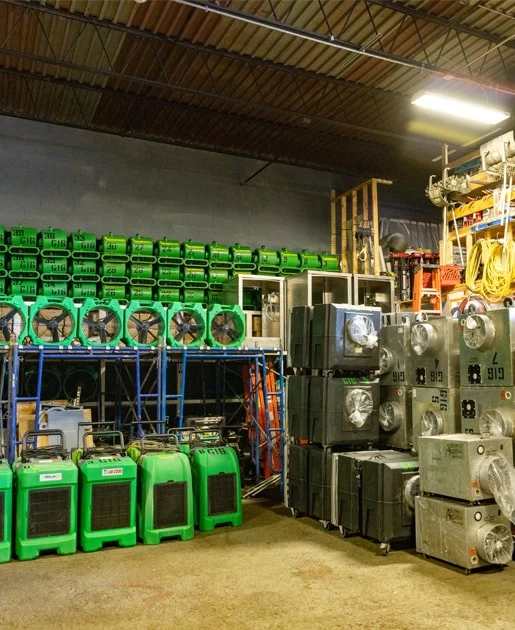
Once the scope is confirmed, extraction and structural drying begin immediately. We place industrial desiccant and refrigerant drying equipment based on the moisture map not just in the obvious wet areas. If the water is Category 3, which is common in Trinity given the combined sewer system that serves this area, the cleanup protocol is more aggressive: full sanitization, antimicrobial treatment, and in many cases controlled demolition of materials that can’t be safely dried in place. In buildings with pre-1980 construction, that demolition step requires a licensed asbestos abatement contractor before any materials are disturbed. We hold that license.
When drying goals are reached confirmed by calibrated readings, not visual inspection we produce post-remediation clearance documentation. That includes air quality testing, final moisture readings, and a written clearance report that meets the requirements of your insurance carrier and, where applicable, the New York City Department of Buildings. The job isn’t closed until the numbers say it’s closed.
Flooded Basement Cleaning and Mold Remediation, Trinity NY
Full-Scope Remediation Built for the Realities of Trinity and Lower Manhattan Buildings
What we deliver in the Trinity area goes well beyond water extraction. Our full scope includes water removal and structural drying, mold remediation, asbestos abatement, lead abatement, controlled demolition, sanitization, and post-remediation clearance testing all under one roof, one license set, and one insurance billing relationship. In Trinity, where the building stock dates back over a century and the flood risk is documented and ongoing, that full-scope capability isn’t a premium add-on. It’s the baseline for doing this work legally and safely.
The flooding risk profile for Trinity specifically is unlike most of the New York metro. Trinity sits at the southern tip of Manhattan, at minimal elevation above sea level, directly adjacent to New York Harbor and the Hudson River. Hurricane Sandy made that risk viscerally clear in 2012, when storm surge inundated streets and below-grade building infrastructure throughout the Financial District with several feet of seawater. That water was Category 3 contaminated, not just wet and it required a fundamentally different cleanup response than a burst pipe. Beyond storm surge, the combined sewer system serving Lower Manhattan backs up into building basements during heavy rainfall events, which is a regular occurrence in Trinity and the surrounding area.
Every job in this area also accounts for the regulatory environment. New York City Department of Buildings oversight applies to remediation and demolition work in this jurisdiction. Insurance documentation requirements for commercial property claims are more complex than residential claims. We handle both, so you’re not left trying to bridge the gap between the physical work and the paperwork that has to follow it.
Does flooding in Trinity, NY buildings usually involve contaminated water or clean water?
In Trinity and the Financial District specifically, flooding events are more likely to involve contaminated water than clean water. The reason is the infrastructure. Lower Manhattan uses a combined sewer system one pipe handles both stormwater runoff and sanitary sewage. When that system exceeds capacity during a heavy rainstorm, which happens regularly in Trinity, sewage backs up into building basements through floor drains and sewer connections. That’s classified as Category 3 water under IICRC standards, which means it contains pathogens and bacteria and requires a significantly more aggressive cleanup protocol than a clean water event.
Storm surge from New York Harbor the kind that flooded Trinity and the surrounding area during Hurricane Sandy in 2012 is also Category 3. Even groundwater intrusion in this area can carry contaminants given the age and condition of the surrounding municipal infrastructure. The practical implication is that if your basement flooded in Trinity, you should assume the water is contaminated until a proper assessment says otherwise. A cleanup that treats Category 3 water like a burst pipe is not just incomplete it’s a health liability and a potential insurance dispute waiting to happen.
How do I know if my flooded basement also has a mold problem after the water is removed?
Mold isn’t always visible, and it doesn’t wait. The EPA’s guidance is that mold can begin growing on wet building materials within 24 to 48 hours of a flooding event. In a basement or mechanical room that’s been wet for any meaningful period of time even a day or two before anyone noticed there’s a real possibility of mold growth behind finished surfaces, inside wall cavities, and on structural materials that weren’t fully dried.
The only way to know for certain is air quality testing and a thorough moisture assessment using calibrated equipment, not a visual walkthrough. In older buildings along Broadway and Trinity Place, where basement spaces often have limited ventilation and materials that hold moisture well, the hidden mold problem is frequently larger than the visible one. Our process includes moisture mapping before any drying equipment is placed, and post-remediation air quality testing before the job is closed. If mold is found during the assessment or remediation, it’s addressed under the same scope you don’t get handed off to a separate contractor.
My building was built before 1980 does that affect the basement cleanup process?
Yes, and this is one of the most important questions a property owner or manager in Trinity can ask. Buildings constructed before 1980 which describes a significant portion of the commercial and mixed-use building stock along Broadway, Trinity Place, and the surrounding Financial District blocks may contain asbestos-containing materials in pipe insulation, floor tiles, ceiling tiles, and joint compound. Buildings built before 1978 may also contain lead paint. Both are regulated hazardous materials under New York State and federal law.
When flood water disturbs these materials, or when a remediation crew needs to open walls or remove flooring to dry the structure, those materials cannot be legally or safely handled by an unlicensed contractor. New York State Department of Labor licensing for asbestos abatement and lead abatement is mandatory. We hold both licenses. A contractor who arrives without them either won’t touch the regulated materials stopping your job mid-scope or will disturb them without proper protocols, which creates a federal violation and a serious health liability for the building owner. This isn’t a secondary concern in a building like yours. It’s the first question you should ask any contractor before they start work.
Will my insurance cover flooded basement cleanup in a Manhattan co-op or condo building?
Coverage depends on the source of the flooding, the specific terms of your policy, and whether the damage affects a private unit, common areas, or both which in a co-op or condo building can involve multiple policies and multiple parties. Standard commercial property policies typically cover sudden and accidental water damage from internal building systems, like a burst pipe or a failed sump pump. Flooding from storm surge or rising groundwater is generally not covered under a standard policy and requires separate flood insurance through the National Flood Insurance Program or a private flood carrier.
In Trinity and the Financial District, where storm surge is a documented and ongoing risk, flood insurance is worth serious consideration if you don’t already have it. For the claims you do have coverage for, the documentation process for a commercial property claim is more involved than a residential claim. It requires detailed scope of work records, moisture readings taken over multiple days, post-remediation clearance testing, and often direct communication with a commercial adjuster. We handle the documentation and billing process directly with insurance carriers, which takes that coordination burden off the property manager or building owner during an already stressful situation.
How quickly does Green Island Group respond to a basement flooding emergency near Wall Street?
We offer 24/7 emergency response, and response time matters more in a commercial or multi-unit building than almost anywhere else. In a single-family home, a flooded basement affects one household. In a multi-story building in Trinity and the surrounding Financial District, water that enters a basement mechanical room can migrate through shared systems and affect multiple tenants, common areas, and building infrastructure within hours. Every hour of delay is a larger remediation scope, more potential mold growth, and more disruption to building operations and tenants.
The Trinity area is accessible via multiple routes West Street along the Hudson River waterfront, Broadway running directly past the church corridor, and the arterial grid connecting to the Brooklyn-Battery Tunnel approaches which means a crew dispatched from our service area can reach this part of Lower Manhattan efficiently regardless of traffic conditions. When you call, you’re getting a real response time commitment, not a vague promise. The faster the extraction starts, the smaller the total scope of the job and the faster your building gets back to normal.
What does post-remediation clearance mean, and why does it matter for my building in Trinity?
Post-remediation clearance is the verification step that confirms the remediation work actually achieved what it was supposed to achieve not just that the crew finished and left. It involves air quality testing for mold spores, final moisture readings at all affected areas measured against established drying goals, and a written clearance report that documents the results. The job isn’t declared done based on how things look. It’s declared done based on what the instruments say.
In Trinity and the broader Financial District, this documentation serves several practical purposes. If your building is subject to New York City Department of Buildings oversight which applies to remediation and demolition work in this jurisdiction having a documented clearance record protects you in the event of any future inspection or inquiry. For commercial property insurance claims, your carrier will likely require detailed post-remediation documentation as part of the claims process. And if a tenant or occupant later raises a health concern related to mold or air quality, a written clearance report from a licensed contractor is your legal protection. Buildings along Broadway and Trinity Place have been through enough Sandy, aging infrastructure, decades of deferred maintenance in some cases that getting this documentation right isn’t a formality. It’s genuinely important.