Flooded Basement Cleanup in University Gardens, NY
When the Great Neck Water Table Wins, You Need a Fast Answer
University Gardens basements flood — and the soil, elevation, and water table here make it worse than most. We handle flooded basement cleanup 24/7, before mold takes over.
I needed a professional consultation explanation of procedure for safe removal of Asbestos in my apartment complex. Without having an account yet, I was very impressed with the caring, knowledgeable and generous advice offered by Jessica, and will look forward to doing business in the future. Thank you so much! I feel much more informed about a sometimes scary endeavor. Peace. Nancy Silva Mineola, NY.
Mia Munoz
Used this company to clean up some water flood in my house. They were fast and easy to work with.very professional, Would recommend to anyone!
Nini Valle
Great company, had a flood and they responded quickly and efficiently. Billed my insurance company directly. I highly recommend this company!
joe colapietro, jr
I had pipe freeze in my basement right before a snow storm and they made to within an hour to help start the clean up process. They we by our side throughout the entire process and even helped with the insurance company. They did such a great job with the cleanup, repair, remidiation, I contracted them to perform the repairs and finishes in the basement. They came with enough manpower and material to get the job done. Leo and Jessica were nothing but a pleasure to deal with!!
Cristian Arredondo c
I had some water damage in my home and Green Island was able to take care of my issue quickly and effectively. I am very pleased with the work they did. They responded quickly and were very professional.
Michael M
Outstanding service! From the office to the field crew everyone was friendly, helpful and responsive. I highly recommend Green Island Group.
When your basement floods, the clock starts immediately. Mold can begin growing within 24 to 48 hours — and in an enclosed basement on the Great Neck peninsula, where humidity lingers and the water table sits unusually close to the surface, that window closes fast. Getting the water out is only the first step. What matters is what happens after.
A properly dried and remediated basement means your home’s structure stays intact, your air quality stays clean, and you’re not dealing with a mold problem six weeks from now that costs three times what the cleanup would have. For University Gardens homeowners — where median home values sit near $975,000 — letting water damage compound isn’t just an inconvenience. It’s a serious financial hit.
The homes in University Gardens tell their own story too. Whether you’re in one of the original 1920s subdivision properties, a mid-century Waverly Hills home, or a unit at Great Neck Terrace, the construction era matters. Older homes have older materials — and when those materials get wet, you need someone who knows what they’re dealing with, not just someone with a wet-vac and a dehumidifier.
Basement Flooding Remediation Experts Nassau County
Every License New York Requires — We Hold Them All
We’re a fully licensed, Nassau County-based restoration company that handles the entire job — water extraction, structural drying, mold remediation, and rebuild — under one roof, with one point of contact. We’re not a franchise.
New York is one of the few states that requires a dedicated NYS Department of Labor Mold License to legally perform mold remediation. We hold that license. We also hold the NYS DOL Asbestos License, USEPA Lead and RRP certifications, IICRC Water Damage certification, and a General Contractor license for Nassau County — which covers the Town of North Hempstead jurisdiction that governs University Gardens directly.
That full credential stack isn’t common. Most companies operating in the Great Neck area hold one or two of those licenses, not all of them. When your home is a pre-1978 build in Waverly Hills and your flooded basement just disturbed asbestos floor tiles, that difference isn’t a technicality — it’s the difference between a safe cleanup and a liability.
Flooded Basement Cleaning Process University Gardens
What Actually Happens From First Call to Final Walkthrough
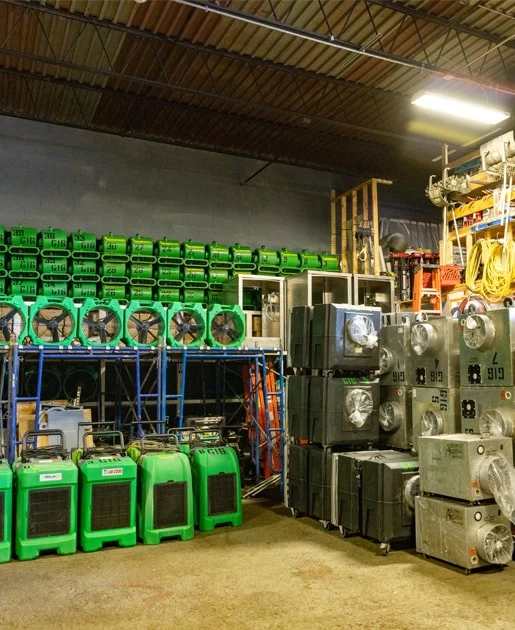
When you call, you reach a real person — any hour, any day. From there, we dispatch a crew to University Gardens to assess the situation on-site. The first priority is stopping the source if it’s still active, then getting standing water out using industrial extraction equipment. This isn’t a shop-vac situation. The equipment is commercial-grade and built for the volume that basement flooding in high-water-table areas like the Great Neck peninsula produces.
Once the water is out, the drying phase begins. Moisture doesn’t stay where you can see it. It moves into concrete block walls, wooden subfloor framing, and wall cavities — especially in homes built in the 1920s through 1950s, which make up most of University Gardens’s housing stock. Thermal imaging and professional moisture meters track what your eyes can’t, and industrial air movers and dehumidifiers run until the readings confirm the job is done, not just until it looks dry.
If mold is found — or if the flood involved sewage backup, which is a Category 3 biohazard requiring a completely different protocol — that work is handled under the appropriate NYS DOL licenses on the same job, without bringing in a second company. For homeowners in the University Gardens subdivision, we’re also familiar with the UGPOA Board’s construction review requirement, meaning structural repair plans can be submitted correctly the first time without delays from a contractor who didn’t know that layer existed.
One Company Handles It All — Water Out to Walls Back In
We handle the full scope of flooded basement cleanup: emergency water extraction, structural drying, moisture mapping, mold inspection and remediation, asbestos and lead assessment where applicable, and complete general contractor rebuild. You don’t coordinate multiple vendors. You don’t manage separate invoices. One call, one company, one job done correctly.
For University Gardens specifically, the asbestos and lead piece matters more than it does in newer construction markets. Homes in the Waverly Hills section were largely built in the 1940s — an era when asbestos floor tiles, pipe insulation, and lead-based paint were standard. A flooded basement in one of these homes can disturb those materials the moment cleanup begins. We hold both the NYS DOL Asbestos License and USEPA Lead/RRP certification, meaning those hazards are handled legally and safely as part of the same job, not flagged as someone else’s problem.
Insurance documentation is also part of our process. The line between what a standard homeowners policy covers — sudden, accidental events like burst pipes — and what it doesn’t cover — groundwater flooding, which is the exact mechanism most likely in this area — is genuinely confusing. We help document damage thoroughly and communicate with your carrier in a way that gives you the clearest possible picture of your coverage and the strongest possible claim.
Why does my University Gardens basement keep flooding even without heavy rain?
This is one of the most common questions from homeowners on the Great Neck peninsula, and the answer is mostly geological. University Gardens sits on a landmass bounded on three sides by water — Manhasset Bay, Little Neck Bay, and Long Island Sound. The elevation is low, the soil has limited percolation capacity, and the water table sits unusually close to the surface. The Village of Great Neck’s own Building Inspector and Village Engineer have formally documented that a large area in this zone is prone to extensive basement and cellar flooding because of exactly these conditions.
What that means practically is that even moderate rainfall — the kind that wouldn’t bother a home in Mineola or Hicksville — can push groundwater up through your foundation slab or through block walls before your sump pump can keep up. If your sump pump is aging, undersized, or loses power during a storm, you get water. The fix isn’t always waterproofing — sometimes it’s drainage, sometimes it’s pump capacity, sometimes it’s both. A proper assessment after a flood event will tell you which applies to your specific property.
How fast does mold actually grow after a basement flood in University Gardens?
Mold can begin growing within 24 to 48 hours of a flooding event under the right conditions — and a closed basement in University Gardens during spring or summer provides exactly those conditions: warmth, moisture, and limited airflow. The EPA recommends starting cleanup within that same window. The 72-hour mark is often cited as the threshold after which mold growth becomes likely rather than possible.
In practical terms, this means the longer you wait — even by a day — the more likely you are to be dealing with both a water damage bill and a mold remediation bill. Mold remediation costs more than water extraction. It also takes longer, requires a separate NYS DOL Mold License to perform legally in New York, and can affect your air quality for months if it’s not fully addressed. Calling immediately after a flood, even late at night, is almost always the right call financially.
Does homeowners insurance cover basement flooding from groundwater in University Gardens?
Usually not — and this catches a lot of University Gardens homeowners off guard. Standard homeowners insurance covers sudden and accidental water damage, like a burst pipe or a washing machine that fails. It does not cover groundwater flooding, which is what happens when the water table rises and pushes water through your foundation. That type of flooding requires a separate flood insurance policy, typically through the National Flood Insurance Program (NFIP).
The tricky part is that many homeowners in this area don’t carry flood insurance because they’re not in a designated high-risk flood zone — even though the local soil, elevation, and water table conditions make basement flooding a documented, recurring reality here. If you’re unsure what your policy covers, the most important thing you can do right after a flood is document everything thoroughly before any cleanup begins. We help with that documentation process and can communicate directly with your adjuster to make sure the damage is categorized and presented correctly, regardless of which policy applies.
What's the difference between clean water flooding and sewage backup cleanup?
The water damage industry classifies flooding into three categories, and the category determines everything about how the cleanup is handled. Category 1 is clean water — a burst supply pipe, for example. Category 2 is gray water, which may contain contaminants from appliances or drainage. Category 3 is black water, which includes sewage backup, and it’s treated as a biohazard.
Sewage backup in a basement requires full decontamination — not just drying. The affected materials often need to be removed entirely, the space needs to be treated with antimicrobial agents, and all of it needs to be handled under protocols that protect both the occupants and the technicians. In University Gardens, where many homes were built in the 1920s through 1950s with older municipal sewer connections, sewage backup is a real and recurring risk — especially during heavy rain events when the system gets overwhelmed. If your basement smells like sewage after flooding, do not attempt to clean it yourself. The health risks are serious, and the cleanup protocol is significantly more involved than a standard water extraction job.
Do I need a permit for basement restoration work in the Town of North Hempstead?
Yes, for structural work. University Gardens is an unincorporated hamlet governed by the Town of North Hempstead, and any structural repairs following flood damage — drywall replacement, framing repairs, subfloor work — typically require a Town of North Hempstead building permit. We hold a Nassau County General Contractor license that covers this jurisdiction, so the permit process is handled as part of the restoration, not handed off to you to figure out separately.
If your home is in the University Gardens subdivision specifically — the 218-home development built on the former University Golf Club site — there’s an additional layer: the UGPOA Board requires that construction plans be submitted for review and approval before work begins. A contractor who doesn’t know this requirement exists can create real delays in your restoration timeline. We’re familiar with this process and account for it from the start, so you’re not the one chasing approvals while your basement sits unfinished.
How much does flooded basement cleanup typically cost in Nassau County?
The range is wide because the variables are significant. A clean water flood in a smaller, unfinished basement might run $1,500 to $3,500 for extraction and drying. A larger space with contaminated water — sewage backup, for example — can reach $10,000 to $15,000 or more before any structural rebuild. If mold is involved, that adds another layer. FEMA estimates that just one inch of standing water can cause approximately $25,000 in property damage when you account for everything it touches.
In University Gardens, where homes are older and often contain materials like asbestos tile or lead paint that require licensed handling, the scope of work can be broader than it would be in newer construction. That’s not a reason to delay — it’s a reason to call a company that can assess the full picture accurately on the first visit, rather than one that quotes low and adds costs as they discover what they’re actually dealing with. Getting an honest, complete assessment upfront is the best way to avoid surprises, and it’s how we approach every job in this area.