Water in Your Westbury Basement Doesn't Wait — Neither Do We
Mold starts in 24 hours. On the Hempstead Plains, with Westbury’s water table and aging housing stock, a flooded basement isn’t just an inconvenience — it’s a clock running against you. We respond around the clock, and we bring every license this work requires under one roof.
I needed a professional consultation explanation of procedure for safe removal of Asbestos in my apartment complex. Without having an account yet, I was very impressed with the caring, knowledgeable and generous advice offered by Jessica, and will look forward to doing business in the future. Thank you so much! I feel much more informed about a sometimes scary endeavor. Peace. Nancy Silva Mineola, NY.
Mia Munoz
Used this company to clean up some water flood in my house. They were fast and easy to work with.very professional, Would recommend to anyone!
Nini Valle
Great company, had a flood and they responded quickly and efficiently. Billed my insurance company directly. I highly recommend this company!
joe colapietro, jr
I had pipe freeze in my basement right before a snow storm and they made to within an hour to help start the clean up process. They we by our side throughout the entire process and even helped with the insurance company. They did such a great job with the cleanup, repair, remidiation, I contracted them to perform the repairs and finishes in the basement. They came with enough manpower and material to get the job done. Leo and Jessica were nothing but a pleasure to deal with!!
Cristian Arredondo c
I had some water damage in my home and Green Island was able to take care of my issue quickly and effectively. I am very pleased with the work they did. They responded quickly and were very professional.
Michael M
Outstanding service! From the office to the field crew everyone was friendly, helpful and responsive. I highly recommend Green Island Group.
A dry-looking basement and a dry basement are two different things. Moisture hides in wall cavities, under subflooring, and inside the concrete block walls common in Westbury’s post-war homes. Without proper extraction and structural drying, what looks resolved today becomes a mold problem in two weeks — and a much bigger bill after that.
Westbury sits on the Hempstead Plains, a flat glacial outwash plain with one of the higher water tables in Nassau County. When heavy rain hits or snowmelt saturates the ground, hydrostatic pressure builds against basement walls and floors — and it doesn’t need a burst pipe to get inside. That’s a local condition that changes how cleanup needs to be done here, and it’s something a generic national restoration franchise may not account for.
When we finish the job right, you get a basement that’s confirmed dry by moisture meters — not just visually clear. You get documentation for your insurance claim. You get a clear answer on whether mold was present and what was done about it. And if your Westbury home was built before 1978, you get the assurance that any lead paint or asbestos materials in that basement were handled by someone who is actually licensed to touch them.
Every License This Work Requires — Under One Roof in Westbury
We hold the NYS DOL Mold License, NYS DOL Asbestos License, USEPA Lead and RRP certifications, IICRC Water Damage certification, and a Nassau County General Contractor license. That combination matters in Westbury specifically, where roughly 30% of homes were built before 1950 and a flooded basement can involve regulated materials that most water damage companies aren’t legally equipped to handle.
We serve homeowners across Nassau County and have worked throughout the Westbury area — from the residential blocks off Post Avenue to the older Capes and colonials near Jericho Turnpike. We’re a certified minority- and women-owned business, and we bring the same licensed crew and the same standards to every home we enter.
When you call, you’re not getting routed to a subcontractor. You’re getting a team that carries every credential this work requires and can take the job from water extraction all the way through final reconstruction — one call, one company, one invoice.
From the First Call to a Finished Basement — Here's Our Process
When you call, we respond — around the clock, including during the nor’easters and overnight storms that cause most of Westbury’s basement flooding. We aim to be on-site within approximately one hour across Nassau County. The first thing we do is assess the situation: where the water came from, what category it is, and whether the flooding has affected any materials in your basement that require special handling. In a home built before 1978, that assessment includes checking for asbestos floor tiles, pipe insulation, and lead paint before any demolition begins.
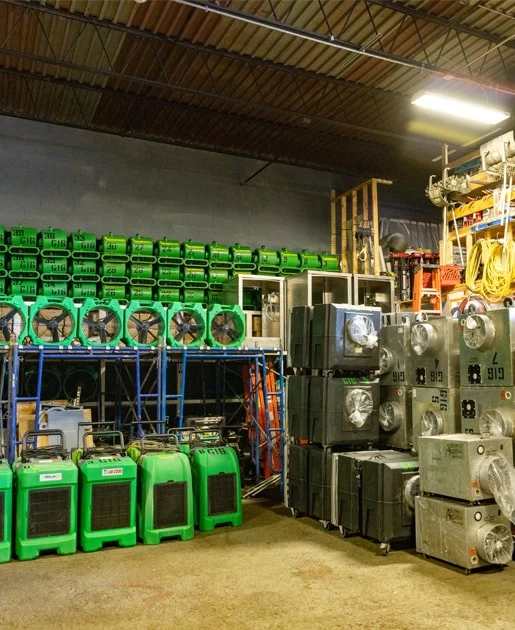
From there, we extract standing water using industrial-grade equipment and set up structural drying — air movers and dehumidifiers placed based on moisture readings, not guesswork. We monitor drying progress and don’t pack up until the numbers confirm the structure is dry. If mold is present, our NYS DOL-licensed remediators handle it as part of the same job.
Once the space is clean and dry, we handle the rebuild. Drywall, framing, flooring — whatever your basement needs to be fully restored. Because we hold a Nassau County General Contractor license, we can pull the permits the Village of Westbury requires for structural work, and you don’t have to coordinate a second contractor to finish the job.
Built for Westbury's Homes, Not a Generic Checklist
Westbury’s housing stock creates cleanup scenarios that a standard water damage company isn’t always equipped for. Homes built in the 1940s and 1950s — which make up a significant share of the village’s residential properties — often have unfinished basements with concrete block walls, older clay sewer laterals prone to root infiltration, and materials that predate modern building standards. When a sewer backup sends Category 3 water into one of these basements, that’s a biohazard event requiring full decontamination, not a shop-vac and bleach.
We handle the full range of basement flooding scenarios: clean water from burst pipes or appliance failures, gray water from sump pump overflow or drainage backup, and black water from sewage events. Each requires a different protocol, and we follow them. For Westbury homeowners with flood insurance through the NFIP or a standard homeowners policy, we also assist with damage documentation and can communicate directly with your carrier — because the strength of your claim depends on the quality of your documentation, and a claim supported by a fully licensed contractor carries more weight with adjusters.
If your basement has been affected by a named storm — Sandy, Ida, or any of the nor’easters that have hammered Nassau County in recent years — and it was never fully remediated, there may be latent moisture or mold that a new event will compound. We can assess for that too.
How quickly does mold grow after a basement floods in Westbury?
Mold can begin developing within 24 to 48 hours of water exposure — and in Westbury’s older homes, the conditions are often ideal for it to take hold fast. Wood framing, older drywall, and fiberglass insulation all hold moisture well, which is exactly what mold needs. The 72-hour window is the critical threshold: if your basement is structurally dry within that timeframe, your mold risk drops significantly. If it isn’t, you’re likely looking at remediation on top of cleanup.
This is why response time matters as much as the quality of the work itself. Surface drying — fans, open windows, a rented dehumidifier — is not the same as structural drying. Moisture that migrates into wall cavities or under flooring won’t be captured by consumer-grade equipment, and it won’t show up until the smell returns or you see growth on the walls weeks later. Professional moisture metering is the only way to confirm the structure is actually dry.
Does homeowners insurance cover flooded basement cleanup in Westbury, NY?
It depends entirely on what caused the flooding. Homeowners insurance typically covers sudden and accidental water damage — a burst pipe, a failed water heater, an appliance leak. If your basement flooded because a pipe gave out in the middle of winter, which is common in Westbury’s older homes with aging galvanized or cast iron plumbing, your standard policy likely applies.
Natural flooding — groundwater rising through the floor, storm surge, or surface water entering from outside — is generally not covered by homeowners insurance. That falls under a separate flood insurance policy through FEMA’s National Flood Insurance Program. Many Westbury homeowners carry both, but not everyone knows which applies to their specific event. We can help you document the damage in a way that clearly supports your claim, and we work with insurance carriers regularly. Having a fully licensed contractor with proper credentials on your side matters — adjusters take that documentation more seriously than a report from an unlicensed operator.
What makes basement flooding worse in Westbury compared to other Nassau County towns?
A few things converge in Westbury specifically. The village sits on the Hempstead Plains, a flat glacial outwash plain with a notably high water table across central Nassau County. Unlike hillier communities further east or north, there’s limited natural drainage gradient here — water doesn’t run off easily, and when the water table rises during prolonged rain or rapid snowmelt, it exerts direct pressure against basement walls and floors. That’s hydrostatic seepage, and it can happen even when there’s no pipe failure and no surface flooding.
On top of that, Westbury’s storm sewer infrastructure was largely built for mid-20th century rainfall patterns. The more intense precipitation events that Nassau County has seen in recent years — particularly during Tropical Storm Ida in 2021 — routinely overwhelm those systems. When street drainage backs up, water finds the lowest point in a structure, and in most Westbury homes, that’s the basement. Sump pump failure during a power outage compounds the problem significantly, and power outages during major storms are common across the area.
My Westbury home was built in the 1950s — does that affect how basement cleanup is handled?
Yes, and it’s worth understanding before anyone starts tearing out materials. Homes built before 1978 may contain lead paint, and homes built before the mid-1980s may contain asbestos in floor tiles, pipe insulation, or joint compound. In a basement that’s been flooded, some of those materials may already be disturbed or damaged — and removing them without proper protocols creates a hazard that’s worse than the water itself.
New York State requires separate licenses for mold remediation, asbestos abatement, and lead-safe work practices. We hold all three — the NYS DOL Mold License, the NYS DOL Asbestos License, and the USEPA Lead and RRP certifications. A standard water damage company operating in Westbury without these credentials cannot legally or safely complete the full scope of work in a home of this age. Before you hire anyone to clean up your basement, ask them to name their NYS DOL Mold License number. That one question will tell you a lot about who you’re actually dealing with.
How much does flooded basement cleanup typically cost in Westbury, NY?
The range is wide because the variables are significant. A minor clean-water event in a small basement — a washing machine overflow caught quickly, for example — might run $1,600 to $3,000 for extraction and drying. A more involved event involving contaminated water, significant structural drying, and any mold remediation can reach $8,000 to $12,000 or more. If hazardous materials like asbestos or lead are present, licensed abatement adds to that cost — but it’s not optional, it’s required by law.
The number that tends to reframe the conversation is this: FEMA estimates that one inch of standing water can cause approximately $25,000 in property damage when secondary damage, mold, and structural deterioration are factored in. The cost of professional cleanup is almost always a fraction of the cost of delayed or incomplete cleanup. In Westbury’s older housing stock, where moisture can sit in wall cavities and framing for weeks before it’s visible, the gap between acting fast and waiting is especially consequential.
Do I need a permit to repair my basement after flooding in Westbury?
For cosmetic work — repainting, replacing flooring like-for-like — you likely don’t. But if the flooding caused structural damage that requires replacing drywall, repairing or replacing framing, or any work that changes the condition of the structure, the Village of Westbury’s Building Department requires a permit. Westbury is an incorporated village within the Town of North Hempstead, which means it has its own building department and code enforcement separate from the town — so Nassau County permits alone don’t cover work done within village limits.
We hold a Nassau County General Contractor license that covers permitted work within the Village of Westbury. We handle the permit process as part of the job, so you’re not left coordinating between a restoration company and a separate GC to get the work done legally. For homeowners filing an insurance claim, permitted work also carries more weight during the claims process — it demonstrates that repairs were completed to code, which matters when an adjuster is reviewing your documentation.