Estate Teardowns on the North Shore Require More Than a Wrecking Crew
When your Brookville property is ready to come down, one licensed Long Island contractor handles the asbestos survey, permits, demolition, and site clearance so your rebuild timeline stays on track.
I needed a professional consultation explanation of procedure for safe removal of Asbestos in my apartment complex. Without having an account yet, I was very impressed with the caring, knowledgeable and generous advice offered by Jessica, and will look forward to doing business in the future. Thank you so much! I feel much more informed about a sometimes scary endeavor. Peace. Nancy Silva Mineola, NY.
Mia Munoz
Used this company to clean up some water flood in my house. They were fast and easy to work with.very professional, Would recommend to anyone!
Nini Valle
Great company, had a flood and they responded quickly and efficiently. Billed my insurance company directly. I highly recommend this company!
joe colapietro, jr
I had pipe freeze in my basement right before a snow storm and they made to within an hour to help start the clean up process. They we by our side throughout the entire process and even helped with the insurance company. They did such a great job with the cleanup, repair, remidiation, I contracted them to perform the repairs and finishes in the basement. They came with enough manpower and material to get the job done. Leo and Jessica were nothing but a pleasure to deal with!!
Cristian Arredondo c
I had some water damage in my home and Green Island was able to take care of my issue quickly and effectively. I am very pleased with the work they did. They responded quickly and were very professional.
Michael M
Outstanding service! From the office to the field crew everyone was friendly, helpful and responsive. I highly recommend Green Island Group.
Your Brookville Project Moves Forward Without the Runaround
Most demolition headaches in Brookville don’t come from the teardown itself they come from everything around it. A contractor who doesn’t know the village-level permit process. An asbestos survey that gets subcontracted to a third party and falls behind. Utility disconnections nobody coordinated. By the time the actual structure comes down, weeks have already been lost.
When the median home in Brookville is worth over $3.7 million and you’re working against a construction timeline, those delays aren’t just frustrating they’re expensive. Brookville’s housing stock skews heavily toward mid-century construction, with a median year built of 1950. That means nearly every structure slated for demolition here legally requires a certified asbestos survey before a single wall comes down. Knowing that upfront and having a contractor who handles it in-house changes everything.
What you get on the other side of a well-managed demolition is a clean, cleared site that’s ready for your architect and builder to move on. No stop-work orders. No surprise environmental findings that halt the project. No neighbor complaints from a crew that didn’t bother managing dust or debris on your two-acre lot off Cedar Swamp Road. Just a site that’s done right, documented, and ready for what comes next.
12 Years on Long Island. We Know Brookville's Territory.
Green Island Group is a Long Island-based, owner-operated demolition and environmental contractor with over 12 years of experience across Nassau County, Suffolk County, and the five boroughs. We’ve completed more than 5,000 projects and a meaningful number of them have been in the incorporated villages of Nassau’s North Shore, where the permit process, the housing stock, and the expectations are nothing like what you’d find in a typical suburban town.
Brookville is its own jurisdiction. The village has its own Building Inspector, its own code, and its own approval process that runs separately from Nassau County’s building department. We’ve navigated that process. We know what the application requires, what the Code Enforcement Officer may ask for regarding asbestos documentation, and how to keep things moving without putting your timeline at risk.
We’re based in Bohemia, NY not a national franchise, not a lead generator with an out-of-state phone number. When you call, you’re talking to someone who actually knows the difference between a village permit in Brookville and a county permit in an unincorporated community. That’s not a small thing when you’re managing a multi-million-dollar rebuild on a North Shore estate.
It starts with a site visit and assessment. Before anything else, we walk the property, evaluate the structure, and identify what’s present asbestos-containing materials, lead paint, any environmental factors that need to be addressed before demolition begins. For most homes in Brookville built around 1950, this step isn’t optional. New York State Industrial Code Rule 56 requires a certified asbestos inspection before any demolition work starts, and we handle that survey in-house.
Once the assessment is complete, we manage the permit application with the Village of Brookville Building Inspector. We coordinate utility disconnections with PSEG Long Island, National Grid, and the local water authority all of it, so you’re not tracking down contacts and making separate calls. If abatement is required, we complete it before demolition begins, with proper air sampling and documentation to satisfy both the village and state requirements.
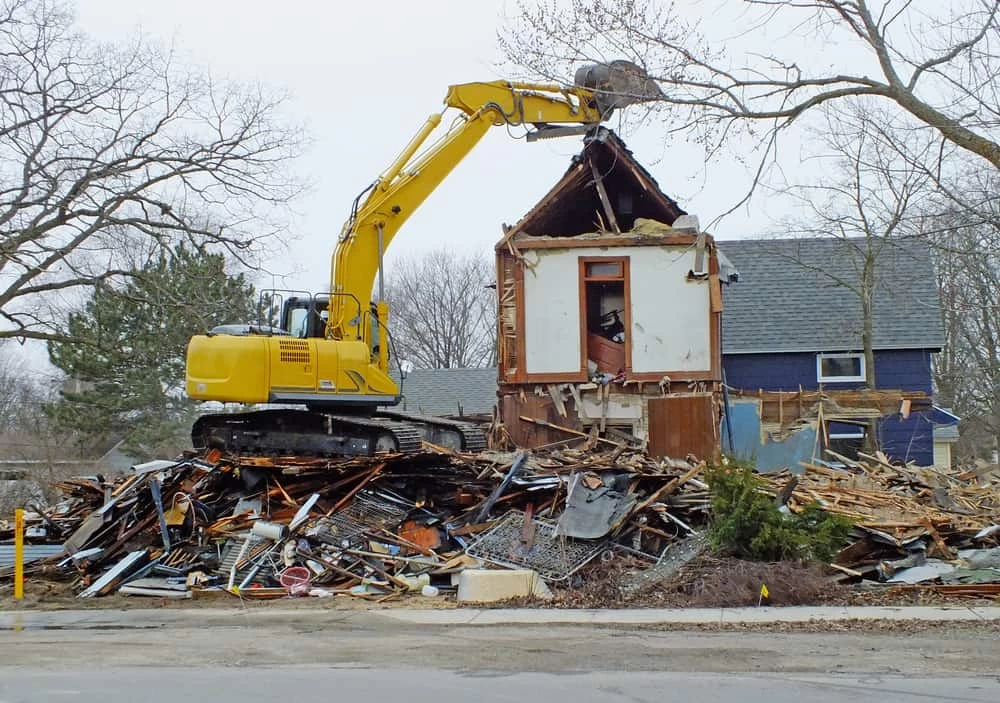
The demolition itself is planned around your property’s specific layout. Brookville lots are large two acres minimum by village zoning and many have mature woodland, private driveways, and neighboring estate properties that require careful equipment staging. We clear the site, remove all debris, and leave you with a clean foundation-ready lot. The whole process is managed by one team, one point of contact, and one contractor who’s accountable from start to finish.
House demolition in Brookville isn’t a single-trade job. The homes here are large, the lots are expansive, and the regulatory requirements are layered village permits, state asbestos compliance, EPA lead paint regulations, and utility coordination all have to happen in the right sequence before a structure can legally come down. We manage every layer of that process as a single, integrated contractor.
That means the asbestos abatement certification, the demolition license, the debris removal, and the site clearance all come from one company not a patchwork of subcontractors who don’t communicate with each other. For Brookville property owners managing a teardown-and-rebuild on an estate-scale lot, that integration isn’t a convenience. It’s the difference between a project that runs on schedule and one that stalls at every handoff.
We serve the full range of demolition needs in this area: full residential teardowns, partial or selective interior demolition, and site clearing for new construction. Whether you’re on a wooded lot near Wheatley Hills, working with an estate executor on a long-held family property, or coordinating a teardown adjacent to the LIU Post campus, the scope of work gets the same level of attention. Every project includes proper documentation for permit closeout because in an incorporated village like Brookville, the paperwork matters just as much as the physical work.
Do I need a permit to demolish a house in Brookville, NY?
Yes and in Brookville specifically, that permit comes from the village, not just Nassau County. Because Brookville is an incorporated village with its own Building Inspector and Code Enforcement Officer, you need to file a written application and receive approval before any demolition work can begin. This is a separate process from the Nassau County building department, and contractors who aren’t familiar with incorporated North Shore villages sometimes miss this distinction entirely which leads to stop-work orders and delays that could have been avoided.
The village code also allows the Code Enforcement Officer to require proof of asbestos examination and remediation as part of the permit process. So before your application is even approved, you may need documentation from a certified asbestos inspector. We handle both the permit coordination and the asbestos survey, so nothing falls through the gap between those two requirements.
Does a house in Brookville need an asbestos inspection before demolition?
Under New York State Industrial Code Rule 56, a certified asbestos survey is required before any demolition full stop. There are no exceptions based on property size or age, but the reality in Brookville makes this especially relevant: the median year built for properties sold here is 1950. Homes from that era routinely contain asbestos in insulation, ductwork, floor tiles, roofing materials, and joint compound. You can’t assume it isn’t there just because the house looks well-maintained.
The inspection has to be performed by a NYS DOL-certified asbestos inspector, and if asbestos-containing materials are found, abatement must be completed by a licensed contractor before demolition begins. Skipping this step or using an uncertified contractor exposes you to EPA fines that can reach $43,000 per violation per day on top of any stop-work order from the village. We’re certified to handle both the survey and any required abatement in-house, which keeps your timeline intact and your liability covered.
How long does it take to demolish a house in Brookville, NY?
The physical demolition of a residential structure even a large one typically takes anywhere from a few days to about two weeks, depending on the size of the home and the complexity of the site. But in Brookville, the total project timeline is shaped more by the steps before demolition than the teardown itself. Permit approval from the village, asbestos survey results, any required abatement work, and utility disconnection coordination all need to happen in sequence before a single wall comes down.
For a well-prepared project on a typical Brookville estate lot, you’re generally looking at three to six weeks from initial assessment to a cleared site assuming permits are filed promptly and no unexpected environmental findings require extended abatement. Projects that hit delays usually do so because the contractor wasn’t prepared for the village-level permit process or didn’t start the asbestos survey early enough. We sequence everything from day one specifically to avoid those gaps.
What happens to all the debris after demolition on a large Brookville property?
All demolition debris is removed and disposed of properly as part of the project this isn’t something you need to arrange separately. For a typical Brookville property on a two-acre-plus lot, debris removal involves multiple hauls, and the logistics matter more than they do on a smaller suburban lot. Equipment staging, driveway access, and tree canopy clearance all factor into how the site is worked and how debris is loaded and transported without damaging the surrounding landscape.
Materials that require special handling asbestos-containing debris, lead paint waste are disposed of through licensed facilities following EPA and NYS DEC requirements. This documentation is part of your project record and matters for permit closeout with the village. By the time we’re done, the site is clean, graded, and ready for your builder or landscape contractor to take over. Nothing is left behind, and nothing is handled in a way that creates liability for you down the road.
Can one contractor handle both asbestos abatement and demolition in Brookville?
Yes and honestly, that’s the setup you want. When asbestos abatement and demolition are handled by two separate contractors, you’re managing two schedules, two sets of documentation, and two points of accountability. If the abatement contractor runs behind, your demolition contractor is sitting idle. If there’s a dispute about scope, you’re the one in the middle trying to sort it out. On a project in Brookville where your overall construction timeline is tied to a multi-million-dollar rebuild, that kind of friction is genuinely costly.
We are both a NYS DOL-certified asbestos abatement contractor and a licensed demolition contractor. We run the survey, complete any required abatement, and move directly into demolition without a handoff to another company. One contract, one timeline, one team responsible for the whole thing. For property owners in Brookville who are used to professional project management across every other aspect of their lives, that’s not an unusual expectation it’s just harder to find than it should be.
How much does house demolition cost in Brookville, NY?
Demolition costs in Brookville are shaped by several factors that don’t apply the same way in a typical suburban town. The size of the structure matters, but so does the asbestos survey (required by law for virtually every home here given the 1950 median build year), any abatement work that follows, village permit fees, utility disconnection coordination, and debris removal across what is typically a large estate lot. A straightforward residential teardown in this area generally runs somewhere in the range of $15,000 to $40,000 or more for a larger estate home with the total depending heavily on what the environmental survey turns up and the scale of the structure.
What we don’t do is give you a low number to win the job and then expand it once we’re on-site. Every estimate we provide accounts for the real scope: the permit process, the environmental requirements, and the site logistics specific to your property. Brookville homeowners managing complex builds deserve cost certainty from the start, not a number that changes after you’ve already committed. We walk the site, assess what’s actually there, and give you a number you can plan around.