When East Garden City's Oldest Homes Need to Come Down
East Garden City’s Mitchel Field-era homes carry real history — and real complications. We handle house demolition in East Garden City, NY from permits to final cleanup, including asbestos abatement, so nothing stalls your project.
I needed a professional consultation explanation of procedure for safe removal of Asbestos in my apartment complex. Without having an account yet, I was very impressed with the caring, knowledgeable and generous advice offered by Jessica, and will look forward to doing business in the future. Thank you so much! I feel much more informed about a sometimes scary endeavor. Peace. Nancy Silva Mineola, NY.
Mia Munoz
Used this company to clean up some water flood in my house. They were fast and easy to work with.very professional, Would recommend to anyone!
Nini Valle
Great company, had a flood and they responded quickly and efficiently. Billed my insurance company directly. I highly recommend this company!
joe colapietro, jr
I had pipe freeze in my basement right before a snow storm and they made to within an hour to help start the clean up process. They we by our side throughout the entire process and even helped with the insurance company. They did such a great job with the cleanup, repair, remidiation, I contracted them to perform the repairs and finishes in the basement. They came with enough manpower and material to get the job done. Leo and Jessica were nothing but a pleasure to deal with!!
Cristian Arredondo c
I had some water damage in my home and Green Island was able to take care of my issue quickly and effectively. I am very pleased with the work they did. They responded quickly and were very professional.
Michael M
Outstanding service! From the office to the field crew everyone was friendly, helpful and responsive. I highly recommend Green Island Group.
No Stop-Work Orders, No Surprise Delays, No Second Contractor
A lot of homeowners in East Garden City start the demolition process thinking it’s straightforward — pull a permit, bring in a crew, done. Then they find out about the Nassau County Rodent Free Certificate. Then the asbestos inspection requirement. Then the utility disconnection sign-offs. By the time they’ve sorted through it all, weeks have passed and nothing has come down yet.
That’s the reality of demolishing a home here, especially in the residential pockets surrounding the former Mitchel Field base. Many of those homes were built in the 1930s through the 1950s — and structures from that era almost always contain asbestos in the insulation, flooring, ceiling tiles, or pipe wrap. Under New York State law, that has to be inspected and cleared before a single wall comes down. Most local demolition contractors hand you a referral at that point and wish you luck.
We don’t do that. Asbestos abatement and demolition are handled under one roof, one schedule, one point of contact. You don’t coordinate between two companies or wait for one crew to finish before another can start. The project moves because everything moves together — and when it’s done, the site is clean, documented, and ready for whatever comes next.
340 Projects Deep, and We Know East Garden City's Regulatory Landscape Cold
We’ve been doing this for over 12 years, with more than 340 completed demolition projects across Long Island and New York City. That’s not a company still figuring out Nassau County’s permit process — that’s a team that’s navigated the Town of Hempstead building department, the Nassau County Health Department’s demolition requirements, and NYS asbestos compliance more times than most contractors have bid on jobs.
East Garden City sits in a unique position in Nassau County. It’s not a quiet residential suburb — it’s the Nassau Hub, home to Roosevelt Field Mall, Nassau Community College, Hofstra University, and some of the most active commercial and institutional development on Long Island. The demolition work we handle here reflects that mix: historic residential teardowns in the Mitchel Field neighborhoods, commercial site clearance along the Meadowbrook Parkway corridor, and everything in between. We hold EPA, OSHA, and NYS Department of Health certifications, plus NYS and NYC M/WBE certification — the full compliance stack for public, institutional, and private work in East Garden City and the surrounding area.
Every Step Handled Before the First Wall Comes Down
The first thing we do is assess the property — not just the structure, but the regulatory picture. In East Garden City, that means identifying whether the home falls under Town of Hempstead permit jurisdiction (it does — East Garden City is unincorporated, so there’s no village building department), confirming what asbestos inspection is required given the age of the structure, and mapping out the full permit and certification sequence before any work begins.
From there, if asbestos or other hazardous materials are present — which is common in the Mitchel Field-era homes and other pre-1980 structures throughout East Garden City — abatement is completed first. That’s a legal requirement under NYS Industrial Code Rule 56, and it cannot be skipped or shortened. Once clearance is confirmed, the Nassau County Rodent Free Certificate is obtained through the Health Department, utilities are formally disconnected with PSEG Long Island, and the demolition permit is pulled through the Town of Hempstead.
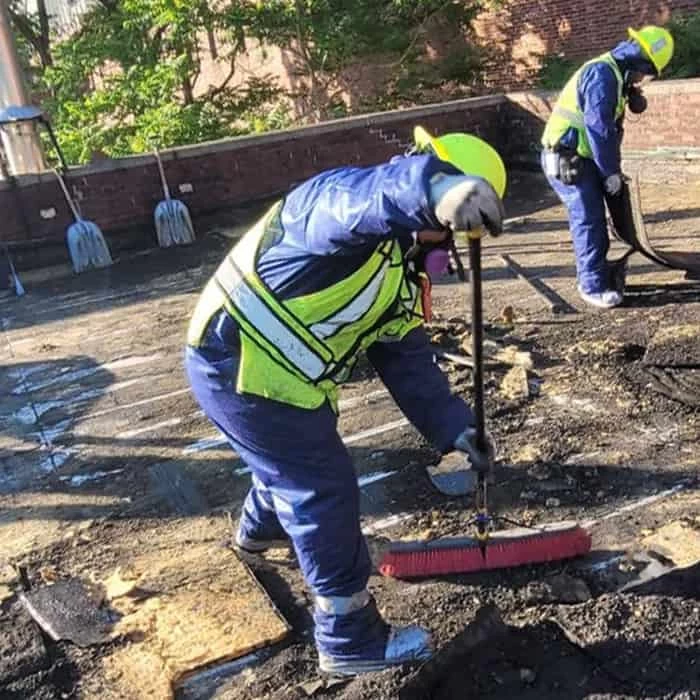
Then the physical work begins. The structure comes down, debris is removed and disposed of properly, and the site is graded and left clean. If the project involves fire damage, water damage, or mold — which is not uncommon in older East Garden City homes — we can carry the project through structural drying, mold remediation, and full restoration without handing it off to anyone else. One crew, start to finish.
Demolition Services Near Roosevelt Field, Nassau County
What's Actually Included When You Hire Us
House demolition in East Garden City isn’t a single-step service — and we don’t treat it like one. Every project starts with a site assessment and a clear scope of work, so you know exactly what’s required, in what order, and what it costs before anything is scheduled. That includes identifying hazardous materials, confirming permit requirements with the Town of Hempstead, and outlining the Nassau County Health Department certification steps specific to your property.
Asbestos inspection and abatement are included in-house for properties where it’s required — which, for the older residential stock in the Mitchel Field residential pockets and surrounding Uniondale neighborhoods, is more often the rule than the exception. We’re NYS DOH-licensed for asbestos work, so there’s no separate contractor to find, no scheduling gap between abatement and demolition, and no risk of a stop-work order because the sequence wasn’t followed correctly.
The full scope covers structural demolition, debris removal, site cleanup, and grading. For projects involving damage — water intrusion, fire, mold — the service extends through remediation and restoration. We also support insurance documentation for covered losses, which matters when you’re dealing with a damaged structure and an open claim. Whether it’s a single-family teardown near Charles Lindbergh Boulevard or a commercial site along the Meadowbrook Parkway corridor, the process is the same: thorough, compliant, and handled completely.
Do I need a special permit to demolish a house in East Garden City, NY?
Yes, and the process here has a few steps that catch homeowners off guard. East Garden City is an unincorporated hamlet, which means there’s no village building department — your demolition permit goes through the Town of Hempstead, not a local village office. That’s different from what you’d deal with in an incorporated village like Garden City or Westbury, which have their own building departments with separate permit processes.
On top of the Town of Hempstead permit, Nassau County requires a Rodent Free Certificate from the Nassau County Department of Health before demolition can legally begin on any residential, commercial, or industrial property. That means scheduling an inspection, paying a fee, and waiting for a Health Department representative to certify the premises. It’s a real step, it takes real time, and it’s easy to miss if your contractor isn’t familiar with Nassau County’s specific requirements. We handle the entire permit and certification sequence as part of the project — you don’t have to figure it out yourself.
Does my East Garden City home need asbestos testing before demolition starts?
If your home was built before 1980 — which covers the majority of the residential housing stock in East Garden City, including the Mitchel Field-era homes dating back to the 1930s — then yes, an asbestos inspection is required before demolition can proceed. This isn’t optional. Under New York State Industrial Code Rule 56, asbestos inspection and abatement must be completed before structural work begins. The NYS Asbestos Control Bureau enforces this actively, and skipping it can result in stop-work orders, fines, and significant project delays.
Asbestos in older homes is typically found in pipe and boiler insulation, vinyl floor tiles, ceiling tiles, roofing shingles, and exterior siding. The older the home, the more likely it is that multiple materials are affected. We’re NYS DOH-licensed for asbestos inspection and abatement, so this gets handled as part of your demolition project — not as a separate engagement with a separate company. That keeps the schedule intact and removes the most common source of mid-project delays for East Garden City homeowners.
How much does house demolition typically cost in Nassau County, NY?
Nationally, house demolition runs between $6,000 and $25,000, with most homeowners paying around $15,800 for a 2,000 square foot home. In Nassau County and the broader New York metro area, expect to pay 20 to 30 percent above that national average. The reasons are straightforward: stricter regulations, higher labor costs, permit fees, and the logistical complexity of working in a densely developed area. East Garden City’s mix of older residential stock and active commercial corridors adds to that complexity in some cases.
Asbestos abatement — which is required for most pre-1980 homes in this area — adds to the overall cost. Depending on the scope, that can range from roughly $1,200 to $6,000 or more on top of the demolition itself. The honest answer is that you won’t know the exact number until the property is assessed, because the age of the structure, the presence of hazardous materials, the permit requirements, and the site conditions all factor in. What we can tell you upfront is the full scope, the full cost, and the full timeline — before anything is scheduled.
What is a Rodent Free Certificate and why does Nassau County require one?
A Rodent Free Certificate is a document issued by the Nassau County Department of Health certifying that a property is free of rodent infestation before demolition can begin. It’s required for all residential, commercial, and industrial demolition in Nassau County — and it’s one of the most commonly overlooked steps for homeowners who haven’t gone through this process before.
The way it works: you submit an application and fee to the Nassau County Department of Health, a Health Department representative schedules an on-site visual inspection, and once the premises is deemed rodent-free, the certificate is issued. You cannot pull a demolition permit or legally begin demolition without it. The Health Department’s demolition permits line is (516) 227-9715 if you need to contact them directly. This requirement is specific to Nassau County — it doesn’t exist in the same form in Suffolk County or New York City — so contractors who primarily work outside Nassau may not even know to flag it. We do, and we handle it as part of the standard permit sequence for every East Garden City project.
Can the same contractor handle asbestos removal and house demolition together?
They can — but only if they’re licensed for both. Asbestos abatement in New York State requires a separate NYS Department of Health license, which most demolition contractors don’t hold. That’s why the typical scenario for homeowners in East Garden City is: hire a demolition contractor, find out asbestos inspection is required, get referred to a separate abatement company, wait for that company to finish and issue clearance, then restart the demolition schedule. It adds time, adds coordination, and adds cost.
We hold both the NYS DOH asbestos abatement license and full demolition capability, so the entire sequence happens under one project with one schedule. The inspection happens first, abatement is completed if materials are found, clearance is confirmed, and demolition proceeds — no gap between phases, no waiting on a second contractor, no risk of the timeline falling apart because two separate companies can’t sync up. For the older homes in East Garden City, where asbestos is genuinely common rather than a remote possibility, this integrated approach is the practical difference between a project that finishes on time and one that drags on for months.
What happens to the debris and site after house demolition in East Garden City?
Once the structure is down, the work isn’t finished — and that’s an area where a lot of homeowners get caught off guard. Debris removal, disposal, and site grading are all part of what needs to happen before the property is usable again, and not every demolition contractor includes all of that in their scope. Some will take down the structure and leave the rest to you.
Our process includes full debris removal and proper disposal — including any hazardous materials that were identified during the abatement phase, which have to be disposed of through certified channels, not just hauled to a standard landfill. The site is graded after clearing so it’s level, clean, and ready for whatever the next phase is, whether that’s a rebuild, a sale, or a commercial development. If the demolition was triggered by damage — fire, water, mold — and the project continues into restoration, we handle that too, including structural drying and mold remediation for properties in East Garden City’s older residential stock where moisture damage in basements and crawl spaces is a real and recurring issue.