Murray Hill's Prewar Homes Deserve More Than a Wrecking Ball
Most homes along Murray Hill’s streets were built decades before modern construction standards existed. House demolition here means asbestos surveys, NYC permits, and tight lots and we handle all of it, start to finish.
I needed a professional consultation explanation of procedure for safe removal of Asbestos in my apartment complex. Without having an account yet, I was very impressed with the caring, knowledgeable and generous advice offered by Jessica, and will look forward to doing business in the future. Thank you so much! I feel much more informed about a sometimes scary endeavor. Peace. Nancy Silva Mineola, NY.
Mia Munoz
Used this company to clean up some water flood in my house. They were fast and easy to work with.very professional, Would recommend to anyone!
Nini Valle
Great company, had a flood and they responded quickly and efficiently. Billed my insurance company directly. I highly recommend this company!
joe colapietro, jr
I had pipe freeze in my basement right before a snow storm and they made to within an hour to help start the clean up process. They we by our side throughout the entire process and even helped with the insurance company. They did such a great job with the cleanup, repair, remidiation, I contracted them to perform the repairs and finishes in the basement. They came with enough manpower and material to get the job done. Leo and Jessica were nothing but a pleasure to deal with!!
Cristian Arredondo c
I had some water damage in my home and Green Island was able to take care of my issue quickly and effectively. I am very pleased with the work they did. They responded quickly and were very professional.
Michael M
Outstanding service! From the office to the field crew everyone was friendly, helpful and responsive. I highly recommend Green Island Group.
One Contractor. No Handoffs. No Surprise Invoices.
When you’re tearing down a home in Murray Hill, the process is rarely just about the structure itself. It’s about what’s inside the walls. The majority of homes in this neighborhood were built during the 1920s through 1950s which means asbestos-containing materials are not a possibility, they’re a near-certainty. New York State law requires a certified asbestos survey before any demolition work begins, and NYC’s DEP requires notification at least seven days before abatement starts. If your contractor can’t handle that in-house, you’re already looking at delays before the first wall comes down.
We’re both a licensed demolition contractor and a NYS DOL-certified asbestos abatement company. That means you’re not coordinating two separate timelines, two separate crews, and two separate invoices. The survey, the abatement, the NYC DOB permit filing, and the full teardown all run through one team. For homeowners on Murray Hill’s narrow residential lots where attached rowhouses and two-family homes share party walls with occupied neighbors that kind of coordination isn’t just convenient. It’s what keeps your project from turning into someone else’s problem.
The result is a demolition that moves on schedule, clears every regulatory checkpoint, and leaves the site ready for whatever comes next whether that’s new construction, a sale, or a full rebuild.
12 Years in New York. Zero Learning Curves on Your Murray Hill Project.
We’ve been operating across New York State for over 12 years, completing more than 5,000 restoration and demolition projects including residential work throughout Queens and all five NYC boroughs. This isn’t a company that occasionally pulls a NYC DOB permit. Navigating the DOB NOW filing system, satisfying NYC DEP asbestos notification requirements, and coordinating with utility providers before a single wall comes down is standard operating procedure for us.
Murray Hill sits within NYC Community Board 7, and demolition projects in this neighborhood fall under some of the most specific regulatory requirements in the state. Owner Leo Torres runs every project personally, which means you’re not getting handed off to a crew that doesn’t know your address from the next job on the list. From Northern Boulevard to the quieter residential blocks closer to Auburndale, we’ve worked in neighborhoods just like yours and understand exactly what the process requires.
What Actually Happens Before, During, and After Demolition in Murray Hill
It starts with a site assessment. Before anything is filed or scheduled, we evaluate the structure, identify potential hazardous materials, and map out what the project actually requires. In Murray Hill, where virtually every home predates 1978, that assessment almost always includes a certified asbestos inspection. If asbestos-containing materials are found and in this neighborhood’s housing stock, they typically are abatement is scheduled and completed before demolition begins. NYC’s DEP is notified in advance, as required by law.
Once abatement is cleared, the NYC DOB demolition permit process begins. For a full teardown, that means plan submissions prepared by a licensed professional, a dust control plan, and neighbor notification all of which we manage directly. Permit processing in New York City typically takes four to eight weeks, and an experienced team that knows the DOB NOW system can reduce that timeline significantly by filing complete, accurate documentation the first time.
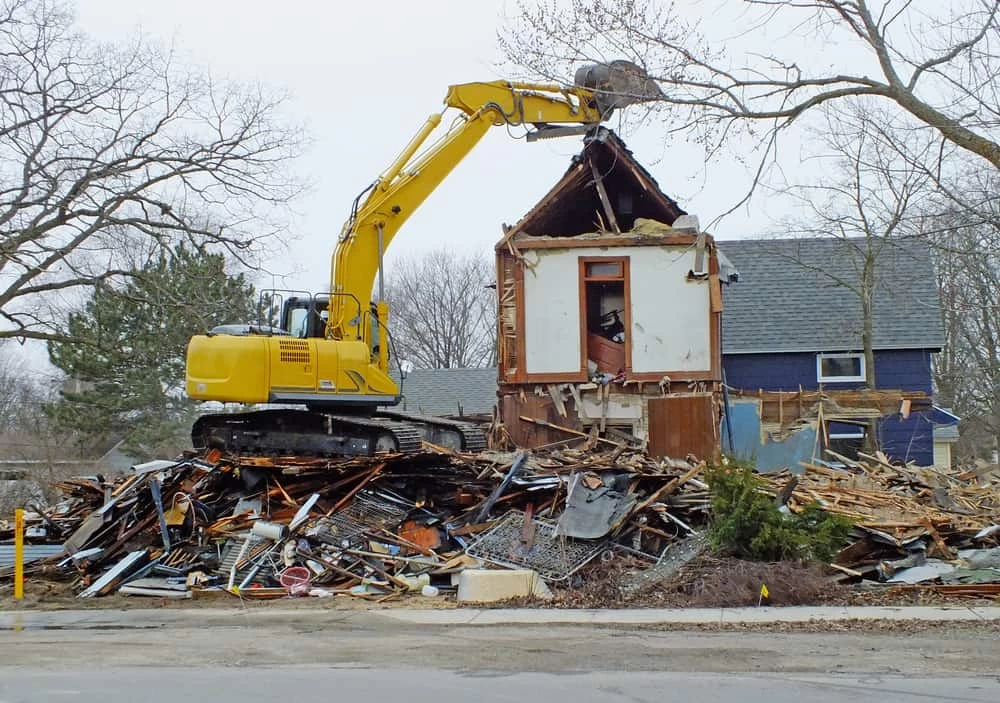
When the permit is approved and utilities are disconnected and confirmed, demolition proceeds. On Murray Hill’s tight residential lots, where neighboring structures often share walls or sit just feet away, the work is methodical not rushed. Debris is removed, the site is cleared, and you’re left with a clean lot ready for its next chapter.
House demolition in Murray Hill isn’t a single service it’s a sequence of regulated steps that all have to happen in the right order. Our scope covers the full sequence: hazardous material survey and testing, NYS DOL-certified asbestos abatement, NYC DEP notification compliance, NYC DOB permit filing and management, structural demolition, debris hauling, and final site clearance. Nothing is handed off to a subcontractor and nothing falls through the gap between two separate companies.
For homeowners dealing with fire damage, water intrusion, or structural failure, we also work directly with insurance carriers and bill insurance companies directly a detail that matters when you’re already managing a claim, temporary housing, and an adjuster who has their own timeline. Multiple customers have specifically noted this in their reviews, and it’s not something every demolition contractor offers.
Whether you’re clearing a prewar rowhouse on a narrow lot near Parsons Boulevard, gutting a two-family home for a full renovation, or preparing a site for new construction, the scope is built around what your specific project actually needs not a one-size package that leaves you filling in the gaps.
Do I need a permit to demolish a house in Murray Hill, NY?
Yes and in New York City, the permitting process is more involved than most people expect. Any full or partial demolition in Murray Hill requires a permit from the NYC Department of Buildings, filed through their DOB NOW system. Full demolitions also require plan submissions prepared by a Registered Architect or Professional Engineer, a dust control plan, a safety plan, and documented neighbor notification. These aren’t optional steps missing any one of them can result in a Stop Work Order and fines starting at $2,500 for a first offense, escalating sharply from there.
What makes Murray Hill specifically more complex is that the asbestos compliance track runs parallel to and must be satisfied alongside the DOB permit process. NYC’s DEP requires notification at least seven days before abatement begins, and that documentation needs to be in order before demolition can legally proceed. An experienced contractor who has pulled demolition permits in Queens before knows how to run both tracks simultaneously so your project doesn’t stall waiting on one while the other is ready to move.
Is asbestos testing required before demolishing a home in Murray Hill, NY?
Under New York State’s Industrial Code Rule 56, a certified asbestos survey is legally required before any demolition or renovation work begins regardless of the building’s age. In Murray Hill, where the overwhelming majority of homes were built during the 1920s through 1950s, this requirement applies to virtually every project. Asbestos-containing materials were commonly used in insulation, floor tiles, roofing, pipe wrap, and ductwork throughout that era, and they don’t become visible until walls come down.
The survey must be performed by a NYS DOL-certified inspector, and if asbestos is found, abatement must be completed by a licensed abatement contractor before demolition begins. NYC adds its own layer the DEP requires advance notification and follows protocols that go beyond the state minimum. We hold the NYS DOL asbestos abatement certification and handle the survey, abatement, and DEP notification in-house, so you’re not managing two separate contractors on a timeline that has to stay perfectly synchronized.
How long does house demolition take in Murray Hill from start to finish?
The actual physical demolition of a single-family or two-family home typically takes one to three days depending on the size and condition of the structure. But the full timeline from your first call to a cleared lot is longer, and most of that time is front-loaded in the permitting and abatement phase. NYC DOB demolition permits typically take four to eight weeks to process. If asbestos abatement is required (which it almost certainly will be in Murray Hill’s prewar housing stock), the DEP notification period adds at least seven days before abatement can begin.
A realistic full timeline for a Murray Hill demolition project, including assessment, asbestos survey, abatement, permit approval, and demolition, runs roughly eight to twelve weeks from project start to cleared site. That timeline can be compressed when a contractor files complete, accurate documentation the first time and doesn’t have to go back to the DOB for revisions. Starting the process earlier than you think you need to is almost always the right move, especially if you’re working toward a spring or summer construction start.
What happens to utilities before a house is demolished in New York City?
All utilities gas, electric, water, and sewer must be disconnected and confirmed shut off before demolition begins. In New York City, this means coordinating with Con Edison for gas and electric disconnection, and with the NYC Department of Environmental Protection for water and sewer. These aren’t steps you can skip or do out of order. The NYC DOB will not approve a demolition permit without documentation confirming that utilities have been properly disconnected by the appropriate utility providers.
The coordination process takes time, and utility providers in New York City operate on their own scheduling calendars. We manage this coordination as part of the overall project scope, which matters because a delay in utility disconnection can push back your entire demolition timeline. For Murray Hill homeowners who are also managing insurance claims, estate timelines, or construction contractor schedules, having one team responsible for keeping all of these moving pieces aligned makes a real difference in whether your project stays on track.
How much does house demolition cost in Murray Hill, NY?
House demolition costs in Murray Hill generally fall between $10,000 and $30,000 for a standard single-family or two-family residential structure, though the final number depends on several factors specific to your property. The size and construction type of the home, the extent of hazardous material abatement required, NYC DOB permit fees (which can reach $10,000 to $12,000 on larger projects), debris volume, and site conditions all affect the total.
What tends to surprise homeowners is how much of the cost is regulatory rather than physical. The asbestos survey, certified abatement, DEP notification compliance, permit filing fees, and professional plan submissions are all required by law and they add up before a single wall comes down. A contractor offering a significantly lower bid may be excluding these line items entirely, which means you’ll see them again mid-project as unexpected invoices. A detailed, written estimate that includes every required step from survey to site clearance is the only way to compare bids accurately. We provide itemized estimates so you know exactly what’s included before you commit.
Can Green Island Group handle demolition on attached or rowhouse properties in Murray Hill?
Yes and this is one of the areas where experience in Murray Hill’s specific residential environment matters most. Murray Hill’s streets are lined with attached rowhouses and two-family homes where structures share party walls with occupied neighbors. Demolishing one unit in that context requires careful structural assessment, proper shoring of the adjacent wall, and a dust containment plan that protects neighboring properties throughout the process. It’s a fundamentally different scope than tearing down a freestanding structure on an open suburban lot.
We’ve completed residential demolition work throughout Queens neighborhoods with exactly this kind of dense, attached building stock. The process includes a pre-demolition structural review to identify shared wall conditions, coordination with adjacent property owners as required by the NYC DOB, and a dust control plan specific to the site. For Murray Hill homeowners on narrower lots near Parsons Boulevard or the residential blocks running south toward 46th Avenue, this level of planning isn’t extra it’s what keeps the project from creating a liability issue next door.