I needed a professional consultation explanation of procedure for safe removal of Asbestos in my apartment complex. Without having an account yet, I was very impressed with the caring, knowledgeable and generous advice offered by Jessica, and will look forward to doing business in the future. Thank you so much! I feel much more informed about a sometimes scary endeavor. Peace. Nancy Silva Mineola, NY.
Mia Munoz
Used this company to clean up some water flood in my house. They were fast and easy to work with.very professional, Would recommend to anyone!
Nini Valle
Great company, had a flood and they responded quickly and efficiently. Billed my insurance company directly. I highly recommend this company!
joe colapietro, jr
I had pipe freeze in my basement right before a snow storm and they made to within an hour to help start the clean up process. They we by our side throughout the entire process and even helped with the insurance company. They did such a great job with the cleanup, repair, remidiation, I contracted them to perform the repairs and finishes in the basement. They came with enough manpower and material to get the job done. Leo and Jessica were nothing but a pleasure to deal with!!
Cristian Arredondo c
I had some water damage in my home and Green Island was able to take care of my issue quickly and effectively. I am very pleased with the work they did. They responded quickly and were very professional.
Michael M
Outstanding service! From the office to the field crew everyone was friendly, helpful and responsive. I highly recommend Green Island Group.
The Structure Comes Down. The Headaches Don't Follow.
Most of the homes in South Ozone Park were built in the 1930s and 1940s. That’s not a problem in itself but when it’s time to tear one down, that age changes everything about how the job has to be done. Before the New York City Department of Buildings will issue a single demolition permit, you need a DEP-certified asbestos investigator to complete an ACP-5 assessment form. That step alone can stall a project for weeks if your contractor doesn’t handle it in-house.
When you work with a contractor who does both certified asbestos abatement and full structural demolition that process runs in sequence instead of in circles. No waiting on a second company to finish before the first one can start. No permit delays because paperwork wasn’t filed correctly. No surprise costs showing up after you’ve already signed a contract.
South Ozone Park also sits in one of the lower-lying sections of Queens, and if you’ve lived here long enough, you know what that means after a heavy storm or a drainage failure near JFK. Sewage flooding has taken out entire basements on streets throughout this neighborhood. When that happens, the clock on mold and structural damage starts immediately. Having a demolition and remediation contractor who answers the phone at any hour and can actually mobilize fast is the difference between a contained problem and a compounding one.
12 Years In. Every Borough. Every Permit. No Shortcuts.
We’ve been doing demolition, asbestos abatement, and remediation work across New York State for over 12 years, with more than 5,000 completed projects. That includes the full range of what Queens throws at a contractor pre-war brick homes, tight urban lots with zero staging room, multi-agency permit requirements, and emergency calls that can’t wait until Monday morning.
The company is owned and operated by Leopoldo Torres, and our work covers all five boroughs, including neighborhoods like South Ozone Park where the DOB, DEP, and FDNY all have a hand in what you can and can’t do before a wall comes down. We hold active licenses verified across New York State and are certified under NYS DOL Industrial Code Rule 56 for asbestos abatement the credential that actually unlocks the permit process in New York City.
With a 4.7-star rating across verified reviews and a track record that includes post-flood emergency work, fire damage teardowns, and full residential demolitions, we’ve seen what South Ozone Park homes look like from the inside and we know exactly what it takes to bring them down safely and legally.
It starts with a site assessment. Before anything else happens, we evaluate the structure, identify what’s present, and determine the regulatory path forward. In South Ozone Park, that almost always means ordering a DEP-certified asbestos survey first because with a median construction year of 1943 and over 60% of the neighborhood’s housing stock built before 1950, asbestos-containing materials are common in floor tiles, pipe insulation, roofing, and joint compound. The ACP-5 form has to be completed and submitted before the DOB will even process a demolition permit application.
Once the asbestos assessment is done and abatement is completed if materials are found the permit gets filed with the New York City Department of Buildings. Utility disconnections are coordinated with Con Edison, National Grid, and NYC DEP for water and sewer. Nothing structural happens until every agency sign-off is in place. That’s not overcaution. That’s how legal demolition in New York City works, and skipping any part of it means Stop Work Orders and fines that start at $2,500.
From there, the structural demolition proceeds, debris is removed, and the site is cleared and graded. If you’re working through an insurance claim which is common after flood or fire damage in South Ozone Park we bill the carrier directly and help navigate the documentation process. You’re not left managing two separate conversations while your property sits open.
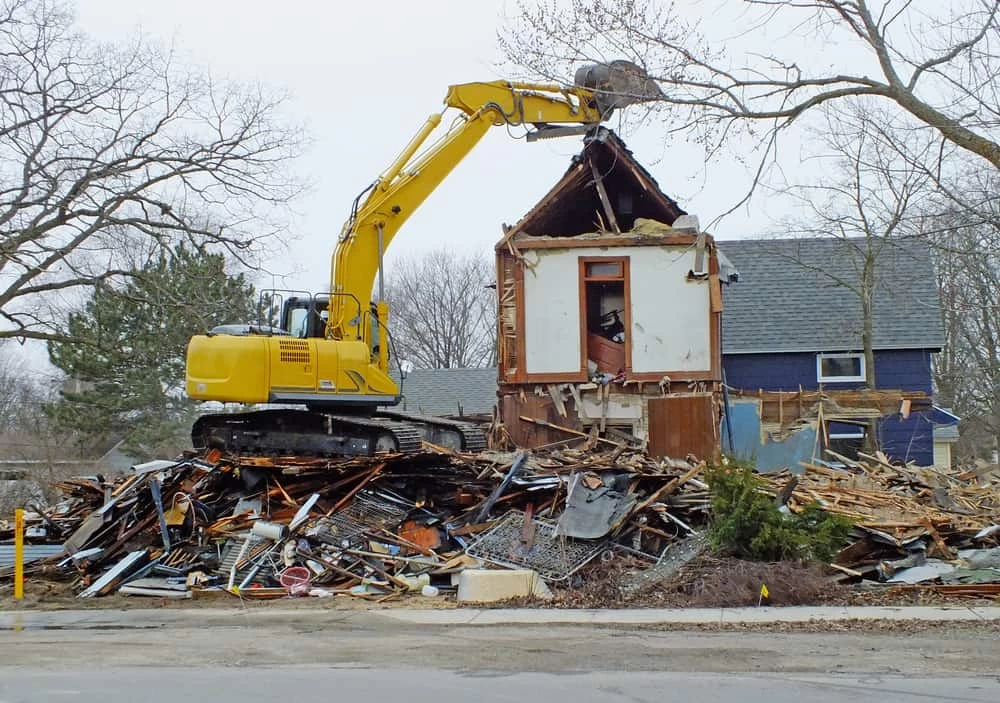
House demolition in South Ozone Park isn’t a single service it’s a sequence of regulated steps, and what you’re hiring for matters. We cover the full sequence: DEP-certified asbestos investigation, abatement if required, DOB permit filing, utility disconnection coordination, structural demolition, debris removal, and site clearance. Every part of that process is handled under one contract, by one licensed team.
The tight residential grid between Lefferts Boulevard and 130th Street presents real logistical constraints narrow access, adjacent structures on both sides, minimal staging space for heavy equipment. We arrive with equipment and protocols calibrated for dense urban demolition: proper containment, dust suppression, and coordination with neighboring property owners before work begins. That’s not standard practice for every contractor operating in this market. For a neighborhood where homes sit close together and the 106th Precinct is active, it matters.
If your project involves fire damage, sewage flooding, or storm damage, we also provide direct insurance billing. You don’t have to front the cost and wait for reimbursement. We work with your carrier directly, handle the documentation, and keep the project moving. For homeowners on Rockaway Boulevard and throughout the surrounding blocks who have dealt with post-flood damage firsthand, that capability is often what makes the difference between starting the job and stalling on it.
Do I need an asbestos survey before demolishing my house in South Ozone Park?
Yes and in New York City, this isn’t optional or situational. Before the Department of Buildings will issue a full demolition permit, you need a completed ACP-5 form from a DEP-Certified Asbestos Investigator confirming the structure is either free of asbestos-containing materials or that abatement has been completed. In South Ozone Park specifically, this step applies to the overwhelming majority of homes because more than 60% of the neighborhood’s housing stock was built before 1950. Asbestos was commonly used in floor tiles, pipe insulation, roofing materials, and joint compound throughout that era.
If asbestos is found, it has to be abated by a licensed contractor before demolition can proceed, and the NYC DEP must be notified at least seven days before abatement begins. We handle both the certified investigation and the abatement in-house, which means you’re not coordinating two separate contractors or waiting on one to finish before the other can start. The permit process moves in sequence, not in circles.
How much does house demolition typically cost in Queens, NY?
Demolition costs in Queens vary based on the size of the structure, what hazardous materials are present, site access, and how debris is handled. For a standard single-family home in South Ozone Park, you’re generally looking at a range that accounts for the asbestos survey, abatement if needed, the DOB permit fee (calculated in NYC based on street frontage, number of stories, and a per-unit rate, with a minimum of $250), the structural demolition itself, and full debris removal.
The honest answer is that any quote you get before a site assessment is a rough estimate. What changes the number most in this neighborhood is whether asbestos or lead paint requires abatement and given the age of the local housing stock, that’s a real possibility on most jobs. Getting a firm, itemized estimate after an on-site evaluation is the only way to know what you’re actually looking at. We provide free estimates and walk you through what’s included before you commit to anything.
How long does the demolition permit process take through NYC DOB?
The timeline depends on a few factors, but the biggest variable in South Ozone Park is the asbestos assessment. The ACP-5 form has to be completed by a DEP-certified investigator before a permit application can even be filed with the Department of Buildings. If asbestos is found, abatement has to be completed and the DEP requires at least seven days’ notice before that work begins. That step alone can add one to three weeks to the front end of the project depending on the scope of the abatement.
Once the ACP-5 is cleared and the permit application is submitted to the DOB, processing times vary. Standard applications can take anywhere from a few days to a few weeks depending on the complexity of the project and current DOB workload. Emergency demolition situations which have occurred on streets like 130th Street in South Ozone Park following fire damage can sometimes be expedited. Working with a contractor who knows the NYC DOB process and files complete, accurate applications the first time is the single biggest factor in keeping the permit timeline from stretching unnecessarily.
What happens if I demolish a structure in NYC without a permit?
Unpermitted demolition in New York City carries serious consequences. At minimum, the DOB will issue a Stop Work Order, which halts everything immediately. Civil fines for a first offense start at $2,500 and escalate from there and if asbestos-containing materials were disturbed without proper abatement and DEP notification, the penalties from the Department of Environmental Protection are separate and can be significantly higher.
Beyond the fines, unpermitted demolition creates title and liability issues that can complicate the sale or redevelopment of the property down the line. In a neighborhood like South Ozone Park where the housing stock is old and asbestos is genuinely present in many structures, the risk of disturbing hazardous materials without proper containment is also a real health and legal concern not just a regulatory technicality. The permit process exists to protect you, your neighbors, and the people doing the work. It’s not something worth cutting corners on.
Can you handle demolition after sewage flooding in South Ozone Park?
Yes, and this is one of the more common situations we handle in this neighborhood. South Ozone Park has experienced documented large-scale sewage flooding events tied to drainage infrastructure failures near JFK Airport events that have displaced hundreds of households and left basements completely destroyed. When sewage water enters a structure, the damage timeline is immediate. Mold colonization can begin within 24 to 48 hours, and structural materials that absorb contaminated water often cannot be salvaged.
We’re available 24 hours a day, seven days a week not as a marketing line, but as a verified operational capability confirmed by multiple customers who have described same-day and after-hours response. For post-flood demolition specifically, we also bill insurance carriers directly and help document the damage for the claims process. If you’re managing a flooding situation in South Ozone Park and trying to figure out what comes next, the first step is getting a licensed contractor on-site to assess the scope before the damage compounds further.
Does homeowners insurance cover house demolition in South Ozone Park after fire or flood damage?
In many cases, yes but the specifics depend on your policy and the cause of the damage. Most standard homeowners insurance policies include some form of debris removal or demolition coverage when the damage is caused by a covered event like fire, certain types of flooding, or storm damage. The key is in how the claim is documented and submitted. Insurers want detailed assessments, photographs, and contractor estimates that clearly connect the demolition scope to the covered damage event.
We work directly with insurance carriers on post-disaster demolition projects, which means you’re not left managing the back-and-forth between your adjuster and your contractor on your own. We handle the documentation and billing coordination on your behalf. For South Ozone Park homeowners who have already been through the stress of a flooding or fire event, that direct billing capability is a meaningful practical advantage it keeps the project moving without requiring you to front the full cost while waiting on reimbursement from your carrier.