Compact Kitchens, Serious Renovations — Built for Bellerose Terrace Homes
Your kitchen was built for a different era. We help Bellerose Terrace homeowners turn tight, dated mid-century kitchens into spaces that actually work for how you live today.
I needed a professional consultation explanation of procedure for safe removal of Asbestos in my apartment complex. Without having an account yet, I was very impressed with the caring, knowledgeable and generous advice offered by Jessica, and will look forward to doing business in the future. Thank you so much! I feel much more informed about a sometimes scary endeavor. Peace. Nancy Silva Mineola, NY.
Mia Munoz
Used this company to clean up some water flood in my house. They were fast and easy to work with.very professional, Would recommend to anyone!
Nini Valle
Great company, had a flood and they responded quickly and efficiently. Billed my insurance company directly. I highly recommend this company!
joe colapietro, jr
I had pipe freeze in my basement right before a snow storm and they made to within an hour to help start the clean up process. They we by our side throughout the entire process and even helped with the insurance company. They did such a great job with the cleanup, repair, remidiation, I contracted them to perform the repairs and finishes in the basement. They came with enough manpower and material to get the job done. Leo and Jessica were nothing but a pleasure to deal with!!
Cristian Arredondo c
I had some water damage in my home and Green Island was able to take care of my issue quickly and effectively. I am very pleased with the work they did. They responded quickly and were very professional.
Michael M
Outstanding service! From the office to the field crew everyone was friendly, helpful and responsive. I highly recommend Green Island Group.
Most kitchens in Bellerose Terrace were built in the 1940s through 1960s — galley layouts, low ceilings, minimal storage, and plumbing that was never designed for a modern household. They were functional for their time. They are not functional for yours. A well-executed kitchen renovation does not just make the space look better. It changes how your mornings run, how your family gathers, and how much energy you spend working around a layout that was never designed with you in mind.
In a community where cooking is serious — where households reflect South Asian, East Asian, and other culinary traditions that involve real heat, real prep, and daily use — your kitchen needs to hold up. That means countertop materials that do not stain or burn, ventilation that can actually handle what you cook, and cabinet finishes that survive years of steam and daily contact. Aesthetics matter, but durability matters more when your kitchen gets used the way kitchens in Bellerose Terrace do.
There is also a financial reality here. With homes in Bellerose Terrace listed in the $684,000 to $769,000 range and annual property taxes averaging around $10,000, every dollar you put into this house needs to do something. A properly executed kitchen renovation in the Nassau County market returns roughly 85 to 96 cents on the dollar at resale — one of the strongest ROI categories in home improvement. You are not just improving your daily life. You are protecting and building on an investment you are already carrying significant costs to maintain.
Green Island Group is a full-service renovation contractor based in New York — not a national franchise, not a lead-generation service that hands your project off to whoever is available. When you hire us, you get one team managing the entire job: demolition, plumbing, electrical, cabinetry, countertops, flooring, and final finish. One point of contact from the first conversation to the final walkthrough.
We have worked throughout Nassau County, including in Bellerose Terrace and the surrounding Floral Park and Elmont corridor. We understand the attached-home dynamics of this area — the party walls, the tight staging, the neighbor proximity — and we plan around them from day one. Noisy work gets scheduled at agreed hours. Shared property gets protected. Nothing about your renovation should become your neighbor’s problem.
We are also licensed through Nassau County Consumer Affairs and carry full general liability and workers’ compensation coverage. That is not a marketing line — it is the baseline you should be requiring from any contractor before you sign anything.
No Surprises — Here Is Exactly How the Project Runs
It starts with a consultation where we look at your actual kitchen — not a floor plan, not a photo, the real space. In Bellerose Terrace, that usually means a compact galley or L-shaped layout in a mid-century attached colonial, and we need to understand the structural reality before we talk about anything else. We will ask how you cook, how your household uses the space, and what has been frustrating you about the current layout. That conversation drives every decision that follows.
From there, we put together a detailed proposal — scope, materials, timeline, and cost — before any work begins. No vague estimates that balloon into something else three weeks in. If your project involves electrical upgrades, plumbing relocation, or structural changes, we handle the Town of Hempstead permitting process entirely on your behalf, including submission, inspections, and certificate of completion. You do not have to figure out the Building Department’s Online Permit Center. That is our job.
Once work starts, you have one project manager overseeing the entire job. Demolition through final installation — it is all coordinated under one roof. We build realistic timelines that account for Nassau County inspection scheduling, material lead times, and the logistical realities of working in an attached home. When we give you a completion window, we mean it.
Kitchen Renovation Services in Bellerose Terrace, NY
Everything Your Kitchen Needs, Nothing You Do Not
A full kitchen renovation with us covers the complete scope — cabinet design and installation, countertop selection and fabrication, flooring, plumbing and electrical, lighting, backsplash, and appliance integration. For Bellerose Terrace homeowners specifically, we pay close attention to space optimization. These are not large kitchens. The goal is to extract every usable inch: floor-to-ceiling cabinetry that reclaims vertical space, peninsula or island configurations that add prep surface without shrinking the floor plan, and storage solutions built around how your household actually functions.
Material selection gets real attention here too. We are not going to steer you toward a countertop that photographs well and shows every scratch within six months. Quartz is the most popular choice right now for good reason — it is durable, low-maintenance, and holds up under intensive cooking. We walk you through the trade-offs between materials based on your actual cooking habits, not just what is trending in showrooms.
For homes built before 1978 — which covers most of the housing stock in Bellerose Terrace — we follow EPA Lead-Safe renovation practices throughout the project. This is a federal requirement, and it matters most in exactly the kind of mid-century homes that define this community. If your kitchen has suffered water damage from aging plumbing or a winter pipe failure, we can also bridge the gap between remediation and full renovation, so you are not just restoring what was there — you are building something better.
Do I need a permit for a kitchen remodel in Bellerose Terrace, NY?
If your kitchen renovation involves anything beyond purely cosmetic changes — new paint, hardware swaps, or appliance replacements that use existing connections — then yes, you need a building permit from the Town of Hempstead. That covers electrical panel upgrades, moving or adding outlets, relocating plumbing, removing or modifying walls, and adding or changing ventilation. Bellerose Terrace is an unincorporated hamlet within the Town of Hempstead, so all structural and systems permits run through the Town of Hempstead Building Department, which now processes applications through its Online Permit Center.
This matters beyond just compliance. With homes in Bellerose Terrace selling in the high $600,000s to low $700,000s, unpermitted work is one of the most common issues flagged during real estate transactions in Nassau County. It can delay or kill a sale, force you to tear out finished work for inspection, or create liability you did not know you were carrying. We handle the entire permitting process on your behalf — submission, plan review, inspections, and final sign-off. You do not need to navigate that process yourself.
How much does a kitchen remodel typically cost in Nassau County?
The honest answer is that it depends heavily on the scope, and anyone who gives you a firm number before seeing your kitchen is guessing. That said, in the Nassau County market, a mid-range kitchen renovation — new cabinets, countertops, flooring, updated lighting, and plumbing and electrical work — typically runs between $40,000 and $75,000 for a kitchen of average size. A higher-end renovation with custom cabinetry, premium countertop materials, and full layout reconfiguration can go above that.
For Bellerose Terrace specifically, the compact nature of most kitchens here can actually work in your favor on material costs — you are covering less square footage. Where costs tend to run higher is in the labor and logistics of working in an attached home: careful demolition near party walls, limited staging space, and the coordination required to protect neighboring properties. We build all of that into our proposals upfront, so what you see in the estimate is what you pay. No line items that appear after demo day.
How long does a kitchen renovation take from start to finish?
For a full kitchen renovation — cabinets, countertops, flooring, plumbing, electrical, and finish work — you should plan for four to eight weeks of active construction once materials are on-site and permits are in hand. The part that surprises most homeowners is the time before construction starts: design finalization, material ordering, permit submission, and plan review through the Town of Hempstead can add four to eight weeks to the front end of the project. Total timeline from signed contract to finished kitchen is often ten to sixteen weeks.
Timing your project matters in Bellerose Terrace. The stretch from January through March tends to be a popular window to start — post-holiday motivation is real, and finishing by spring means you have a new kitchen for the warmer months when families use outdoor space more and the disruption is easier to manage. If you are planning to list your home, give yourself at least four to five months from contract signing to a sale-ready kitchen. We build realistic schedules and do not pad them — but we also do not promise timelines that ignore how permit processing and inspection scheduling actually work in Nassau County.
What kitchen layout works best for a small attached colonial in Bellerose Terrace?
The most common kitchens in Bellerose Terrace are galley and L-shaped layouts, typically under 150 square feet, in mid-century attached colonials. The instinct for many homeowners is to open the space up — remove a wall, borrow square footage from an adjacent room. That can work, but it requires a structural assessment first, especially in attached homes where walls may be load-bearing or adjacent to a shared party wall. We always assess the structural reality before recommending layout changes.
Within the existing footprint, the highest-impact moves are usually vertical: floor-to-ceiling cabinetry that uses space most kitchens waste above the upper cabinets, deep drawers instead of lower cabinet shelves, and pull-out organizers that make every inch accessible. A peninsula or small island can add significant prep surface in an L-shaped layout without reducing floor space in a way that feels cramped. The goal is not to make the kitchen look bigger in photos — it is to make it work better for a household that actually cooks in it every day.
My Bellerose Terrace kitchen has water damage — can you renovate instead of just repair it?
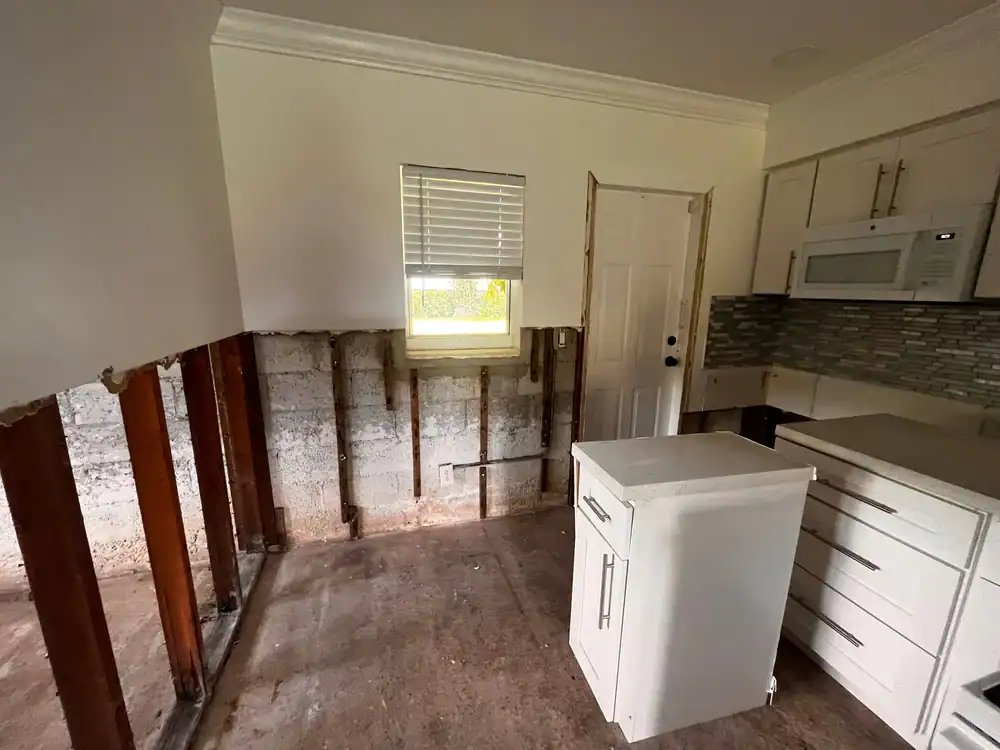
Yes, and honestly, a water damage event is often the right moment to do it. Long Island winters are hard on the aging plumbing in Bellerose Terrace’s mid-century housing stock. When a pipe fails or water infiltrates through a failing seal, the walls are already open. The incremental cost of upgrading while you are already in demo mode is a fraction of what a standalone renovation would cost later — and you avoid the regret of restoring a kitchen you were already planning to replace.
We can take a water-damaged kitchen all the way from remediation through a completed renovation. That is something most restoration-only companies cannot do — they can dry it out and patch it, but they cannot redesign and rebuild it. If your kitchen has suffered damage and you have been putting off a renovation, this is worth a conversation. We will walk you through what the scope looks like, what insurance may cover, and what the renovation upgrade would add on top of that. No pressure — just a clear picture of your options.
How do I know if a kitchen contractor in Nassau County is actually licensed?
In Nassau County, home improvement contractors are required to hold a current Home Improvement Contractor License issued by Nassau County Consumer Affairs. This is a specific, verifiable credential — not a generic “licensed and insured” claim that anyone can make. You can verify a contractor’s license status directly through the Nassau County Consumer Affairs website by searching their name or license number. Any legitimate contractor operating in Bellerose Terrace should be able to give you their license number immediately, without hesitation.
Beyond the county license, you should also ask for a current Certificate of Insurance showing general liability coverage and workers’ compensation for all employees. Under New York State law, if a worker is injured on your property and the contractor does not carry workers’ comp, the liability can fall on you as the homeowner. This is not a hypothetical risk — it happens. Ask for the COI before any work begins, and make sure the coverage amounts are adequate for the scope of your project. We carry both and provide documentation to every client before the first day of work.