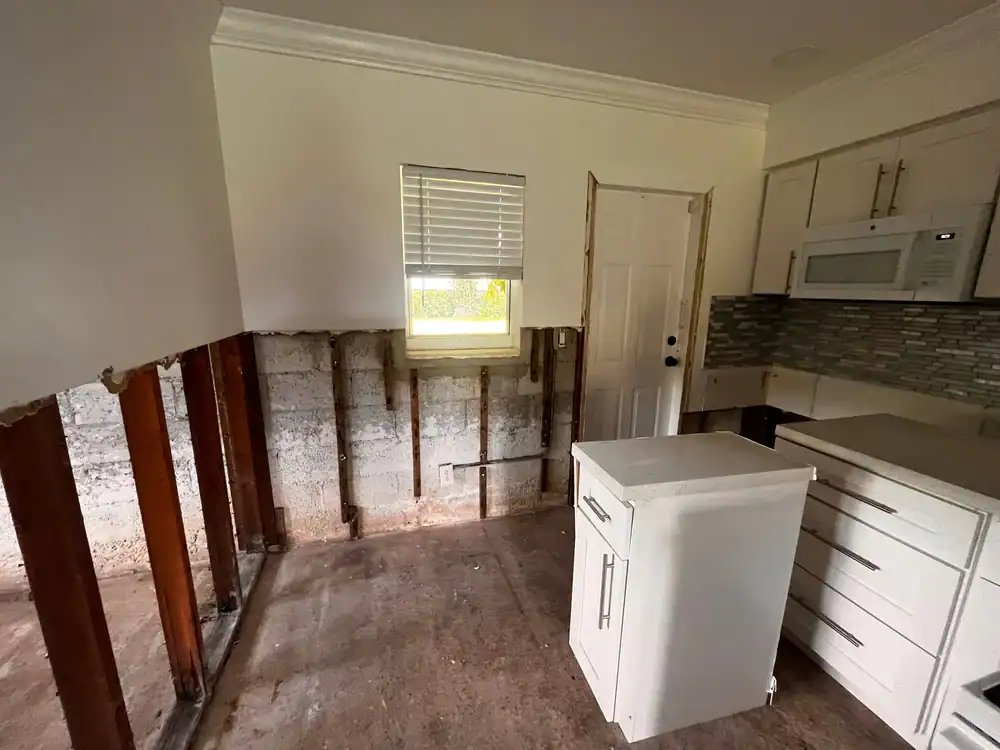
Blue Point kitchens carry history in their walls and sometimes more than that. We handle the full kitchen remodel, from the first design sketch to the final permit sign-off, with no subcontractors and no surprises.
I needed a professional consultation explanation of procedure for safe removal of Asbestos in my apartment complex. Without having an account yet, I was very impressed with the caring, knowledgeable and generous advice offered by Jessica, and will look forward to doing business in the future. Thank you so much! I feel much more informed about a sometimes scary endeavor. Peace. Nancy Silva Mineola, NY.
Mia Munoz
Used this company to clean up some water flood in my house. They were fast and easy to work with.very professional, Would recommend to anyone!
Nini Valle
Great company, had a flood and they responded quickly and efficiently. Billed my insurance company directly. I highly recommend this company!
joe colapietro, jr
I had pipe freeze in my basement right before a snow storm and they made to within an hour to help start the clean up process. They we by our side throughout the entire process and even helped with the insurance company. They did such a great job with the cleanup, repair, remidiation, I contracted them to perform the repairs and finishes in the basement. They came with enough manpower and material to get the job done. Leo and Jessica were nothing but a pleasure to deal with!!
Cristian Arredondo c
I had some water damage in my home and Green Island was able to take care of my issue quickly and effectively. I am very pleased with the work they did. They responded quickly and were very professional.
Michael M
Outstanding service! From the office to the field crew everyone was friendly, helpful and responsive. I highly recommend Green Island Group.
A Kitchen That Finally Matches the Home You've Built
Most Blue Point homeowners aren’t looking to flip their house. You’ve watched your home triple in value since 2000, and you’re staying. What you want is a kitchen that actually reflects that one that works for how your family lives, not just one that looks good in a listing photo.
The problem is that most kitchens in Blue Point haven’t kept up. The home is worth $600,000-plus, but the kitchen is still running on 1960s cabinet layout, laminate countertops, and a galley design that made sense before open-concept existed. That gap is real, and it’s fixable.
What you get on the other side of a well-run kitchen remodel isn’t just better countertops. It’s a kitchen you actually want to be in. One that handles the humidity and salt air coming off the Great South Bay without the finishes bubbling or the hardware corroding in three years. One that was designed for your space, your workflow, and your home not pulled from a catalog and dropped in.
12 Years In Blue Point, and We Still Handle What Others Won't
We’ve been doing restoration and remodeling work on Long Island since 2012 over 5,000 projects across New York State, based out of Bohemia, just a few miles up Sunrise Highway from Blue Point. We didn’t start as a kitchen remodeling company. We started in environmental remediation asbestos abatement, mold removal, water damage restoration and that background is exactly what makes us different in a hamlet where homes from the 1930s, 1950s, and 1960s are the norm.
When you open a wall in a pre-1980 Cape Cod on Blue Point Avenue and find asbestos tile or lead paint behind the cabinets, most remodeling companies stop. They hand you a phone number and tell you to call someone else. We’re licensed to handle it ourselves, in-house, without stopping your project. That’s not a small thing when your kitchen is already torn apart.
We’re M/WBE certified through New York State, IICRC certified, and hold a verified Home Improvement Contractor license plus five additional licenses. These aren’t self-declared credentials they’re verifiable. You can look them up.
No Guesswork Here's Exactly How Your Blue Point Kitchen Remodel Runs
It starts with a conversation at your home. We come to you, measure the actual space, and listen to how your household uses the kitchen not just what you want it to look like, but how it needs to function. From there, we build a 3D model of your finished kitchen so you can see the layout, cabinet placement, countertop materials, and lighting before a single wall gets touched. If something isn’t right, we adjust it. The goal is that there are zero surprises once demolition starts.
Once you’re happy with the design, we handle the Town of Brookhaven building permit process for you. Blue Point falls under Brookhaven’s Building Division, which requires an itemized cost estimate, a licensed surveyor’s stamp for alterations over $2,000, and a Certificate of Occupancy at project completion. If your home sits close to the Great South Bay shoreline, wetlands approval from the Town’s Department of Environmental Protection may also come into play. We know the process, we manage the paperwork, and we coordinate directly with inspectors so you don’t have to.
Demolition, cabinet installation, countertops, plumbing, electrical it all runs under one contract with one point of contact. When the job is done, we close it out with a proper Certificate of Occupancy so your investment is fully protected, legally and financially.
A kitchen remodel in Blue Point isn’t the same as one in an inland Suffolk County town. The salt air off the Great South Bay, the coastal humidity, and the seasonal swings from brutal winter cold to summer heat indices pushing past 100°F those conditions eat through materials that weren’t chosen with this environment in mind. We specify cabinet finishes, hardware, countertop sealants, and flooring that hold up in a coastal setting, not just ones that photograph well in a showroom.
Beyond materials, we handle the full scope. That means layout redesign, custom cabinet installation, countertop replacement quartz, granite, or whatever fits your home plumbing and electrical coordination, and finish work. If your kitchen remodel uncovers water damage, mold, asbestos, or structural issues behind the walls (which happens regularly in Blue Point’s older housing stock), we handle that in-house without bringing in a separate contractor or blowing up your timeline.
For homeowners whose kitchen damage follows a storm or flooding event something the South Shore knows well we can manage the insurance billing directly and coordinate the restoration and remodel together under one project. You don’t have to manage two separate companies or two separate claims processes. It’s one call, one team, and one finished kitchen.
Do I need a building permit for a kitchen remodel in Blue Point, NY?
Yes and it’s not optional. Blue Point falls under the Town of Brookhaven Building Division, which requires a building permit for any kitchen remodel that involves structural changes, electrical upgrades, plumbing relocation, or gas line work. The application requires an itemized cost estimate from your contractor, and for alterations exceeding $2,000 which covers virtually every kitchen remodel a survey prepared and stamped by a licensed land surveyor is also required. Once the project is complete, you’ll need a Certificate of Occupancy issued by the Chief Building Inspector before the space can legally be used.
If your home is near the Great South Bay shoreline, there’s an additional layer: wetlands approval from the Town of Brookhaven Department of Environmental Protection may be required depending on your property’s proximity to tidal areas. Skipping the permit process isn’t just a legal risk it can create serious problems when you go to sell the home. We manage the entire permit process on your behalf, from application through final inspection.
How much does a kitchen remodel typically cost in Blue Point, NY?
The honest answer is that it depends heavily on scope. A minor kitchen remodel new cabinet fronts, updated countertops, fresh fixtures can run in the $25,000–$40,000 range. A full gut renovation with layout changes, custom cabinetry, new plumbing and electrical, and high-end finishes can reach $80,000–$107,000 or more. In Blue Point specifically, where median home values are approaching $666,000, most homeowners are investing in the middle to upper end of that range because the home can support it and the return is real.
Labor typically accounts for 50–60% of total kitchen remodel costs, which means the contractor you choose is the single biggest cost variable you control. Going with the cheapest bid often means paying twice once for the original work and again to fix what went wrong. Minor kitchen renovations are delivering up to 113% ROI in 2025, and roughly 54% of realtors recommend a kitchen upgrade before listing. In a market like Blue Point, where homes are selling at a premium and buyers expect quality, a well-executed remodel pays for itself.
What happens if asbestos or mold is found during my kitchen demo?
This is one of the most common mid-project surprises in Blue Point, and it’s worth understanding before you hire anyone. Any home built before 1980 and that covers the majority of Blue Point’s housing stock, which includes Cape Cods, ranch homes, and Colonial Revivals from the 1930s through the 1970s may contain asbestos in floor tiles, pipe insulation, drywall compound, or ceiling materials. Lead paint is also common in pre-1978 construction. When a kitchen wall gets opened and these materials are found, a contractor without environmental remediation licensing has to stop work entirely and bring in a separate abatement company.
That means your project pauses, your timeline extends, your budget jumps, and you’re now coordinating between two separate contractors. We’re licensed for asbestos abatement and environmental remediation. When we find something behind your walls and in Blue Point’s older homes, it happens we handle it ourselves, in-house, without stopping the job. Your project keeps moving, your timeline stays intact, and you don’t have to manage a second company in the middle of a kitchen demolition.
How long does a kitchen remodel take from start to finish?
A straightforward kitchen remodel no major layout changes, no hidden structural issues typically runs four to eight weeks once materials are ordered and permits are in hand. The permit process through the Town of Brookhaven Building Division adds time upfront, which is why starting that process early matters. We initiate the permit application as soon as the design is finalized so there’s no unnecessary delay between approval and the start of construction.
Where timelines extend is when unexpected conditions come up water damage behind walls, outdated wiring that doesn’t meet current code, or materials that need to be remediated before work can continue. In Blue Point’s older housing stock, these discoveries aren’t rare. The advantage of working with a contractor who handles remediation in-house is that those discoveries don’t become project-stopping events. They get addressed and the work continues. We’ll give you a realistic timeline before the project starts, not an optimistic one that falls apart the moment something unexpected shows up.
What kitchen materials hold up best in a coastal Blue Point home?
This is a question worth asking before you commit to materials, because the wrong choice in a waterfront community can fail fast. Blue Point’s position on the Great South Bay means your kitchen deals with elevated humidity year-round, salt air coming off the water, and temperature swings from sub-freezing winters to summer heat that regularly pushes past 100°F with the heat index. Those conditions accelerate wear on cabinet finishes, corrode hardware, break down grout and caulking joints, and cause wood to swell and warp if it wasn’t specified for a coastal environment.
For countertops, quartz outperforms granite in high-humidity settings because it’s non-porous and doesn’t require sealing. For cabinetry, a thermofoil or painted MDF finish holds up better than natural wood veneer in coastal humidity or, if you want real wood, a species like white oak with a moisture-resistant finish is a stronger choice than cherry or maple. Hardware should be solid stainless or brushed nickel rather than chrome or brass-plated, which corrodes quickly near saltwater. We’ve been working in South Shore homes for over 12 years and know which products last here and which ones look great in October and start failing by the following summer.
Can a kitchen remodel be done while we're still living in the house?
Yes, and most Blue Point homeowners do exactly that. A full kitchen demo and rebuild is disruptive there’s no way around it but it’s manageable with the right planning. The key is sequencing the work so the most disruptive phases (demolition, rough plumbing, electrical) happen as quickly and cleanly as possible, and that the project doesn’t drag on for months while your family is eating takeout every night.
We set up temporary containment during demolition to keep dust and debris out of the rest of your living space, and we establish a clear daily work schedule so you know when the crew will be there and what’s happening each day. In Blue Point, where the average commute is already over 40 minutes each way, the last thing you need is a contractor who shows up unpredictably and leaves your kitchen half-finished for days at a time. We build a realistic project timeline before work starts, communicate changes when they happen, and treat your home like it’s occupied because it is. Most of our clients find the process far less disruptive than they expected going in.